FlorianB
-
Posts
412 -
Joined
-
Last visited
-
Days Won
1
Content Type
Profiles
Forums
Events
Store
Downloads
Gallery
Everything posted by FlorianB
-
In my eyes these are study pieces for the beginner but for a decent price the collection seems OK. However, some day it won’t be easy to get rid of them again. BTW: No. 7 lost the rim, it should look like: https://world-seiyudo.com/product/tu-050522/
-
Itomaki Gata, (Vertical Spindle Shape Tsuba), Historical Examples ???
FlorianB replied to Barrett Hiebert's topic in Tosogu
Can’t believe, that there are much pure itomaki-gata out there, because it is not convenient for practical use. The spikes could entangle with the clothes while wearing or drawing a sword mounted with a Tsuba of this particular form. -
Tosho-style. Sorry to say, I recognize a lack of precision in execution (the shape of nakago ana for instance) for giving the impression of an older piece.
-
Hi Justin, I agree that it is an original from Edo period, however difficult to ascertain to a specific school or smith. The condition, too, isn’t the best. As Dale suggested try to restore the rusty areas with antler or bone. Nice contrast in between the iron surface and soft metals, copper, brass, silver and shibuichi for the rat. It seems that the patination of the rat is partially rubbed off. Sometimes after many years it might restore by itself. Nice find anyhow! Any dimensions?
-
Miraculously it has been sold in the last hours - what a pity!
-
Ohno Christian/Buddhist Tsuba (for whopping $112 on Jauce)
FlorianB replied to Iaido dude's topic in Tosogu
The surface tells it own tale. -
I have doubts, too. Silver becomes bluish-black while tarnishing. The colour here looks mere like shibuichi, a small amount of silver at least. Moreover I think the use of solid silver is only to be found on top level handicraft.
-
Mushrooms are always depicted with elongated stems. At least: Kukurizaru giving the impression of mushrooms (or distant pines? ).

-
I just wonder about the motif. The similar pine tree pattern is well known. But on Okan's piece it looks like kukurizaru (or tumblers). Kukurizaru are an old motif, but always in different angles, to show the playful sense. But here they are all upside down - so what’s the idea?
-
Christian Ship Tsuba (Is This Really an Ono Kozeho?)
FlorianB replied to Iaido dude's topic in Tosogu
Can’t imagine as a depiction of Namban ship. Other artworks show a very exact view of those foreign vessels, so I can only imagine, that the Tsuba artists refer to hearsay and imagination - if it is really a foreign ship. Needs further investigation. Popular designs have been copied dozens of times and I think the workers sticked simply to the model without knowledge of the meaning.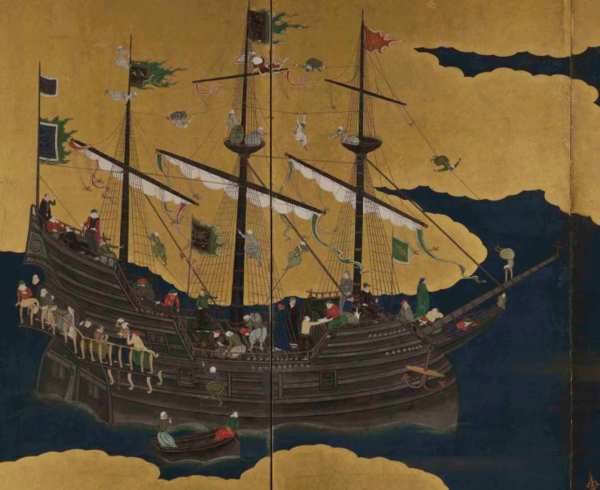
-
Christian Ship Tsuba (Is This Really an Ono Kozeho?)
FlorianB replied to Iaido dude's topic in Tosogu
The sailing boats in Sasano’s book show not necessarily the same as in the Tsuba at the top. There have been different types of sailing boats, some smaller for fishing, others were larger cargo boats for coastal transport. The extrem shapes (especially the stem) of the first Tsuba I can’t assign to a traditional boat form. Maybe these should give the idea a foreign ship? -
Steve, have You recognized that the forms on the left and right could be warabite or stylized fern sprouts?
-
I found a connection between Bishamonten and Shomu Tenno (701 - 756). The latter did a lot to establish Buddhism in Japan and one of three important sutras was the Hokke-kyo. In this sutra Bishamonten promises to protect men. So it may be the depiction of Shomu Tenno (thus the archaic look of the fan) holding a sutra scroll. It’s only a guess but maybe it is worth to research in this direction.
-
It's a fan. First I thought of a gumbai or Japanese war fan used by military commanders. However it's an unusual, archaic looking model. Maybe chinese? I'm only guessing so I hope someone else could tell the story of this scene to clarify the details.
-
On the Kashira a courtier is shown with his typical "kanmuri" or court cap (could also be something similar chinese). The other character might be Bishamonten definitely. The story behind this scene I'm not able to tell. The scroll might be a sutra with which the courtier summons Bishamonten. The latter points to something unseen, probably depicted on the missing Fuchi?
-
I don't think the Tsuba in question portrays a woman at all (Sorry to say on International Women's Day! ). IMHO the motif depicts Kanzan and Jittoku, two chinese Zen monks alleged living in the 7th century. While Jittoku is holding his typical broom, Kanzan is not shown but represented by the scroll (rusumoyo). Frequently broom and scroll alone symbolize this unique pair.
-
Sorry for confusing You. Of course a maru-mimi is a typical trait of Akasaka smiths. I was talking about the ring-shape of the rim, the technical term is torus. The generations from the fourth onwards used this shape frequently, but I’m not sure about Ko-Akasaka and first generation particularly.

-
Did Ko-Akasaka - in this case Shodai Tadamasa - produce such fully rounded rims?
-
I think the theme is correctly named. However, both the tradition of cherry blossom viewing and the use of cloth curtains are very old. So the conclusion the tsuba is of the same age as the depicted woodblock print is not correct. I suppose it was made during the Genroku/ middle Edo period based on the hitsu-ana both in suahama shape. Some blossoms show abrasions at the corners, so it seem like overlay in some parts?
-
Exact measures would help. Crane and pines. IMHO Akasaka-style maybe by a minor workshop. Here's an Akasaka which seems to be the model for Yours:
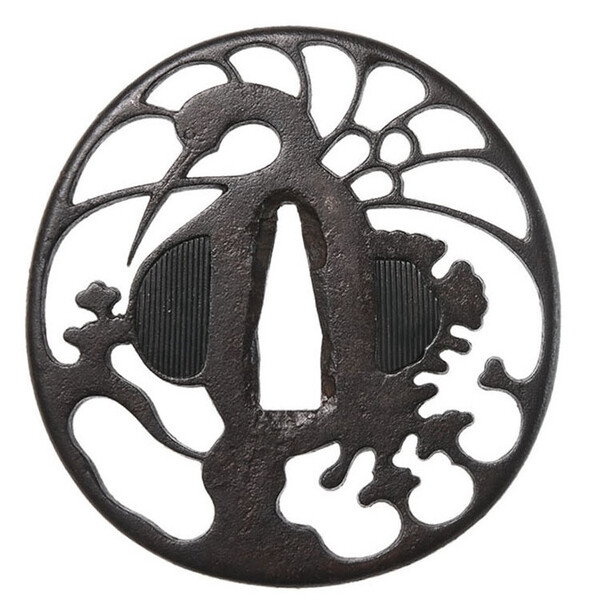
- 1 reply
-
- 2
-

-

-
Help request on publication source of a recent tsuba buy
FlorianB replied to Michael 101's topic in Tosogu
IMHO it looks like an older dealer's magazine, but I have no idea by which retailer. -
RE: Which tsuba schools incorporate rectangular/square hitsu-ana?
FlorianB replied to Iaido dude's topic in Tosogu
Steve, You’re right, kaku mimi ko niku. 78mm x 75 mm x 6 mm, I speculate it’s from Genroku period because of the elegant design. IMHO the rectangular hitsu ana should add an archaic touch as mentioned above. -
RE: Which tsuba schools incorporate rectangular/square hitsu-ana?
FlorianB replied to Iaido dude's topic in Tosogu
An Owari from my collection:
-
Jean, if I understand it right the punched holes must have raised rims of squeezed material, which have been hammered flat or filed off afterwards. The same hole on my tsuba (front and back side). It seems possible the rims have hammered flat here causing a slight deformation of the circular shape.

-
RE: Which tsuba schools incorporate rectangular/square hitsu-ana?
FlorianB replied to Iaido dude's topic in Tosogu
I think, rectangular hitsu-ana should evoke the impression of or a reminisce to old age. Sometimes a connection to Genji-chapter symbols seems possible (the first one). The last one looks like a well frame.