.png.109da69f50d2b8856e823a9916a8b657.png)
Jake6500
-
Posts
571 -
Joined
-
Last visited
-
Days Won
5
Content Type
Profiles
Forums
Events
Store
Downloads
Gallery
Everything posted by Jake6500
-
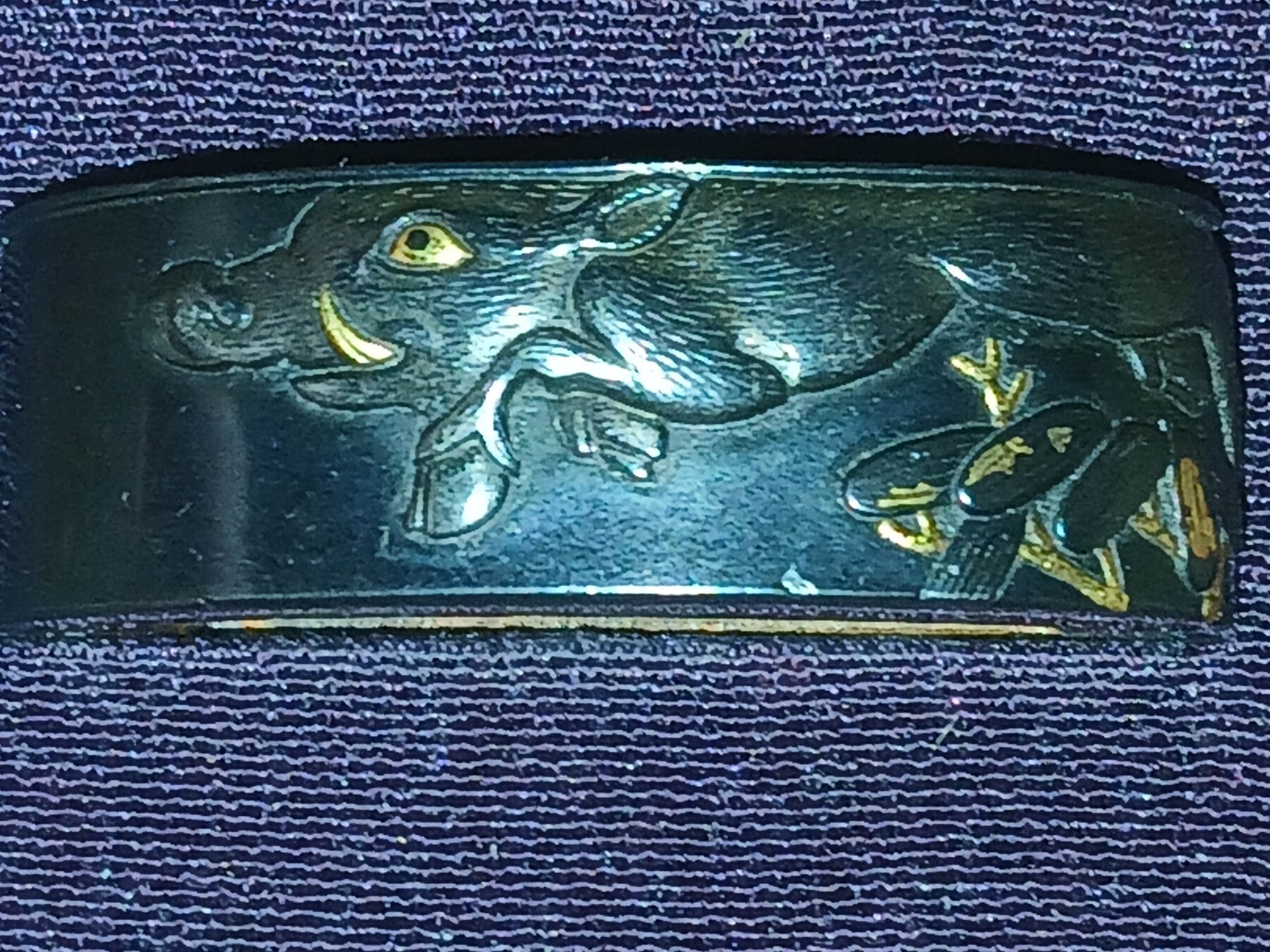
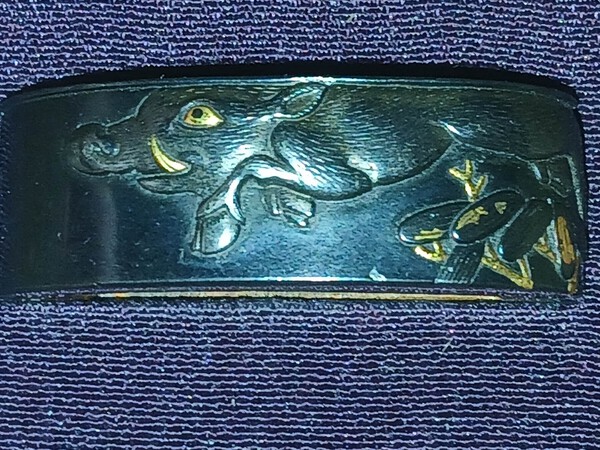
I recently acquired a new fuchigashira (been in my possession for about a week now) that I wanted to share with the forum. At this stage it is probably now the best piece in my collection and has been signed "Sozui". The mei appears to match one of the variations of Hamano Sozui's signature and from what I have read, Hamano Sozui would often create pieces with Japanese and Chinese folklore themes, so a Sojobo/Tengu design would fit his modus operandi. The work is a pretty high quality with an inlaid stone used for the eye of the Tengu figure as well which leads me to believe this might be an actual Sozui piece and not gimei... The pictures honestly don't do the piece justice as they were taken from my phone with 5x zoom and compressed to meet file size requirements but let me know what you all think!


-
As Dale has already said, you don't find signatures on authentic pre-Edo pieces. Dale's link is also to a reliable seller in Matsukaze, I have purchased things from that seller before. If you're new to tsuba and want assurances, buying from him is a safe bet. In any event, the item you've posted appears quite expensive for a dubious tsuba that may not even have any historical value.
-
Hi Jason, This is a nice tsuba that looks well crafted. Whilst I usually don't gravitate toward open works in my own collection I am a fan of this one... As for the theme, this is only an educated guess (I am not sure and would like to see what other forum members think) but the dragon appears to be holding a koku of rice on the reverse, and appears to be consuming the rice pouring out of the bag on the front side. My guess is that the theme is therefore from the Tawara Toda Monogatari from the 14th century in which the protagonist is awarded an inexhaustible/infinite bag of rice by a dragon as a reward for slaying a Mukade. If this is indeed the theme it could have the implied association with wealth as Japan had the kokudaka system in which rice was measured and used as the primary form of currency for centuries. The symbolism of the tsuba might therefore be thought of as "infinite wealth" and may have been owned by a merchant (presumably an educated one!) Just my take on it, lets see what everyone else thinks! PS/Edit: For the school, maybe Bushu Ito? It gives me similar stylistic vibes to a Bushu Ito tsuba I have in my collection!
-
It's a tricky balance. What I would say is try to do as much research on a piece as you can before buying and try to build an ongoing digital catalogue of works you've encountered. Past forum threads are always a great source of information when searching for more information about a piece, school of craftmanship or specific artist/mei.
-
I agree with this, however beware that higher price doesn't always mean better quality! I have no issues with paying more for quality but it takes some time to train your eye to be able to spot mid-high level work and there are also over-priced pieces floating about. Train your eye to recognize quality before spending! I've only just started to reach the point where I can identify the higher quality stuff by eye and distinguish it from mid to low level work. I did well with my last couple of purchases and I was willing to pay a bit more for them, but I've also had some solid purchases under $150. Price is not everything and can be deceiving.
-
To me the middle one looks a lot like a seahorse...
-
Dale and Peter even exhibit modesty befitting of their expertise! You are both experts compared to me, that is for sure!
-
I'm hardly as much of an expert as Dale or Peter here but my first instinct was also that this is an Ohno school tsuba. Ohno tsuba tend to be thicker than most other tsuba of similar styles so when you get to the 5mm+ range it is likely an Ohno piece as opposed to Kanayama, Yagyu, etc. That said however, this would have been a pretty common design and it might be hard to distinguish between Yagyu, Ohno, Myochin or Kanayama with such a design.
-
Thank you very much for the information. If this is an authentic 1st gen Tsunekatsu piece I will have done even better than I thought on this purchase! I have had some pretty good luck on my last couple purchases, I can safely say the purchase before this one (I believe it is an authentic Hamano Sozui fuchigashira) is probably the best piece in my entire collection. I will make a thread about that piece shortly as well. Whilst I thought this latest piece was nice, I had not expected it to be a close second! Thanks again for the assistance!
-
Just managed to find this in 'Japanese Sword Guards' by Okabe Kakuya, Published by the Museum of Fine Arts, Boston: Perhaps my guard comes from a student of these artisans.

-
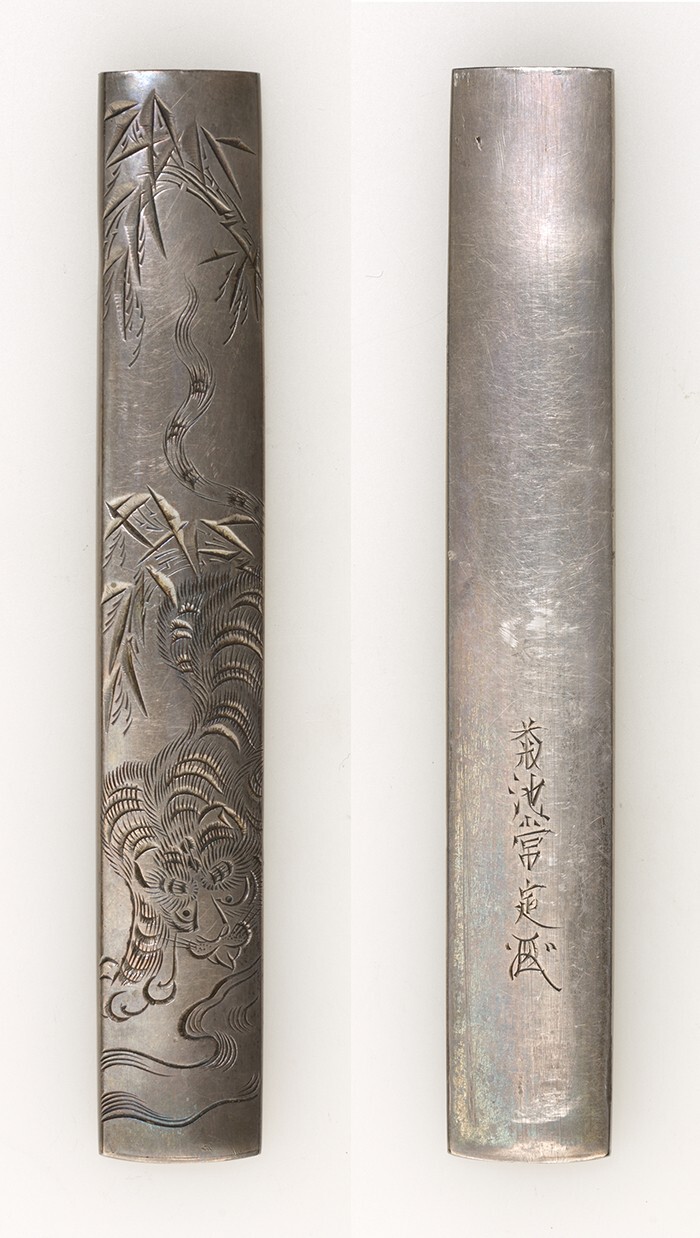
Interesting, your tsuba seems a lot more similar stylistically to the first example... As you said, not much similarity to mine. I did find these examples of Kozuka by "Kikuchi Tsunesada", circa 1800 that has a similar design and style to my tsuba (shishi lion/tiger, katakiribori) Now I don't know what to think! Are these two different branches of the Kikuchi lineage?

-
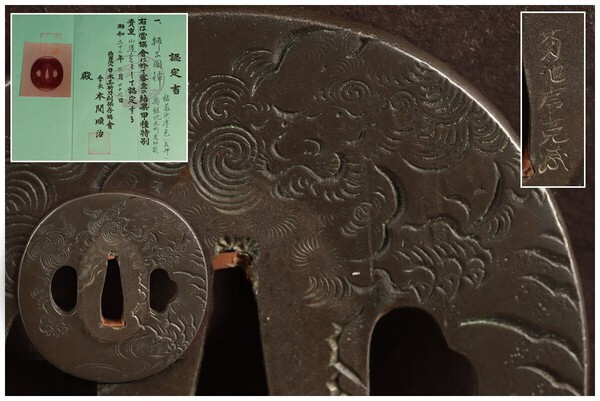
As this thread didn't get any responses the first time around I am going to bump it up in the hope of receiving some new responses... I recently found this papered Kikuchi tsuba on Jauce and as soon as I saw it I knew I had to snatch it up... It appears to be signed "Kikuchi Joukaku". https://www.jauce.com/auction/1160942560# Does anyone have any information they could share about this artist or the Kikuchi school generally? Most everything I've been able to find is that the Kikuchi school were big on Katakiribori and not much else... And of course, whilst it is papered it is green papered... Do you think this is an authentic Kikuchi school piece or gimei?
-
I would love to assist in your experiments but the thought of actually doing that with a piece of history makes me feel physical pain...
-
Yikes, now I'm paranoid about the fuchigashira I'll soon have coming in the post.
-
Bit late to the thread on this one but I concur with the answers of our fellow board members. The embroidery is depicting the various stages of Edo Period cotton production from picking to separating the cotton from the seed, weaving, etc.
-
Haha, I'd be too nervous to try and import any of this stuff into our country Dale, what with the strict wildlife protection laws and customs. Biological materials are an automatic pass!
-
Not the best pictures off my phone camera but hopefully they'll suffice... This pair 100% come from Nara. The maple leaf on the side is also a common Nara image. Not exactly the same style as yours but the spotted deer makes the association with Nara likely!


-
Yes I believe so, which is why I suggested it may be from Kaga! I'm pleased other observers have also picked up on it! Most of my collection are more artistic ornamental (mid-late) Edo Period pieces but I want to build a collection of 4 pre-Edo tsuba with mon such as this one if I can find them!
-
You are very likely correct about the connection to Nara as the deer trade was historically an important part of the Nara economy. All parts of the deer would be sold or serve a purpose in Nara and deer themed fuchigashira are common from the Nara area. In fact, I have a similar fuchigashira in my collection which I received as a gift.
-
Here is a tsuba I recently picked up... (possibly Azuchi-Momoyama tsuba from Kaga?)
-
Interesting reference to Chinese culture which of course was directly linked to early Japanese culture. Here is some more information about the link between the story of Amaterasu and the Taiko drum: Konagaya, Hideyo. University of Pennsylvania ProQuest Dissertations & Theses, 2007. 3260933. https://www.proquest...e=gscholar&cbl=18750 Finding articles with pertinent info has sure gotten harder without access to Jstor! Maybe I should pay for a subscription. Anyways, given your post and the knowledge imparted I now think that there might be two separate themes in this thread! Mason's example tsuba (and probably also his own tsuba given the resemblance in the two designs) seems to be about the story of Amaterasu in the Nihon Shoki whilst the other tsuba in the thread seem to be references to Chinese culture. I think the defining differences seem to be A) whether or not the Taiko is being played by a person? B) If the chicken is atop the drum it is a clear indication of the latter rather than the former?
-
So the relevance of the Taiko drum here appears to relate to the contents of the Nihon Shoki which mentions a mythical account for the origin of the Taiko drum in Japan. It states that the Taiko drum was first created when the goddess Ame-No-Uzume emptied out a barrel of sake and danced on top of it in order to lure Amaterasu out from her cave. This dance performance is the mythical origin of Taiko music. It seems likely to me that ALL of these tsuba featuring the drum and the rooster are references to the story of Amaterasu and the attempts to lure her out of her cave. Note that the mitsudomoe is a symbol often featured on Taiko drums, specifically.
-
They certainly look like a match to me! Very interesting post.
-
So a couple of things... 1) What is meant by "Samurai era coins" exactly? Historically, Japan used the koku (rice bale) as a unit of measurement and currency for most of its history in what is referred to as the kokudaka system, so if you are in search of Japanese coinage pre-dating the Edo Period (from the wars) I'm afraid you won't find what you're looking for... It basically doesn't exist. 2) If however you are in search of more Edo Period things such as the Kin or Gin Shu Ban coins in your photo, you can find these from reputable sellers specialising in old/historical coins on Ebay with a quick search. I've also seen these on Jauce from time to time while browsing tsuba, without directly looking for them. Plenty of Japanese sellers also sell these internationally on Ebay. If you're searching for authentic Ryou gold bars these are going to cost a small fortune and are a lot rarer, however the JP government minted replica ryou bars a while back which are more affordable and accessible. 3) I noticed there is an absence of Edo Period mon coins in your collection. These are readily obtainable on Ebay also. A simple search of "Edo Period coin" will return results if these are what you're looking for. Just pick a reputable seller. They are not super expensive either as they were minted en masse during the Edo Period.
-
Hey Colin and Ian, thanks for your responses. Don't worry about disappointing me, I certainly didn't pay an exceptional amount for these and originally bought them for the designs without a second though about the lineage of the artists which only piqued my curiosity later. As I am new to Tosogu collection in general would you mind elaborating a little for me? All I know about Shakudo is that it is an alloy metal. Are we talking about the colour of the black nanako base of the fuchigashira? I should add that the last few photos are zoomed in by about x4 on a phone camera with flash photography and then compressed, so the quality of the work might not be fully represented by the photographs. Even if it's not authentic I think it's a pretty nice piece in hand so I am not disappointed! EDIT: Nvm I think I was being stupid and now see what you guys mean! Thanks for the feedback and the new knowledge Ian, as well as the wonderful visual reference!
.thumb.png.4c5df79fec171b2dc4a23af38e280a4d.png)