.png.109da69f50d2b8856e823a9916a8b657.png)
Jake6500
-
Posts
646 -
Joined
-
Last visited
-
Days Won
7
Content Type
Profiles
Forums
Events
Store
Downloads
Gallery
Everything posted by Jake6500
-
Just the fact someone would bid that much in the first place, and then even more so that the owner would turn it all down and relist the item lol
-
This reminds me of when archaeological conspiracy theorists use the line "The absence of evidence is not evidence absence..." to justify whacky nonsense like aliens building the pyramids. Maybe so, but it also isn't evidence of presence... I can't disprove the idea that Genghis Khan rode a unicorn or that he was buried in Iceland; but that doesn't mean I'm going to start a unicorn cult in Reykjavik.....
-
? Seriously? Whatttt
-
Jesus, I never bothered to check what it sold for
-
The very use of the term "ninja" amongst historians is highly contentious in and of itself. What even was a "ninja" and where did the concept come from? The weird mythologised blend of ikko-ikki peasant roots, espionage and what could bluntly be referred to as "magic" prompt many scholars of the period to avoid use of the term altogether. I cannot think of any equivalent class (real or mythologised) in Western culture... Maybe a DnD Paladin?
-
As a general rule in this hobby, when in doubt do nothing... Sorry I have nothing new to add to the discussion but Colin said all that needs to be said!
-
.thumb.png.4c5df79fec171b2dc4a23af38e280a4d.png)
Painted collection number comes in handy for provenance.
Jake6500 replied to Spartancrest's topic in Tosogu
That Shozui tsuba is spectacular and will no doubt sell for more than my kidneys Dale -
I think one of the big giveaways that this is gimei is in the fingers on the fuchi. Granted this is no doubt even smaller than the pictures make it look, fine details like fingers and hands are often a good way to tell the overall quality of works and the fingers here seem to lack the finesse of a master craftsman. Not sure I agree with Kirill either, overall I do not get the Hamano school vibe from these pieces. I can see where this idea has come from as both the Hamano and Mito schools were influenced by the earlier Nara and Goto schools making them stylistically similar. Both schools were known for using iroe takazogan like in these examples on a shibuichi, shakudo or in this case an iron base. One of the characteristic elements of Hamano work that you would often see in Hamano pieces and which you wouldn't generally see in Mito school work are expressive gold eyes. Mito work generally features thinner eyes more characteristic of the Nara school which I think this set (and the higher quality tsuba example) align with. You see these eyes in some late Hamano school pieces too so this is by no means conclusive one way or the other, but it does give some indication. Mito work is also known for its "soft" style whereas Hamano school work often includes more powerful, striking contrasts. The colour combinations featured in the kashira of this set give off more of a Mito vibe to me as the parasol (specifically the colour/metal choice) seems to soften the contrast of the mixed-metal design. On the flip side, the contrast between iron and gold on the robe of what I presume is a court minister(?) in the fuchi does resemble the type of takazogan contrast you would see in both Mito and Hamano school work, so it is hard to definitively rule one way or the other. Both schools also feature takanikubori prominently like that seen in this set.
-
As a regular resident of the Tosogu section I just purchased my first blade (about 2-3 hours ago at time of writing this post) and wanted to share with the forum! The blade is a hozon certified kinnoto (imperial royalist sword) from the Gassan school dated August 1863 by Unzenshi Sadahide. It is a very large katana with a 75cm blade and 27cm nakago. The blade has a lot of weight and thickness to it, I'd say about twice as heavy as an average katana. Aside from the size and heritage of the sword, I really like the lengthy kissaki as well. The blade should make for a fun koshirae project in the future! Let me know your thoughts, I am still a novice when it comes to blades! Here are a few photos:
-
I will be looking into getting a better camera soon, as well as some lighting... I just purchased my first blade today (literally about 2 hours ago) and will need the appropriate light to fully enjoy the fine details after all! Edit: Link to thread https://www.militaria.co.za/nmb/topic/54033-gassan-school-sadahide-kinnoto-first-blade/
-
Branching out from my usual lane in the Tosogu section... For Cody's knowledge, would it be fair to assume based on the mei that this is likely an example of a shinto sword (sword dating to the early/mid Edo period circa 1596-1780) or even more precisely if this is a Tadatsuna sword, that this blade would have been produced in the Osaka area? From what I read online there is another Tokubetsu Hozon certified blade out there with an identical inscription dated to the 7th year of Houei (1710). This would be the prolific (but talented) second generation Tadatsuna, not the first.
-
Interesting example Jack, It's always interesting to see how Japanese artisans - the majority of which would never have encountered a tiger before - present tigers in their work. The example you've linked attempts to portray tigers through a realist lens which makes it an interesting case study that deviates from some other Edo Period examples that adopt a more surrealist approach. Yurakusai Sekibun for example produced a large variety of tiger tosogu along the realist-surrealist spectrum, some of which appear more cartoonish and many of which have exaggerated rounded features.
-
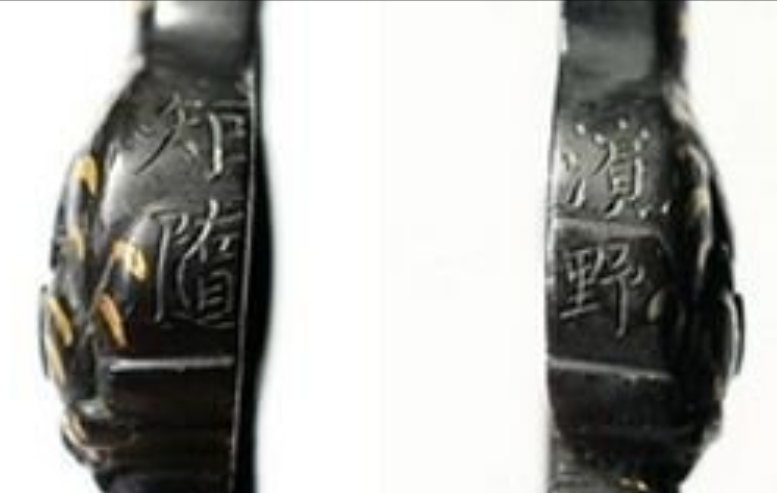
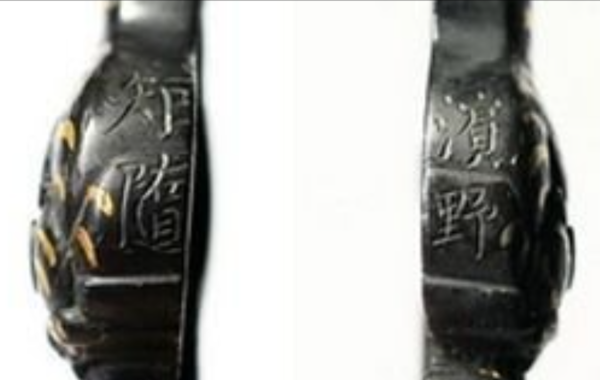
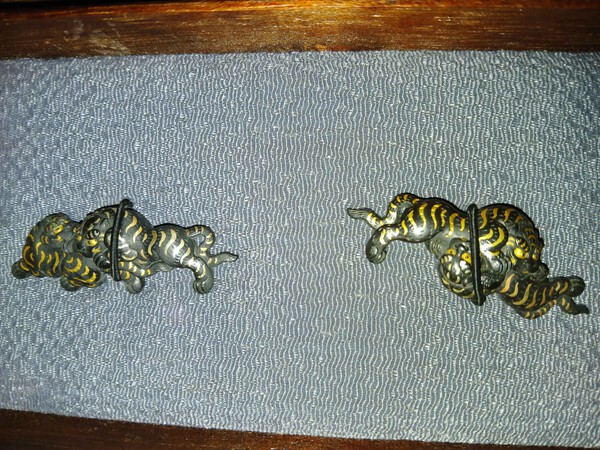
Hey Tosogu fans, I'm doing my usual thing and creating this thread to share my latest acquisition with the forum. I recently picked up this pair of tiger menuki on Jauce signed Hamano Noriyuki! The menuki are uncertified however they seem to match the Hamano school stylistically. A fine detail that caught my attention and convinced me to bid for these was the different purities of gold used in the stripes of the tigers distinguishing them from each other. Here is an enlarged photo of the signature from the original auction listing, followed by a photo of my own taken from my phone camera. Apologies for the less than stellar quality!
-
I'll see if I can find an opportunity to do a scan rather than a photograph some time in the near future and will upload the result here for you! Thanks again for the great resource!
-
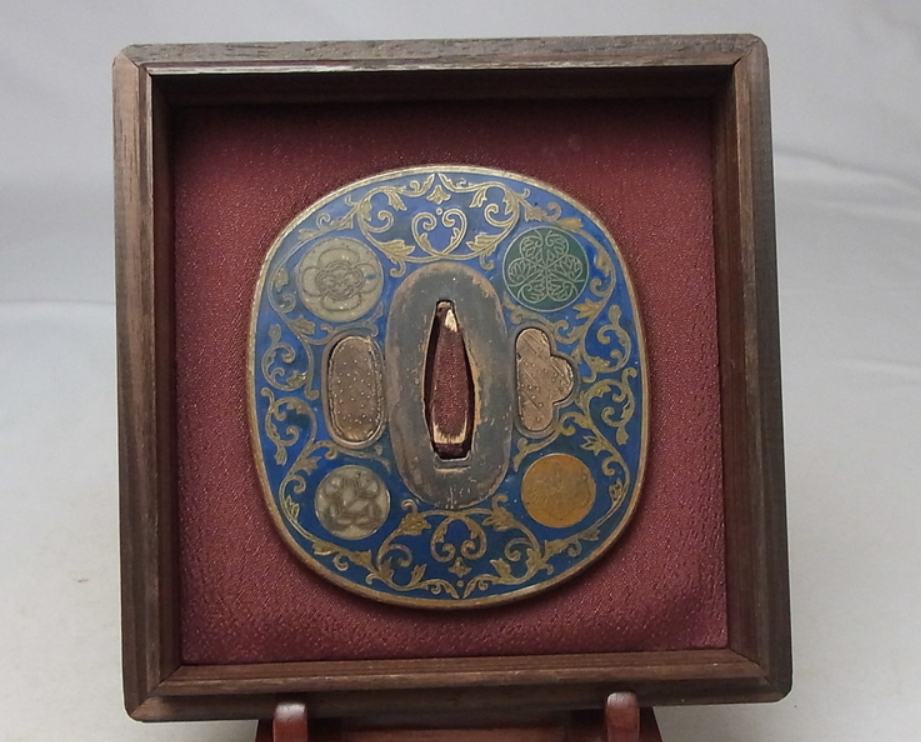
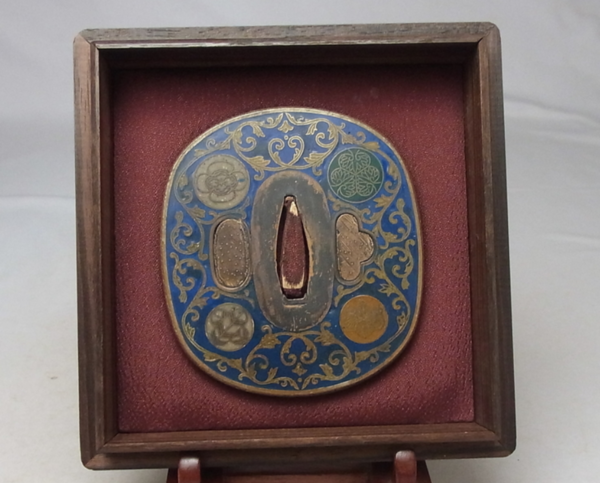
Hey Mauro, Thanks for compiling these. I recently purchased a tsuba that appears to also have a hakogaki by Kanzan. You may recall seeing my thread about it a couple months ago... Figure I would re-post it all here and you can assess whether it is a close enough match to add to your compilation! Translation: 鐔 - Tsuba 七宝紋所之図 – Shippo, mondokoro no zu (figure of family crests) 朧銀磨地 – Oborogin, migakiji 七宝紋散 – Shippo mon chirashi 金覆輪 珍品也 – Kin fukurin, rare item 無銘 平田彦四郎 – Mumei, Hirata Hikoshiro (attribution) 昭和壬子年秋吉日 – Showa Mizunoe-Ne year (1972), autumn, a lucky day 寒山誌 – Kanzan wrote.

-
I don't think it actually has anything to do with your kozuka Luca, but it sort of reminds me of the kusari and fundo on a kusarigama.
-
To me these look like tobacco pouch ornaments like Grey said. Both the size and round shape would suggest this is likely. They may have been repurposed as menuki at a later date. This would suggest to me that these might be Meiji Period works. They are quite well made and there are some fine details there. Condition could be better however... Some examples from the net: Many artisans who made tosogu also dabbled in other ornamental metalwork such as these.
-
Very interesting explanation and I can see what you are saying. It is quite a large seppa, very large, thick and gives off late Edo or Meiji era Kabuki vibes.
-
Dale is our resident Tosogu expert. We are all astonished at how he can pull up examples of tsuba from ancient tomes. One of the ways you can judge the age are by the shape of the hitsu-ana (hole on the side). Older tsuba tend to have different shaped hitsu, narrower or sometimes more triangular in shape if you're looking at a tsuba that is old enough (Muromachi). The other thing is that back in these earlier pre-Edo periods tsuba generally took a mokko-gata (flower) shape instead of the more circular shape we see in Edo Period pieces. Not all mokko-gata tsuba are necessarily that old (there are many examples of Edo period ones that emulate the old style) but it is still a useful indication.
-
Sheep weren't really a thing in Japan until the end of the Edo Period, however the presence of sheep in China for thousands of years and in neighbouring Korea during the Goryeo dynasty theoretically makes the prospect of a sheep or ram themed tosogu possible... Who knows? Maybe a Nanban sheep themed piece is floating around out there somewhere.
-
I had the same idea once upon a time, then I checked the price tag of an actual XRF gun and awoke from my dream turned nightmare lol
-
Hey Kai! I don't have too much to add that hasn't already been said by others. As has been shown, the most common place to find mei on menuki is probably on plates inserted into the back, followed by tiiiinnnyyy signatures on the sides. Mei in general on menuki are however relatively uncommon and even some high quality works might not feature signatures. Viktor has provided some brilliant images of this (including an Ishiguro school pair with a signature on the side from a recent auction I remember observing and paying close attention to!!) Your hesitancy is shared and the rarity of explicit materials about menuki (especially in English) are part of the reason that I myself have always strayed from purchasing menuki for my collection until literally this past week when I purchased my very first pair on auction. I can confirm that the listing you have posted is reliable, not just based on the images of the item but also based on the seller. I have purchased a couple items from this exact seller in my first year of collecting, they are reliable and everything they sell is authentic. I don't buy from them anymore but this is simply because I have developed my eye for quality and have started to spend larger quantities of money on superior quality pieces. (Basically I'm an addict but there's no Tosogu Anonymous program ) As a general rule most of the knowledge you will obtain about styles and schools from other pieces like tsuba or fuchigashira are generally transferrable to menuki as well. If you know a school is known for particular stylistic choices or that a specific artist is known for certain types of designs, consider these factors when evaluating menuki purportedly from that artist or school. For example, something I learned only recently is that lions by the Goto school generally are identifiable by some specific design elements. Take these examples I found online as an example: This is an image of a tsuba by Goto Mitsumasa. If you have a close look (you may need to zoom in) you will see that the lion on this tsuba has a belly that appears slightly distended in shape and that three ribs are noticeable on the lions side (in some examples this might be 5). Here are a pair of Goto lion menuki. Note these same design features: It follows that even if these menuki are not signed, even if the seller said they had no idea which school these menuki were from, you could probably make the judgement that they are connected to either the main line or a branch of the wider Goto school lineage. As you gather more knowledge about specific schools you'll be able to apply that knowledge to menuki, even if you acquired it from tsuba.
-
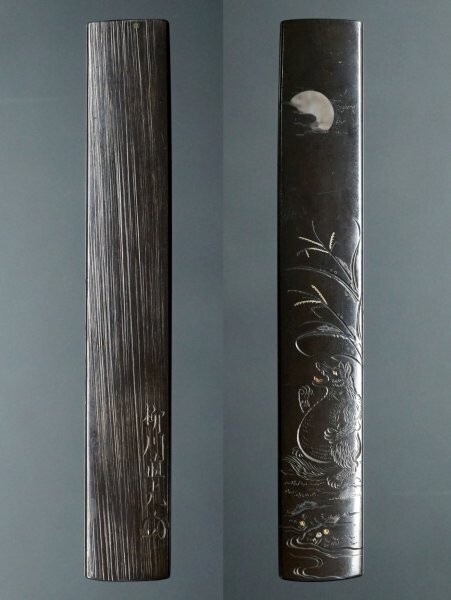
Re-sharing this seeing as the design is relevant... Some of you may have seen me post this Yanagawa kozuka of mine before in its own thread. Tanuki and moon design done right! Mei is Yanagawa Naomitsu.
-
I just picked up some signed Hamano Noriyuki (not certified but *probably* authentic) menuki for 140,000 or so yen so I am preparing to take yet another import tax hit!! These will be my first menuki
-
This is a piece I probably wouldn't go for but $130 for an authentic Edo Period tsuba is an acceptable price and I concur with everybody else in the thread. The tsuba is mixed metal and has clearly been mounted once or twice. Not bad for one of your first purchases. You'll be hooked on the hobby, overspending and getting crushed by import taxes in no time Kai. (In a good way? Lol)