Bazza
-
Posts
2,855 -
Joined
-
Last visited
-
Days Won
28
Content Type
Profiles
Forums
Events
Store
Downloads
Gallery
Everything posted by Bazza
-
Mmmmmm - I like it heaps. Is it signed??? A HOSONO school piece by any chance??? Regards, BaZZa.
-
Gorgeous looking gun, a bit down in condition but immensely interesting. First thing noted was the steel spring - looks like the gun was converted to percussion. Can you confidently remove the barrel?? It will surely be signed... Best regards, BaZZa.
-
Also, the last two pictures suggest a yakiotoshi even with the habaki in position. Strange given it is presumably machiokuri, so then is it a retemper??? BaZZa.
-
Hi Jim P, KASHU JU NIN and MITSU ? Regards, BaZZa.
-
My copies arrived a couple days ago. Magnificent book - here I'm talking of presentation, design and layout. The book is a masterpiece in its own right. I'm assuming that the content is spot on and being a sort of "iron guy" I'm going to enjoy spending a lot of time looking through this, then looking at my "iron discs" for comparison. Nothing much there to write home about!! Oh, and being a sort of iron guy I fair swooned over Darcy's Juyo "Eye Candy" post. Wht go to Heaven - we have it here on Earth. Huge thanks to Piers for making a great effort to bring this book to us and to Marcus for posting out my copies. The good will of folks on this Board is truly humbling. Best regards, Barry Thomas aka BaZZa.
-
New member need advice on my first nihonto
Bazza replied to daytona1712's topic in General Nihonto Related Discussion
Teo, it is a very long road you have ahead of you if you decide to stick with Nihonto as a DOU - a Way of Life. Spend your $1,000 on selected books - you will find discussions here about that. Learn how to use the Board to your learning advantage - the "Search" function and the "Articles" section are good places to start. The next most useful thing I find these days (apart from my library) is google. Just put yakiotoshi into google and read all about it. Best regards, BaZZa. -
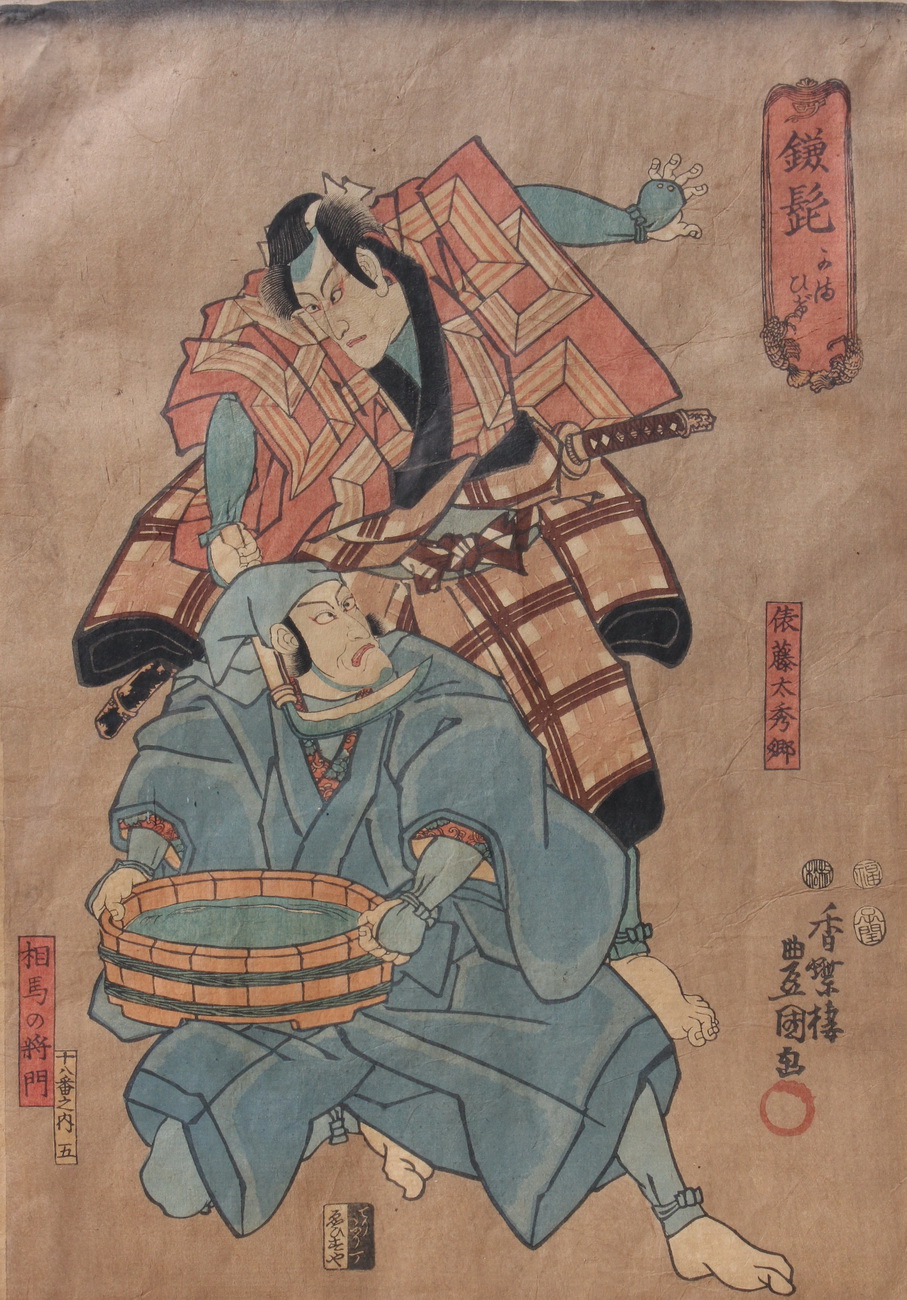
Again, just to post a photo of a kama "in action". I've had this ukiyoe for nearly 50 years, having bought it as a newbie wanting anything to do with swords - the polisher fitted the bill!! I'm sure the ukiyoe cognoscenti will know, but I believe this to be by UTAGAWA TOYOKUNI I. I did some googling once and found a hint of a legend wherein a polisher ruined the sword of a samurai and here we see said samurai taking his revenge. Note the MIE pose - the cross-eyed expression was intended to indicate intense emotion - on this topic see for example http://www.shogungallery.com/wwwboard/a ... 3/100.html I mentioned this ukiyoe in the following thread, but at the time didn't have a photo available. Having found it this present thread seems just the place to post the photo: http://www.nihontomessageboard.com/nmb/ ... dcfab348a4 Best regards, BaZZa.

-
New member need advice on my first nihonto
Bazza replied to daytona1712's topic in General Nihonto Related Discussion
It is interesting to see what appears to be a yakiotoshi (hamon coming off before hamachi). Only seen it once in 50 years... not that I see so many!! Here is the danger of commenting on offered photos when one really needs to hold a sword in your hands. To me this is uninspiring and has the "look" of a Shôwatô. Bestests, BaZZa. -
CLAP CLAP CLAP - a SOUSHOU tameshimei. Morita san, you are a lifesaver to we hakujin. What a brilliant mei - and is the swordsmith's name not there at all??? Can anyone trump this soushou mei and give Morita san another challenge????? And let us please see details of the blade. Is it in antique koshirae or Shinguntou?? Best regards, BaZZa.
-
I am told by a freind in swords that TOKO TAIKAN page 409 has an oshigata of the sandai. I'm also told that Shibata's REI has numerous oshigata/photos of later generation Teruhiro in the HEISEI issues without generation mentioned, apart from earlier issues having oshigata noted as shodai or nidai. Best regards, BaZZa.
-
Evan, Thanks very much for the definitive link with Oracle Darcy's concluding post beautiful menuki. I have no idea where I read the leopard connection, but I'm certainly glad to have that little misunderstanding cleared up. I'll go back to that thread and "catch up" on The Rule of Thirds. Best regards BaZZa.
-
Unless I'm going off my head this menuki portrays a leopard, not a tiger????? BaZZa.
-
I suspect faked patina and gimei...
Bazza replied to CurtisR's topic in General Nihonto Related Discussion
I think the mei is SEKI JU KANE... I agree with Peter Bleed that this could be a nice (Mino?) sword, possibly Koto?? BaZZa. -
OK - we need some clarification here. The active ingredient in nitromors is dichloromethane, aka methylene chloride, but this link http://en.wikipedia.org/wiki/Nitromors says: ----------------------------------------------------------------------------------- The current All Purpose version of the product ( as of 2011 ) does not contain any of the active ingredient dichloromethane, and the logo representing approval by the Guild of Master Craftsmen no longer appears on the tin. ( image to follow ) ----------------------------------------------------------------------------------- So what does it contain at present???? Nitromors may not be available in Australia, but I would guess that ANY paint stripper product that has methylene chloride as an active ingredient would work exactly as Ford has outlined. However, anyone contemplating using it would do well to read here http://en.wikipedia.org/wiki/Dichloromethane Best regards, BaZZa. EDIT: I haven't felt the same about my cuppa since I read this "In the food industry, it has been used to decaffeinate coffee and tea"
-
Barry and All, If this sword has no or a wooden blade then it might belong to that class of swords described as a "Doctor's sword". Bestests, BaZZa.
-
Yugen - a study in the dark. Another free film in HD.
Bazza replied to Ford Hallam's topic in Tosogu
MEIN GOTT - sounds more like an "exercise for many fingers" than a pleasantly melodious guitar piece!!! But thanks for the introduction to a guitar artiste previously unknown to me. I shall seek out other performances. Bestests, BaZZa. -
There are a number of armours in the Powerhouse Museum in Sydney, Australia http://www.powerhousemuseum.com/ One of the armours is a near complete assembly of a mid-Edo armour and accessories acquired in 1948. I remember being told it was accompanied by a very long banner detailing the history of the armour. The "banner may have been a sashimono of sorts. The armour is described here http://www.powerhousemuseum.com/collect ... irn=241380 And this is a portion of the text. I have highlighted a few words: ------------------------------------------------------------------- This suit of armour with accessories and related horse tack was purchased by the museum in 1948. Unverified acquisition records state that the equipment dates from 1775 and belonged to Komu Kaemon, a samurai of the officer rank from the Bizen clan. It is certain, however, that this collection is a remarkably complete example of samurai equipment from the middle Edo period. The armour is of superior quality and features all the elements outlined above. It has purple and white silk laced lames with primary and secondary heraldic symbols or mons. The helmet is a sofukurin type featuring gilt edged ribbed plates. This was a revival of earlier helmet styles as was typical during the Edo period. Accompanying the armour is a very rare sleeveless felt coat or jin-baori with matching mon. These coats were worn over armour at camp and occasionally into battle. Underclothes comprised of breeches and robe are also included. There are two armour boxes again with matching mon. These were used to store the armour. There are paper storage bags and several banners and lengths of cloths. There are no shoes. Read more: http://www.powerhousemuseum.com/collect ... z3CRH86OOz Under Creative Commons License: Attribution Non-Commercial --------------------------------------------------------------------- Good luck with the research. Bestests, BaZZa.
-
Something over 40 years ago I had a wakizashi with a garish irridescent green and white "candy-striped" saya. I remember it well. The mumei blade I thought in my immature daze was nothing remarkable - I'd like to see it now to be sure!! But the thing I most remember is the tsuba. It was an iron sukashi tsuba, not Namban, and it had a 'biscuit' broken out of it. A crystalline structure was clearly evident in the break and I always attributed this to the metal being cast iron, more so as there was no bending at or around the break. In light of the present discussion I regrettably cannot describe it in more detail, but the presence of a clean break and coarse crystalline structure to me clearly indicated cast iron. I have no idea how old this tsuba was, but by the highly decorative ('gauche'??) saya I would have guessed Meiji period. As a person with little technical knowledge of the subject, the present discussion encouraged me wander into google to see what I could find out about the history of cast iron. There is a bit and I'll reproduce a little - here is the link: http://www.historyworld.net/wrldhis/pla ... oryid=ab16 and at the very bottom of the page the text states: ----------------------------------------------------------- Cast iron in the east: 513 BC Thus far in the story iron has been heated and hammered, but never melted. Its melting point (1528°C) is too high for primitive furnaces, which can reach about 1300°C and are adequate for copper (melting at 1083°C). This limitation is overcome when the Chinese develop a furnace hot enough to melt iron, enabling them to produce the world's first cast iron - an event traditionally dated in the Chinese histories to 513 BC. In this they are a thousand and more years ahead of the western world. The first iron foundry in England, for example, dates only from AD 1161. By that time the Chinese have already pioneered the structural use of cast iron, using it sometimes for the pillars of full-size pagodas. ----------------------------------------------------------- I'm not at all challenging any prior posts and I do understand the difficulties of molten iron insinuating into fine spaces. I have no purpose here other than to perhaps pose the question "If Chinese were producing cast iron in 513 BC is there any evidence of intricate casting, such as a tsuba or an intricate ritual object??". I apologise if this seems simplistic... BaZZa.
-
Ah, God, how I love you blokes. This mere mortal has found this thread to be of immense and passionate interest. I read Boxer's 19thC piece on Namban (perhaps I should say "foreign influence") tsuba 45-ish years ago and was entranced, and saw in-hand Peter Bleed's auriculate tsuba when he visited Melbourne only a few years ago. Although I have kept for a long time a very good Namban tsuba, I haven't either "what it takes" or the resources to follow this interest up with more solid research myself, so I have deeply appreciated contributions to the thread. For passionate if not always reasoned argument this thread proves to me beyond doubt the great importance of the Board. Kudos to all, especially Brian who bonds us together. Bestests, BaZZa.
-
Jim and I had a long and robust correspondence. I admired/still admire him immensely and miss his presence amongst us. I still occasionally read his writings. A real gem of a man. RIP. BaZZa.
-
Two Sukashi tsubas on Aoi-Art
Bazza replied to Bernard's topic in Auctions and Online Sales or Sellers
Just having a stab... The first one is much older and the second one a later Edo copy. BaZZa. -
On NHK tomorrow
Bazza replied to Ian's topic in Sword Shows, Events, Community News and Legislation Issues
Brilliant program. Shame about the uchiko segment... BaZZa. -
Is the entire mei shown??? It could be 三州住久氏 Sanshū jū Hisauji???? The kanji in question looks to me more like a variant HISA 久 than a NIN 人 ... BaZZa.
-
Chris you may have these already, but I recall (inaccurately???) that there was an article on the Kunisuke generations in one of the JSSUS issues of "Art and the Sword"??? BaZZa.
-
Well, to "hang it out there" I can't but help agreeing with Stephen. When I see a big, ubu, mumei katana with o-kissaki I think Shinshinto... BaZZa.