


uwe
-
Posts
2,163 -
Joined
-
Last visited
-
Days Won
2
Content Type
Profiles
Forums
Events
Store
Downloads
Gallery
Everything posted by uwe
-
Do you have a picture of the full inscription from the other side of the nakago?
-
For the sake of completeness, the other side of the tsuba reads “星ケ丘” (Hoshigaoka)!
-
It rather looks “…祐定” (Sukesada) to me, Bill!
-
Not sure, but I would say “敏周” (Toshichika)?! March 1945
-
“萬歳國次” (Banzai Kunitsugu) I guess… (February 1854)
-
….ok, let’s continue. The date is “文久二戌年八月日” (August 1862, year of the dog). So you may have an nicely Aikuchi mounted Tanto from the renowned Gassan school. Now I leave it to the sword connoisseurs here to judge wether the signature is legit or not. Forgot to mention….the mon is called “Hanabishi”. Unfortunately almost impossible to pin down a certain family without additional info (or it’s simply meant as an adornment?!).
-
Hello Tatyana, the mei seems to be “月山雲龍子貞一作” (Gassan unryūshi Sadakazu saku). I’ll be back in some minutes….
-
Type 3 - Can you please help with the translation
uwe replied to Erwin's topic in Translation Assistance
I read “兼宗” (Kanemune), “昭和十九年十一月” (November 1944) -
Hi and welcome Mark! All I can do is confirm the translation “兼元” (Kanemoto). Obviously one of the many Kanemoto’s from Mino province. I’m sure the sword scholars here can help you along, as far you provide more pics of the blade. BTW, the tsuba (sword guard) was made by “大高寛長” (Ōtaka Hironaga), a late Edo artist from the Bushū-Itō school. Now I leaf the stage to the more knowledgeable….
-
It looks like “豊州高田住守行” (Hōshū Takata Jū Moriyuki)
-
It depends we’re you draw the line between very good and top It’s an later Edo period “interpretation” of a medieval armor…
-
No. 2. Fun auction to support the forum. Runs until 3 November.
uwe replied to Bugyotsuji's topic in Military Swords of Japan
Great undertaking Piers 👍 -
Yes Andrew, it’s not unusual to find numbers or combinations between numbers and letters on parts of lent armors (okashi-gusoku) referring to the respective inventory system. Mostly done in red and often hard to read. Honest armor, like it!
-
I admittedly struggling with the second character. The first is "中" (chuu) which means as much as middle or medium. So I guess the writing refers to the size of the kote....
-
I guess it reads rather “Seki jū Okada Kaneyoshi saku” (関住岡田兼義作).
-
The provided description is “interesting”….I don’t dare a comment 🙄… 🤓
-
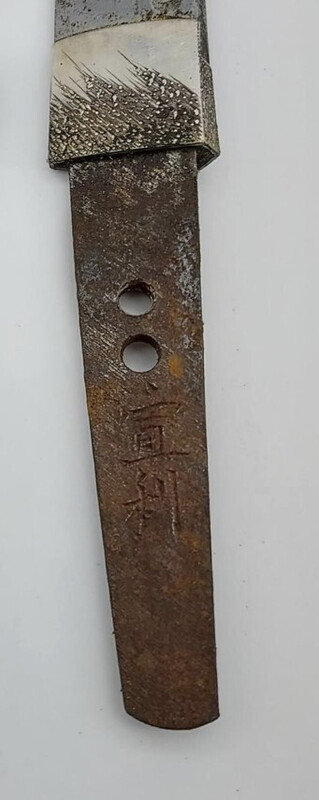
It's "宣利" (Nobutoshi) !
-
Hi Louise, at the quick. It’s a Kuwagata-Maedate. Modified over time, the oldest form of tatemono for Japanese helmets. Nothing to do with a clan or family. There is one book dealing with maedate, as far as I know. Unfortunately only in Japanese language. I can go more in detail this evening if nobody chimes in….
-
Tang of Kai Gunto - need help with translation
uwe replied to Kolekt-To's topic in Military Swords of Japan
First five are perhaps “濃州住栗木…..” (Nōshū jū Kuriki…) -
It’s called “Maru ni mitsubiki”. Unfortunately used by many families, for example: Abe, Asano, Kawasaki, Sabae, Kitsukawa, Sakuma, Takaki, Tsugu, Kitanokoji, Manabe….etc…etc. In a modified form by: Ashina, Furuta, ….etc.
-
Let me add “Matsudaira” (Tango) and “Honjo” (Mino)…
-
It seems to be “濃州関住星谷義長” (Noshū Seki Jū Hoshitany Yoshinaga)!
-
Thanks for the add Brian!
-
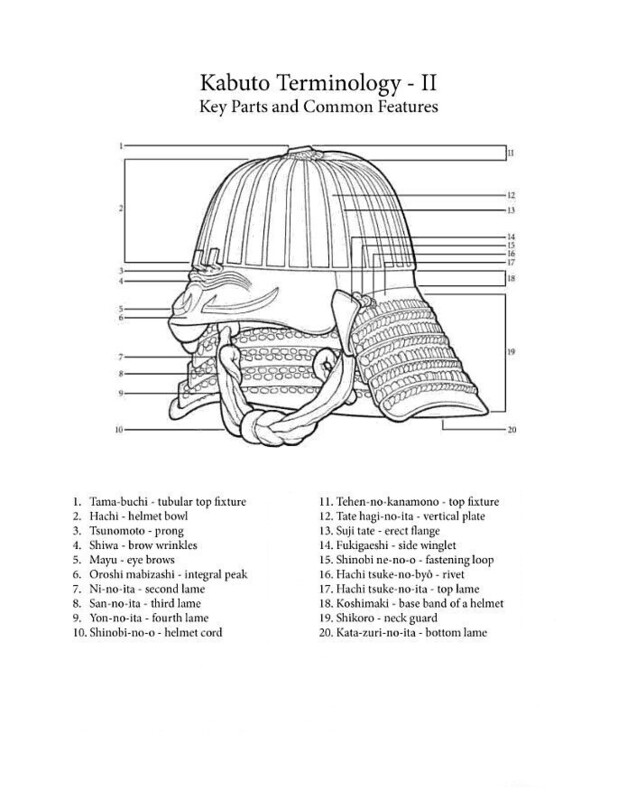
Hi Michael, sorry for my shallowness. A kaji kabuto is simply spoken a firemans helmet, worn by samurai while performing this spezial duty. The sketch below should introduce the main terms for kabuto: NB:- Kabuto sketch from the Watanabe Collection book by Trevor Absolon and David Thatcher And now the mon. Mon means basically family crest. Unfortunatly this particular crest was used by many, many families over the centuries. So it will be almost impossible to pin down the "original owner"...sry!

-
It’s a Kaji-kabuto with “hidari mitsudomoe mon” on the fukigaeshi. Nice find!




