Ray Singer
-
Posts
5,379 -
Joined
-
Last visited
-
Days Won
148
Content Type
Profiles
Forums
Events
Store
Downloads
Gallery
Everything posted by Ray Singer
-

Hands Up Who Has Seen Such Kind Of "suriage" Before ...
Ray Singer replied to TheGermanBastard's topic in Nihonto
While I am not familiar with a Juyo example, there is a Tokubetsu Hozon Rai Kunitoshi which papered with both the separate nakago and the now osuriage wakizashi blade. I do not know for certain if the NBTHK would paper a sword with an attached nakago such as this but my feeling is that they would not because, even if the mei is found to be correct and the nakago is believed to belong to the blade, it would still seem that this sword is structurally compromised. With the Rai Kunitoshi wakizashi, the blade had a fully reformed nakago (was structurally sound) and would have received papers (to some smith/school) even if the associated nakago did not exist. -
Hands Up Who Has Seen Such Kind Of "suriage" Before ...
Ray Singer replied to TheGermanBastard's topic in Nihonto
That is what I was indicating as well. Perhaps 'extension' was a poor choice of words, but a repair intended to restore the length of a nakago which was broken. When this is done with the intent of deception to use the nakago from another sword it is referred to as a tsugi-nakago (接ぎ茎・継ぎ茎). -
Hands Up Who Has Seen Such Kind Of "suriage" Before ...
Ray Singer replied to TheGermanBastard's topic in Nihonto
Looks like a nakago extension, which may have been done to replace a broken nakago. Very unusual. Is the nakago only pinned in place? -
Hasebe Kunishige? Your Thoughts Please
Ray Singer replied to mareo1912's topic in General Nihonto Related Discussion
Machi-okuri? My gut feeling when I saw the photos were ubu and late work. I'll hold off on further opinion pending better photos... -
Hasebe Kunishige? Your Thoughts Please
Ray Singer replied to mareo1912's topic in General Nihonto Related Discussion
My impression it that someone put a lot of effort (gone a bit over the top) to make the nakago appear old. There are some unusual mekugi-ana present. A few examples for comparison. https://www.aoijapan.net/?s=hasebe&x=0&y=0 http://www.nihonto.com/hasebe-kunishige-and-hasebe-kuninobu-%E9%95%B7%E8%B0%B7%E9%83%A8%E5%9B%BD%E9%87%8D%EF%BC%86%E9%95%B7%E8%B0%B7%E9%83%A8%E5%9B%BD%E4%BF%A1%E3%80%80/ -
Hasebe Kunishige? Your Thoughts Please
Ray Singer replied to mareo1912's topic in General Nihonto Related Discussion
Looking at the style and condition of the horimono, it looks quite late to my eyes and I would assume it to be ato-bori. Notice that there is absolutely no wear to the horimono from past polish, and compare with the condition of horimono which are original to the time period. -
Help With Reading Sayagaki And Origami
Ray Singer replied to Krystian's topic in Translation Assistance
The kanteisho places it with Monju. The sayagaki more specifically gives the sword to Nanki Monju Shigekuni. http://www.nihonto.com/nanki-shigekuni-%E5%8D%97%E7%B4%80%E9%87%8D%E5%9B%BD/ -
Not sure that this brings value to your post, but your sword brings to mind an interesting osuriage Sendai Kunikane wakizashi which was shortened by Shibata Ka (with the suriage documented on the nakago). http://www.sho-shin.com/ss3-2.pdf
-
I believe this is Hattori Tantosho Yorimasa. This would be WWII era work. My understanding is that Enomoto Sadayoshi used this mei when he was producing standard gunto.
-
Nhk Documentary - In Love With The Samurai Sword
Ray Singer replied to Blagoy's topic in General Nihonto Related Discussion
I love this documentary and have watched many times. Here is a link to the Yamato (no) kami Yasusada featured in that film. http://new.uniquejapan.com/a-yamato-no-kami-yasusada-wakizashi/?com=Swords -
Chogi (same kanji as Nagayoshi)
-
Bends can often be resolved by a professional togishi. It is not necessarily a deal breaker.
-
Shorter naginata with deep curvature in the monouchi is typical for the Edo period, seen in both Shinto and Shinshinto. From the look of the tsuka, I would guess that it has a short, ubu nakago (rather than an osuriage one). The naginata-hi are simplistic, also pointing to later work.
-
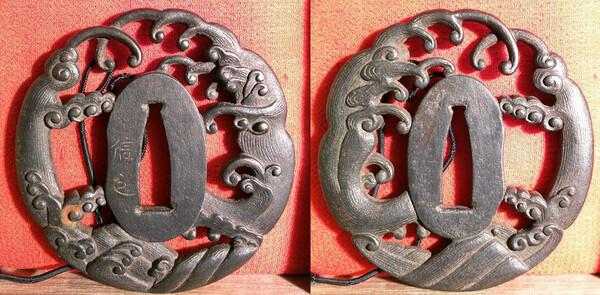
Fuyuhiro. And below, an identical tsuba.
-
I am likely wrong on the date, but perhaps Koei san nen kyu gatsu hi.
-
大和國保昌五郎 Yamato (no) Kuni Hōshō Gorō
-
Help With Translating Of Old Blade Mei
Ray Singer replied to Pitomnik's topic in Translation Assistance
It is by Yoshimasa and has the appearance of a Seki blade (WWII era), slightly suriage. -
Tallahassee Fl Centurion Auctions
Ray Singer replied to Stephen's topic in Auctions and Online Sales or Sellers
I was planning to attend in person but had to cancel at the last moment. The auction just closed. I likewise thought the naginatanaoshi was interesting, as was the Hizen Masatsugu. The Nobufusa sold at an attractive price. -
I can do an overlay comparison tomorrow, but to my eyes the nakago in the kanteisho appears to match the actual sword.
-
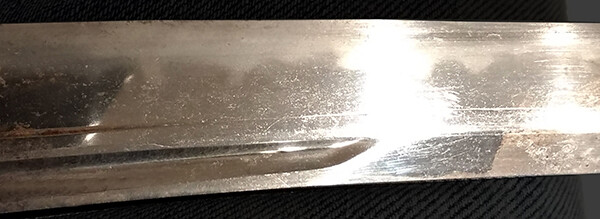
Thanks as always Markus. The sugata is a very interesting one. The blade is in the form of a naginatanaoshi, but appears to be ubu with a deep sori that is most prominent through the nakago, giving the feeling of a kodachi. Nagasa is 53cm. The sword has a narrow mihaba and the the slender shape gives me the feeling of an Oei blade. The hamon is one which would lead me to say Nobukuni, even if I have not seen the mei, and has resemblance to another Nobukuni I own. The boshi has kaeri (not yakitsume).

-
Nope. Mike Yamasaki (not Mike Yamaguchi)
-
Anyone Know This Swordsmith ?
Ray Singer replied to Emma's topic in Auctions and Online Sales or Sellers
A few links below... https://nihontoclub.com/smiths/KAN1810 https://www.aoijapan.net/katanamumei-tashiro-genichi-kanenobu/ http://www.militaria.co.za/nmb/topic/13606-oshigata-request-for-tashiro-gen-ichi-kanenobu/ -
Thanks Curran, appreciate the feedback. Also just found that Markus has a nice, cross-generational comparison chart on his page below... https://markussesko.com/2017/05/09/kantei-4-yamashiro-28-nobukuni-%E4%BF%A1%E5%9B%BD-school-3/ Best regards, Ray
-
Hi Axel, Thanks for the reply. It does seem that all examples I have readily available have either a vertical or right-leaning center stroke. The reason I hold out hope is that I have a note in my mental archives that the sandai signed this way... Best regards, Ray
-
I am curious if anyone has a sho-shin example of Nobukuni which corresponds with the attached mei. This is for a very interesting piece with a nijimei of Nobukuni, which greatly resembles Oei Nobukuni work. The KUNI is signed differently from established examples, with the center stroke leaning to the left rather than to the right or vertically from those smiths who worked in late Nambokucho and early Muromachi. Any reference examples, if such exist, would be greatly appreciated...