Bruce Pennington
-
Posts
14,031 -
Joined
-
Last visited
-
Days Won
169
Content Type
Profiles
Forums
Events
Store
Downloads
Gallery
Everything posted by Bruce Pennington
-
Thanks Thomas, I just learned something (from wikipedia): "Watatsumi 海神 "sea god" or Ryūjin 龍神 "dragon god" was the ruler of seas and oceans, and described as a dragon capable of changing into human form. He lived in the undersea Ryūgū-jō 龍宮城 "dragon palace castle", where he kept the magical tide jewels."
-
So, obviously not a 1-off design! Thanks Bryce.
-
 Forgive my ignorance, for it is Legion, but I thought I was told that tamahagane (and the nihonto qualification) had to be made from a tatara. That is why blades made by Yasugi steel are not considered gendaito/nihonto. Yasugi Co used kilns and advanced tech, rather than tatara. Am I not understanding something (highly likely!)?
 -
Thank you! You may turn out to be right George, I'm open to that, but I'm puzzled by things like Volker's gunto. It's clearly an expensive custom order, not a refit in my opinion. So why would a fitting shop take the time to stamp a number on a blade but not on the fittings? What purpose would the blade number serve?
-
koa isshin mantetsu hada
Bruce Pennington replied to lonely panet's topic in Military Swords of Japan
JP, it’s essentially a condensed version of his website. And it’s in Japanese, so the pictures are all I could get from it. Won’t name names, but it was a gift from one of our members! Just thought he should receive some public praise even if we keep his name anonymous. -
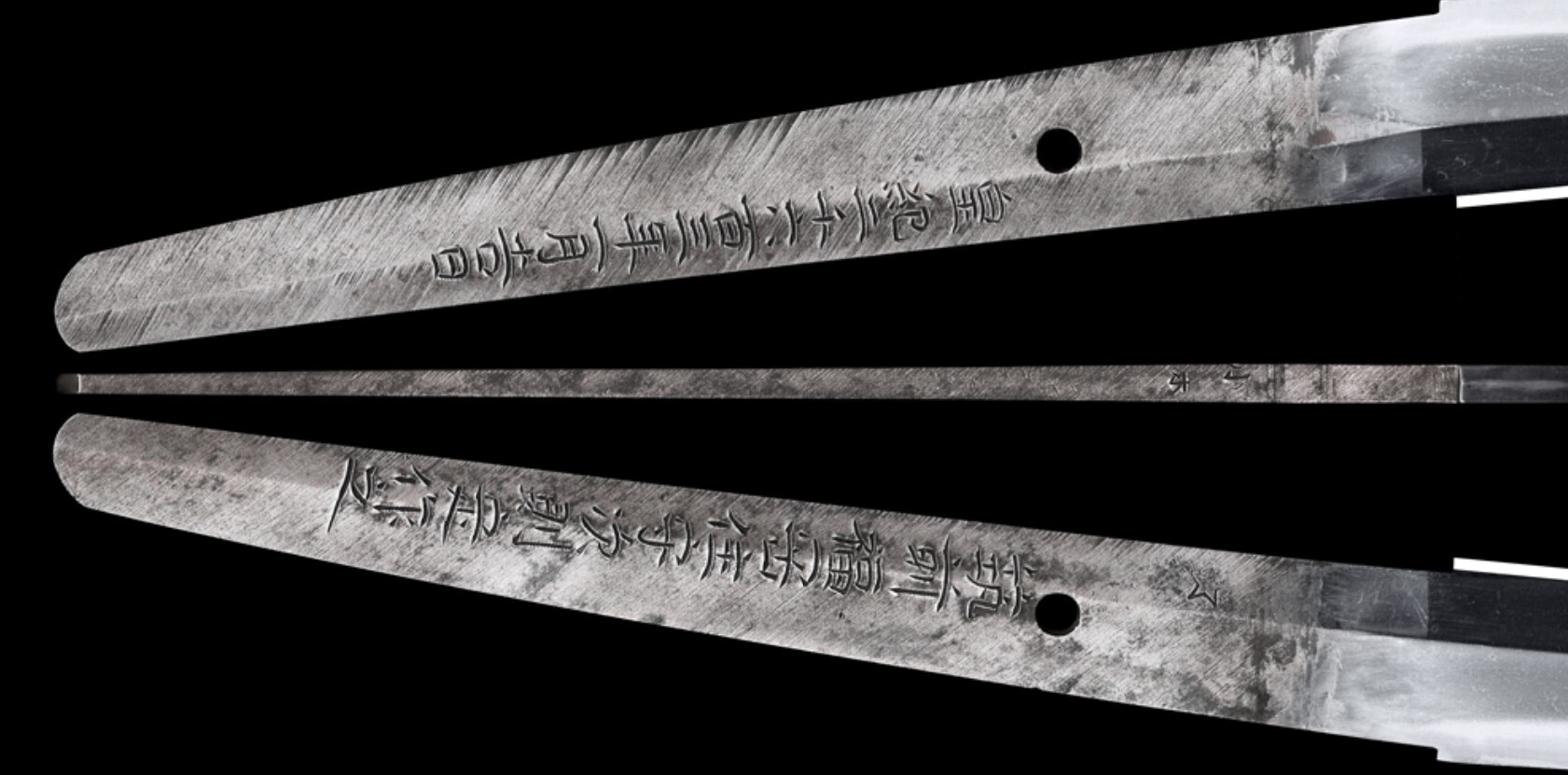
I agree George that this would point to RJT numbering, not shop numbering. If Volker's fittings don't have numbers, I feel his "75" is an RJT number too. It wouldn't make sense that a fitter shop would go to the trouble to number a blade but not put the number on the fittings. I don't have these Kunihide blades in my files. Do you have photos or links so I can log them in? I do have an addition to your list: Masaharu (location unknown) 10/1944 "6" on mune Also, I have 2 oddballs: Mitsunobu (who is listed RJT, but the blade isn't dated and no star - from one of your articles!) 707 on mune (it's mounted Kaigunto, so that should explain the lack of star) and Toyo Knife Co. mei No date 510 on mune
-
Thanks for the mune photo! The photos of the seppa/tsuba are almost clear enough to tell, but it looks like they are not numbered? Are there numbers on ANY of the fittings? There don't seem to be any.
-
Great, can I get a picture for the files?
-
Yamakami Akihisa Late War (Type 3) Gunto
Bruce Pennington replied to MacTheWhopper's topic in Military Swords of Japan
I agree with Chris. -
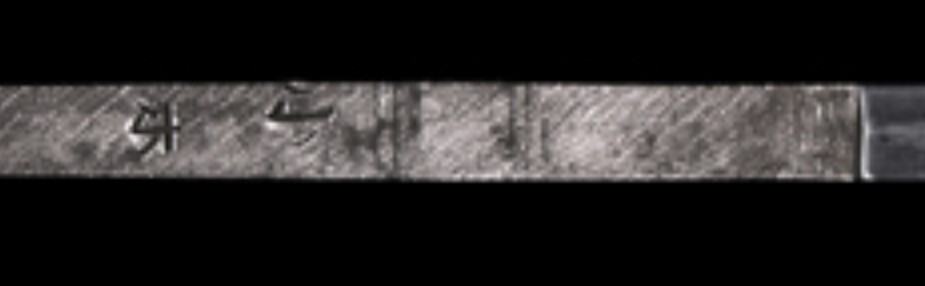
Love it Volker! Any stamps on the nakago mune?
-
You had it, John!
-
I’m going to continue this conversation with you Jacques, for a little longer, but I realize it’s probably a waste of my time. You obfuscate and sidestep factual points of the conversation. The reason we posted the swords above with papers was to directly counter your claim that I just quoted. No other reason than that. I’ve made all the points that need to be made. And I will simply standby and wait for you to provide evidence for your idea. So far, it is only an idea, a possibility. For example it is also possible that aliens from outer space made some of the swords with star stamps. I have no evidence to support it, but it is just as possible an idea as yours.
-
Late model War Mounts 1944 Date
Bruce Pennington replied to Swords's topic in General Nihonto Related Discussion
Usually the two go together. A blade isn't "traditionally made" unless the smith used tamahagane. -
Found THIS ONE but it's a Type 98 drawing.
-
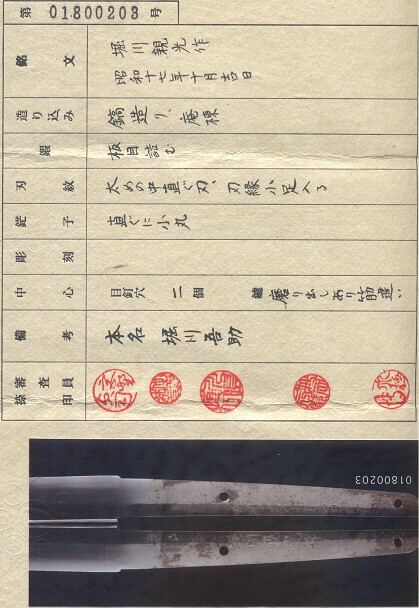
Just starting through my files. Here's a 1942 Chikamitsu (owned by Edward G) with papers:


-
And here: http://ohmura-study.net/767.html
-
Bruce, Bruce here, Ha! That always feels a little strange! Can you show some pictures of the backstrap and side "ears". The floral arangement shown is a "Sonin" level of possibly a Colonial Sword. Hopefully the experts will help with the kanji. To my inexperienced eye, they look like roughly cut katakana: Fu フ Ni ニ Wo ヲ Ka カ If correct, I don't know what that would signify.
-
Jacques, I have found myself in your shoes a couple of times debating with Nick Komiya about things that didn't fit regulations. In both cases, he was adamant that Army personnel wouldn't violate regulations, but in both cases I had actual swords and/or photos that showed that they did! So, yes, I am a realist (heck, I was in the military myself and know of a guy, who knows of a guy, that had a friend that defied regulations a time or two! HA!) and know that Japanese personnel didn't always follow the regs. HOWEVER, like my cases with Nick, your case hinges on having examples to back your idea. I'll repeat - every blade has to stand on it's own merit, but so far, I haven't seen a star-stamped blade that was an obvious showato. The circumstances support a presumption of innocence, unless proven guilty with some counter-evidence.
-
Ammad, The "contingency model" or Rinji-seishiki (RS) (Japanese for contingency model) was an Army-wide version, not made specifically for the RJT system. So all sorts of blades can be found in RS mounts. It was designed (did we already have this conversation?) to be cheaper than the Type 98 and more durable for field operations. But the fittings could be put on any blade. So, you'll find standard showato, gendaito, and even ancestral blades in them. The standard blades are normally found in the light tan saya with 1 release button, while gendaito are usually found in custom saya with textured lacquer and usually 2 release buttons like yours.
-
Yes, Jacques, I've read Leon's book too. Maybe you haven't been following our discussion on Arsenal Mark on RJT Sword Fittings. There you will see that I've been corresponding with Leon about our recent discoveries in RJT regulations. You will also find his revelation that after polishing a star-stamped RJT blade, himself, he now believes it to be tamahagane. I see by your number of posts, that you are not new to Japanese sword collecting. Maybe you're new to WWII gunto collecting, though? Because if you've been around long enough, you will have learned that ALL reference material - Ohmura, Fuller, Dawson, Kapp, etc - have dated material in them that recent discoveries have made obsolete. Even swordsmith interviews must be viewed with a grain-of-salt as they were simply reporting information as they understood it from their understanding of events. Leon is currently working on an updated version of his book, and I suspect that section will see a revision with new information.
-
Right about that. The fittings are obviously brand new though. I admit, I shouldn't be commenting on hamon, but I don't think the Japanese, with even a fake hamon, would end one like this, right?


-
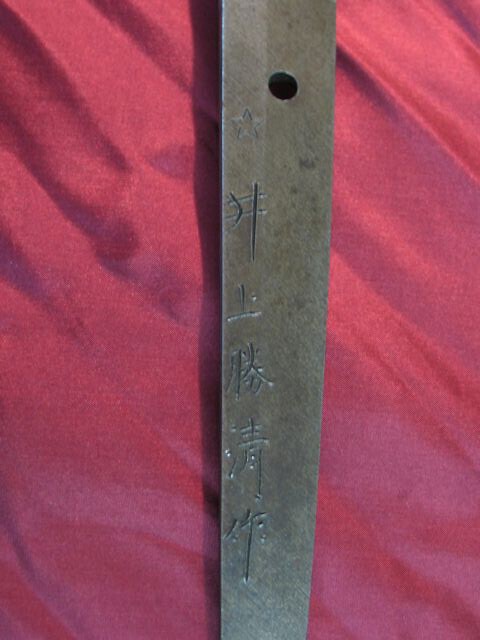
Jacques, While it is always true that every blade must stand on it's own, your idea is just that- an idea, imagination, speculation. Here are the facts: 1. We have an IJA Regulation stating that all RJT blades will be made with tamahagane, and multi-folded. 2. We have an IJA Regulation showing that the Star is an army material stamp indicating that the material used in the manufacture of the item was provided by the army (and from item 1, we know the material provided was tamahagane). 3. We have first-hand account from Kuniie, who inspected RJT blades and put the star on them. For your idea to be true, a smith would have had to risk violating Army regulations and losing his contract, imprisonment, etc. It's just not likely, and the burden of proving your hypothesis is on you. A similar reverse conversation could be had about Sho and Seki stamped blades. We have evidence from the Seki website and Ohmura-san that blades being inspected by the Seki Cutlery Manufacturers association were all showato. Yet, there are guys who claim their blades are gendaito, and there is even a famous case where one passed shinsa and was papered. So, in this case, the evidence says that blades stamped with Sho or Seki are showato, but someone may prove their blade to be an exception if the can. The burden of proof is on them.