

ROKUJURO
-
Posts
7,190 -
Joined
-
Last visited
-
Days Won
40
Content Type
Profiles
Forums
Events
Store
Downloads
Gallery
Everything posted by ROKUJURO
-
This is an interesting topic. I have some experience in producing iron from iron ore in a bloomery furnace as it was used in the early iron age in Europe, The TATARA works in a similar way, and the material produced is quite close, as one can see in the research paper of TATSUO INOUE on the subject. So I may be able to offer some information about the characteristics and properties of TAMAHAGANE in general. Firstly, the iron (TAMAHAGANE) produced is very pure and contains almost no alloying element with the exception of carbon. All other elements contained are impurities with a percentage of less than 0,01%. However, TAMAHAGANE is not consistent in its composition, but the contents, especially in carbon, vary to an extent. This makes the selection of the raw metal so important. Black iron sand (SATETSU), the best of which is mined in the CHUGOKU mountains, contains a number of other elements, e.g. titanium, silica, aluminium, calcium a.s.o. in considerable amounts. But one has to know that by the bloomery method the iron oxide is reduced to metallic iron without passing the molten state. This prevents other elements being solved in the liquid iron. So there are no different iron alloys being produced by the TATARA process (wherever this took place) with the exception of very small amounts of impurities which we can consider as not having an impact on the mechanical properties of the steel produced, but perhaps could influence the inner crystalline system, resulting in different features on the finished blades. . This allows the assumption that differences between KOTO and SHINTO sword blades are mostly related to the ways the steel was forged and heat-treated by the respective smiths. P.S. By the way, iron sand is not only found in Japan, but it can equally be obtained from the shores of the Baltic Sea by the magnet method. There is no reason why it should not occur in other places as well.
-
Oliver, as by Sébastien already identified, the MEI is probably 正阿弥 (SHOAMI).
-
Donny, to me, the blade does not look genuine. There are not enough good photos of the blade itself to support my feeling, and the corrosion is quite bad, but I see a NAKAGO with a wrong shape - SHINOGI not clear and in an unusual position - and wrong YASURI ME. There are genuine GUNTO with a kind of erratic filework, but mostly not that bad. The MEI is not in a good position in relation to the MEKUGI-ANA. It would help to see clear photos of the naked NAKAGO with everything stripped, especially the HABAKI. If HA MACHI and MUNE MACHI are on a level, it might nonetheless be a Japanese war-time blade. KOSHIRAE-wise, everything seems genuine indeed.
-
Dale, they are all wrong except your dear wife. It is indeed 'an old ladies brooch'.
-
Oliver, have a look at good TSUBA - in hand, in books, and in the internet - and compare. Try to get a sense of what quality, good design, and good workmanship can mean. Many of us collectors have made mistakes in the beginning, but that is the way of learning - trial and error. The more you see, the more you will be able to differentiate. Good luck, and don't be disappointed! (Jean is indeed French)
-
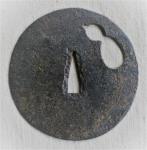
Oliver, looks like GOSHU no JU, smith's name not identifiable for me. This may have to do with the TSUBA possibly being cast. Details often get lost in the process.
-
Really no machines? I remember talking to a well known German NIHONTO dealer many years ago. He was proud to tell me that 'his' polisher, a certain KASUGA in KOBE, used machines for the basic grinding to save time, and so could do the job for much less than a private collector would have paid. There is another subject I want to comment on. The foundation polish is the basis for all other steps of polishing, but the shape is formed by the smith himself who does the first steps with a file, a SEN and some relatively coarse stones. After this treatment, the HAMON is - at least slightly - visible and the shape is given to a very high degree. NIKU and MUNE are clearly formed, KISSAKI, SHINOGI and SORI are defined, all lines are sharp. That is what I have seen myself but maybe not all swordsmiths work that way.
-
Chris, when you like it, it is the right TSUBA! Unless you want to sell, you have to find the right match for yourself, which is often dictated by money, but mostly by the individual taste.
-
Chris, these photos are indeed better! TSUBA looks handmade, but a bit on the crude side. Maybe the maker had JAKUSHI in his mind, but was in a hurry (mass production?). Probably much later than early EDO. The blue colour of the iron has nothing to do with forging or the quality of the metal. This could be the effect of a final heat treatment.
-
Chris, the JAKUSHI school (early EDO JIDAI) used this subject quite often in their iron TAKABORI TSUBA. In this case, the bad resolution of the photo does not allow to see details. I could not tell if it is cast or genuinely handmade, but the application of precious metals can be a hint to a real TSUBA.
-
GentIemen, I am missing one point in the discussion: Owning Japanese water stones and being able to use them in a traditional way to give a sword a new surface is one thing. The other side of the traditional Japanese TOGI is the knowledge of SUGATA and all other properties of the different schools and makers. The necessary study (in hand!) of so many blades (thousands!) is very probably only possible in Japan, and the guidance of a skilled master over many years as well. Steve may be right when he says that not all Japanese polishers are created equal, but in the whole the risk of damaging a blade ( = altering in one or several of the original aspects and properties) is very probably much less with a fully trained Japanese TOGISHI.
-
Ken, and then again, you surely don't want to display a GUNTO in connection with AIKIDO! And of course never a bare blade!
-
Dominnimod/ Senor Ubaldo, please sign all posts with your first name plus an initial, so we may address you politely. This is a question of personal taste. 'Plain' is not necessarily boring in my eyes. Think of a good SUGU HAMON on a classical blade! In the case of this TSUBA, it is an unfamiliar or even rare technique of decoration and possibly interesting, but not beautiful in my eyes. Of course I would not alter it, so my suggestion of "saving" it got a !
-
Recovering Lost Signatures
ROKUJURO replied to Michael Kwok's topic in General Nihonto Related Discussion
Or even by a TOGISHI.... -
Donny, hopefully, there is a good iron plate underneath the 'decoration', so I hope the TSUBA can be saved! To my eyes, this is quite ugly!
-
Jason, sorry that we could not satisfy your expectations for a precise KANTEI via photos. But I will give you a valuable advice for future purchases of blades: NEVER touch it with bare hands!
-
Recovering Lost Signatures
ROKUJURO replied to Michael Kwok's topic in General Nihonto Related Discussion
X-ray also use electrons, so EBSD might really work. Anyone having such a machine at home? The MEI is hammered in with a chisel, so it is not really cut (removing steel), but the vertical impact on the metal is probably less strong compared with a machine stamp as used on firearms or other mechanical parts. -
Mark, I don't see an inscription on the TSUKA, but if you meant TSUBA MEI then TADAHIRO would also be my guess. Pictures of the blade are always welcome here!
-
Neil, is this a HIRA ZUKURI shaped blade?
-
Probably not Japanese MEI, but the owner should be banned generally from buying blades......
-
I think the same as Evan. Plum flower (UME no HANA) SUKASHI.
-
Thank you for that link, Gordon! That was very interesting, although much of this forging 'industry' is know - not only in China, but also in Mexico and South America.
-
Ed, the design of your MENUKI is really elegant. Can we see the underside please?
-
Adam, I think that you did fine on this TSUBA, and it is a good start into collecting. It seems to be of good quality and in very nice condition. The price you paid is on the cheap side, depending a bit on the size of the TSUBA. The AOI leaves design is a standard one with KINAI like the one below. As KINAI were made roughly between 1600 and 1800, yours may be mid-EDO.
