

ROKUJURO
-
Posts
7,002 -
Joined
-
Last visited
-
Days Won
38
Content Type
Profiles
Forums
Events
Store
Downloads
Gallery
Everything posted by ROKUJURO
-
Robert, if you care to read the many posts on NMB about similar swords and value questions, you will find that you will get no definite answer. Even if you gave the precise dimensions (including SORI, KASANE, MOTO HABA and SAKI HABA a.s.o.), it will be the market and possible buyers who will give you a price idea. There are some collectors who do not care much if a signature is correct or not; others will expect an evaluation paper from a renowned organization like NBTHK. The quality and condition of a sword (not easily visible on photos) are still more relevant than the signature. Sometimes you find valuable blades with wrong signatures! Get some information on this smith ( https://www.nihonto.com/shinkai/ ) and take your time for a sale! INOUE SHINKAI is a very famous name and was often faked. First be sure about what you have, and then you may be closer to an evaluation. Prices I found in the internet range between $ 2.000.-- for an obvious fake and $ 50.000.-- for an appraised blade, but these are no limits. If it were my sword, I would ask one of our high-end dealers (Raymond, Darcy, Ed) for help.
-
 I just got an information about an exhibition of Japanese household items of higher quality, including quite nice lacquer work, a few TSUBA and swords, some textile items a.s.o. Please have a look: https://www.japaninwuelfrath.de/galerie
- 1 reply
-
- 3
-

-
Harry, is that HABAKI gold foiled or is it really solid? It is difficult to determine from the photos. In any case it is a nice one, as is the whole KOSHIRAE.
-
I am not on Facebook (and never will be) but I like No. 3 (KO-SHOAMI) best, closely followed by 4 and 5.
-
This cooling effect is indeed used in the earthenware pottery of a number of cultures. Asian stoneware is usually water-tight, but sometimes larger impurities like feldspar grains can open up a small gap, allowing liquids to sip out. We see that especially in old IGA or SHIGARAKI ware.
-
Steven, thank you for mentioning that. I have always to remind myself that we are looking at photos, not objects. Thinking of the famous René Magritte painting 'Ceci n'est pas une pipe'.....
-
I am not able to make enlarged copies of the TSUBA photos, otherwise I would have shown a number of details that I cannot explain how they were made. The coarse surface does not look like forged or chiseled/scraped as it has many tiny protrusions. I don't believe that is from corrosion alone. The same applies to some spots where I can see superficial 'irregularities', e.g. in one ear of the rat. Also the surface of the TAGANE marks is coarse which would not be the case when they were made with a chisel. But of course I am constantly learning, and I am sure Ford could explain where I am possibly wrong.
-
Looking for info on a Japanese knife.
ROKUJURO replied to badger73's topic in General Nihonto Related Discussion
Bob, you can also look under HANAGATANA. -
Perhaps YOSHI (?) TADA. Grinding a NAKAGO is a bad idea, but in this case it may not be so damaging as it looks like a late WWII factory blade.
-
In any case, I think that the blade is really a nice one. Certainly not a theater item!
-
Bathala, welcome to the NMB! Please sign all posts at least with your first name plus an initial as is requested here.
-
Congratulations on that purchase; it is a nice TOKKURI! It looks indeed like BIZEN stoneware, so you do not have to be afraid to put it in your dish-washer. Stoneware is sintered ceramic fired at temperatures above 1.260°C, so it's hermetically sealed and safe to use whatever tensides or soaps you want to use (of course you will want to rinse it carefully). It does not need a glaze like earthenware. I don't think it is old; considering that there are no traces of use to be seen on the bottom, it is probably contemporary. But that is just my observation from the photos; I may well be wrong.
-
Doug, welcome to the NMB! I read the signature of your sword as NOSHU SEKI no JU KANENAO SAKU, which means KANENAO of SEKI province made this. The SAKURA (cherry blossom) arsenal stamp is a hint to a likely non-traditionally (= factory) made blade. The other side of the NAKAGO (tang) will probably show a WWII date. Please read here on the board about etiquette and preservation of blades, so you can pass your sword on in good condition to future generations.
-
Interesting old blade, good polish, and very good photos!
-
The tools I know for removing a TSUBA sitting tight on a NAKAGO are made of wood and wouldn't cause damage!
-
I think it is SAWADA (?) KANEMITSU
-
Thank you Piers! That allowed a look at very special items you cannot see elsewhere!
-
Ken, that stuff is so flammable, and with all your volcanos.....better be careful!!
-
John, you could indeed say so if this was a GENDAITO. Is that the case?
-
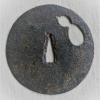
What puzzles me about this TSUBA is the fact that the TAGANE marks in the NAKAGO ANA have been left untreated. Usually you will find them filed down to fit a blade. Concerning patina in general, the surface has a lot to do with the appearance of it. Some HIGO TSUBA have a very smooth surface, allowing for a deep black sheen. Patination of iron may vary from brown to deep black depending of the chemicals used. Some rust spots (?) seem to have been treated with a sharp tool, which gives the impression of an amateurish handling. Traces of wear from SEPPA are almost not visible on the photos, so together with the 'clumsily' executed hills that form the background, I have an impression that it may be a very recent TSUBA.
-
Charlie 123, welcome to the NMB! Please sign all posts with your first name plus an initial so we can address you properly. You can add your signature to your profile. The MEI (signature) of your sword seems to read SEKI no JU ISHIHARA KANENAO. The TSUKA (handle) looks to me like a replacement with one of a cheap decoration KATANA. Please compare: http://www.aoijapan.com/img/sword/2014/14764-1.jpg
-
Yes, probably for a blind man like me.....
-
Really? I accept your expertise but I am a bit unsure. What are the three dots in the middle? HIGO MATSU no TSUBA.doc