Gakusee
-
Posts
1,929 -
Joined
-
Last visited
-
Days Won
22
Content Type
Profiles
Forums
Events
Store
Downloads
Gallery
Everything posted by Gakusee
-

Accidental Autograph Collector Kanzan Sato
Gakusee replied to Surfson's topic in General Nihonto Related Discussion
Hi Kiril, could you please elaborate on your statistical inferences about correlation coefficients and dependencies? I am not following the statistical / mathematical logic here. Thank you. My own observation is that Tanobe sensei is somewhat selective about the blades for which he writes sayagaki. He tends to write sayagaki for higher quality blades (at least Tokubetsu Hozon) or for those unpapered blades which he knows are easy Juyo bets by virtue of quality or rarity or both. In contrast, Sato sensei seems to have been more prolific in his sayagaki and some of the blades for which he wrote sayagaki might not surpass the Hozon criteria today. That was the case with one of my Muramasa blades, which had his sayagaki and was able of qualifying only for Hozon. I could not get to TokuHo as it was a bit polished down and the mei was partially obscured. So, despite the importance of the smith, they said that it being a Muromachi period blade it would not qualify for TokuHo on the basis of impacted mei (and probably what remained of the blade). Regardless, the blade was a textbook Muramasa and Sato sensei’s opinion was obviously accurate and upheld by the NBTHK. -
Hi Georg: - firstly, I think you can get it polished for less than €5k. In fact I have recently had 3 mukansa level polishes for around €3k. Admittedly, those were more touch-up/rectification of bad polish or minor rust. Of course, there is also admin involved in getting it there and back but not more than 500-1000; - next, you will need a reputable agent to do the admin work (import, authorisations, despatch to polisher and receipt, applying for export permit and sending it back). You need someone reliable and either based in Japan (eg Paul Martin) or someone with an international network who can arrange local details (eg Darcy Brockbank). These are well known experts and authorities and trustworthy. - the sword will not “paper” if the signature is judged gimei. However, subject to which institution you submit it to (NBTHK or NTHK) you will receive either verbal informal feedback (NBTHK) or a more formal, written view (pink slip or notes sheet from NTHK). With that guidance, you decide what to do - eg, remove the signature (done by a professional in Japan, mostly by compressing the makura and restoring the yasurime) or keep (genuine or needs further study) or whatever - there is of course a shortcut to the formal submission process - requesting a high authority like Tanobe Michihiro sensei to look at it and opine on its authenticity. Darcy recently did this for someone on a very old blade. That saves the hassle of a longer submission/waiting time for the predesignated formal assessment days (these are not every month and there are specific dates for shinsa) - workmanship is very important and a “window” ( short section polished to clear up the hamon and hada) will assist if the signature is borderline. If glaringly gimei, then the window is more for you to assess the quality and decide whether to invest in a full polish and assess economic outcomes should you be wondering if you could recoup polish investment or are thinking of selling it However, I am personally a bit sceptical that someone would have faked the entire sugata and the quality grooves and the minute details to such an extent. Of course, it is possible, but I think the fakes are more on the more straightforward katana-type blades. Admittedly, as we are not experts, we would need 20-30 Masayuki mei in great detail to examine and compare to be able to give firmer opinions on the tagane, makura, strokes, etc
-
Well done, Brian! The sword indeed looks pretty good and it seems worthwhile to polish it to reveal the hamon properly. One indeed needs to bear in mind the underlying condition (but chances are it will be better preserved than an 800-year-old blade). Now, there seem to be quite a few Masayuki signed Juyo blades, even though their value is not perceived to be at the same level as when he became (and signed) Kiyomaro. In fact, through the Juyo zufu, one can stumble across 3-4 similar naginata blades signed Masayuki, with similar grooves and overall sugata. So the indications on this one are good!
-
The mei looks very confidently and well executed. It has the right positioning on the nakago mune and versus the ana. It resembles several of the “slimmer” Masayuki mei I have in my references. Of course one needs to assess the entire blade but it looks very promising. Congratulations on your luck (tiny investment recouped already and free sword on top, which might be rather valuable).
-
Good sword. Thanks, Jussi and James. For the period, it is as it is supposed to be, showing Oei traits well.
-
So, which ones are the concrete swords we are talking hypothetically and theoretically above? Thanks.
-
i wish this was still in its original mounts
Gakusee replied to lonely panet's topic in Auctions and Online Sales or Sellers
This blade is rather narrow and with a distorted nakago. Somehow it does not seem well proportioned. The forging seems good but the sugata...... -
Yes, a topic of hot debate and different preferences. Sometimes (often actually) people talk over swords and if you have a mask on that prefers saliva reaching the blade. Bare hands on tang is great but then if you want to (and do) handle tsuba and koshirae afterwards, it becomes a bit problematic. Sometimes also one needs to be careful about shumei, kinzogan and kinpun mei - handling with bare hands is also ill advised there. Any closeups of the actual blades from those who were there? Would be great to see some of the better blades and koshirae.
-
Cotton soils easily and rust can be transferred onto other items, once nakago has been touched with cottons gloves on. How many people religiously launder their cotton gloves after EACH sword viewing? The friction is also better managed with latex and as they are disposable and non-organic, one can argue cross rust contamination is minimised. I have often seen people touch blades with cotton gloves believing the blades are protected and there is no need for fukusa. In fact, sweat permeates and penetrates via the cotton. Downside of course is the environmental impact ((( But digressing...... Paul and Ian - well done for organising such an amazing day. Hopefully the members appreciate the effort that goes in it, not least removing items from storage or display and sharing them with random visitors, this placing trust in those visitors they would take proper care. And of course, the talks and presentations, ushering people around, etc. John - nothing wrong with little rubber from time to time....we are all human after all
-
Remember this blade? Thought was Mino/Kanemoto but could be earlier?
Gakusee replied to Blazeaglory's topic in Nihonto
Mino and what is being described is the effect of nie scintillating on the blade. -
Well, gentlemen, good advice all around. We just need to be mindful not to exert undue pressure on George, who is very new to all of this and let him imbibe and process the available information. It must be overwhelming and confusing and I know I would feel like that if I were plunged in a completely new area and people were telling me I had one (or one of two) of a kind items in the world. Notwithstanding the above caveat, I would like firstly to salute Ray for the noble gesture and secondly to echo the advice given before and just reiterated: - the sword is already in Japan and has / is being licensed to stay there indefinitely (until exported). It will be wasteful to forego the torokusho process and re-export it so quickly without utilising the available resources to enable one to make an informed decision - every time it travels, there is further exposure to changes in humidity and also a chance that it might be examined inappropriately by customs officers when it leaves/enters a country, which might result in fingerprints on the blade, potential damage etc - even if no one damages it in transit (and I am always paranoid this might happen, even when I transport my own swords in person and oversee the customs officials myself), as Ray points out the fact that there is residual rust corroding the blade is in itself extremely dangerous and damaging to the blade. Such corrosive oxidation must be stopped as soon as possible - indeed the top restorers are in Japan (see point one above about blade already being there!!). Yes it will cost several thousand dollars and yes it will take 6-12 months of waiting but that is a worthwhile investment even if one decided not to proceed to [high] papers. But I would suggest these are done while the sword is there: 1) gentle polish 2) Tanobe sensei sayagaki 3) Hozon certificate - no one is saying George needs to sell the sword immediately (despite offers made or declined) but George should be in a best position to make an informed decision (currently this is not the case due to the state of the sword) - with all due respect to Benson, the sword is in the Mecca of sword restoration, its homeland, where it can be (and has been) expected be several people above Benson’s skill levels and knowledge. A top sword polisher appropriate for its state has been recommended by the top sword judge / expert in the world (Tanobe sensei). That is subtle but needs to be fully appreciated: Tanobe sensei reviews swords, gives a preliminary view, indicates if he might give sayagaki or not, recommends a polisher specifically for the blade (taking into account age, smith, state of preservation etc) and then writes sayagaki after polish. George: it is simply not true that a sword needs to be perfect or in a perfect condition for it to be valued or appreciated by sword connoisseurs. In fact, Darcy recently had a very valuable signed Awataguchi tachi also with condition issues on one side, also not with the highest papers [Juyo or above] but it got recognised as pretty much unique quickly. People who know what they are doing will omit some hamon issues and the thinness or the hamon. Value might not be $100k if there are issues with the hamon and fukure does not close well but it will still be in the tens of thousands of dollars - should you wish to sell it. But again, no one is saying you should be selling it or jumping to conclusions just yet - we are simply cautioning that the best must be done for the sword regardless of what you intend to do with it. And the best is definitely not to go back to the US or stay locked in its current state.
-
Well, den Hosho is not really sensible as Hosho is already a group attribution, Chris. So they could have said Hosho rather than Tegai Kanekiyo, if we are talking about that specific blade above. On Tegai Kanekiyo - well, there are more than 1 zaimei (shodai) blades. The problem is also then exacerbated by there being several generations, with shodai rare but then sandai having a few more blades which have a Juyo status. I would personally also trust more Tanobe sensei’s attribution (he studies swords for longer in his home office before he writes sayagaki than the Shinsa panel) and definitely Kunzan sensei’s attribution (his are very, very rare and treasured by connoisseurs). Going back to the original, broader topic: at the lower level they become indistinguishable and interchangeable. But agreeing with Chris in that attribution is the first attestation of quality, the higher end Yamato blades obviously get attributed to the overall better smiths, who have been studied empirically and whose [signed] work the Shinsa has records of and can compare to. Just flicking through some of the TokuJu records, there are a lot of Taema, a fair few Tegai Kanenaga, some Shikake Norinaga, a fair few Senjuin.
-
Chris is on the right track for non Yamato schools even though there is some confusion (eg Unji is Bizen school and the tier 3 in that trajectory Sanjo/Awataguchi—Rai—Enju should be Enju) I also think he is confusing or equating rarity (Hosho being rare) with quality. Frankly to me Yamato is also quite fungible as it seems to Chris with the exception of the top smiths Ray mentioned.
-
Some Really Great Sword Books Up For Auction
Gakusee replied to Jussi Ekholm's topic in Auctions and Online Sales or Sellers
Ha, makes me glad I lowballed my bid as with the shipping costs it would have worked about market price -
I have noticed that really old papers (well before pre-sessions 20s...) used to insert “den” quite a lot and afterwards direct smith attributions crept in gradually. Recently it seems to me that it has probably morphed again, with a dosage of conservatism, i.e. smith +/- 5%. But this is a very, very complex area and one needs to look at the history of the term usage and so on. In any case, Darcy explained it very well here: https://blog.yuhindo.com/den/. There are blades who have retained “den”, gained “den” or lost “den” when transitioning from Juyo to TJ. Interestingly, if there is a Honami kinzogan inscription or the blade has a solid daimyo provenance, or both of these, then den seems less likely.
-
Excellent, just excellent......thanks for the update, Darcy
-
Some Really Great Sword Books Up For Auction
Gakusee replied to Jussi Ekholm's topic in Auctions and Online Sales or Sellers
Where are the realises prices? I am having major problems with that website on my Apple devices. Thanks -
Brian, George - it is my pleasure. I have learnt a lot from the board over the last 10-12 years (even before I registered as a member), made great contacts and friends here and if I can help, I shall try my best. I am very happy for George and wish him all the best! Frankly I would also not have noticed all of this but as I check most of the new content, sometimes I even go in the military sword section out of curiosity, even though not my thing or forte. But it helps to educate oneself so I check “ newer sword “ topics occasionally. It was genuinely my pleasure and excitement to slowly see how all the details gradually stack up to build a fuller picture. Thank you to George for obliging all of us and having faith to do as requested, dismantling the sword and showing us pics. Thank you to Darcy for his generous offer and help and in general helping educate the Western Nihonto community. And thank you to Brian and the NMB for providing this forum to us.
-
Well done to Darcy and George. Wish both luck with it and fingers crossed Tanobe sensei verifies the nakago and mei. He would probably recommend a polisher for it too, as certain polishers are good at certain eras and schools. It will have to be touched very sensitively by a most skilled polisher due to some thinness and the fukure but even so I am cautiously optimistic. I am genuinely happy for George. Also, it shows that great blades do still turn up in the US, even though more scarcely. Darcy - please kindly update us after Tanobe sensei has seen it. It is a great and exciting odyssey! Thank you.
-
Uwe, beautiful and high-quality items displayed at your meeting. Envious!
-
Francis, well done on the outcome - you must be thrilled! And to respond to the the title of the thread - yes, I do like your tachi! Paul has also helped me with polishes, with Juyo and Hozon and TH shinsa and all sorts of matters. He is an outstanding individual! Congratulations on your success.
-
I cannot see this well and it is also upside down. Something like Naganori perhaps
-
Nihontoclub is not Peter G’s but Stan Kazarena’s, member here. In response to Steve M above: I know only the most basic of Japanese but to me the calligraphy is not close. The kanji are probably properly written by a native speaker but the rest.....
-
Peter G, I need to inspect the sword hada and hamon photos on a larger screen but it does not look promising. Kanemitsu produced one of the best hada in Bizen and in general. Yours has many rough patches. The nakago jiri is different from what one would expect from this master. And now - onto the mei. Look at the difference and lack of certainty in some of the strokes on yours. Look at how some are deep and others shallower on your nakago. The calligraphy is messed up. Then look at two genuine TokuJu mei I have attached below and compare.
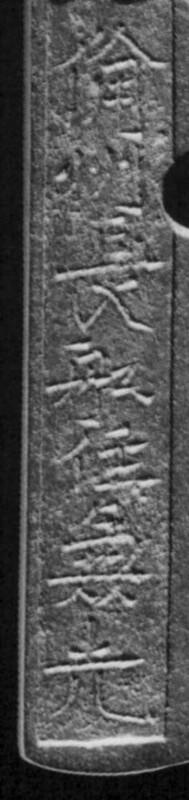
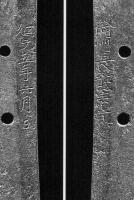
-
Jussi I remember seeing it. It is a massive blade. I was not overwhelmed, probably because there were some many other outstanding swords there and other KoBizen and Ichimonji, or it could have been the lighting in the NBTHK exhibition hall. But if you analyse it, it was only a matter of time for it to go TJ - incredible length (94cm!!!) ubu tachi - decent preservation (despite thinner monouchi hamon and barely-here boshi) - powerful and impactful utsuri - remnant of signature - great school - venerable old age The “weak Juyo”/JINO comments Darcy is making are about blades that just about scrape through (in terms of preservation, or length etc) and also of not necessarily the superlative schools. So, frankly blades like these are almost a definite for TJ. The only other important (here, missing) factor is daimyo provenance. Not saying that this was not a daimyo blade (in fact, most probably it was) but simply that background here is lost to time. If you have daimyo provenance I have noticed blades are almost certain to go TJ as well (well, it helps to have it but also the fact that it was ex-daimyo meant it had to meet very stringent quality and appreciation criteria in the first place, so that argument goes on both directions).