Gakusee
-
Posts
1,954 -
Joined
-
Last visited
-
Days Won
22
Content Type
Profiles
Forums
Events
Store
Downloads
Gallery
Everything posted by Gakusee
-
This is indeed in the wrong section as this section is usually associated with gunto and gendaito, and probably less frequented by the Koto guys. However, there have been readings by a lot of the other members. I suggest you mention where you live and the NMB establishes who lives nearest to you, where the local sword clubs are and where the next shinsa / sword show is. Best to inspect in hand. Before you do anything to it, I do suggest you speak with someone knowledgable who can inspect it in hand and probably “open an window” with T Tenold and B Benson (this means they look at it, assess it, perhaps polish a short section so that you can assess the jihada and hamon to really see if this looks/feels like old steel).
-
George, I would be interested in what the others have to say but so far, from the new photos: - do not overthink the grooves (bohi) as they might be added later (atobori) in the life of the blade; - you have added interesting photos of the top of the nakago into the blade (see how the steel narrows from the rusted part /tang into the semi polished blade surface?) which demonstrate the blade has been polished many times over its life - again usually an indicator of an older blade. Similarly where the notches should be for the start of the cutting edge (called hamachi for cutting edge and munemachi for the blunt back/top of blade) separating it from the badle portion (the tang) these are almost not visible as the polishers over time have abraded away steel to keep the blade polished; - also, importantly, look at the overall blade shape. The deepest curve is in the bottom one third (starting from the tang) which is called koshizori and is also often an indicator of old Bizen blades or Kamakura-period blades. The tip of the blade, well, is between a small tip (kokissaki) and medium tip (chukissaki) tending towards kokissaki perhaps. Again tends to indicate an older form. - almost forgot to add a very important observation: look at the the first 15 cm from the hamachi / blade start notches above the tang towards the pointed tip/kissaki if the blade. Notice the rapid narrowing of the width of the blade as it approaches the midsection but definitely before it reaches the midsection. That rapid narrowing is called funbari or fumbari and is also usually an indicator of Koto period swords - what you are showing as a defect seems to be fukure (blister) I think, which has opened through time/polishes but these can be repaired carefully by a qualified polisher. They can be plugged in, and if skilfully done, are barely visible. Of course, they detract from value but on a Koto blade that has been used and polished many times that is excusable. - in the full length shot of the blade with the meter I think I see one area of choji hamon (around hamachi and up 10-15cm) All the indicators are there of good age on the blade, even though the length is not too big for the time (you have misaligned the meter but I think the blade length / nagasa is around 67-68cm) but could have been made as a kodachi. But there are shorter blades made by the Ichimonji Munetada and the other Bizen / Aoe smiths. I strongly urge you to oil it several times and remove the oil with soft Kleenex paper and oil again and then several times. No touching with bare hands of the blade. Nothing done on the tang/nakago but that is the only area you could touch with bare hands I am no expert. Far from it: I am just a beginner in this life long path of fascination with Japanese swords and arms. But from my beginner’s eyes you have a sufficiently, interestingly old blade bearing the hallmarks of a Kamakura period sword with what seems like a well preserved, aged tang with a mei that strongly resembles the published references. If I were you, I would invest in a professional polish but before you do that - approach perhaps Ted Tenold and speak with him and ask for a window and his opinion. Please ask some of the more experienced people in your area as you might have something special.
-
Chris S I am not sure you are understanding me? No one is talking about expensive swords here. Please reread my post. It talks about the fact t that you cannot separate just the value of “the work” or the value of the “certificates”’( even though Omar was trying to ask how TH would change the value from Hozon or analogous progression under NTHK, say from 70 points to 78 points). That is why you cannot see any dollar amounts in my response, unlike all the other responders. Of course, then Omar decided to weave in a complication and interject that apart from the theoretical question which he was posing, actually, then he really wanted to know the potential value of an unknown shinshinto smith whose blade he was thinking of buying. Well, these are related but different theses, my dear interlocutor. We are either theoretical or very specific in the questions we ask. If he wants to know how much to put aside for the latter, there are plenty of replies above.
-
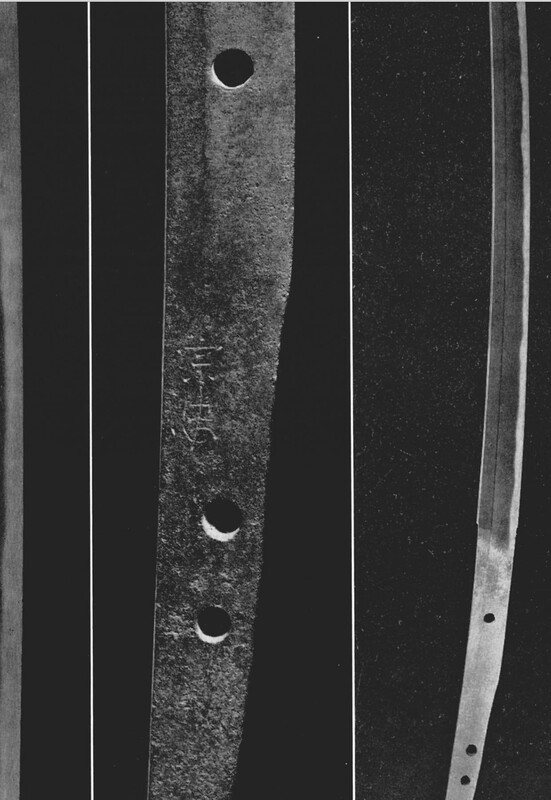
George A few things - good swords tend to be cared for and if you were to see a top sword preserved properly you would think it was made yesterday. Yours is out of polish and the details are not visible but I think worthwhile for a polisher to open an window or two. Can you strip the blade as attached and measure the distances between the notches as highlighted in the images of two Munetada swords below, one of which seems to have a somewhat similar “pheasant thigh” tang to yours? Is there a steep narrowing from the tang of the sword where the sharp edge stars towards the bottom quarter of the blade up towards the tip (something called funbari and sign of old Koto tachi)? Your photos need to be closer and with better light but again - due to polish we might struggle to discern forging style details. Below is a list of Munetada smiths (excluding Gendaito smiths) from the Index by Markus Sesko - you will see they do tend to be old guys: MUNETADA (宗忠), Jōryaku (承暦, 1077-1081), Yamashiro – “Munetada” (宗忠), according to tradition the son of Sanjō Munetoshi (宗利) MUNETADA (宗忠), Kenryaku (建暦, 1211-1213), Bizen – “Munetada” (宗忠), Ko-Ichimonji school, according to tradition the son of Muneyoshi (宗吉), only few works are extant by Munetada, we know a jūyō-bunkazai and two jūyō-bijutsuhin blades, the former is slender, has funbari, a deep sori, and a ko-kissaki, the kitae is itame with a hint of midare-utsuri, the hamon appears along the central blade section as regular ko-chōji, the monouchi area bases on suguha with ko-nie, the bōshiis sugu with a round kaeri, his blades have altogether a slender and elegant tachi-sugata and tend somewhat to nie, that means they show ko-nie and occasionally also kinsuji, jōjō-saku ◎ MUNETADA (宗忠), Tenpuku (天福, 1233-1234), Bizen – “Munetada” (宗忠), Fukuoka-Ichimonji school, according to tradition the son of Yorimune (依宗) MUNETADA (宗忠), Shōgen (正元, 1259-1260), Bizen – “Munetada” (宗忠), Fukuoka-Ichimonji school, according to tradition der student of Yoshiie (吉家) MUNETADA (宗忠), Einin (永仁, 1293-1299), Satsuma – “Naminohira Munetada” (波平宗忠), Naminohira school, hoso-suguha, ko-gunome MUNETADA (宗忠), Einin (永仁, 1293-1299), Yamato/Tango – “Munetada” (宗忠), “Miyatsu no Shō-jū Munetada” (宮津荘住宗忠), according to tradition the younger brother of a not further specified Masatsune (正恒), he moved later to Miyatsu (宮津) in Tango province, nickname Miyatsu-Nyūdō (宮津入道), masame in combination with a ko-midare with ashi, some sources date him also into the Kenmu era (建武, 1334-1338) MUNETADA (宗忠), Tenbun (天文, 1532-1555), Yamato – “Washū-jū Munetada” (和州住宗忠) MUNETADA (宗忠), Tokuji (徳治, 1306-1308), Bitchū – “Munetada” (宗忠), Aoe school


-
The problem is that you cannot isolate quality from the smith from the era from the blade. The are interconnected You could have two blades by the same smith with radically different values due to condition - one could be mumei osuruage with some ware due to use / polish and the other could be well preserved so prices could be different by a factor. Value could be contextual (eg toko Taikan ratings) or more absolute ( Fujishiro etc). Provenance, koshirae etc could all affect it. Have you read Darcy’s blog (yuhindo.com) from beginning to end? If not, do so and peruse the ladder theory chapter that talks about certificates and quality. A lot of your questions are addressed in that blog , admittedly with examples of high end blades and smiths but the logic applies more generically.
-
Well, George and others. I am very intrigued as the nakago and the smooth-looking edges of the mei/signature seem to indicate age and possibly even Koto era (George this would be 13c-14c) but again - with these pictures one cannot tell. Frankly, I do not think the polish is good enough at the moment to judge the finer details but an overview of the bare blade shape and closeups of the surface (jihada) and tip (boshi and kissaski) and also sideways lengthwise photos with tip pointing towards a single light source to show the forging and shadow (utsuri) would help. George - if this is a genuine Fukuoka Ichimonji Munetada (again, please do not raise hopes just yet but some of the indications are there), this will be a very valuable blade (several tens of thousands of US dollars) as that smith is rather rare. There are some very highly rated swords by him (Juyo Bujitsuhin and Juyo Bunkazai - these are ratings denoting historically important blades).
-
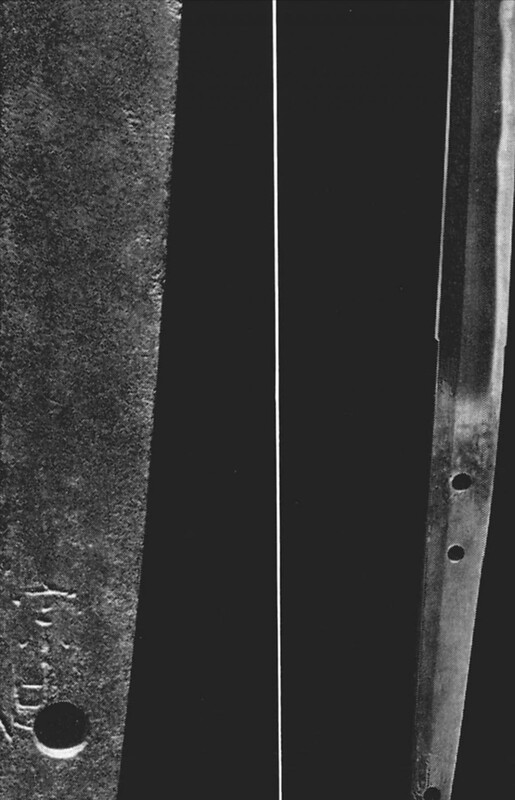
Dear George I do not want to raise hope or expectations, especially as we have seen only tiny snippets of the sword and not the entire bare blade (stripped of handle, metal collar, hand protector etc) and also close-ups of the pointed tip and the sides of the blade. I am deliberately avoiding more specialist language but can go into that as necessary. Now, there were various older/ancient Bizen smiths who signed Munetada. The shape of the tang is indeed an ancient shape and could either indicate a very old age or a later smith emulating old, historic shapes. The tang does seem to have some old age to it, evidenced by not really visible file marks on the tang and the patina but needs a close inspection in hand as an original tang on a sword is a great indicator of age. There were some of those Bizen smiths called Ichimonji and ko-Ichimonji. They had a hardened edge (hamon) which was narrow but quite active. Here I cannot see the hamon well to judge. Also, Ichimonji had an interesting feature like a shadow on the blade surface called utsuri. The older Bizen smiths had something called jifu utsuri (fingerprint like whitish spots above the hamon). I think I can see some of that but not sure if what I see is an artefact of lighting or just staining due to lack of good polish. However, on the balance of things - older looking tang, signature on that side of the tang (tachi mei), possibly older surface grain (jihada), I strongly recommend you have this looked at by someone experienced. It is not unusual for senior officers (such as your grandfather) to receive hereditary swords from similarly senior commanding Japanese officers (which generals’ swords sometimes were not machine produced but were in fact old). To go a bit further: below I attach images of very highly rated historic swords bearing the signature of Fukuoka Ichimonji Munetada. There are some similarities in the “tada” characters to your sword and also note how one of the images has the same shape tang as yours and in fact even one of the (probably original) retaining peg holes is in a similar position vis-a-vis the signature and the bend in the tang. There are some differences in the “mune” character, but I have noticed that even in the documented examples I have there are differences among them. All of this is making me even more curious to see the entire blade and look at closeups to check whether you indeed you might have a very valuable blade. Things to examine carefully are the signature chiselling (upturned edges or time-smoothed lines, patina in the signature grooves), the tang patina, the blade surface (jihada and shinogi-ji), the blade tip (kissaki) with its edge hardening (boshi), the presence of lack of that shadowy surface hardening (utsuri), etc.
- 190 replies
-
- 10
-

-
The golden days of the 1950s-1980s when people could “discover” JuTo level and thereabouts for $100 are gone. One nowadays should aim to go for the education, especially if there are lectures and hands-on study, and the social aspect. And also if looking for mid-level swords reasonably overpriced. It is a better bet to engage here as here there are some very good bargains.
-
People like Sa Yukihide, Kurihara Nobuhide, Koyama Munetsugu, Unju Korekazu crafted worthy blades in the 1860s. Darcy has done a lot for this community, generously sharing his knowledge here and in his blog. I encourage all newcomers having joined in the last two years to go through Darcy’s blog and articles here. He studies and writes with zeal and passion.
-
Funny message or not, it is a decent ko-dachi at a decent price.
-

Www.studyingjapaneseswords.com
Gakusee replied to yurie's topic in General Nihonto Related Discussion
Dear Yurie, I have just read part 2 of 12.5 - it is excellent and very insightful. Thank you for all the information you have given us. Please keep this up. -
I actually agree with Jean and think that there are great works among the leading Oei Bizen smiths. Of course, it becomes a bit murky when you compare them with a generation before like Chogi and Kencho and Tomomitsu - these are guys who created outstanding works. I do not think the Oei guys have kokuho (unlike the Soden ones) but they definitely have JuBu works. Quote from Honma sensei: “There are the terms ‘Ōei-Bizen’ and ‘Sue-Bizen’. The former is a favourable naming and the latter is somehow a derogatory one. ”
-
Who Cares About Kanteisho Level?
Gakusee replied to Jean's topic in Auctions and Online Sales or Sellers
Yes, I also checked it out. Very atypical for Awataguchi and completely the opposite of a Norikuni I have seen in hand. This one is flamboyant with some obvious hada versus the textbook tight hada and tight suguha. Even the better preserved omote here shows ohada. So I am curious what Paul will say as he is very focused on that school. It is a real pity that the ura side it has been so savagely shaved down but the rarity of a Norikuni signature cannot be overstated. Plus the nie is great, remarkable. I also think it will pass Juyo even if one only allowed for the rarity of the signature. -
Well articulated, Chris. Appreciation often comes with time and study. What I liked ten years ago has unfortunately given way to other tastes and preferences - we evolve. However, understanding contextual ratings is very important. It becomes particularly relevant when one tries to assess not necessarily the topmost schools and smiths by let us say average smiths. With those average guys we know they are not supreme, so we need to compare them to what was around them at the time. That also gives a useful perspective when estimating which swords can go Juyo or not. While H and TH are more lists to be ticked, Juyo is more contextual. I think certain nations and cultures indeed become more focused on benchmarks of excellence, paradigms, criteria. Indeed, Japan seems one of those, where things are measured and put in neat categories. It helps them organise their thinking and life and that applies to Japanese swords and smiths too. Regarding the Tokuno ratings, they are useful but are indeed one of the benchmarks, alongside Fujishiro ratings, cutting sharpness ratings, NBTHK or bunkacho ratings etc. It is also interesting to check how the ratings have changed between the two editions of Tokuno’s writings. He changed some of the top smiths ratings - eg Masamune was upped to a level where is above everyone else while before he was in the top tier but there were others above him. I think Tokuno in the 1970s and 1980s succumbed to the Soshu and Masamune obsession and elevated Masamune to the very top. I do not agree with some of the changes in the second edition of the Tokuno rankings where Masamune was elevated at 3800 points (only one at that level) and the next one is 3500 where you have Rai Kunitoshi (was 2000 before), Mitsutada (was 3000 before), Tomonari ( in the first edition was the only one at the very top with 3500) and Kunitsuna (2500 before) and then others at 3000 and below. Anyway, one just needs to take their own view.
-
Responding to a few comments further up from Ray and others. Actually there are a number of similarities between the illustrated kaziuuchimono per the Aoi Art examples and this sword in question. I am particularly focused on the not well defined nioiguchi line here - it does not seem well controlled and in places the line is not consistent. The nie and nioi do not seem well controlled. It seems to have better hada than the typical/ Aoi kazuuchimono and in general better than most but I would not go as far as saying “excellent” sword.
-
Chris I think it is impossible to disassociate the smith (and the quality, reputation etc embedded therein) from the mere presence of the mei. So, while indeed your categories 2 and 3 above are at least to me the most important reason for the preference for a mei, it is difficult to say that an Yamato mei will be more valuable than a Norishige mei (or even mumei Norishige ). Perhaps the presence of a Yamato mei might be much more significant to determine the exact manufacture but in relative value terms that is not true. But I am almost sure you were talking about the presence of the mei per se. And therein lies the relative weakness of most Yamato works. They are fungible ( per the same textbook you have been reading )
-
Www.studyingjapaneseswords.com
Gakusee replied to yurie's topic in General Nihonto Related Discussion
Dear Yurie san As others have said - please keep writing and teaching. It is great to have your blog. Thank you. And your family/father seem to have some amazing swords. Are they kept in Japan in a museum? Best wishes. -
If only on one side, as Ray says, then probably kitaeware.
-
Is it on both sides of the sword? Hagire is mostly perpendicular but could be at an angle as it is a crack in the hamon.
-
The main difference being that Rai is not an improvement on Sanji, Gojo, Awataguchi, while Ichimonji is an improvement on ko-Ichimonji. But again, the comparison is not appropriate as you have Fukuoka Ichi, Yoshioka Ichi, Kamakura Ichi, Katayama Ichi, etc etc, with differing degrees of nie / nioi forging and different degrees of flamboyance. Some Katayama Ichimonji are confused for Aoe, some of the Kamakura Ichi have a lot of nie. So, I am afraid the Bizen school has something for everyone - those who are obsessed with nie and hada and those who like flamboyant hamon. You just need to pick the school and period.
-
B&m Exhibition Munich
Gakusee replied to uwe's topic in Sword Shows, Events, Community News and Legislation Issues
I thought Uwe’s comment was tongue-in-cheek and jocular in nature? For an amateur like me, the photos in Uwe’s website actually show a great exhibition -
As always it boils down to personal preferences. Maybe Chris is not a Rai person? Some of the criticisms for Rai were about thin skin and superficial beauty, which you do not have with Bizen. There is no sumihada and unsightly patches that sometimes can be seen in Rai or Hizen. The argument about mass production - well, successful schools had to deal with demand. The Osafune school was so successful that indeed they had a great number of master smiths signing on behalf of Nagamitsu probably (it is a less documented process but is mentioned in some of the books). What is less glamorous and definitely less good is the mass “Sukesada” production (excepting Yosozaemon and one other) and mass Mino production. But these two later offshoots had to satisfy the constant war driven demand for blades and did not have time for perfection.
-
Mekugi-Ana Chiseled Vs. Other
Gakusee replied to Blazeaglory's topic in General Nihonto Related Discussion
Ken, thanks and that is very informative, but you are actually supporting my point about regulation-induced shortening?! The broader point I was trying to make and clearly failed was that a given blade could have been shortened for regulatory reason but also due to damage. We cannot know why and how a specific blade was shortened. Some were cut because of the stature of the owner (Oda Nobunaga), others due to damage (occasionally visible in habaki or nakago area - see Darcy B’s TJ Hasebe) and yet others - due to regulations and possibly some - for a combination of these reasons. -
Ok, let me explain about Bizen as that is getting me: - Bizen smiths could and did forge in nie- please refer to Ko-Bizen and Ko-Ichimonji, where nie is very, very clear - Gotoba and others (post Ko Ichimonji) seem to have liked the finesse of nioi and konie, hence Fukuoka Ichimonji responded to market demand and their patron, the emperor - the Ichimonji smiths therefore started to forge more in nioi, though nie is present as konie in the hamon, jigane (including small chikei) and sunagashi. Often Ichimonji descriptions in the Juyo zufu nado refer to konie ( please read through the Juyo description of my Ichimonji below as an example) - to compensate for the “softer” jigane, which also helped relieve Hamon stresses (choji in the Hamon introduced some torsional tensions), the Ichimonji smiths hardened the jigane with utsuri. So, you see the intricacy and technical innovation - complex hamon to please visually (and scare oppponents per some texts) but softer jigane to compensate for hamon and then utsuri to harden the jigane. - going beyond Ichimonji, we move to Osafune, where all of the smiths could and did render some konie and then we eventually reach the 4 generation, where Kenemitsu, Chogi Nagayoshi, Kencho Kanenaga, Chikakage all produced Soden Bizen with plenty of nie. So, Bizen smiths were virtuosos as were the Soshu guys. Yamashiro elegance is something else but in technical innovation the Soshu and Bizen smiths ruled. Extract: “ The two major currents of Kamakura era Bizen were the Ichimonji and the Osafune Schools with the former distributing until the Nanbokuchô era successfully into the Fukuoka, Yoshioka, Iwato and other local branches which all gave rise to many outstanding smiths. The name of the school goes back to the habit of some of its smiths signing their blades just with the character (monji) for “one” (ichi). However, some Ichimonji smiths also signed with a name under the character Ichi, or just their name and without the character Ichi. The Yoshioka-Ichimonji School took the place of the earlier Fukuoka-Ichimonji School and prospered from the end of the Kamakura until the Nanbokuchô period. Representative Yoshioka-Ichimonji smiths were for example Sukemitsu (助光), Sukeyoshi (助吉), Sukeshige (助茂), and Sukeyoshi (助義), i.e. the smiths of this school shared the character for Suke (助). As for the workmanship of the school, we hardly find the large dimensioned midare that was applied by the earlier Fukuoka-Ichimonji School but usually a rather small dimensioned midare which shows a noticeable amount of gunome. This blade shows an overall dense itame that is mixed with mokume and that features ji-nie, a fine chikei, and a midare-utsuri. The hamon is a chôji that is mixed with gunome, togariba, plenty of ashi and yô, small tobiyaki, kinsuji, and sunagashi. The hardening is in nioi-deki with ko-nie and the nioiguchi is bright and clear. Thus the jiba shows very well the characteristic features of the Yoshioka-Ichimonji School and we therefore agree with the inscription. The blade is of a superb deki, having an excellently forged kitae and a yakiba with a clear and bright nioiguchi, and is in addition of an outstanding condition. “
-
I would like to avoid tilting the argument towards differences in taste. Of course, personal predilections do however colour and inform one’s views. So, I would go with the statement that (on average, excluding some exceptional blades) Yamato is often overrated as are Hizen blades. The former were created as utilitarian blades and that is how they ought to be viewed. But so were others - with the difference that apart from serving the main purpose (cut) they were also beautiful (an added bonus - eg look at Soshu or Bizen). One often hears how Yamato blades are rare - it is for a reason. They were used, abused, destroyed and mostly not treasured. They were not treasured because probably aesthetically they were not great or one emperor (or another) or shoguns did not like them. But those lieges knew better than us what was good functionally and visually. The latter - well, replicas of the past (Yamashiro) and also suffer from some of the Rai criticisms above. In general, I would not have picked on the Rai school to find fault with. Interesting approach, Chris. I have mostly seen beautiful Rai work. Were they commercially minded? Absolutely. But they were shrewd and also had to deal with the diminishing resources they had.