Gakusee
-
Posts
1,929 -
Joined
-
Last visited
-
Days Won
22
Content Type
Profiles
Forums
Events
Store
Downloads
Gallery
Everything posted by Gakusee
-
Balanced view. Positive: - very good sword by one of the top masters of the Omiya school,who has many Juyo swords and even JuBi and JuBu - typical Nanbokucho kissaki and wide and masculine - very good sunagashi and kinsuji - top togishi polished it - comes with TH koshirae which is not overly flashy, not easy for koshirae to get TH Negative; - a bit short (the Juyo Morikage tend to be over 68cm or zaimei if shorter)- this was shortened by 12-20cm - “only” Omiya: the school is considered second tier (but they attributed it to a top master in that school, so thought highly enough of it) - already priced as a Juyo sword. You could buy some decent Juyo for less than that For the advanced student: - the TH blade paper is recent. This could be a positive in that it might not have been tried many times for Juyo - but could also mean the blade went out of and came back in the country and was papered from scratch to obtain a different judgement, eg some more highly rated Soden smith or something - to evaluate that one needs to look at the torokusho number - Omiya is a safe bet here - it is a very good blade but probably just not at that level to be a Chogi or Kencho or whatever. I also like it but doubt it will go Juyo (could be marginal due to suriage) and would negotiate hard to get a better deal on the price.
-
The issue is they are extremely difficult to get. It took me 5 years to find my copy
-
Well I am debating whether to sell mine
-
Simpler to buy Ise no Toko for $200 outright.
-
Paul, so no one is implying that one needs a signature in order to have a beautiful or valuable sword. In fact, most such swords are without signatures. What a signature is to me is like a crown jewel on an already beautiful crown - it makes it that little bit more special and valuable, as on top of being beautiful, it has more of its history and authentic condition left in the mei. The reality is that a mei on a proven old blade will increase its value, ceteris paribus. As I, similarly to you, am focused mostly on Kamakura and to a much lesser degree- Nanbokucho, I recognise the enormity of the task ahead. So, the way I approach it is: school > smith > quality and visual characteristics I yearn for (in that step, I assess the presence of mei as well) > provenance > whether it comes in a package or not (koshirae) > paper. I suppose the difference in my approach is that I tend to ascribe a greater value to the swordsmith. And when the workmanship of, say, late Mitsutada and early Nagamitsu is very similar or late Nagamitsu and early Kagemitsu being similar, and then some Kagemasa being very close to later Kagemitsu, or best Kencho being attributed to Chogi, etc, having a mei resolves the uncertainty if one is pursuing a smith. This of course is much more applicable to Bizen, where mei are more present than other schools in Koto. Kirill: I have noticed that the NBTHK have started giving attributions to previously “unutilised” smiths - I suppose they have realised there are so many Nagamitsu or Rai Kunimitsu that it must be other smiths in the schools who have forged those. So, your approach of having one of a kind blade is very interesting and actually this could lead to a lot of value, especially if the blade has the hallmarks of the school that the putative mei in the tang supports. After all, the workmanship + quality should verify the mei. So, an only mei or one of a very few mei could soon start to get recognised and papered properly. Also, the current level of understanding is that the previous tiering of first generation-second generation was overdone. A lot of what we see with the Kamakura smiths is now believed to be earlier work and earlier mei of the smith actually transitioning to later work and later mei by the same smith (change of fashions, forging approach etc). However, I disagree with Kiril that papering is a trouble not worth taking for Koto/Juyo (not explicitly said but implied). In fact, this is the one of most interesting pursuits - finding a great blade and papering it through the ranks. For me that “hunt” matters - it is the excitement but also the verification of one’s discovery, knowledge, learning more about a blade, etc. This is however not slavish pursuit of higher papers. A blade could be at Hozon only and still be an incredibly precious and important and beautiful blade. Now, I am aware that some owners prefer to have “secret” blades - unpapered, not on official registers but with Honami papers or daimyo provenance etc. These are usually highly experienced people, who know more than me and can assess such unverified blades better. I suppose I still prefer to get to at least Hozon. It is subjective when artistry reached (or has it reached?) its peak. For me, that is 980- 1330 but then, there are some great blades in 1650-1850. Also, one cannot exclude the wilder Nanbokucho period. Personally, my favourite period is 1200-1280, when Gotoba conducted an orchestra of virtuosos and then they each flourished in their schools and gave birth to exciting trends across Yamashiro, Bizen and later - Soshu.
-
I think the low to mid-end has dropped in value. At upper end (Juyo and above) there is a massive differentiation. You have “lower-end” Juyo (2.5m-3m yen), where one can look for good value but one needs to know what to look for. At upper level of Juyo, for top smiths, values have gone up. You could have a Juyo sword selling at 15-25m yen for the topmost maker (eg Tomonari, Sadamune etc) and a JuBi at half that value (Naminohara). So it is very much dependent on Smith+School+Quality (sometimes also provenance) as opposed to level of paper. I would love to lay my hands on a Hozon Masatsune or Hozon Masamune, not caring for a higher-level paper:).
-
Jussi, great initiative to start a thread like that. Also kudos for more profound posts together with Kirill and Paul. Firstly, I think swords attributed to only “Shintogo” mean swords attributed to Shintogo Kunimitsu rather than some “shintogo school”. It is a bit like a Shizu attribution being essentially shorthand for Shizu Kaneuji and the students being lumped either in Yamato Shizu or Naoe Shizu. Also, the few mumei Shintogo swords which are not just Shintogo tend to specify Shintogo Kunihiro. So if they thought it was someone else apart from Shintogo Kunimitsu they would have attributed it to Shintogo Kunihiro. Jitsua, Sairen etc require a special degree of appreciation. A bit of acquired taste with their overly prominent hada and what some perceive as not very refined lamination. But they are rare and if signed, even if aesthetically you have better swords such as Awataguchi or Rai, they are then precious as you overlay rarity on top of rarity, so rare squared. Now, onto signatures. I am also obsessed with mei. For me this is particularly important as I am very focused on collecting Bizento. Mei are rare in Soshu as they were the “working horse” of their time - used, abused, destroyed and shortened. Plus the predilection of shogun for Soshu swords in the Muromachi and later eras, meant Soshu swords were shortened to be passed off for Masamune, Go etc, and there was Honami inflation of these attributions too. So if you get a top Soshu sword and it is signed, it is a right treasure, obviously. For old blades, eg Kamakura, top smith + ubu mei is very rare. So, people should also carefully consider gakumei and orikaeshi mei. In fact, for a sword with gakumei to be considered shoshin, it must be so stereotypical and convincing that it actually means it must be a great example of that smith. I would dare say it might even sometimes be a better sword than a zaimei shoshin sword where the smith experimented, deviated from the canon or displayed one of the less usual styles of his. But one way or another the presence of mei, especially for Kamakura and earlier, is very special.
-
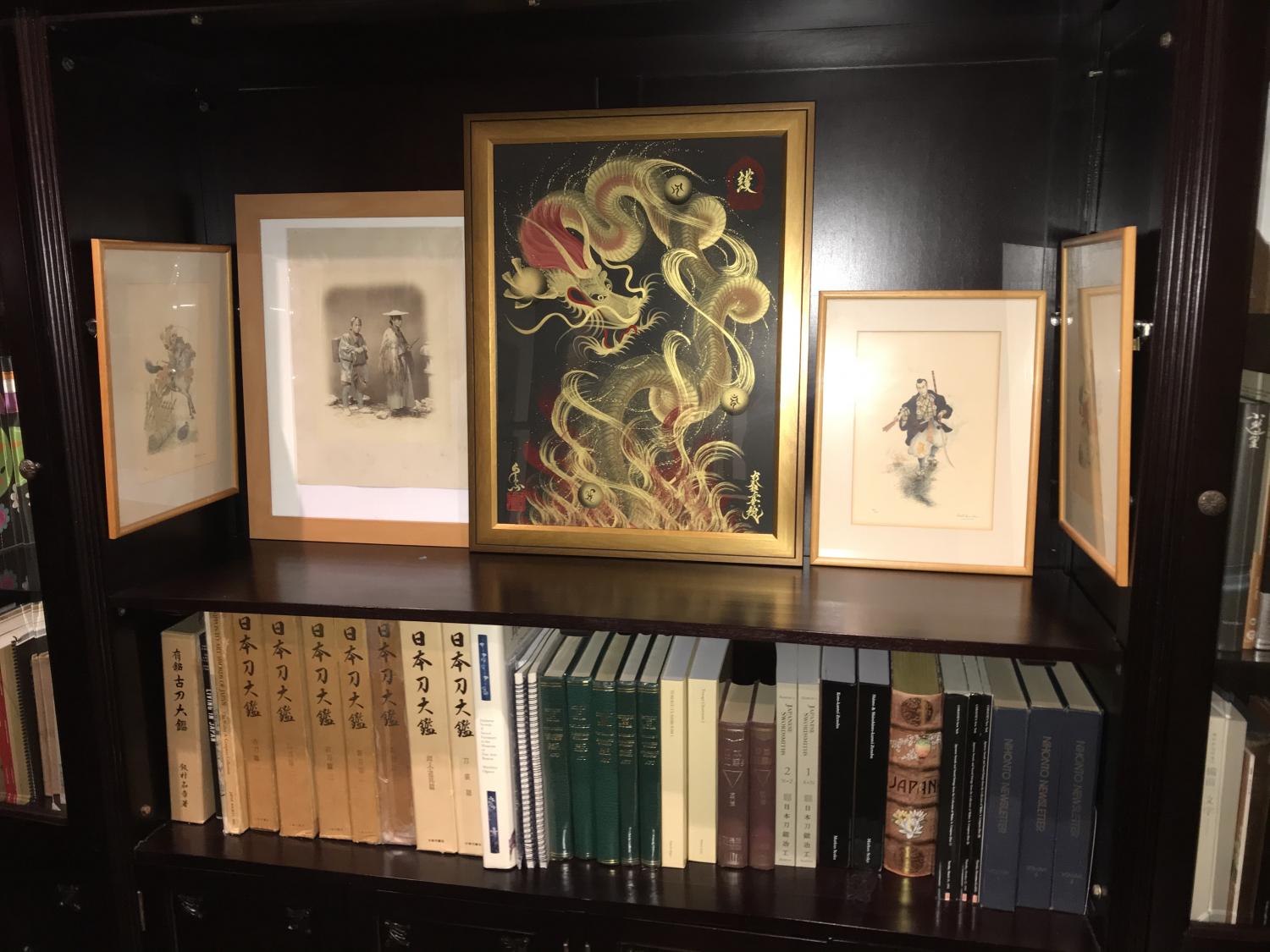
Ben, I like them a lot but with shipping and import duties the price doubled for me. I think I shall stay with one protector dragon.
-
To me it looks a bit like some Gassan blade
-
Both sets look very well, Piers!
-

Collecting History R.b.caldwell
Gakusee replied to BIG's topic in General Nihonto Related Discussion
Thanks, Peter. I did go through this indeed but it was mostly calligraphy and the swords were not explained or documented properly. Oh, well, thanks anyway -
A very good one Rivkin. Thanks for sharing with us. Interesting features.
-
Collecting History R.b.caldwell
Gakusee replied to BIG's topic in General Nihonto Related Discussion
Apologies for resuscitating a 2-year old thread. So, clearly some is known about his fittings as they were described in books and auction catalogues, which Pete has kindly listed up. What about his 50 or so blades? The newspaper article above mentions that his collection was second only to Walter Compton’s, so it must have been formidable..... My interest was recently piqued as I came across an extremely rare Ko-Aoe Juyo blade which had been owned by him in the past.... -
Thanks! Much bigger than I thought so had to move things around. But very speedy service and the quality is really high.
-
The protective fire dragon has landed. The paint on the back is still fresh and not fully dry!

-
Does not look like Masamune.
-
Well tight hada with konie and Yamato characteristics could potentially be Taema too. Sometimes gets confused with quieter Soshu
-
Yes, it is true the NTHK gives more detail. They give you the worksheets which have commentary and mention key characteristics around hada, sugata etc. But I am really curious about Yushu blades.
-
Well, Kirill, my point about Yushu and higher NTHK levels was their extreme rarity. I ascribe this to the fact that really superb or old/precious blades automatically go to the NBTHK as a medium for papering instead of being submitted to the NTHK. Now, why would that be? Could it be that people impute a relatively higher weight to the NBTHK paper marketability or perceived reputation, or that indeed the NTHK puts such preponderance on condition (including signature) that they under appreciate the older treasures? Kirill mentioned that even Juyo received middling 70s scores when in fact Juyo is supposed to be Yushu level blades. So there is clearly a disconnect in standards there (abstracting ourselves from the pure opinion-related differences in attribution, which often arise too for those who decide to paper a given blade by both organisations). The Koto fanatic blog was indeed enjoyable. He kept going until 2018 when he ran out of steam. People lose interest educating others or become busy with other things. Understandable. Soshu is indeed a lake of treacherous waters that one needs to tread very carefully. I agree there were a lot of inflated attributions by pressured Honami and the scarcity of signed blades causes people to be sceptical. But there are enough historically passed down Soshu blades (that were shortened and Honami documented that) which knowledgeable people can extrapolate from. Unfortunately most are not accessible to us. I beg to differ a bit on Enju vs Rai as there are many Rai with underwhelming hada or qualities (mostly second tier like Kunizane or similar) that probably could be confused for Enju. Overall Enju is a bit inferior, that is true, with its hada not quite the nie-sprinkled tight koitame perfection of a top-condition Kunimitsu (for reference, Dr Sawaguchi has one of his Juyo currently exhibited in the last Juyo shinsa exhibition - to me that is the Rai benchmark and was much better that any of the other Yamashiro Juyo exhibited including the Awataguchi). The point about colour is a highly contentious one and one cannot speak about colour differences unless the two blades being compared are next to each other. This jigane being dark or that hada being darker can only be stated if the blades are in the same location with same lighting.
-
A broader question/request.... I have seen and handled numerous Juyo and above blades but have not seen in person any Yushu, or let alone Sai Yushu blades. I have heard from more knowledgeable people that NBTHK rewards more highly historical importance and significant smith craftsmanship while the NTHK recognises more highly the condition and state of preservation, alongside quality too. Does the community here have NTHK Yushu + blades and what are they / what is the commentary / what score? Appreciate this is invasive and intrusive, and therefore people might not feel like sharing. Thank you
-
Juyo Biyutsu Den Mihara Masahiro
Gakusee replied to Fuuten's topic in Auctions and Online Sales or Sellers
-
Juyo Biyutsu Den Mihara Masahiro
Gakusee replied to Fuuten's topic in Auctions and Online Sales or Sellers
Yes, Brian, apologies if we overstepped. Indeed, it is best to discuss sold items. Actually, my view on the above item was positive but I don’t want to do other people’s marketing here. Please feel free to delete and also erase the opportunity to learn and engage in an intellectual debate. -
Paul has described the rules and the concepts very well. I wonder why we keep asking the same questions. Traditionally made, with a large proportion of tamahagane (I think it needs to be at least 75 per cent but this needs double checking in Japanese language in the Japanese sources - for instance the NBTHK webpage touken.or.jp), functional etc.
-
Juyo Biyutsu Den Mihara Masahiro
Gakusee replied to Fuuten's topic in Auctions and Online Sales or Sellers
So, Fuuten: I was hoping when you posted that you could comment on the quality or lack thereof, characteristics of the blade, agreeing / disagreeing with the judgement ) trying to stimulate a deeper discussion here is getting more and more difficult, I have regretfully noticed. So, to give an example: this is a top quality Mihara, with fine jigane. That is probably the reason that was attributed to Masahiro, who together with Masaie is the top of the Ko-Mihara crop. Of course, very few mumei blades have been attributed directly to Masahiro, but there are plenty of zaimei Masahiro in order to know what his workmanship is like. The koshirae is poor in comparison and it might not have been packaged with the original blade. -
Well, the truth of the matter is that some Yukimitsu and Masamune are fungible as Yukimitsu was a very top smith. There have been blades which flipped between Masamune and Yukimitsu as they progressed through the ranks. That is understandable as they both studied under the same teacher and followed the same techniques and experimentation (Awataguchi hybridised with Ichimonji). Also perhaps some of the Masamune are top level Shizu Kaneuji. So, if we stick to the above three conditions you mention, perhaps one can relax the unique features/style point. Top level works are just incredible in the clarity of their jiba or the elegance of nie and the fineness of hada. Just that some stylistic expressions might yield as a best answer either Masamune or Yukimitsu or Masamune and Shizu or Sadamune vs Masamune etc. Also, some Masamune, while clearly very good, leave you scratching your head and wondering..:.either he had an off day or the blade must be tired from polishing and lost half of its glory. But many other Kamakura smiths’ blades could also exhibit such sub-par or tired condition, even when signed. So, overall there, I concur with the proviso that attribution is first and foremost an appraisal of quality (eg, top early Soshu vs late/mediocre work or top Yamato versus so-so Mihara) and secondly a conjecture to the most likely / most convincing smith. On the point of Muramasa, the gunome hamon you mention is not really pure gunome that goes all the way consistently. It usually is some gunome in some sections which then transitions into notare or togari. While the Muramasa (shodai) has some of his lineage in Mino, his works were richer than the [language warning!!] boring pure gunome. Now, they are not some amazing pieces of outstanding art but they could cut well, due to his marginally higher-than-usual carbon content. I delved a lot into Muramasa in my earlier days, even getting Sato’s Muramasa book and various Muramasa exhibition catalogues, my observations are based on several hundred oshigata or photos observed. Have to say, though, that in his yari (I had a Nidai one), his style relaxed and was less stereotypical mirror image and formulaic gunome-togari mix. Please note that above I have converged the Shodai/Nidai discussion into one and have ignored Sandai/Kodai discussion.