Nobody
-
Posts
4,169 -
Joined
-
Last visited
-
Days Won
70
Content Type
Profiles
Forums
Events
Store
Downloads
Gallery
Everything posted by Nobody
-
The mei looks more like Tomoyuki (å‹ä¹‹) to me.
-
BTW, the Kyoka (a comic tanka) was composed by Shokusanjin (蜀山人). And the name appears in the second picture. Ref. http://en.wikipedia.org/wiki/%C5%8Cta_Nampo Morita-san, you are amazing.
-
Hi, These are all I know for now. Mei: ä¸é‡Žå…¼è²«ä½œ (Nakano Kanetsura saku) – WWII smith in Seki Ref. http://home.earthlink.net/~ttstein/seki.htm Tag: address and name å·è¶Šå¸‚å®®ä¸‹ç”ºäº”äº”ä¹ (Kawagoe-shi, Miyasita-cho, 559) – the number could be wrong? 伊藤米次郎 (Ito Komejiro (or Yonejiro?)) BTW, there is a rice-cleaning company in Kawagoe-shi, which was established by Ito Komejiro 1st. But that might be only a coincidence. http://www1.ocn.ne.jp/~film/itoh_seibu.html
-
It is not a paper issued by NBTHK. It is a paper of Bijutsu Nihonto Hozon Shinsakai (美術日本刀ä¿å˜å¯©æŸ»ä¼š). I do not know its reliability.
-
Maybe, he wanted to say that if the sword was once identified as worth national treasure, it could not be send back from Japan.
-
Bizen Yokoyama Sukeyoshi (?) on eBay
Nobody replied to Marius's topic in Auctions and Online Sales or Sellers
Both Sukekane (ç¥åŒ…) and Sukeyoshi (ç¥ç¾©) added “Tomonari 58th generation†to their signatures. Ref.: p. 294, The Connoisseur’s Book of Japanese Swords Though I do not say that the mei is genuine, the inscription is not strange. -
The description about Ryusei-To appears only on pp. 1-2 of the document, and there is no technical feature on the swords except the composition of the meteorite.
-
This should be interesting...
Nobody replied to Leatherdog's topic in General Nihonto Related Discussion
Yaki-modoshi (at the bottom of the following page) - tempering http://www.eonet.ne.jp/~sumihira/00home/home.html I am sorry. The last two links were not correct. The correct links are as follows; Yaki-namashi (at the bottom of the following page) - annealing http://www.eonet.ne.jp/~sumihira/04kaji ... ukuri.html Yaki-modoshi (at the bottom of the following page) - tempering http://www.eonet.ne.jp/~sumihira/04kaji ... kiire.html -
This should be interesting...
Nobody replied to Leatherdog's topic in General Nihonto Related Discussion
This sword smith correctly describes Yaki-namashi and Yaki-modoshi in his sword making procedures. Ref. Manabe Sumihira Tosho (真é‹ç´”å¹³ åˆ€åŒ ) http://www.eonet.ne.jp/~sumihira/00home/home.html Yaki-namashi (at the bottom of the following page) - annealing http://www.eonet.ne.jp/~sumihira/00home/home.html Yaki-modoshi (at the bottom of the following page) - tempering http://www.eonet.ne.jp/~sumihira/00home/home.html -
This should be interesting...
Nobody replied to Leatherdog's topic in General Nihonto Related Discussion
Paul, The resson of the improper use of the terms may be simple. I think that they simply misuse the terms, because they just do not know correct terminology. And that has nothing to do with swordmaking world. There are many people who do not know the difference between yaki-modoshi and yaki-namashi. -
This should be interesting...
Nobody replied to Leatherdog's topic in General Nihonto Related Discussion
Paul, I also hate to be argumentative. However, I suspect that they do not have correct knowledge about legitimate technical terms which have been defined and used in engineering. Some examples; http://is.jisw.com/01130/post_64.html http://blog.sina.com.tw/tool/article.ph ... yid=393891 -
This should be interesting...
Nobody replied to Leatherdog's topic in General Nihonto Related Discussion
Not exactly. Yaki-modoshi is a legitimate technical term. It means tempering as Alan says. FYI; Quenching – yaki-ire (焼入れ) Tempering – yaki-modoshi (焼戻ã—) Annealing – yaki-namashi (焼éˆã—) Normalizing – yaki-narashi (焼準ã—) -
Ryusei-To (æµæ˜Ÿåˆ€): Swords made from meteorite (but Gendai-To) viewtopic.php?f=1&t=505&p=6290&hilit=ryusei#p6290
-
This Week's Edo Period Corner
Nobody replied to Bugyotsuji's topic in General Nihonto Related Discussion
This video shows a mechanical doll of Edo period, though it may be a replica. http://jp.youtube.com/watch?v=-JV--AwLxiE -
This Week's Edo Period Corner
Nobody replied to Bugyotsuji's topic in General Nihonto Related Discussion
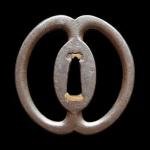
Today’s wild guess; :D knockdown handles for a Chochin (æç¯) -
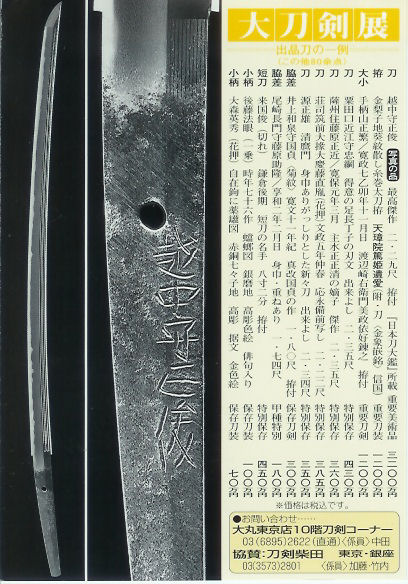
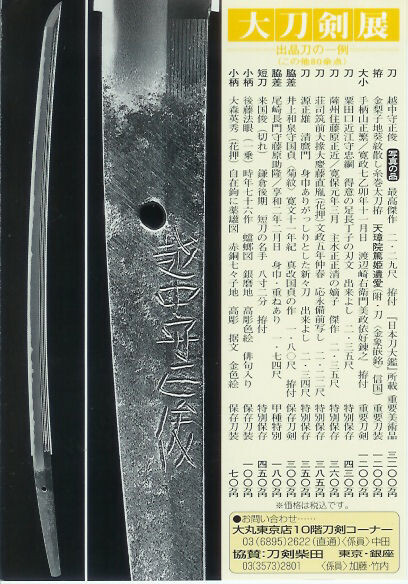
Token Shibata (刀剣柴田) summer sale; Jul. 9th (Wed) - Jul. 15th (Tue) at Daimaru Dept. Store Tokyo 10F (大丸æ±äº¬åº—10階美術画廊)
-
This should be interesting...
Nobody replied to Leatherdog's topic in General Nihonto Related Discussion
The Mei reads Jitsua (實阿). If it is genuine, it was made in around 1300 in Chikuzen. However, it is said that there are many gimei swords with that name. The attached picture shows a Tachi of true Jitsua of Atsuta Shrine. That is made in 1333. Ref. http://www.atsutajingu.or.jp/event/tenji.htm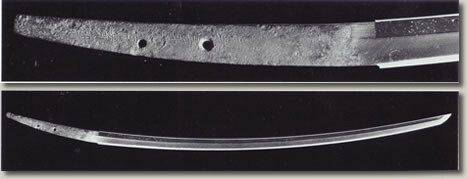
-
Kanefusa; http://home.earthlink.net/~ttstein/kanefusa.jpg
-
Finally....a truly functional tsuba
Nobody replied to Ford Hallam's topic in Auctions and Online Sales or Sellers
You can buy it at this shop when you are in Tokyo. http://www.tnm.jp/en/guide/museumShop/index.html -
FYI; viewtopic.php?f=1&t=36&hilit=Gendaido+vs+Shinsakuto
-
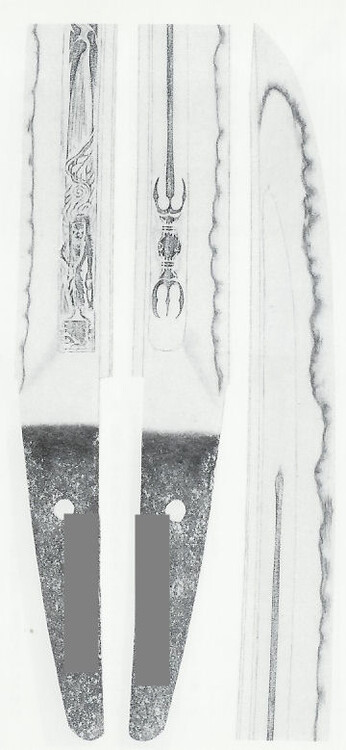
What do you think about this attached wakizashi? I think that it resembles the blade of Aoi in its shape and Horimono style.
-
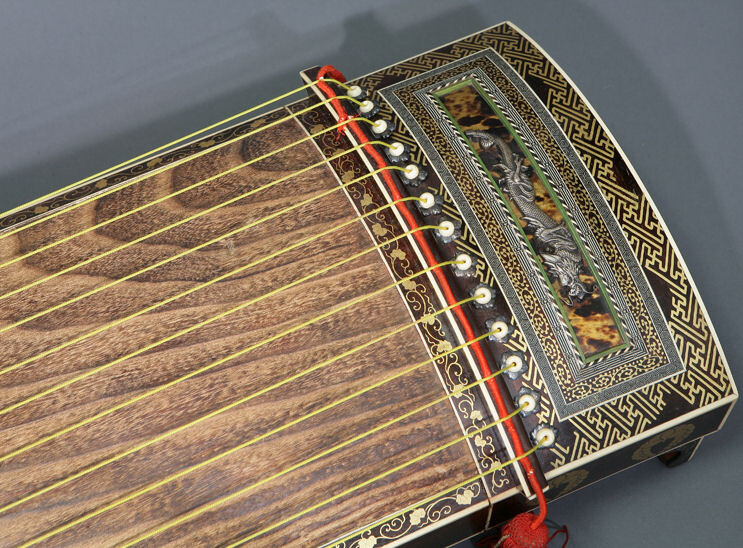
This Koto (ç´) with Sayagata is now on sale at Aoi-art, though it does not seem to be seen on English pages. http://www.aoi-art.com/antique/etc/F08304j.html http://www.aoi-art.com/antique/etc/image/F08304-2.jpg
-
The blade is already reserved. Is it by you?
-
There is a Japanese proverb. Saru mo ki kara ochiru (猿も木ã‹ã‚‰è½ã¡ã‚‹). "Even monkeys fall from trees", i.e. "Even experts sometimes make mistakes". I found three examples. In each case, 国次 (Kunitsugu) is wrongly identified as 兼次 (Kanetsugu) by experts (maybe). Incidentally, there was a post which includes this Kunitsugu’s Mei on another board, and Morita-san correctly read the Mei. I also misread the Mei as Kanetsugu at first, though I am not an expert. :lol: http://forums.swordforum.com/showthread.php?t=90092 BTW, the correct reading is "Noshu Seki ju Murayama Kunitsugu (濃州関ä½æ‘山国次)". 1. Token Hataya Murayama Kunitsugu (æ‘山国次) is wrongly identified as Murakami Kanetsugu (æ‘上兼次) http://www.toukenhataya.jp/goods/sword/sword_s247.html 2. Token Shozando Murayama Kunitsugu (æ‘山国次) is wrongly identified as Murayama Kanetsugu (æ‘山兼次) http://www.shouzando.com/katana.htm#k-murayamakanetugu http://www.shouzando.com/k-murayamakanetugu1.htm 3. Even a Torokusho (registration card) includes misreading. (a picture attached) Murayama Kunitsugu (æ‘山国次) is wrongly identified as Murayama Kanetsugu (æ‘山兼次) http://auction.woman.excite.co.jp/item/105189889 http://photos.yahoo.co.jp/ph/higodouta/ ... %26.view=t

-
Hi, If you are thinking of the sword with the paper attached, they are referring to the following Masakiyo and Motonaga. They do not say that the sword was shortened some 300 years ago. They say that the sword was more than 300 years old when it was shortened by Motonaga. Masakiyo (æ£æ¸…) – thought to be Kagashiro Masakiyo (åŠ è³€å››éƒŽæ£æ¸…): Ca. Bunmei era (文明: 1469-1487) Province: Izumi (和泉) Sue Koto Josaku (末å¤åˆ€ä¸Šä½œ) Aoki Taira Motonaga (é’木平元長): Ca. Bunka era (文化: 1804-1818) Province: Owari (尾張), Settsu (æ‘‚æ´¥), etc. Shin-Shinto Chu-Josaku (新々刀ä¸ä¸Šä½œ)