


paulb
-
Posts
3,046 -
Joined
-
Last visited
-
Days Won
73
Content Type
Profiles
Forums
Events
Store
Downloads
Gallery
Everything posted by paulb
-
Dear David, I am delighted that my mistyping of Yagyu gave you an opportunity to publicly display your razor sharp wit and diplomacy. Before becoming involved in such activities again I will try and remember a well known saying "better to remain silent and be thought a fool than to open your mouth and remove all possible doubt" Perhaps you might consider this on occasion as well.
-
Congratulations Guido It is a beautiful looking koshirae
-
As a totally non fittings person I would go with However whether it is an authentic piece or a later copy I couldn't guess. I am hoping one day someone can explain to me the enthusiasm and desirability of this type of work as to my uneducated eye they always look crude and clunky. I am sure I am missing all the key points
-
Kicho papers are barely worth the paper they're written on
paulb replied to Ed's topic in General Nihonto Related Discussion
I know we have debated this often before and I am sorry Ed I cant add much to the statistics. I have had three swords past with old papers on, two I have moved on one I still have. As far as I know one was resubmitted by the next owner and was successfully papered to the same school. The one I have is for a mumei blade and I am content with the attribution as it fits what I can see in the blade.I have no plans to sell the sword on so little reason to resubmit it at present. In line with Lee's point about bad papers effecting the reputation of the whole, I think he is absolutely right. However it doesn't need to be the majority or even a large number. The fact that any were proven to be deliberately fraudulent (not just wrong but deliberately misleading) destroys confidence in all and as a result the whole range of papers becomes suspect. If I understand correctly the cause of the problem were papers issued by local branches rather than those issued from the HQ ( I don't know this for a fact but it has been said often before). There is also the more recent cases of fake older papers (particularly the rarer blue ones) appearing on Ebay. As always it depends on the sword but if I saw a supposedly high level sword being sold with old papers I would immediately have concerns. Obtaining modern papers would substantially improve its saleability and value so for a dealer (particularly one based in Japan) not to do this would seem strange regards Paul -
How does one determine value?
paulb replied to obiwanknabbe's topic in General Nihonto Related Discussion
Hi Kurt, I think this subject has cropped up on numerous occasions since this board began and has been a subject of discussion long before that. As far as I am aware there is no existing price guide (at least not in English) There are a number of guide lines relating to condition rarity age and size which can be seen in many references. But in reality I think the "It is worth what someone is willing to pay for it" is as accurate as it gets. The only true guide is when looking at it are you willing to pay the asking price, if not then it isn't for you and you walk away, if it is then you buy it. The only time this becomes an issue is if you are buying as an investment. I think everyone here and in the broader sword world would not recommend that as a good idea. -
Collecting Japanese swords vs japanese sword collecting
paulb replied to Peter Bleed's topic in Nihonto
Ianb wrote: Ian this is one of the few times I have to disagree with you. It depends what you are trying to achieve in your gazing. I would argue that if you are trying to understand the technology, identify the features and qualities that make something a masterpiece then you have to look at top range work. Using your painting analogy I agree that you will not gain a breadth of understanding by viewing the work of one artist. But by studying a range of top work from different periods and schools you can understand the process and technology better and gain a better appreciation of the at. Such study also enables you to understand lesser work better and to understand deficiencies. You cannot understand a masterpiece properly, be it sword, painting sculpture or whatever by spending you time looking at the mediocre. The features that define top quality work are not there to see. You describe finding a piece of lead in a tsuka and I agree with you it offers all sorts of questions and possible insight in to usage but it tells you nothing about the craft of sword making I fully accept that for many the history usage etc. is the main fascination and I have listened to many lectures by you offering great insight into this. That is not the same as understanding and studying art swords and should not be confused as such or offered as the correct approach to understanding swords better. -
Collecting Japanese swords vs japanese sword collecting
paulb replied to Peter Bleed's topic in Nihonto
Taking Alex's point a step further I would suggest that the greater majority of collectors start as accumulators. Their original purchase stimulated by any number of factors. Having accumulated a number of objects they then start to look at them more closely and study the subject in greater depth. For some the overriding thrill is in the chase,searching out a possible hidden treasure, buying something at a low price and gaining a kick through simply adding to the accumulation. As Chris mentioned there are a number of older collections that demonstrate that trend in abundance. For others the research and study starts to overtake the need to accumulate. This can be governed by the limitation of available resources but it can also be a result of looking with greater understanding and appreciation at what you have. To be effective most collections have to be themed. Without focus the subject area is to vast and it would be impossible to collect high quality examples of everything. It makes sense for a collector to choose a theme that reflects their preferences. I would also take it a stage further. After many years of collecting and study the need to acquire things greatly diminishes. It becomes more important to see examples of high end work and to try and appreciate why they are better than other pieces rather than adding to the numbers you have accumulated. At this point a good reference library starts to become of greater importance than buying another sword. -
ADVICES FOR NEWBIES BUYERS - RULES OF THUMB
paulb replied to Jean's topic in General Nihonto Related Discussion
all good points I think what I am saying is that it is not unusual for a first purchase to be an impulse buy. What is criminal is when the same approach continues and the buyer fails to learn and take good advice. On a number of occasions in the past I have watched people jumping again and again hoping each time they had found a treasure when in fact they just bought another fake. Starting is often more emotional than objective. as one progresses (we hope) greater understanding and objectivity kick in. Buying what you like is fine but the more you study the more you will understand why you like what you buy regards Paul p.s. many thanks to whoever was responsible for adding the spell check, it will save numerous edits and acute embarrassment on my part -
ADVICES FOR NEWBIES BUYERS - RULES OF THUMB
paulb replied to Jean's topic in General Nihonto Related Discussion
Jean I agree with you totally and cannot fault your advice. The points you make are repeated often in numerous posts here Likewise Clive's point is perfectly valid, there is no substitute for seeing good quality swords at events in Japan. While I agree with these points now, it isn't how I started. My first sword was bought spontaneously when I saw a dealer draw it from it's saya. I knew nothing and had studied nothing. I bought it because it was probably the most beautiful sword I had ever seen (at that time) it was pure instinct. Since then I have devoted many years and a lot of money on books and looking at swords. Regrettably I have never seen swords on my few trips to Japan (always business and short on time) I hope to correct this failing next year. Despite my dodgy start and lack of Japanese visit experience I enjoyed the process, learned a lot and enjoyed the effort. I have made numerous mistakes but probably learned more from them. I have also put together a small collection I continue to enjoy. So while I think Jean and Clive are absolutely right I wonder how many of us, who have started a long time ago actually followed such advice when we began? -
Second supplement arrived within 3 days of order. As with others this is an excellent reference and great value for money. Thank you Markus
-
sorry no I havent but maybe he is better known on your side of the Atlantic
-
Joe Just another point and with no disrespect to your teacher who I obviously dont know. We have had a number of occassions over the years when new people present something they have shown to their martial arts teacher who has advised them as to what it is and what to do with it. On many occassions they have been wrong. Being an expert in using a sword doesnt qualify someone to assess the blades history or merit, anymore than me studying the structure of sword for 30+ years qualifies me to tell someone how to use it. As I said I do not know your teacher or his background but decisions as to how to treat an old blade should be taken by qualified polishers or experts in the subjetc of Art Swords not by martial arts prationers. It could be of course that your teacher is both, as are other contributors here. Regards Paul
-
Joe, Like most Hizen smiths his blades were above the average of the time. Unless you are properly trained please do not polish a window or do anything else. This shouldnt be done on any sword other than by a qualified polisher and hizen blades have especially thin skins so the potential to do irrepairable damage is considerable regards paul
-
Mine is ordered Just in case anyone is in doubt these volumes are probably the best value references there are in English (or German). I have a library of reference work built up over the last 30 years that includes the NBTHK English magazines and all of the other major references in English, plus very many in Japanese. Since Markus started publishing these works they are the first port of call (and often the last) when doing kantei. They are very comprehemsive and very easy to use. Thank you Markus and keep up the good work (and also get well soon from your rcent health issues) Best Regards Paul
-
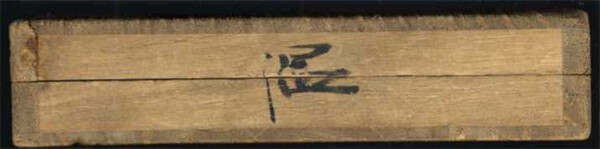
Many thanks Morita-san I would never have got there! Now all we have to do is try and understand what the writer meant. As I havent seen the tsuba in the box I have no idea if it relates to the composition or something completely different. Thanks again Best Regards Paul
-
Dear All Images below of two characters on a box belonging to a friend. He is unable to translate and I am clueless Any help would be much appreciated. Regards Paul

-
Hi Jean I saw this on Fred's site and even as a non Bizen fan I have to say I was really taken by it. I think it is a beautiful looking blade. As you know, you and I follow a similar collecting path trying to put together a few good examples of each of the main traditions. I am currently lacking a Bizen example and a Soshu blade, having deviatied in to such things as Aoe and Enju. I somehow doubt that I will acheve the one example of each tradition that you are striving for. I thought for some time about converting what I have in to a single blade (having already done this going from 25 to 3 at one point) I am not sure that when it came to the final decision I could do it. partly becaue I think pieces are often better seen in comparision to others but mainly because the responsibility of caring for important works becomes increasingly onerous over the years. I would be interested how you view this. Sorry to deviate and thanks for hoghlighting that beautiful work it looks to be an exellent work (even to w non Bizen lover)
-
Hi Micha, According to Markus' geneology the earliest Kuniyoshi was working in Gentoku era (1329-31) and the name continued through to Oei (1394-1420) I am a great fan of Enju work, particularly early work which at it's best is regarded to the equal of Rai.It is believed that the schools founder was a Yamato smith who was a student of Shikkake Norihiro. He then studied under Rai Kuniyuki when he became his son in law. As with many other schools later work lost some of the quality. If you pm me your email address I will send you a write up I did on an early Enju wakazashi. regards Paul
-
Importing/Exporting and Customs queries and advice
paulb replied to Brian's topic in Swords and Edged Weapons
depends on the shipping agent. parcelforce is slower and less able than Fedex often holding items and requiring additional proof of age and value. This can cause several days delay. Provided the invoice clearly states age and value it should not be a problem. You will have to pay 5% VAT (standard charge on antiques) Parcelforce also charge a handling fee. Regards Paul -
Hi Andrew I think over the years there has been much debate about which is stronger or better. Not only between traditionally made and machine made but also different types of hand made, different schools, provinces etc. The key really comes down to the quality of the handmade blade. As you know this varies dramatically. I would suggest that the best hand made is better than anything else. This is not based on any technical knowledge just my own rather biased view. Others may add weight to this or offer alternative information Regarding who carried family blades I am sure some carried their family heirloom with pride in to conflict. i think others purchased older blades because they wanted to take some histyory with them Others with less money to spend took what they were given. I also think that the type of sword carried did not relate to an officers rank although many high ranking officers did have good swords. I think some important blades have appeared surrendered from lower ranking operational officers.
-
Yes agreed
-
Hi Julian thank you for the additional images and sizes which help a lot. Without seeing much detail of either hada or hamon it is pretty much impossible to be confident (at least for me to be confident) but based on the shape of the blade, the colour and shape of the nakago my initial reaction is this is a later koto Bizen piece, possibly one of the so called "bundle sword" which were semi-mass produced duiring the 15th and early 16th century in Bizen. However as said before the above is by no means certain and if possible it would be worth showing it to someone ith more expertise than I have over there to give you an opinion with the sword in hand not sure if this is much help but it may give you a starting point Best Regards Paul
-
Hi Julian, When you take some more pictures can you take one of the whole blade without the habaki in place? that will give a better idea of the overall shape. Alos can you list some dimensions such as length of the blade from tip to the start of the nakago, the thickness and width. All will help to try and identify it more closely. The short "stubby" tang looks like a later koto Bizen work and it appears to have some age. You are right there are some very high value Norimitsu swords, but the name was also used by several generations in the late koto period and first impression is that this may be one of these later blades. I look forward to some more images Good luck Paul
-
Hi Darcy, Thank you for taking the time to post such a detailed and informative view which I fully agree with. I can fully understand when buying from the internet without the opportunity to see the blade in hand (which we nearly all do these days) why papers are increasingly important. However the point you make which I think is key is that it is not what papers the sword has, it is whether or not that level of paper is the highest it can achieve. having never been submitted for Juyo is totally different to having been submitted and failed. Good sellers will often say if a sword has reached its papering limit. The most expensive sword I ever purchased had hozon papers. When I bought it my intention was to submit it to Juyo shinsa. I then asked myself why? It had three seperate attributions from all confirming the school and maker. It's quality spoke for itself. If I submitted it it would be away for up to 18 months (assuming it passed) So until such times as I decide to sell it I will keep it here and enjoy it. when I do sell I will consider submitting it for higher papers (which it has never been). Thanks again for taling the time to post best Regards Paul


