paulb
-
Posts
3,046 -
Joined
-
Last visited
-
Days Won
73
Content Type
Profiles
Forums
Events
Store
Downloads
Gallery
Everything posted by paulb
-
no problem Alex for a few seconds I enjoyed the thought of being considered a hungry wolf albeit unintentional
-
Dear Grev and Alex, At risk of sounding a little over defensive can I confirm that I have absolutely no interest in buying your sword and my attempt at valueing it was triggered by a request for help rather than any form af canine lust for your blade. I think the vast majority here would try and give you an honest opinion (but opinion is all it will be) rather than trying to mislead you to make a fast buck Back to the woods for me
-
Hi Grev, I think I am with Uwe on this one late sword with a modified/damaged nakago. The blade looks clean and in reasonable polish/condition with no faults. the koshirae while not special has a pleasant aged look to it. I think Uwe is also right about the target market, someone with an interest that wants an honest example. Based on the softness of the current market I think the lower end of Uwes estimate ie around €2500 or £2000 is about right. Anything more than tha you will be doing well. Regards Paul
-
Peter, I think the bottom line is that a sword should be presented in the best possible condition to enable the panel to see the detail. I dont think there is sucha thing as a specific "Juyo" polish it just needs to be the best achievable to show the blade off to good effect.
-
Tony I dont know if there is much to add beyond what you have already said. Based on what can be seen in it's current state of polish it is an unsigned wakazashi derived from Mino. Personally I would not put it as early as you have (dont know why but it just looks later, I would guess mid Edo but in reality it could be anywhere between 1550 and 1850) As to school or smith I think it would be almost impossible to bring it closer in it's current condition. sorry probably not much help best regards Paul
-
thanks Grey too many things going on early in the morning. I did say Norishige in the answer I will edit my slip. Jacques I think I might have the Zufu copy with the Norishige (I must have known it from somewhere) If I find it I will send it to you cheers
-
Following Brians request I have listed below the reasoning behind the answers I gave (all but one wrong!) 1. Ko-Mihara- I said Unshu group. When I first lookd I believed this could be a number of schools, Rai, Enju, Mihara etc. I was not happy with the boshi and the hi which ends well back from the kisski. I had not seen this in the schools mentioned. On scanning through koza and other references I did see a simialr hamon, boshi and hi on an Unji blade so opted for that. 2. I said Aoe answer Rai Kunimitsu. Suguha with this type of small ashi is seen in a number of schools. I went with Aoe based on the slightly pointed nature of the boshi which is typical of chu-Aoe and also the busy ko-choji seen near the ha-machi which again I have seen in many chu-Aoe works. 3. I said Shizu or late Shikkake answer Chogi. I dont understand this one at all. The boshi looks Yamato. there is a huge amount of activivity running through the boshi inthe form of Sunagashi. Were the hamon less flabouyant I would have said Shikkake Nobunaga. A classic Shikkake feature is the hada becoming masame as it enters the hamon creating this type of sunagashi and the brushed hamon. Becuse the hamon was so active I felt it had more Soshu influence (which of course it did) so went for Shizu or very late Shikkake. I think with 50 or more answers I would still not have picked up Gogi on this one. I have learned something more!! 4. Den Norishige- I said Norishige I dont know from where or when but I recognised the sword. I was going to disqualify myself from this but then realised recognition is what it is about and the fact I had remembered it was part of how we learn. So one out of 4, if in school I think the report would be "Must try harder". However it was a very useful thing to do and I hope we can do more of these going forward. I do think we need to start looking at more detail in combination (Beginning o sound like kantei through the back door) to be able to make more accurate assessment. edited to correct an early morning slip. should have said Norishige not Naotsuna (must be getting old)
-
Received the supplement last Saturday and am delighted with it. Ordered this volume today. At the current rate of publishing I will be spending more on your books than food :lol: thanks as always and especially following the recent hamon exercise here I am sure this work will prove invaluable
-
Grey, Thanks very much for doing this. I think it was an interesting exercise. Not wanting to draw too broad a conclusion for what has, between the three things we have tried, been a fairly limited sample, I think there are some points worth considering. 1. I think in both the hada and the hamon exercises people were offeing understandable answers and while few were totally correct the conclusions were understandable. I think also the results for hada were marginally better than for hamon. 2. I wonder if it his is because we focussed on koto. I think it is generally accepted that during the koto period steel was produced locally. This created individual characteristics in the jigane which offer clues as to the origin of a particular work. By the time we get to Shinto steel is produced more centrally and therefore the hada in shinto swords becomes more cuniform in appearance with less local variation. 3. As a way of differenctiating work in the Shinto period more school specific hamon start to appear such as the toran of Sukehiro, the sudare-ba of the mishina school and many others. I wonder if we did the exercises again based on shinto work we might see a more accurate result for hamon and less for hada? Maybe something for the future. I think one conclusion I have drawn from this is something we always quote but are often guilty of failing to do. We need to assess the sword in it's entirity. Looking first at shape, then hada, hamon and nakago. Only when viewing the blade as a whole are we likely to make a realistic kantei. Thanks again Grey we must do some more in a while and once we have recovered!
-
Thanks for doing this Grey. I find this more of a challenge than either the shape or hada exercises but then I guess I had the inside track on those. When doing the NBTHK kantei which is based on the same quality images as the ones you posted I realise how much I depend on the description telling me what I cant necessarily see in the oshigata. That combination should, and occassionaly does, lead me to the right conclusion. With these looking just at the hamon, particularly those which are largely suguha I am trying to narrow down the response from a possible half dozen to 1 or 2. Not very confident I have got them right but felt obliged to have a go :D
-
thank you (I think )
-
Hi Grey, Thanks for this it is a great follow on to the hada exercise and it is fun to have the tables turned and have to do some work. I am trying to ignore the answers so far and work my way through them. If possible and to help narrow it down a little it would be helpful to know if the hamon are nie or nioi deki. Would that be possible?
-
I was thinking the same thing Brian but my photography isnt up to showing detail of some of the more subtle ones. may have to revert to oshigata which will take a bit more time. I will se what I can do cheers
-
Hi Jean On the second batch two people, you and Veli, got two correct answers. via pm for second and third attempts Veli got them all right and you had 3 Atari and 1 dozon Others tended to have one right and others close but not quite where they should be. I appreciate how challenging it was and the idea as always in these things is not to necessarily be right, but to go through the process. As in kantei it forces you to look at detail and assess. Judging school and smith on about 10cm of steel is as has been said almost impossible (possible exception of Gassan or Norishige) but none the less it helps focus eye and mind (I hope).
-
thank you Jacques for your as always positive contribution. You make the effort in doing these things truly worthwhile
-
After a couple of days and more than 450 viewings I think those who were going to answer probably have done. The fact that only 8 people felt confident enough to have a go suggests this was a lot more challenging than the original exercise we did relating to shape. When I was putting it together I was sure that I would find it a very tough call. so well done to all who tried I think if nothing else it points to a fairly obvious but often overlooked truth. When looking at a sword we need to look at it in it's entirity. What makes a sword one thing and not another is the combination of shape, hada and hamon and how each of these interact with each other. looking at one element makes the task extremely difficult. Answers: As the majority focussed on the second set of images I will start with them. 1. Ko Bizen- this caused the greatest problem with no-one gettting right first time and only one person (Veli) getting it on the third attempt via pm, well done. The more I look at these very early blades the more I come to the conclusion the differences are very small and subtle. It is easy to understand how the image could be equally attributed to ko-senjuin or an early Kyo smith. The combination of itame and mokume is common to all of them to a greater or lesser degree. 2. CHu-Aoe- people either placed this as Yamashiro or Bizen and so to some extent both were partially correct. I mentioned previously about Aoe using Bizen material and Yamashiro technique. Based on the image answers of Ko-Mihara or Enju would have been equally valid. 3. Enju- This sword has been well travelled in recent years. When seen recently at the Florida show many regarded it as equal to Rai Kunitoshi or Rai Kunimitsu in quality of jigane. It is a really beautiful thing. When I first saw it I though it comparable to Awataguchi. Then when I saw an Awataguchi blade close up I realised I was kidding myself. This is good but nowhere near as tight and uniform as Awataguchi work. It is however as good as any Rai blade I have studied. The reason it was attributed to Enju is that it has an O-maru boshi. My only regret is that it isnt 6" longer, if it were an O-suriage katana rahter than a wakazashi I have little doubbt it would recieve Juyo papers rahter than the Tokubestu Hozon it currently has. 4. Yamato shizu- Answers to Mino and Soshu are equally valid as this represents the transition from Yamato to Mino via Soshu (complicated isnt it ) and shows elements of all. The Ko-Bizen blade dates from the late Heian or early kamakura the others from mid to late kamakura periods. First set: These are all Bizen swords 1. the same as 1 above 2. Osafune School 3. Soden Bizen As mentioned in the beginning often the differences within a tradition, particularly one as prolific and successful as Bizen can show far greater variation than some of the differences between different schools/traditions. Thank you and well done to all who took part I think all of you got some right or identified the right elements which led you to the conclusion you reached. I hope it has been an enjoyable and useful exercise.
-
yes but I miss out on all the vouchers and special offers
-
Sorry Adam, I cant offer better images, they are all I have at present. It would also be difficult to offer hints without giving too much away. Others are getting some reasonable answers based on whats there. The second set show a lot more detail than the first so hopefullly they may help you have a go. As said beofe they each show some charactersitic that is regarded as typical of a given school or tradition, all date from Kamakura to Oei period. Edit, Sorry on re-reading I think both Adam's and Adrain's points deserve a better response. Doing this type of exercise from images on a screen has severe limitations. I actually think it is more difficult than shijo kantei from magazines. In those the hada and actvitiy cant be seen but is described for the reader In these you have to try and identify the features from a less than perfect image. Taking Adrians points: colour- I think it would be incredibly difficult to assess colour on an image. To do it inn hand is difficult enough and I believe can only be done effectviely buy comparison against a known example. (BTW all these images are greyscale) Brightness and clarity of nie and chickei- all these images have had minimal adjustment. By playimg with contrast, brightness etc it is possible to greatly exaggerate activity within the hada. However this is as likely to mislead as help. Likewise the style and quality of polish can enhance or detract. In this case you look to see if a feature is there or not and then look how it sits within the overall pattern of the hada. Is the pattern large or small, tight or loose. Is there ji-nie or chickei etc. This should be enough to point you towards a tradition. I would suggest that even with sword in hand to be able to gauge comparative brightness of nie or variations in utsuri would be difficult without known examples to compare to. By way of a hint I mentioned in the beginning that the variation wiithin a tradition may be greater than differences between traditions therefore some people saying soshu while others say mino is perfectly understandable. Within the 7 examples there are three traditions represented either by mainline schools or closely related work which at some point has passed as mainline.
-
All the comments on each are understandable, and some are right. No one has them all right as yet. As I said it is a challenging thing to do but I think it is useful. I will let it run for 24 hours so all time zones have a chance if they want Thanks for taking part Best regards paul
-
My copy arrived today excellent value as always Markus. Thank you very much regards Paul
-
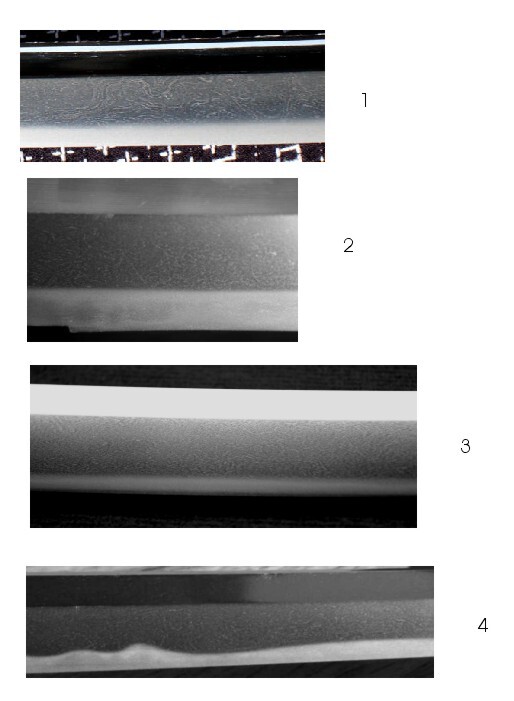
I looked at this again this morning and the more I look the more I think the images lack sufficient detail to give anyone much hope. My apologies for that. I think they have increasingly lost detail as I have transferred them from one form to another (could also be a lack of competence on my part) I will leave the original up for those that might want to have a go at them, but have also attached a different set which hopefully offer greater clarity. Again these are all koto works, authenticated to a high level and in good polish. They all demonstrate what might be described as text book hada for the schools/tradition they represent. This is not any easy thing to do but as in kantei the discipline of trying to identify what you are seeing is a great aid to learning. See what you think.
-
Hi Josh, I am not sure the images are good enough to allow people to judge. I will leave it up for a while but if there are no takers I might try again with some different ones. Thanks for the interest Regards Paul
-
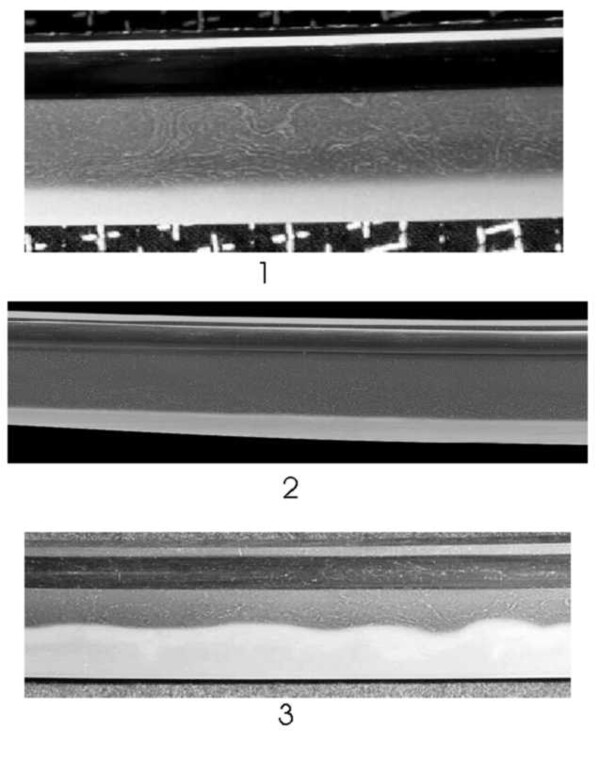
A while ago I posted an image showing 5 swords and asked people to identify the period they were made. A lot of people took part and enjoyed the exercise. Recently I have been looking at swords from several different, but well documented schools and have been surprised at the variation apparent in closely related smiths work. Some of the differences seen were larger within a school than between examples of different schools. When I started studying the mantra (as I remember it) was that shape told you period, hada tradition hamon school, and boshi smith. I may not have got that right it is some years since I heard it. However the hada of a blade should be a good indicator of tradition. As another fun exercise I have attached images of 3 swords. None of the images are mine but the owners have given me their permission to use them in various articles. All the swords are koto blades and all have high level authentication papers. For those that want to have a go please take a look and see if you can identify tradition and possibly school as well. I appreciate how diffiuclt it is to see detail from images but hopefully there is enough to see to allow people to identify key factors. Can I suggest as a starting point trying to put them in date order, then tradition and if you really want the challenge school or even smith. All images are from long swords and I think the hada is indicative of the particular school it is attempting to illustrate.
-
Hi Andi, we have all been there so I know what you mean. I will misquote a learned gentleman from many years ago "better to ask a question and be thought a fool for 5 minutes than to not ask and remain a fool for ever" One of the pleasures of being a long time in to this subject is you realise how little you know so asking questions no longer has any great stigma attached (provided you listen to the answers and learn from them) you are very fortunate in Munich in having some of the most knowledgeable people in Europe there. If you are not already a member of the NBTHK EB join now!! there is a wealth of knowledge on your doorstep.
-
I would go for both as they contain different information. If I had to choose 1 it would be Nagayama's "The Connoisseurs Book of Japanese Swords"