


jason_mazzy
-
Posts
1,076 -
Joined
-
Last visited
-
Days Won
1
Content Type
Profiles
Forums
Events
Store
Downloads
Gallery
Everything posted by jason_mazzy
-
I thought you were coming up 2 weeks ago. Am I crazy?
-
Dangit. i had yoshi mitsu written down but the left 1/2 looked weird. edit: Actually I don't have that kanji for yoshi so that makes sense why yoshi looked weird.
-
offthe hand maybe tokimitsu, but I am not the kanji guru at all. only ones that look like it a bit to me are: 勝 Katsu 時 Toki 助 Suke
-
This side is where I am thinking there is no turn back.
-
I was lucky enough to recently pick up to nihonto in decent condition. Both could use a polish but I am lucky to have enough activity to work with. A motto passed to me was the Boshi never lies. While I rarely deal in absolutes I have tried to learn much about the boshi and as such I come to you. I would generally call this ko-maru or maybe o-maru but the actyivity in the boshi makes me wonder if that changes the boshi type. I'm not even sure there is a turn back because of the pattern and it may be Yakizume. Could this be kaen or haki kake because of the lines like a sweeping?
-
This came on my new acquisition. It is a large circle, with the smaller circle with design in the middle, and 2 more even smaller design (one on each side). it was very similar to yours and even though you cant see it is has extremely fine nananko (unfortunately they have been beat up a bit).
-
 If I am to understand this, Any sword in this book would have a drawing and a copy of the mei. Is that correct?
 -
Seki 1570 SK2,113, OT94, K79, NJ159 I noticed one of the lists is Gyobutsu Tohaku Meito Oshigata.(Swords of the royal family). Sato Kanichi & Numata Kenji.. I am not familiar with this book. Does being in this book mean you worked for a family?
-
Thank you Chris. So it is the same kanji, just different pronunciation.
-
why kanewaki instead of kanewaku?
-
Wow. I just blew my cash or that would be a purchase. the polish cost is paid right there. Actually it's a horrible deal. don't buy this. Nothing to see here, move along........................
-
I like the fuchi, and there appears to be activity in the blade.
-
and don't clean the patina off the nakago
-
I have pure essential clove oil. not sure what the tannins may do to the blade so I never tried it.
-
great. thank you.
-
ok thank you. i saw the link on a nihonto forum and was surprised to see the gold plated ones. Mine is iron as it is magnetic and i have had no luck in finding how or when the Japanese began goldplating.
-
Ford, I have found several of these tsuba types now. When did the Japanese begin to gold plate the tsuba for? Bling out the tachi in Edo? http://www.ogpantiquesinternational.com/store/p79/TSUBA.html http://www.ogpantiquesinternational.com/store/p80/TSUBA.html http://www.ogpantiquesinternational.com/store/p89/TSUBA.html http://thumbs3.ebaystatic.com/d/l225/m/mQEpATM02b3ZNFOoTyrmg1A.jpg
-
He does not seem to be of a high ranking. the use of special steel??? does that have any special meaninh? I did find this bit on him Hidetoshi (Hawley HID 195) was a pupil of Fukumoto Amahide. He worked at Amahide's sword factory in Seki, Gifu prefecture, where he made both showato and gendaito. In fact many of Amahide's Showa period swords were made and signed by Hidetoshi acting as a substitute for his teacher (i.e. daisaku daimei). Hidetoshi was rated Chuge-saku and Ge-saku by WW2 sword authorities. See also Slough page 33. Curious if it is suitably forged just with railway steel?
-
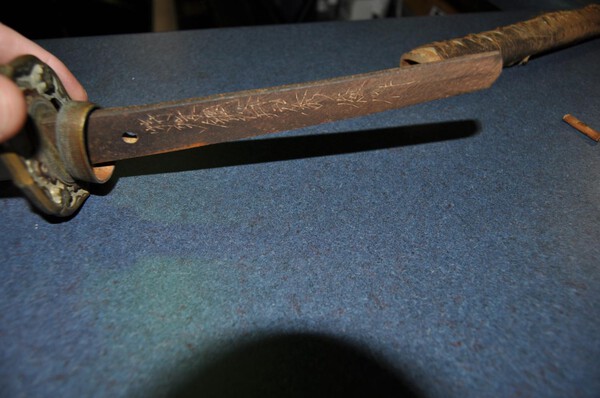
A seki smith signature. far too chippy to read. Also are seki ever machine cast blanks? or just oil quenched, western steel? I thank you very, very, very, much in advance for all your time assisting me and others on the board.
-
I'll take em!
-
still waiting on the sword to arrive from polish...................
-
He was supposed to swing by, but I never heard back from him. Hope all is well.
-
is Takeo Seki still polishing? anyone have his contact information?
-
Christmas eBook Super Sale 50% off
jason_mazzy replied to Markus's topic in Auctions and Online Sales or Sellers
Markus I'm looking for the koto kantei book. Was there a sale on hardcopy?
