FlorianB
-
Posts
412 -
Joined
-
Last visited
-
Days Won
1
Content Type
Profiles
Forums
Events
Store
Downloads
Gallery
Everything posted by FlorianB
-
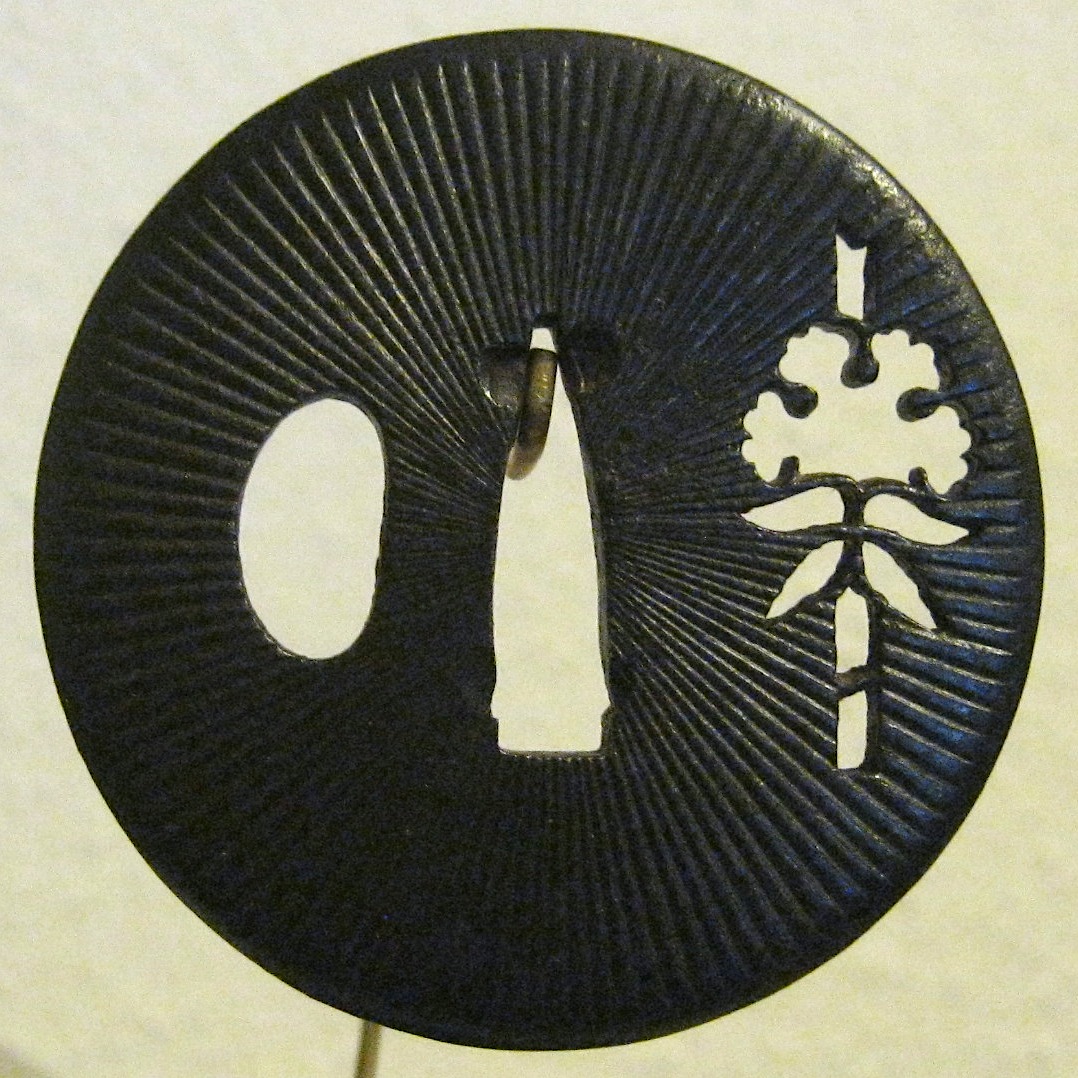
@ Steve: I’m afraid corrosion wouldn’t have erased all traces of carving while the circular cut is still clearly to be seen. Maybe it was intentioned to carve it but regarding the other side it’s more likely zogan should have been applied (or was applied and fell off). @ Manuel: It is interesting that in Your piece the blossom shows large petals, but the area beneath it is rounded whithout indentations in the iron. So IMHO this proofs a teamwork, a basic form was produced and others made a decoration in zogan. These Tsuba are definitively not Heianjo although the technique is similar. Besides other features Heijanjo-Tsuba should have decorated rims. Florian
-
I bought a similar one, but without zogan, years ago claimed as Ko-Hagi. I stumbled also about the zogan pieces and in my opinion the zogan was added later to enhance or just to vary the stereotyped design. On Steve’s (?) Tsuba the blossom is missing on the front side. Obviously only the outline was worked in iron and hint to some kind of industrial production. This particular motiv can be seen very often so it must have been popular maybe as a souvenir. Florian
-
Grev, obviously a terrific job - well done! By now I recognized that the “Choshu-Tsuba” in the book and the “Ko-Shoami-Tsuba” on the museum’s site must be the same according to the accession number. Florian
-
Interesting offer! Meanwhile I’ve had a look at the museum’s website and found this one: http://www.bmagic.org.uk/objects/1930M893 Claimed as Ko-Shoami. Because of the use of gold in mine not KO but KYO-Shoami would have been my next choice. However, Choshu schools are offsprings of Shoami so it’ the same periphery. Florian
-
Thank You for Your comments. @ John You're right, it's an iron Tsuba. I don't know the book. Is there a shot of the mentioned piece? By the way, I considered Choshu, too, but as You said it's a little bit vague. Florian
-
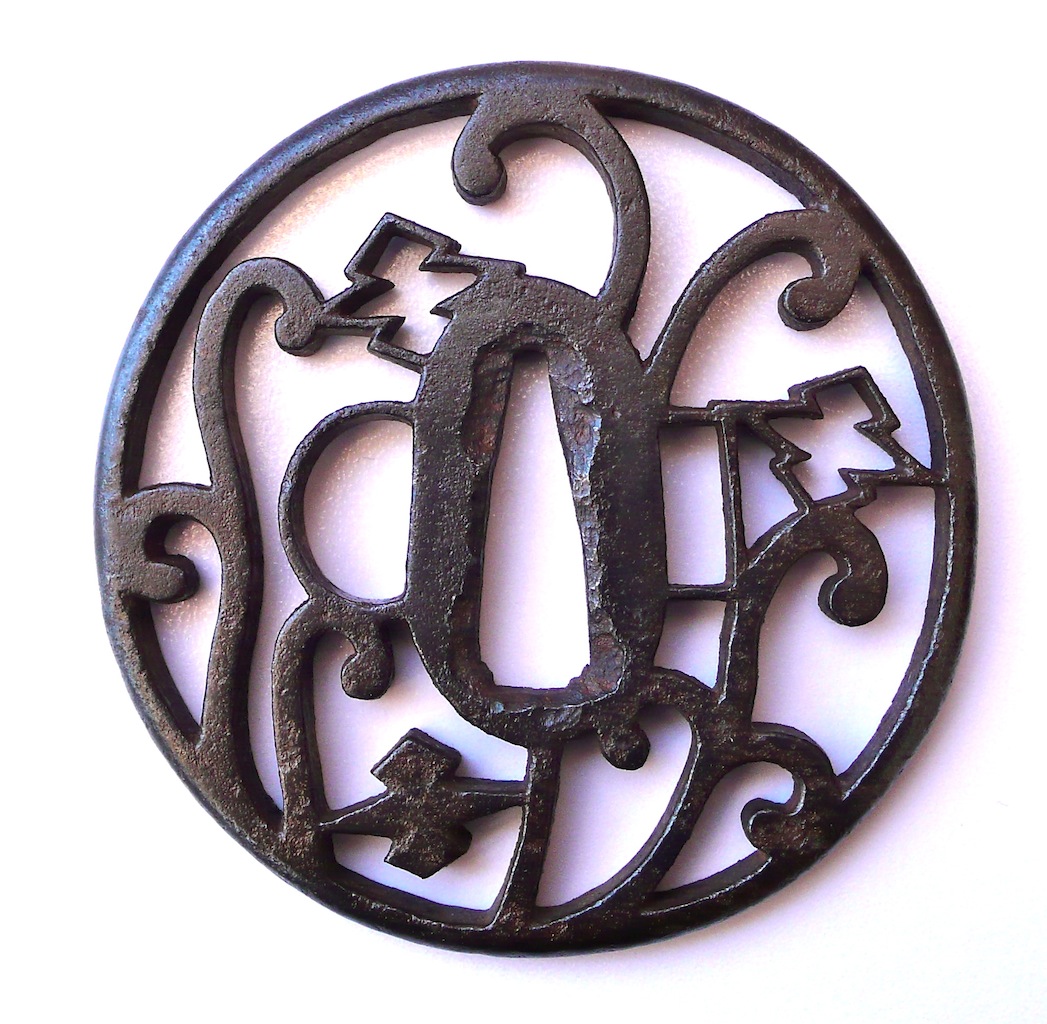
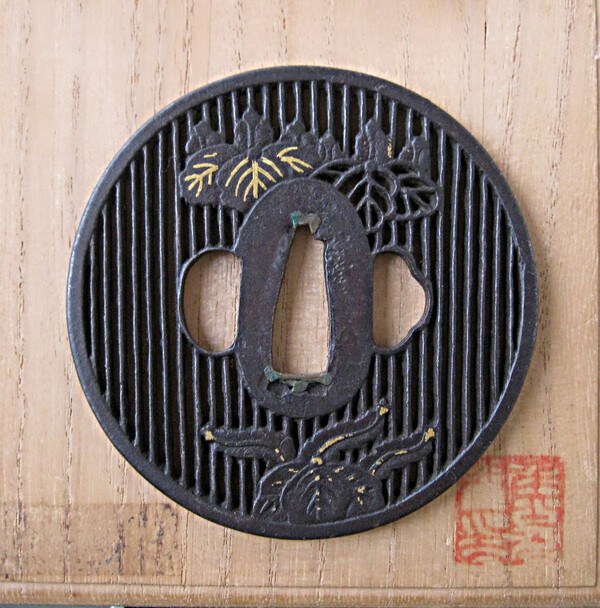
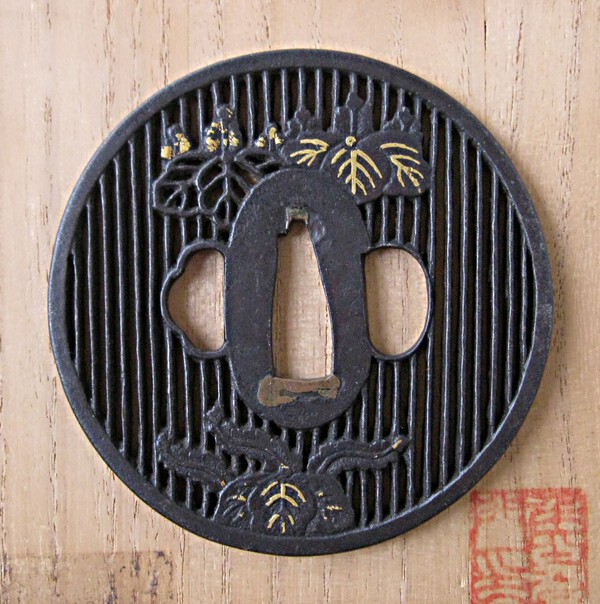
Hello all, I would like to show You a Tsuba I own (sorry for the mediocre pictures): It is exactly marugata (7,78 x 7,78 cm) and 0,45 mm thick. There is no niku and the rim is kaku-mimi. The kiri are executed in flat relief and accentuated with gold nunome. I’m fond of the very thinly executed lattice. The irregularities inside the lattice are rust particles, not looking good, but certainly not to remove. Although I have some ideas by myself I like to ask for Your opinions concerning school and age. Thank You, Florian

-
I stick to my impression that this is the original shape. The mentioned variations in shape are foremost result of the maker’s creativity and only sometimes a practical use could be determined. There are examples of Tsuba with flattend rims to avoid a rolling away if the Sword lies on the ground. Maybe this could a reason here, too, if You look for some... I agree wilh Steven that this Tsuba is not a formal one at all. Formal tsuba should show the kamon of the owner. Florian
-
There are so many variations in keijo I persume this could be the original shape looking like a fundo. Strange anyway. The rim has to be closer examined to clearify this. However a Tsuba of decent quality. I have no idea what the person (if it is one) represents, maybe some kind of chinese sage... Florian
-
Hello Romy, according to the “Sword and Same”-book by Joly/Higotaro I would agree the bonji on the omote above the ken is “Fudô Myoô”, the upper on the ura could be “Dainichi Nyorai”. The others are very simplified and I could only speculate “Tamonten” and “Monju” - but that’s a shot in the dark. Alas the bonji shown in the web seem to be almost always just reproductions from the above mentioned book (first published in 1913!), a resource for the simplified ones is obviously missing. Florian
-
More likely nothing changed in the V&A since Mr. B. W. Robinson's days in the 1960ies ... Florian
-
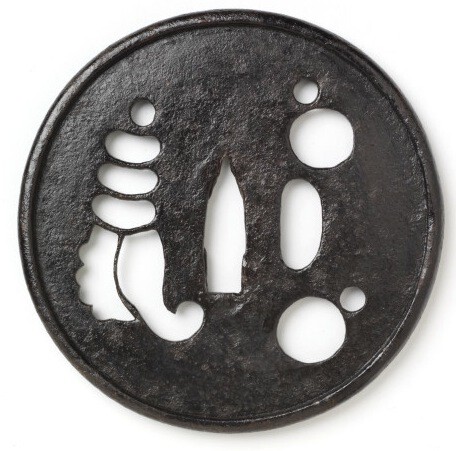
The overall appearance, the elongiated hitsu-ana and irregularities in the sukashi (later ones are more exactly made) make me believe it must be Ko-Tosho, probably late Muromachi. Size and thickness of about 3 mm could be found on similar specimen, too. The lower elements could also be interpreted as a tumbler or kukurizaru frequently found on this kind of Tsuba. Early kukurizaru show a small circle connected with a kidney-shaped form, later ones just two circles of different sizes. Found this at the V&A Museum: But moon and star work in Yours as well - as You like it. Very nice piece! Florian
-
No measurements and slightly blurry pictures make it not easy... Seems a very short but healthy blade with a top grade horimono and pointed nakago. That’s why I guess one of the Gassan smiths like Sadakazu or Sadakatsu could be considered. But it’s just a shot in the dark. Florian
-
Size doesn't matter. For those who like curiosities. Florian
-
Looks like the remains of a long blade. The tip is poorly reshaped. But I wonder someone made a new koshirae for this. Florian
-
Alas I have no idea about a school but because of the fan-shapd sukashi, the sharp angeled nakago-ana and the mentioned niku I would put it into the Edo-period. Certainly it appears older due to corrosion and apart from that an old look (some sabi-feeling...) was maybe intentioned. Florian
-
It could be possible that these ornaments are Kamon, but it’s more likeley they are simply design. The mon are embossed by stamps and such decorations could be seen frequently without any heraldic relevance. Florian
-
A friend of mine sees a relation to Akasaka. Indeed there are common traits like size and thickness, the niku, the small, offset kozuka-hitsu-ana and the slight conical shape of seppa-dai - though no sanmai-awase. My friend supposes it could be some kind of proto-Akasaka still without layered steel. Any suggestions to this idea? Florian
-
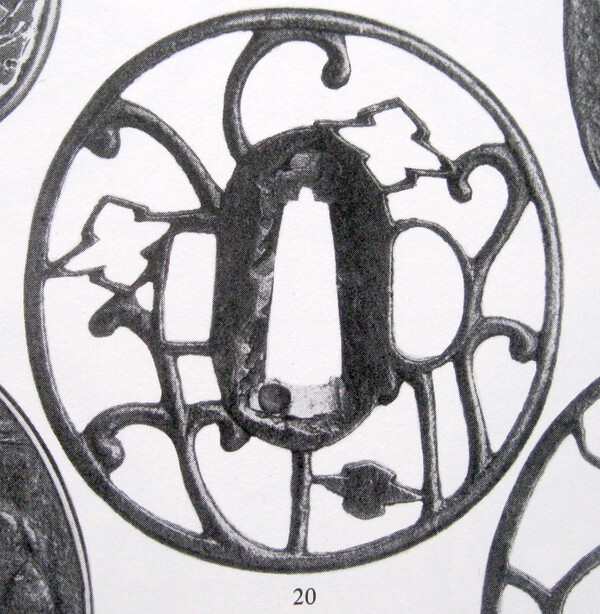
Ko-Shoami was my first choice, too, because of the archaic and unconstrained look. But angular hitsu-ana were also produced in later times, so Shoami of Edo-period seemed another option. By the way, I have another Ko-Shoami of about the same thickness. Owari came in to my mind as well, but in this case it must be a late one and should be more refined than this. Lack of refinement and the smaller seppa-dai speak in my opinion against Akao. Mauro, Your picture is interesting. Have a look at this one: Clearly the same specimen and depicted in a 1976 reprint of the “Red Cross” Catalogue from 1916. Not actually a textbook, mere a picture book and this Tsuba is claimed in here as “Kanayama nenuke”, 17th century! Florian
-
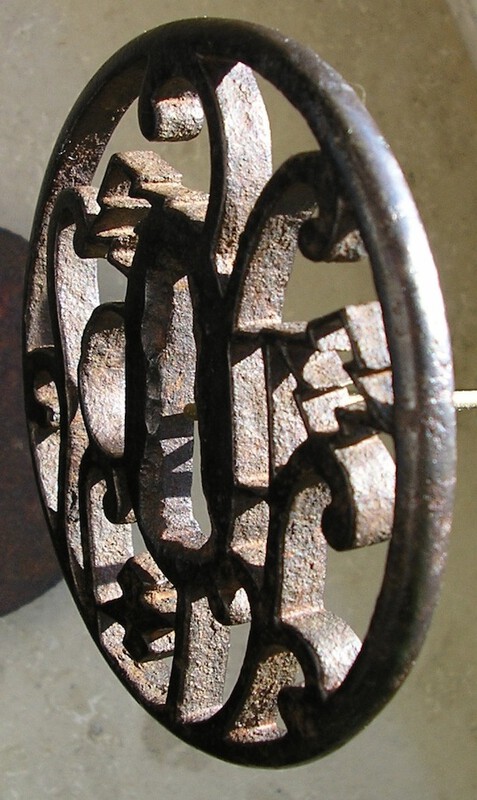
Gentlemen, I’d like to discuss my latest acquisition. This Tsuba measures 77.5 cm x 78.8 cm, the thickness at the seppa-dai is 0.65 cm, at the rounded rim 0.6 cm. The design comprises warabite and matsukawa-bishi. Although I’ve done research yet, I’m uncertain of a definite attribution. That’s why I ask for Your opinions concerning school (or “style” as some of You would prefer) and age. There isn’t any paper so feel free to speculate. Furthermore: Is there a special meaning in combination of warabite and matsukawa-bishi? Thanks, Florian

-
Gentlemen, indeed we do not much really know about Tsuba. The whole classification-system we follow today came from later times especially out of the middle of the last century, based on comparing and looking for similarities. This system is far from perfect and all those “cross-over” pieces prove this. There is, however, no other or better system. Dealing with Tsuba would be rather boring simply to state that someone made a piece at some time in the past somewhere in Japan. In respect classifying seems obviously a desire of man - why not speculate further and put a Tsuba in a labled box? Florian
-
My first impression was Owari but the somewhat unique design make me agree with Kanayama. It is said their Tsuba are thick but there are also thinner ones, probably a later one. The smooth surface could be migaki finish and would proof an Edo period origin. Is there a shot of the missing part? I wonder if it was removed for fitting or omitted purposely. I’m also curious about the circular tagane with riffles. Florian
-
Hello Grev, sorry for misunderstanding. Alas I can’t catch exactly Your second question. Concerning the Edo-Tosho-piece it is IMHO made of iron with a polished surface (migaki) usual in Edo-Period (mine shows the same). Shakudo wouldn’t look like this, even if rubbed. Further shakudo and other material mixes are made very fine so that neither rough traces of wearing nor tekkotsu wouldn’t appear. Concerning the second Tsuba with the kebori-Design I must admit my lack of knowledge, but judging by the picture I think it is made of iron, too. The polished surface isn’t glossy but could be heighten by rubbing with cotton. At last the Ko-Tosho Tsuba shows a lustreless surface and it appears there is initial rust. Deer antler and cotton cloth would help enhance its beauty, too. Florian
-
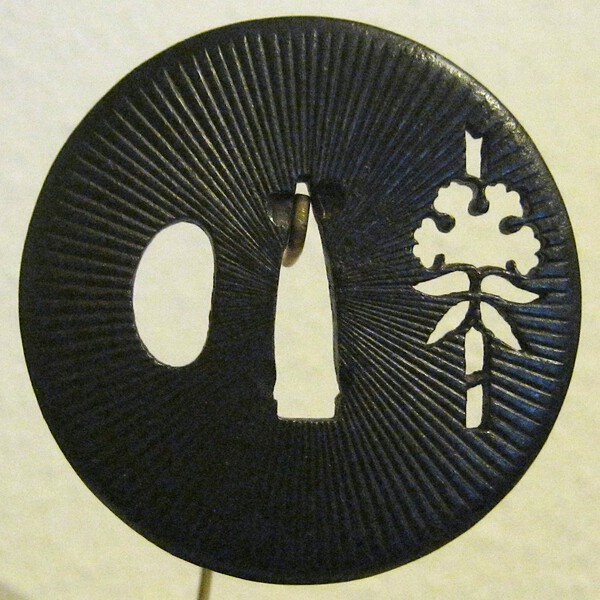
Grev, You seemed to be a bit disappointed because this Tsuba isn’t a Koto one. In my younger days when I have had neither money nor knowledge I purchased this late Tosho-style-Tsuba: Fortunately most of the rubbish I bought in those times has gone again but although I know it’s only a humble piece and despite meanwhile I own better specimen I kept it until today because I simply like it. So know what You have and enjoy Your Tsuba! Florian
-
Difficult to identify without closer inspection. Could be traces of corrosion or tekkotsu which is slighty rubbed. But alas in case of the latter that’s not a hint to pre-Edo-times. There’s a round spot, too, (5 o’clock position) maybe the remains of some glued label. Florian
-
It is thicker as Ko-Tosho, the thickness decreases at the rim and the sukashi is more sophisticated. You’re right, a typical example for a later Tosho-style-Tsuba. Florian