


Mark
-
Posts
2,223 -
Joined
-
Last visited
-
Days Won
2
Content Type
Profiles
Forums
Events
Store
Downloads
Gallery
Everything posted by Mark
-
maybe Yasuyoshi
-
i have heard it called Wakimono but that does not seem to match your kanji so maybe there are multiple terms used
-
Could some please tell me what this mei says
Mark replied to dirk marshall's topic in Translation Assistance
before trying to figure out who did what you should try and determine if either had anything to do with the sword == not trying to be too negative but unless it has reliable papers i would work on the validity of the mei first -
Extremely hard to read Wakizashi signature..*!LARGE PICS!*
Mark replied to YukouYukimura's topic in Translation Assistance
maybe SoShu Ju Masahisa -
I have a katana by 23rd gen Kanefusa with the Kiku on waves on the blade. I will be putting it on ebay when i get motivated. If anyone is interested before i get around to it i would sell it for $1500 If it is inappropriate to post this here i apoligize, please move it to the sale section-- but i only mention it as Kanefusa was mentioned in this thread
-
I had a dead mint Kunimori in high end army mounts that i sold at the Chicago sword last year (or maybe the year before), i think it sold for around $3000. The buyer and i thought that was a fair price, maybe i sold it too cheaply, but it sat on the table for at least a day with the price tag so i did not think it was way underpriced.
-
Anyone know of this Australian dealer?
Mark replied to Henry Stewart's topic in Auctions and Online Sales or Sellers
i dealt with him on an ebay item i was selling. you can email me directly if you need specifc information -
I have a katana, the mei is hard to read but my guess is Bizen Kuni Osafune Ju Shigemasa tsukuru...... I find that this maker is somewhat obscure, seems to be a student of Shigesane and of the Motoshige school circa 1360's, but i can't find a reference oshigata anywhere, would anyone have an oshigata for this smith? Thanks!
-
Nihonto dealer Lee Geinman...
Mark replied to slavia631's topic in General Nihonto Related Discussion
I have known Lee for years, he is a regular at the Tampa sword show and i see him at many other shows. The previous description sounds fair, he is a great guy to talk with. -
looks like KaShu (Kaga) Yukimitsu -- not sure what to make of it, does not seem natural, kanji look sharp and the yasuri are either gone or hard to see
-
the width of the groove suggests Bizen. The way the groove ends near the kissaki suggests Nambukcho. The sugata looks a bit later, it seems that if shortened it would have originally been sakisori. Maybe early muromachi. hard to say more from a picture but i guess late soden bizen might be a possibility
-
can you show a picture of the back (spine) of the tang? what is the blade thickness where the habaki fits, and what is the thickness at the lower hole (one closest the end of the tang- where the horimono ends)? If the thickness of the blade is the same in both areas, and the blade then radically tapers to the end, it may be a shortened Koto blade, If the tang tapers from the habaki area to the end as is usual then i would say it is not an old shortened blade and may be Shinshinto made as you see it now. It seems strange that the horimono does not "thin out" as it goes along the tang, if it were a shortened blade and the tang was filed down i would not think the horimono would be as deep and sharp at the lower end................. just my observation.
-
I am not a good judge of writing style, so that is a good point. It just seems to me that if i wanted to put a fake test on a blade i would do it like all the others (gold inlay - and pick a name of a tester who may be uncommon but at least recorded) instead of making it so atypical. At least this is an interesting and educational discussion.
-
Ian, Thanks for the thoughts. The blade is certainly suriage, possibly O-suriage, I have seen a few gold test inscriptions, but only one or two in silver. Do you think it may be done in silver as the blade was shortened already, or did you mean that the silver may be because the test was done under different circumstances, or something else?
-
Thanks to everyone for their help. I hope this post at least allows some educational discussion. Grey asked an interesting question about the gold vs. silver -- i would have thought that if this was a later addition to up the value someone would have used gold instead of silver. there is hardly any gold weight so the cost of the materials should not have made that much difference. Any thoughts about that?
-
Group, I try to help others when i can, so i hope someone can offer me some assistance. I have a wakizashi with a silver inlayed inscription. I think it is a cutting test and the testers name but i am not very experienced with these inscriptions. So everyone knows the situation: I own the sword, it will probably be for sale in the future but i do not plan to put it on eBay, i have a friend i trade with who expressed an interest. Thanks!
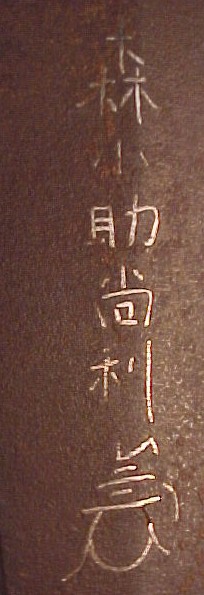
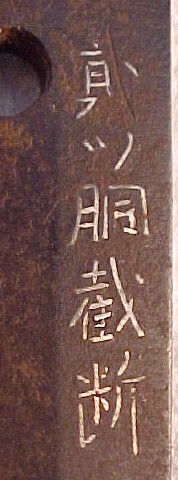
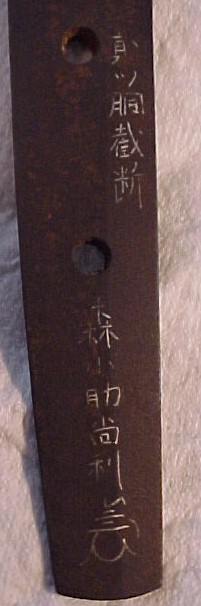
-
could it be Etchu (no) kami Fujiwara ____
-
Bizen Yokoyama Sukeyoshi (?) on eBay
Mark replied to Marius's topic in Auctions and Online Sales or Sellers
I have a Sukemune katana (34") that is a custom order and is signed 58Th Gen Tomonari -
This should be interesting...
Mark replied to Leatherdog's topic in General Nihonto Related Discussion
I have seen in hand a genuine (Juyo) example of this smiths work. I remebeber noting the hada was quite loose. the hamon was also somewhat "soft". -
you could ask for a "window" to be polished so the temper can be seen. Then make sure the agent clearly knows that, -- if the sword has no temper or appears retempered you want it returned as is. that way you can find out at minimum cost
-
from what i see it is common to use these terms for swords made 1926-1945 --Showato to refer to swords made that are mass produced, or oil tempered, in contrast to Gendaito which is commonly used to describe swords that are hand made in the traditional way from tamahagane
-
looks like a Soshu stlye dragon around/swallowing a sword/ken it is stylized but you this
-
I saw a Hisamichi on Danny M's site http://www.nihontocraft.com/Hisamichi_katana.html
-
A person i knew swore he had a dozen sets of 3 matching swords he called Trisho...... strangely enough when i visited his home and asked to see them they were all out at the cleaners so i did not get to see this impressive collection. true story.
-
I am not a tsuba collector, but it looks Namban to me. The square opening for the kogai is usually associated with early tsuba but my guess is that this is a later cast copy, maybe circa late 1800's


