
Soshin
-
Posts
2,935 -
Joined
-
Last visited
-
Days Won
3
Content Type
Profiles
Forums
Events
Store
Downloads
Gallery
Everything posted by Soshin
-
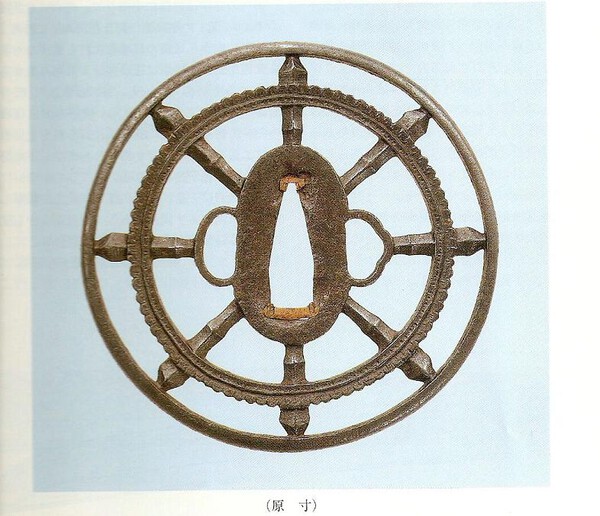
Hi Everyone, Here is my all time favorite (sorry Mike Y.) tsuba with this design. Keep in mind I still really likes Mike Y. example which is more then likely older. This tsuba is a NBTHK Juyo Tosogu made by the Ko-Shoami school circa the later part of the Muromachi Period. I just love the ji-sukashi design of the ken (swords) within the rinbo (Dharma Wheel). The photo was taken from Token Bijutsu Magazine. Enjoy everyone. :D Yours truly, David Stiles
-
Hi Pete K., Thanks for the additional details and the clarification the rubbing of Nobuie tsuba were complied and reproduced in the Bakumatsu Era by Nakamura. To say they were published by him isn't compeletely accurate statement on my last post. Yours truly, David Stiles
-
Hi Everyone, It is a nice weather today for November in Maryland so I did a art photo of what I think is a Ko-Tosho tsuba in my collection. It is unpapered and of average size at 8.0 cm is diameter. The thickness at the rim is 3.0 mm. The ko-sukashi design is of a war fan or gunbai in Japanese. The kozuka-hitsu ana I think was added later to the tsuba. The patina is a bit thin in a few places but overall not that bad and no active rust. The color of the patina that is there is a nice bluish-black characteristic of Tosho tsuba. The rim also displays a fair number of fine tekkotsu and the surface displays the hammer marks (tsuchimei-ji) of the tsuba maker. More photos of this tsuba is on my website. Yours truly, David Stiles

-
Hi Ford, That is a really good point. I think the publication of this book: http://www.japaneseswordbooksandtsuba.com/store/books/c125-nobuiye-tsuba-shu-akiyama-kyusaku had a really big impact in the making of many late Edo Period Nobuie style tsuba by swordsmiths. The specific book I linked to is the 1926 edition by Akiyama Kyusaku which was taken directly from the original work Nobuiye Tsuba Shu by Nakamura Kakudaiyu. This early book of Nobuie tsuba rubbings was published is the 1850s and it was a first of its kind. Before that the Nobuie designs were not know to the general Japanese public. Yours truly, David Stiles
-
Hi Everyone, Here is a good example of this schools work with NBTHK Tokubetsu Kicho papers: http://www.ksky.ne.jp/~sumie99/tsuba27.html. The example is in a late Edo Period Nobuie style and is a signed work of Naoaki a student of Naokatsu. Yours truly, David Stiles
-
Dear Mike Y., Thank you for posting such a wonderful tsuba. The ji-sukashi design is clearly a Buddhist Dharma wheel in my mind. The patina of the iron is just wonderful. I could picture the old Tendai-shu warrior-monks such as Benki would have such a tsuba on their Odaichi or Nagamaki. Yours truly, David Stiles
-
Hi Henry W., Good question. I think it is likely size, age, and quality of iron as well as the ko-sukashi design. This just my opinion and what I would look for. The patina as already stated is also really important. Yours truly, David Stiles
-
Hi Mike Y., I would like to acknowledge and thank you for all of the wonderful examples you have posted on the NMB. All of which are way outside of my purchaing power and would not normally be accessible to me. Being a member of the American branch of the NBTHK I would also go on to personally thank you for all the wonderful research material you have put together for NBTHK members in the USA. Please continue posting on NMB but if you had enough I can fully understand as I somestimes wonder why I contribute myself. Yours truly, David Stiles
-
Hi Henry W., That is a nice tsuba you linked to. I generally agree with Kunitaro-san statements with following exception. Lately the NBTHK has only been using the Ko-Tosho describtion for tsuba that date from the Middle Muromachi Period or before. This is different than how Sasano and others in the past have used the term to refer to pre Edo Period Tosho tsuba. Yours truly, David Stiles
-
Hi Stephen V., No the tsuba designs were carved and inlayed. I will send you a PM shortly so you can send me better photos for my reference. The two quickest indicators that this tsuba was never intended to be mounted on a sword is because 1) it lacks a seppa-dai area free from a design carving and inlay around the nakago-ana to rest the seppa used to fit and fill gaps between the tsuka, tsuba, and habaki, 2) the nakago-ana has never been altered to fit a nakago of a Nihonto. The Japanese generally use the term shiiremono which literally means “received commodity”to describe these type of decorative art of the Meiji Period while nicer pieces were for domestic use a larger proportion of pieces were of lower quality intended for export to west. Haynes's Index has the following dates for is signed works 1867 and 1875. The last date is the 8th year of Meiji Period. It is record that he was born in city of Mito Hitachi Province and work at Mukogaoka in Tokyo. Hope you find this little bit of additional information helpful. Edit: Here is a link to a signed tsuba by this artist at a Christie's Auction http://www.christies.com/lotFinder/lot_details.aspx?intObjectID=4777232 this was provided by Stephen V. by email. Yours truly, David Stiles
-
Hi Ludolf, Thanks for the more specific information about who made the tsuba during the Meiji Period. I will take out my copy of Hanyes's Index and look up the artist this evening. I was wanting to add this is a good example of shirimono produced in the Meiji Period. Yours truly, David Stiles
-
Hi Stephen, In my opinion you tsuba looks to be from the Meiji Period. It was never indented to me mounted on a Nihonto and was made and sold mostly for the export market. The Japanese term for this "shiiremono". Would a more detail discussion of how I arrived at this conclusion be helpful? Yours truly, David Stiles
-
Hi Janusz, What are the measurements of both tsuba including thickness? Both tsuba I think are real and of Japanese origin. The second tsuba I am fairly sure is a Kinko (soft metal) Sanmai tsuba from the Edo Period (1616-1868) but can't be completely sure until I see the inside surfaces of the openings as well as a view of the plate rim. The first tsuba which is iron is more difficult and it looks like it dates to the later part of the Edo Period (~1770-1868) and would likely be the work of the Shoami school from that time Period. The Shoami would also work these type of sukashi designs like this among a course surface. This late Edo Period date I think is indicated by heavily contrived hammer marks on the plate surface and dry blackish color of the patina. The rim cover of the first tsuba was likely added much later and is not original while the rim cover on the second tsuba is original and is typical of Sanmai tsuba and how they are made. I hope you find some of the information helpful. Yours truly, David Stiles
-
Hi Alan, It might have said Norisuke but at this point it is really hard to tell. I agree with Christian the tsuba was not repatinated. Norisuke and the Futogoyama school in Owari were the major producers of late 3rd generation Yagyu tsuba during the Late Edo Period. Finding Norisuke tsuba with strong Yagyu design isn't uncommon. Here is a school example that was unsigned and papered by the NBTHK to Ko-dai Yagyu: http://www.aoi-art.com/fittings/tsuba/F12184.html. I think my tsuba would paper the same way by the NBTHK if submitted. Yours truly, David Stiles
-
Hi Denis, After spending the evening looking for information and organizing some of my Nihonto related information from the NBTHK I was not able to find any information on it electronic or otherwise. I was very upset and regretful with myself for selling this Nihonto that I didn't leave any records having had it include photos or a write up. Now the only thing that remains of the Nihonto is in my memories. I sold it to a collector in Chicago so maybe I'll see it at the Chicago Japanese Sword Show in a few years. Yours truly, David Stiles
-
Hi Everyone, I once had a signed Echizen Kanetane Katana with NBTHK Tokubetsu Kicho. Let me do some searching on my computer tomorrow to bring up information about the Nihonto. If I remember correctly it is was in old polish and was papered in the 1970s. Likely new papers at the time wound have required a new polish. When I had it I was thinking it was the work of the Shodai Kanetane of Echizen. It was a really nice katana. P.S. This I think this is my first post in the Nihonto forum. Yours truly, David Stiles
-
Hi George Trotter, I would also like to see more photos of it if possible. It looks really nice. Thank you. Yours truly, David Stiles
-
Hi Ed, Just sent you a email about a tsuba on your website which is part of the Christmas sale. Hi Pabbi (Al?), Follow the link on my message board signature to my website. It has a fair amount of information on it. It also has a small sales section where I list only things from my personal collection for sale. Let me know if you have any questions. Yours truly, David Stiles
-
Hi Brandon, Hope your can reason with your friend. Some of my best tosogu pieces in my collection came from other collectors here on the Nihonto Message Board. I could maybe understand a security concern but that is one reason I try to use PayPal for most of my transactions. Yours truly, David Stiles
-
Hi Brandon, If your friend is in the price range of paying $600 for a tsuba you should tell him to check out the sales section of the Nihonto Message Board. There are a fair number of tsuba in that price range all of which are authentic in terms of age and country of origin. Just trying to be helpful. Yours truly, David Stiles
-
Hi Brandon, I would need to agree with Jean C., on this it is a Chinese copy using industrial brass as the plate material. The workmanship and detail of the design is so poorly cased it hard to determine what the design is. The signature I find really badly carved and nonsensical. With all due respect I am always amazed people will spend money on such things while real tsuba are let unsold. This brings to mind a quote on the other forum. Yours truly, David Stiles
-
Hi Pete K., I think I found the clip on YouTube you are talking about. What a classic movie enjoy everyone. :D Yours truly, David Stiles
-
Hi Malcolm, The design is of a saihai or commanders baton. Both in Sasano's first English translated book as well as in Owari to Mikawa no Tanko there are Yagyu tsuba with this stylized saihai. Hi Christian M., In regards to your question. Under bright light faint laminar folding/layers are visible on along the rim and the inside surfaces of the ryo hitsu-ana as well as the nakago-ana. This is much more subdued compared to a Myochin tsuba I once had in my collection. It recently sold at Grey Doffin website. Here is the link: http://www.japaneseswordbooksandtsuba.com/store/tsuba-%26-kodogu/t141-iron-mokume-tsuba for your reference. Hi Alan, It might have had a gimei at some point but it is impossible to tell what the inscription said if there was one in the first place. It might have been just a bit of rust along the seppa-dai that was later removed and left some shallow bits. Yours truly, David Stiles
-
Hi Jean C., Thank you glad you like it. Not sure if it is much help to Christian M as it is a late Edo Period Yagyu, Ko-Dai tsuba. I noticed the same thing you are referring to on the omote along the left side of the seppa-dai in hand. Not sure if it was a signature or some type of inscription was removed. If something was removed it was a very long time ago because the patina at this location is the same as it is across the whole tsuba. This might have been done by the original tsubako right after it was made if the tsuba was sold to a high ranking official or samurai. An alternative idea is that the tsubako was unhappy with how he signed the tsuba so he removed it and left the tsuba a mumei. The idea of the tsubako doing this would explain the consistency of the patina in the area that once had the inscription as he would know how repatinate the surface that once had the inscription to match the other parts of the tsuba. Yours truly, David Stiles
-
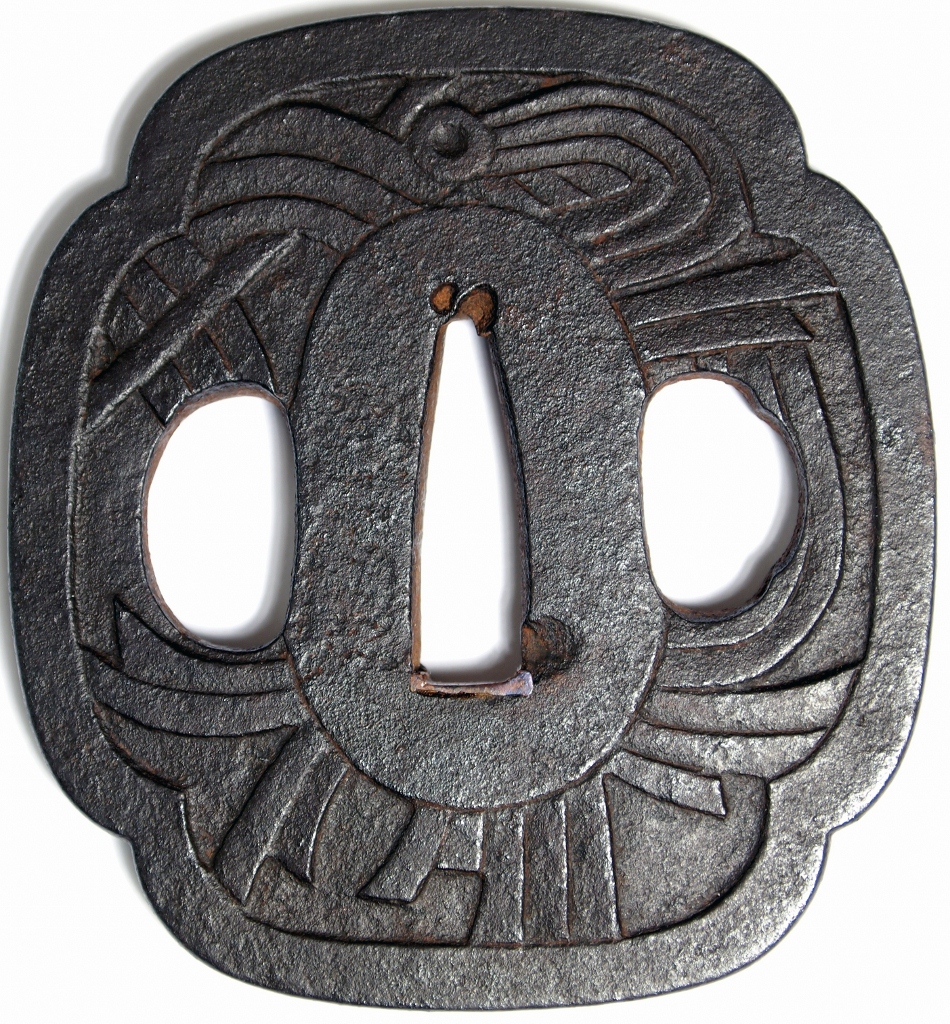
Hi Christian, I am not complete sure of your question. :? If I am understanding your question correctly I personally wouldn't classify a tsuba based only on one specific attribute. In this case even an important one such as sabi-ji. I would also go on to say that Mid Edo Myochin and Owari Yagyu groups had different sabi-ji. Attached is want I think is a Yagyu, Ko-Dai tsuba that I have in my collection likely made by someone working in the Futogoyama school located in Owari during the late Edo Period. The original owner was thinking it was a Yagyu tsuba work of the Nidai Noritsuke which it could be. Notice the blueish/black color intermixed with a deep brown of the sabi-ji as well as the overall sandy texture of the surface finish which are all characteristic of Yagyu tsuba workmanship. This along with the square rim shape, overall shape, small size but great thickness, and the fact that the design is in the Yagyu design books indicates this is a Yagyu tsuba. The quality of the iron and the interpretation of the design would indicate a later generation (Ko-Dai) designation in my opinion. I hope you find my write up helpful to your discussion. Yours truly, David Stiles