
Soshin
-
Posts
2,939 -
Joined
-
Last visited
-
Days Won
3
Content Type
Profiles
Forums
Events
Store
Downloads
Gallery
Everything posted by Soshin
-
Hi Joseph C., I would use bone or ivory to remove any active red rust but you will need to avoid any of the inlay work. I would not recommend using any oil on the fittings but very carefully clean them with a mild unscented soap and warm water first. Once the iron parts with rust have been rubbed with bone or ivory rub with a soft white cotton rag. The red rust will come off onto the rag and color it. On a some what unrelated topic to fittings. If you do get the blade polished go with a professional and have them or someone they know make a new habaki for the blade. This would be the most expensive restoration. Yours truly, David Stiles
-
Hi Joseph C., Could we have a photo of the whole mountings of the tanto which don't look to be in the best shape? From the looks of what you did post designs on the fuchi-gashira is of a folding fan. The handle at some point would need to be fixed. To me it looks like a reasonable project piece but take it from experience be careful how much money your send restoring a Nihonto. Often it is better to spend a bit more and get something in already good condition. Yours truly, David Stiles
-
Hiya Cielmerlion, Please don't follow your impulses there are people out there that will take advantage of them. Knowledge and saving your money are your true friends. Please follow the web links above or below (my website) to learn and search this forum. What you have done is a common mistake one that I have made myself along time ago. As for your tsuba I fully concur with what has been said. It is a poor cast reproduction likely from the Showa Period (circa 1920-1989). Yours truly, David Stiles
-
Hi Everyone, I was looking at this tsuba and the white background and I am thinking the color balance of images are way off. To far shifted towards the blue part of the visual spectrum. I wonder what the tsuba would look like in hand under natural sunlight? Regardless the workmanship and design composition is very poor I would consider it likely Shiiremono (仕入物) work of Meiji Period. Yours truly, David Stiles
-
Hi Grev UK, As Brian R. said I would say average quaility Aizu Shoami school tsuba from the late Edo Period or early Meiji Period. The design is also one I haven't seen before. The reverse side design is I think a single folding fan. Yours truly, David Stiles
-
Hi Dan, A major rule here on the Nihonto Message Board from my personal experience is to sign at the end all your posts with at lest a first name and first letter of your last name. In regards to your tsuba I would say your tsuba likely dates from the late Edo Period to early Meiji Period. The design style and craftsmanship reminds be of Mito school. Here are some examples provided by Google Images: http://www.google.com/search?q=Mito+school+tsuba&hl=en&tbo=u&tbm=isch&source=univ&sa=X&ei=scXZUOjrIZC00AH8q4HICQ&ved=0CEQQsAQ&biw=1366&bih=681. Hope you find this information helpful to your own research. Yours truly, David Stiles
-
Hi Brian R., Thanks for posting a photo of one of my favorite tsuba. The fine detail and expression on the face of the Buddhist Monk and tiger is just wonderful. Yours truly, David Stiles
-
Hi Everyone, Thanks for the nice Akasaka tsuba example Pete K. and for forcing me to Google to determine what "safu juice" is. Here is a early Saotome tsuba with a design also found in Kanayama tsuba. The design discussed in Sasano's final book page 146 in regards to a Kanayama tsuba as four circles as well as a highly textured surface of hammer marks and iron bones along the rim I think does a fine job of capturing the Wabi-Sabi Japanese aesthetic associated with Zen Buddhism. Again comments and questions are welcome. Yours truly, David Stiles

-
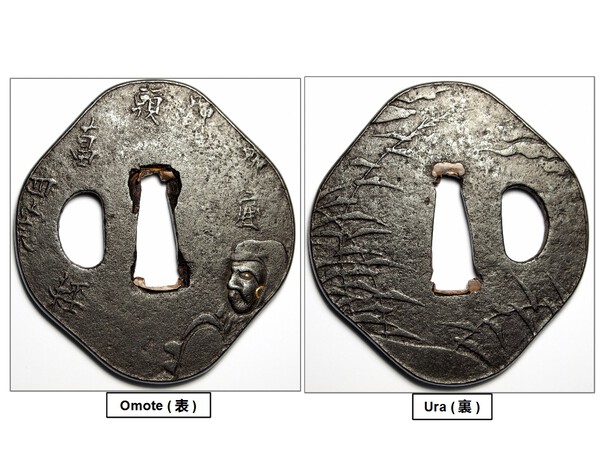
Hi Everyone, Here is one of my favorite tsuba with NTHK Kateisho from my collection. It is a unsigned work of the Saga school cira the late Edo Period. I find it has a nice Zen aesthetic that is also clearly about Buddhism in a more general since due to the subject matter of Daruma (Zen Buddhist Master) and a short Koan written in mid air. The revise side has a more symbolic meaning showing bamboo blowing in the wind with a clouded sky. If you have studied any book of classical Koan you would understand the symbology. I remember showing this tsuba to my Budo teacher and his initial reaction was that the tsuba display the concept of Iki (粋) a traditional Japanese aesthetic. Patrick R. thank you for posting this topic that I find really interesting and everyone's replies have been great. Comments and questions about my tsuba are welcome. Yours truly, David Stiles
-
Hi Pat R., Mostly I purchase tsuba from other collectors that are members of the Nihonto Message Board. These include but is not limited to as I might have forget someone: Grey D., Mariusz K., Henry W., Mark J., and Curran C. I have also purchase tsuba from Jack F. of my local Nihonto study group. In terms of Japanese dealer I have purchase from Aoi Art, Tokugawa Art, Zen Gallery, and Bushi Art. Hope you find this helpful. Yours truly, David Stiles
-
Hi Everyone, I don't see any Akasaka school characteristics except maybe shape in this tsuba including the iron of the rim. Ignoring all the later poorly added gold wash to the tsuba the I have seen similar designs in some other ji-sukashi Edo Period Shoami tsuba. It might be wise to remove the gold wash and have a tsuba with a some what decent openwork design tsuba. Yours truly, David Stiles
-
Hi Peter M., To me it looks like a late Edo Period or early Meiji Period Shoami tsuba. Sorry can't be more specific with this type of work. This is my opinion based upon my experience. I hope you find the information helpful. Yours truly, David Stiles
-
Hi Brian R., Its called the eBay mark up. Will not offend others by providing more examples of this effect. :? Still a really great book to read and understand the designs on tosogu. All provided examples are Juyo level or above tosogu which makes looking at the book a real treat. :D Yours truly, David Stiles
-
Hi Curt R., As John said above he is Bishamonten an alternative name for him is Tamonten (多聞天). He is a tenbu (天部) divine or celestial being mainly acting as guardian of Buddhism. Vaisravana is this name in Sanskrit. In regards to the fitting themselves soft metal is not my focus therefore I will defer to more knowledgeable people that collect these type of tosogu. Yours truly, David Stiles
-
Hi Mike Y., Could you post the reverse side of these very fine tiger menuki? Thank you for taking the time out of your busy day to post on NMB. Are these from your personal collection or will they be listed on Tetsugendo website? Yours truly, David Stiles
-

Great experience with Ed at Yakiba....
Soshin replied to kaigunair's topic in Auctions and Online Sales or Sellers
Hi Everyone, I would agree with Sam and Junichi. A few of this tsuba listed recently for sale on his site I once owned and many of this tsuba show fine taste in my opinion. Here is one of my favorites I once owned: http://yakiba.com/Tsuba_Ko-Umetada.htm. It is at a very fair price in my opinion. As a disclaimer I am not the current owner listing it on this website on consignment. Yours truly, David Stiles -
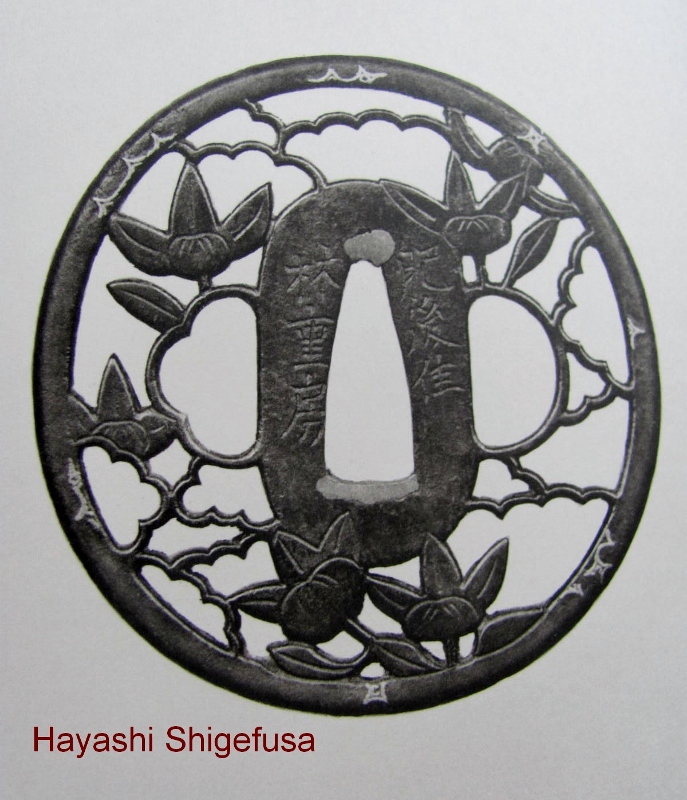
Hi Everyone, A friend of mine who had a copy of Higo Kinko Taikan has provided me with photograhs via email of the two tsuba with this tachibana in mist openwork design and permission to post on the NMB. Here are the photos with added text. I will then follow up with some of my conclusions based upon this new evidence. This tsuba is signed Hayashi Shigefusa who is the third master of the Hayashi school. This tsuba is mumei but clearly is in the Hayashi school style. While my tsuba shares this design it is different and the carving of the tachibana using the kebori technique is different an in my opinion finer and more naturalistic. The seppa-dai of my tsuba while rounded is not as rounded as the signed example provide from the Higo Kinko Taikan or the Sasano example. My tsuba by seppa-dai alone in contrast to the mumei example reminds me of the second generation master Hayashi Shigemitsu work. My tsuba also lack the Hayashi characteristic katsurabishi-zogan of the signed example done by the third generation. My tsuba will be interesting and educational to submit to NBTHK shinsa. I hope to do this early next year. I would love to hear other people comments, thoughts, and ideas as well. Yours truly, David Stiles


-
Hi Everyone, I received my copy of Fukushi sensei book The Art Appreciation of Japanese Sword Fittings today. What a wonderful book and a fine read with many good color photos of Juyo level and above tosogu. Yours truly, David Stiles
-
Hi Pat R., Thanks for posting this. I have been coming across once in a while the same design of my tsuba in very inferior versions. All of these inferior versions like the one in your post appear to be younger in terms of age but often not in as good of a condition as mine despite being younger. This example you post like the previous one I found is likely made in the late Edo Period or early Meiji Period. Some of the inferior examples like the one your posted is likely shiiremono (仕入物) and not work of Heinjyo school. Here is a link to eBay where I found another poor example of the design: http://www.ebay.com/itm/380481830919?ssPageName=STRK:MEWAX:IT&_trksid=p3984.m1423.l2649. There is one more listed in the original NMB topic I started about this tsuba: http://www.militaria.co.za/nmb/viewtopic.php?f=2&t=13617&st=0&sk=t&sd=a&start=0. I also find it interesting that all of the lower quality copies lack the very specific pattern of five round chisel marks on each side around the nakago-ana of my tsuba. I am thinking this was a form of kakushi-tagane that you often hear about. This was used by the Hirata (平田) school in Higo Province but I am hypothesising that this was also done by the Hirata (平田) school in Awa Province. Hirata is the family associated with the Awa Shoami school. These two families were just branches of the same family once based in Kyoto before the Edo Period. In the end I think it would be interesting to submit my tsuba to NBTHK or NTHK shinsa. Here is a link to my website for a complete write up of what I know about this tsuba: http://dastiles1.wix.com/reflections-#!Edo%20Period%20Tsuba%20Part%201%20/c211q. It is the second tsuba on the webpage. Yours truly, David Stiles
-
Hi Everyone, Here is the new tsuba and only Higo tsuba in my collection. It has the tachibana in mist ji-sukashi design. The measurments are 7.6 X 7.9 cm with a rim thickness of 5.0 mm and a seppa-dai thickness of 5.5 mm. I think it is a Hayashi school Higo tsuba. The deep purplish black color of the patina is just wonderful and the tsuba is a joy to view in hand and reminds me of the Hayashi tsuba on the Tetsugendo website. I once said that Higo tsuba are a bit over rated but now I understand more as I have such a nice example in my collection now. Learning and development is an important process in this hobby. I hope my photographic skills do this fine (my opinion) tsuba justice. I will be bring it to Tampa show next year to let people see in person. :D Yours truly, David Stiles

-
Hi Evryone, I am going to try to photograph my new tsuba which Ford had with the tachibana in mist open work design sometime in the next few days. I will post the resized images here for everyone to view. Comments and questions are always welcome. Yours truly, David Stiles
-
Hi Ford, Thanks for the reply. I find your well worded explanation about the negative and positive elements helpful for my study. I still wish the MFA example was kept in better condition. Yours truly, David Stiles
-
Hi Pat R., It should be noted that MFA example is not without merit. The continuation of the organic wood bark texture along the rim is nice and reminds of some Higo tsuba. The first tsuba still in my subjective opinion has a better open work composition along with fine gold inlay work. In a more objective area Grey's tsuba is in much better condition then the MFA example. Yours truly, David Stiles
-
Hi Pat R., In terms of quaily I would agree with Keith G. that Grey's is better. To me the second tsuba shows no characteristics that remind me of Higo workmenship. The best way I determine this first is by the shape of the ryohitsu-ana and seppa-dai. The color of the patina is also not characteric of any the Higo schools. The second tsuba is likely just a later Shoami tsuba of a bit lower quality in terms of design composition. It also lacks the nice gold inlay work. The condition is also far better in the first tsuba. Yours truly, David Stiles
-
Hi Everyone, This topic has been a very good read on a slow Sunday. I remember this fine sword at the Gendai Nihonto NBTHK/AB exhibit at the Tampa show in 2011. The horimono of Fudo-O and bonji on the omote and the hatahoko on the ura side was just wonderful as well. I am also really enjoying the write up done about the Nihonto in note give out to NBTHK members and attendees. Yours truly, David Stiles