
Soshin
-
Posts
2,932 -
Joined
-
Last visited
-
Days Won
3
Content Type
Profiles
Forums
Events
Store
Downloads
Gallery
Everything posted by Soshin
-
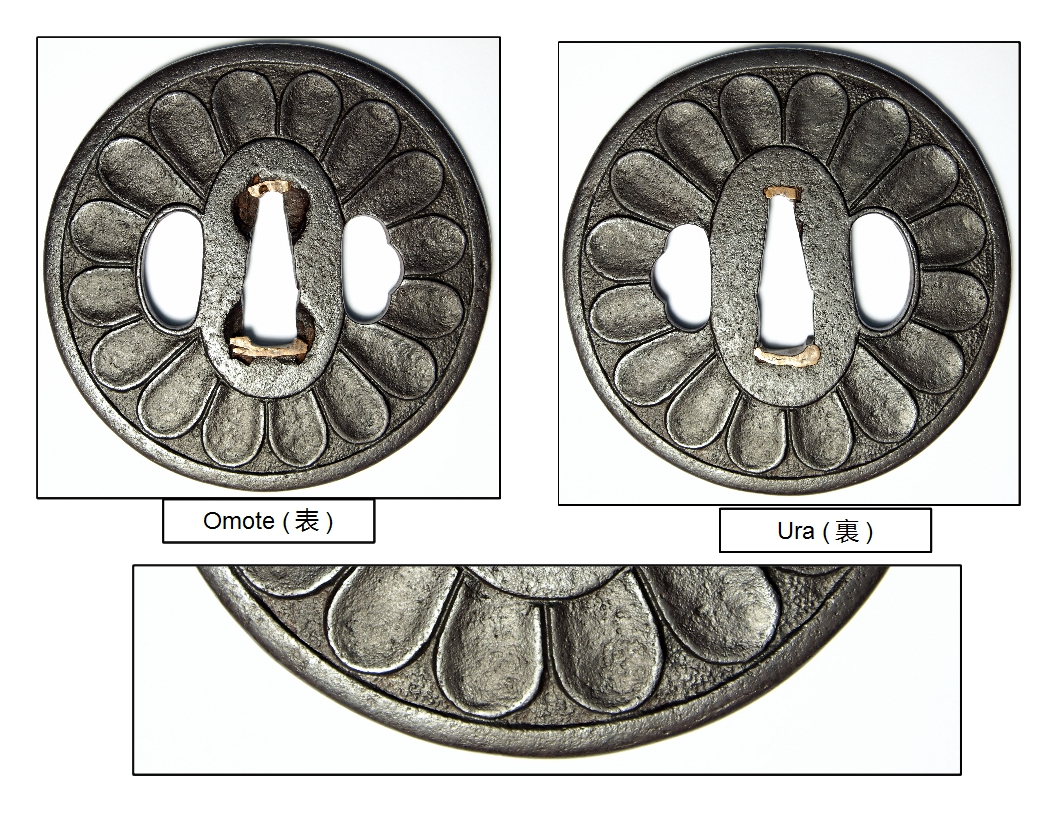
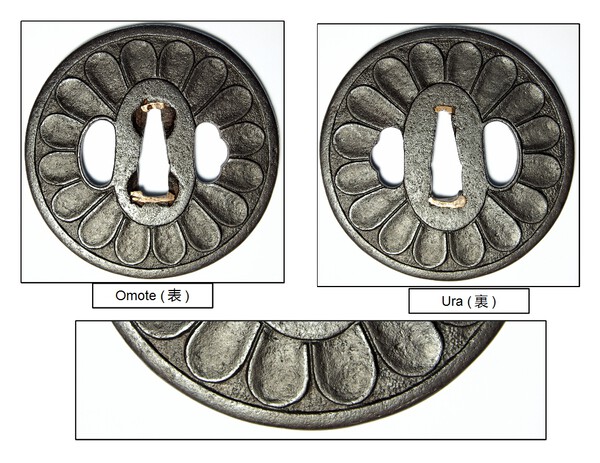
Hi Mauro, Yes I am very familiar with that book. I have my own copy and I often use it as it is a really helpful resource. Looking at tagane-mei (鏨銘) as you call this type of surface treatment is often found on Ko-Umetada and early Umetada school work. This along with great turn-black treatment of rim and quality of the kin nunome-zogan (gold inlay) makes me think this tsuba is a work of the Ko-Umetada school circa the Momoyama Period. Attached is another early Umetada tsuba I have with tagane-mei similar to iron nanako between the 16 petals of the chrysanthemum flower. Yours truly, David Stiles

-
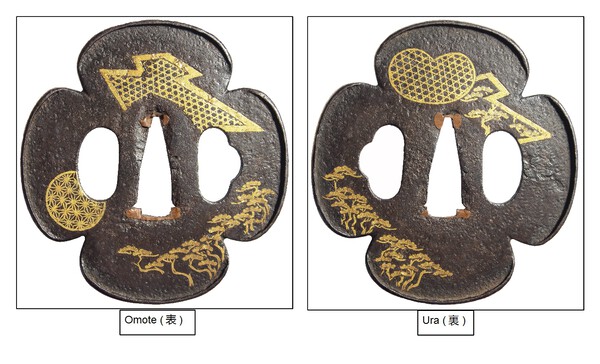
Hi Mauro, I do see the similarities between my tsuba and the tsuba in the photos you posted in regards to the designs. In regards to keshō-tagane (化粧鏨) they are often found around the nakago-ana of a tsuba. They were sometimes very specific and could be used to identify artists that often didn't sign there work. Some of the different schools of tsuba makers in Higo Province were known to do this. Please see the following fine example posted on NMB: http://www.militaria.co.za/nmb/download/file.php?id=36961 of the Hirata school of Higo Province. The tsuba is mumei but the keshō-tagane (化粧鏨) show a very specific shape and pattern and the tsuba can be attributed to being the work of the 1st generation master Hirata Hikozo. Because the chisel work is distributed around the surface of the tsuba where there isn't gold inlay I was using the Japanese term ishime-ji (石目地) to describe the surface which has a almost stone like appearance. Attached is link to a high resolution composite photo of my tsuba above. Yours truly, David Stiles
-
Hi Moriyama-san, Thank you. I think you are correct about what the designs are. Yours truly, David Stiles
-
Lorenzo, Words are not semantics they are what we use to communicate. The tsuba that is the topic of post isn't bad but I generally don't submit things to shinsa if I think they will fail. If you read and understand the context of the link to what I had for sale it make sense because I was referring to the great number of Higo copies much of which are of average quality. In reponse to this idea that I can't tell a fake from a real tsuba because I don't buy off of Yahoo Japan. I really don't have time for this nonsense and I hope and prey you don't either. Goodbye. Yours truly, David Stiles
-
Hi Lorenzo, My eyes are just fine but I also don't shop on Yahoo Japan and have given up on eBay unless a friend is selling something. I said a bit. I hope you understanding the meaning of this English word in my quoted sentence. The meaning is a small quanity of something. Hi Mike Y., Thanks for all of the wonderful Higo examples all which are works of fine art. Yours truly, David Stiles
-
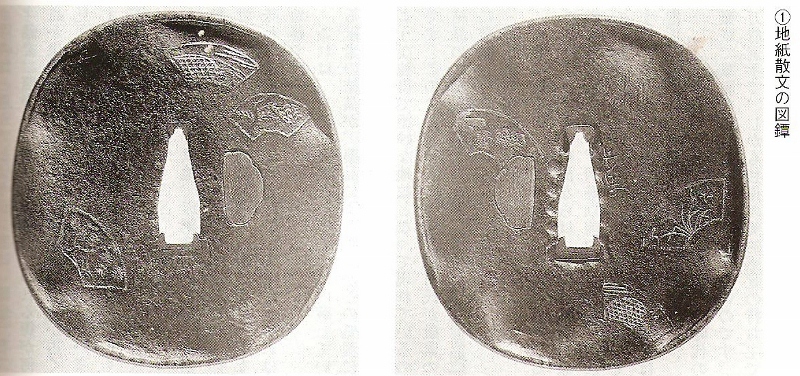
Hi Everyone, Thanks for all of the helpful replies. Ian C. the link was really helpful as the tsuba does have some of the same designs done using a different style of inlay technique. I was also able to find a tsuba with similar designs done with the same style of inlay technique. Attached is the tsuba from the Token Bijutsu magzine issue number 634 tosogu number 1. It is a signed work of the Ko-Umetada artist Mitsutada. Notice some of the similar designs within the paper fans pictured. Yours truly, David Stiles

-
Hi Curran, I agree I wouldn't consider myself a lover of the Higo schools in my eyes a bit over rated with so many copies and fakes. As a matter of fact I have a modern Higo copy on my website for sale http://dastiles1.wix.com/reflections-#!sales/c6jy. In regards to the not submitting a tsuba for shinsa there are a few tsuba in my collection that I will not bother submitting to NBTHK shinsa and I really like them. Some examples include those tsuba that already have NBTHK or NTHK papers, tsuba that have already failed shinsa or would fail (AKA all of my Yamakichibei tsuba), went through a fire or have other major condition issues. Yours truly, David Stiles
-
Hi Everyone, I have a few questions about a tsuba in my collection. Below are some photos I did over the weekend. The measurements of the tsuba are 7.6 by 8.2 cm. The thickness at the rim is 6.0 mm but is only about 3.0 mm at the seppa-dai. The rim shows a great amount of turn back causing it to have so much thickness. Two of the designs in gold inlay (kin nunome-zogan) are matsukawabishi (pine bark mon) and matsu (pine). What are the two other designs one on the omote and the other on the ura? Within these designs are star shaped geometric shapes each with six points. Overall the tsuba has a very strong Kyoto feel. The thin (relative to the rim) plate of the tsuba also show a interesting fine ishime-ji (石目地) texture made likely by a specialized chisel. I am not sure if you can see this on the low resolution of the photo I posted. The patina is a deep rich black which I think have been mixed with some black lacquer. Would love to hear others opinions of what the designs are and/or general feedback about the tsuba. Yours truly, David Stiles

-
Hi Curran, After viewing the tsuba in question I would agree this tsuba don't deserve this much discussion. I am also of the opinion that I wouldn't even bother with submitting it to NBTHK shinsa IF it was in my collection because someone gave it to me as a gift. Yours truly, David Stiles
-
Hi Curren, I remember being told by someone that the NBTHK will fail it and would not igoure the false attribution. The specific case that I remember was for a Nihonto. Not completely sure for Tosogu. If the attribution can be safely removed I would do so. This was done to nakago of a Nihonto and it later passed after failing once before with the false attribution. PS Thank for the tsuba boxes. Yours truly, David Stiles
-
 Hi Ken, I am not answering for the boss man (i.e. Brian) but I will be publishing my articles first in JSSUS newsletter then on NMB. Yours truly, David Stiles
 -
Hi Brian, Keep in mind that there is fair amount of late Oinin and Heianjyo Shinchu Zogan school overlap within Kyoto. With all brass inlay work by the mid Edo Period becoming a pure Heianjyo school style. This style had brass inlays that was more complex and naturalistic. The iron plates were also more refined and homogenous. Yours truly, David Stiles
-
Hi Pete and Brian, I was going to say the same thing. The tsuba looks like a late Onin school tsuba. Keep in mind that a late Onin tsuba are still fairly old circa the Momoyama or early Edo Period. I would say little and it would be mixed with brass and used in the flat inlays. Overall I like the tsuba. Thanks for posting Brian. Can we also see photos of the other parts of the koshiriea that look really nice as well. Yours truly, David Stiles
-
Hi Everyone, Just sent Brian the Administrator a copy of my first tosogu article that was published this year in the JSSUS Newsletter Volume 44 No. 3. For the JSSUS members on the NMB this version will have higher resolution color photos of each Tosho tsuba example that I discuss in the article. This weekend I plan to start working on my next article that will come out early 2013. :D P.S. I will also be listing my first article on my personal website as well. Yours truly, David Stiles
-
Hi John L., I agree with you last comment having exained a few examples of Mino workmanship of different qualities. I had another idea the tsuba could be a Ko-Kinko Sanmai Tsuba. Here is a similar one: http://www.legacyswords.com/fs_ant_tsuba14.htm. Can we see additional views of the inside areas of the openings to see how the plate was made? For example to see if it was made of a single piece or layers of different soft metals. Yours truly, David Stiles
-
Hi Rick, Your tsuba is signed Yasu (安) Tsugu (次) left of nakago-ana. On the right it says Mi(水) to(戸) Ju (住). To me it looks like a mid Edo Period Mito school tsuba stylistically from Hitachi Province. I am sure Yasutsugu is listed some where and a more specific work period can be established for the maker of your tsuba. Yours truly, David Stiles
-
Hi John L., This photo is better and the lighting and color more realistic. Now it looks like a average Mino school tsuba circa the mid to late Edo Period. The nanako isn't the best but I have seen worst. I have seen very nice Ko-Mino tsuba with similar designs among nanako but with much better craftsmanship in terms of the design and the execution of the nanako. Yours truly, David Stiles
-
Hi Henry, What i think is a different patina could be a layer of lacquer. These subtle differences are really hard to tell without having the tsuba in hand to examine. Regardless if the fukurin is original or not I like the tsuba. This important point we all agree on. Yours truly, David Stiles
-
Hi Henry, The fukurin soft metal is a different color in the photos indicating a different patination process. Generally I also think a fukurin of a completely different piece of metal with a some what different patina color are generally added later to help support and protect the rim from additional damage after it have been in use awhile and maybe as part of some type of repair. I have seen this before on a Namban tsuba I once had in my collection. Yours truly, David Stiles
-
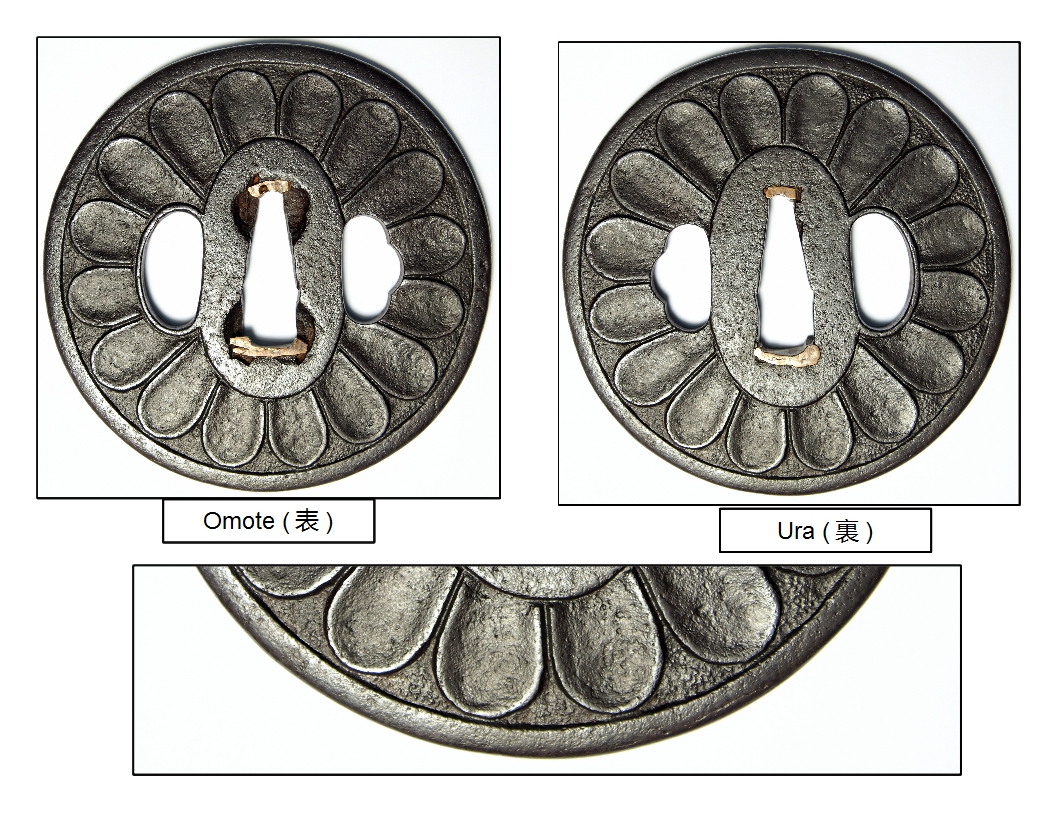
Hi Rick, To me it looks like a Ko-Kinko (old soft-metal work) tsuba with a nice fukurin that was added and/or repaired much later then when the tsuba was made. All in all a good tsuba thanks for posting. I like the mon designs they look like they have been lacquered. The kiku or Chrysanthemum is 16 petals which was used as a Imperial badge. This is often seen in early soft metal work crica the Momoyama Period. Here is a tsuba in my collection also with a 16-petal Chrysanthemum design. I think my tsuba with the same design is a little later from the early Edo Period and made of iron. Is it new to your tsuba collection or on one of your nihonto? Yours truly, David Stiles
-
Hi Everyone, I would agree with Mariusz K. on this the workmanship look fairly poor and in my opinion on par with Meji Period shiiremono. The photo is not the best and I could be wrong but in my opinion not likely. Yours truly, David Stiles
-
Hi Everyone, In my honest opinion the first two look modern circa at or around World War 2 as they look to have been made with mill (i.e. modern) steel. The second tsuba looks like it just came off a Gunto the first is a modern reproduction of an Edo Period open work tsuba. In terms of good antique tsuba the only I see in the set is the third one. The third tsuba I would date from the Edo Period (1616-1868). Would be nice to see more detail photos of it. I hope you find the information is helpful. Sam take a look at my website for examples of antique Japanese tsuba. The link is below. Yours truly, David Stiles
-
Ford Hallam New website
Soshin replied to Ford Hallam's topic in Auctions and Online Sales or Sellers
Hi Ford, Sorry for the late reply. Nice new website. I have slowly been trying to finish my website (link below). The upcoming holiday weekend in the USA will hopefully allow me to update and finish it. Your truly, David Stiles -
Hi Henry W., Thanks for the reply. I love the solid gold fukurin don't see many of them. :D To answer my question above truthfully the longest I have waited for a tsuba is only about four months. Bulding patience and saving money is a work in progress for me. This is not counting the very few high end tsuba that I traded much of my former collection for. Yours truly, David Stiles
-
Hi Everyone, Just wanted to post this link to a new article I found online by very long time collector, scholar, and prolific writer about tosogu Mr. Robert (Bob) Haynes: http://www.shibuiswords.com/joshuHaynes.htm. The website also contains fair amount of information about him you can also search the Tosogu forum and find fair amount of information about his work. It is a really interesting article to read as it discusses his most recent (March 2012) acquisition of a famous tsuba which he waited the last 60 years to purchase. In a era of short attention spans, quick fixes, express shipping, and impulse buying on eBay ( ) it is really refreshing to read about someone waiting that long to purchase a tsuba let alone anything. The take home message I get from reading the article is to keep saving my money for the really nice pieces that sometimes goes up for sale if you are very patient. What is the longest you have waited to purchase a tosogu? Comments, questions, your own stories are welcome. Take care and thanks for reading. Yours truly, David Stiles