
Soshin
-
Posts
2,935 -
Joined
-
Last visited
-
Days Won
3
Content Type
Profiles
Forums
Events
Store
Downloads
Gallery
Everything posted by Soshin
-
Hi Marc, Thanks for the replies and the color photo. From looking at the photo and Sasano book I don't think they are of the same tsuba. Both photos are of the ura side I wonder if anyone has a photo of these two tsuba from the omote side. I would like to examine the chisel marks around the nakago-ana. In a old book of mine titled 600 Japanese Sword Fittings Terms by W. M. Hawley. I came across a figure written in Japanese detailing the chisel marks around the nakago-ana used by the first three generations of the Hayashi Higo school. This might have been used by Sasano to attributed this tsuba to the Sandai Hayashi. Here is a scan copy. Yours truly, David Stiles

-
Hi Everyone, Very nice work Ford. I can't wait to see what he can do with a iron tsuba. :D Yours truly, David Stiles
-
Hi Ludolf, From the characteristics of the workmanship I would think this tsuba is a product of either H 09934 (circa 1850) or H 09935 (circa 1772). They both would sign "Choshu Hagi Ju" along with Tomokiyo. The question now remains is the kao on the tsuba. Does anyone have records containing examples of the two kao used by these two different artists? If so how does it compare to the one on the tsuba? Yours truly, David Stiles
-
Hi Curran, Thanks for the link. The shape of the fruit and placement of five leaves (sometimes only three are showing) indicates the family crest of the Tachibana family of court nobles (kuge) from the Nara and early Heian periods. This would also explain why Sasano used the term "Tachibana" in his description of the design. This is very different then the family crest of the Tachibana family of samurai from the Momoyama and Edo Periods which is more contemporary with the Hayashi Tohachi tsuba. Having more examples of this design used in Hayashi tsuba from Higo Kinko Taikan would be helpful. Yours truly, David Stiles
-
Hi Chris B., Yes the spear shape leaves on the Higo tsuba are similar to leaves of your Mikan example. Not complete sure the shape of a persimmon (kaki) tree leaf as the angle for viewing the leaves in your photo is hard. Thanks for the reply and the help. Yours truly, David Stiles
-
Hi Junichi-san, You clearly have a Choshu school tsuba. Researching anything to do with the Goto school for a iron tsuba like this is pointless as they were soft metal (Kinko) artists that did mostly menuki as well as fuchi-gashira. Some of lower level Goto artists did make tsuba during the Edo Period but they were soft metal and not at all of this style. There might be a few exceptions to this rule during late Edo Period or early Meiji Period. Could you provide a detail front view of the omote side so that the Kanji of the signature is clearly visible. Once I have a good view of your tsuba signature I will look it up in Haynes's Index. Thank you. P.S. I hope this is the first of many. Yours truly, David Stiles
-
Hi Everyone, Taking a break from the typical Owari, Umetada, or Shoami tsuba I often post about. I was going some research about the openwork design of this Higo tsuba made by the 3rd Hayashi master Tohachi. The design is described in Sasano last book on Sukashi tsuba as something like "citrus fruit in mist". I was told by a friend that the same design was pictured in the Japanese book Higo Kinko Taikan which has two Hayashi tsuba with a similar openwork design. Having a scan or photos of these two tsuba along with the caption information would be helpful for my research. Below is a scan from Sasano book page 332 as well as a quote of the text about the openwork design. I feel it is a classical Higo openwork design composition. Last year I was eating lunch at a Japanese Buddhist temple and I had a chance to try for the first time a Japanese persimmon (kaki 柿). Couldn't the openwork design be consider a persimmon fruit in mist and not a citrus fruit? Persimmon do ripen in the Autumn which will often has cool mists in the mornings. Here is link to Wikipedia for more information about persimmon: http://en.wikipedia.org/wiki/Persimmon. Yours truly, David Stiles

-
Hi Everyone, Here are the answers. I wish I was as good at knowing such facts as selling things from my collection. The menuki on the right as you view them on your screen is: The menuki on the left as you view them on your screen is: Yours truly, David Stiles
-
Hi Curran, Those are some really nice menuki. I like Unno Moritoshi work. Quick quiz what are two Buddhist deities poplar in Japan pictured on each menuki. I know the answer and they are both related to the bushi class. Yours truly, David Stiles
-
Hi Everyone, I once had a complete koshirae including kojiri at one time that was all iron with exception of the menuki which were copper if I remember correctly. The tsuba was a large Tempo tsuba with hot stamps of the kotobuki Kanji character. I don't see very many. Yours truly, David Stiles
-
Hi Everyone, I consider Mariusz a friend but I disagree with this statement. My reasons are in my original post. These categories are not arbitrarily constructs of scholars but were based upon how the tsuba was made and the origin of the techniques used to make it. If they were really swordsmiths or armorsmiths making the early tsuba is not complete clear but the techniques that where used to make them were originally developed by armorsmiths or swordsmiths. Therefore it it logical to say a few early tsuba might have been the product of professional armorsmiths and swordsmiths. Hi KM, This whole idea of class change I think it a non issue because swordsmiths, tsuba makers, and armorsmiths were all of the same social class. A armorsmith or swordsmith making a few tsuba as a side job would not cause social chaos be it in the Late Edo Period or the Muromachi Period. In regards to your dimples on your tsuba surface to me they look like the result of rust that has destroyed parts of the surface and the fine file marks. This is not characteristic of great age but of poor preservation by a former owner. Please don't take it personally this is just my educated opinion and I could be wrong. As any serious examination of tosogu or nihonto can not be done by looking at photos on a computer screen. Yours truly, David Stiles
-
Hi KM, Herny W. makes a very good point that is worth discussing in my opinion. The term katchushi tsuba in a pre Edo Period context means a armor maker or his assistants who would work making tsuba as a side business and would incorporate a number of techniques also used in armor making. These include forging method of the plate, openwork design, surface treatments, rim design, lacquering, etc. This is in contrast to a katchushi style tsuba from the Edo Period which while having many of the stylistic characteristic of being made by a armor maker is often made by a professional tsuba maker or in the cases a swordsmith. Here is a good example I like of a shinshinto swordsmith (Tosho) making a Kachushi style Nobuie tsuba: http://www.ksky.ne.jp/~sumie99/tsuba27.html. The original Shodai and Nidai Nobuie use of lacquer and other methods discussed above clearly indicates there skills were of katchushi origin. I hope you find this additional information helpful. Yours truly, David Stiles
-
Hi KM, No the tsuba isn't Aizu. I would say late Edo Period in the style of a Kachushi tsuba of fairly average quality in my opinion. In one photo it looks like you are using a dead bird as a tsuba stand!? :? Yours truly, David Stiles
-
Hi Pete K. and Mike Y., Being interdependent and working for the Hosokawa Daimyo directly I wonder who trained him. Someone can't gain that ability without great effort and much training. Even after such training with such skill what would stop him from being the head master of a established Higo school he originally trained in. Mike Y. said he was overlooked I did a Google search of the name and didn't find anything just this NMB topic. Just looking for additional information about the artist. Yours truly, David Stiles
-
Hi Mike Y., Thanks for posting photos of this tsuba. I really like it. Was the overlooked artist associated with a specific school or did he work independently for the Hosokawa family in Higo during the late Edo Period? Yours truly, David Stiles
-
Hi Kunitaro, Thanks for the reply. Even with good photos they are no substitute for having the tsuba in hand to examine for a few days. In regards to papers I consider them very educated opinions of a human organization that enchance the resale value of the Tosogu or Nihonto. Yours truly, David Stiles
-
Hi John, Nice quick write up of what Zen is. The only minor points I could add is that Chán is the Chinese term for Japanese Zen. Chán was a translation of the Sanskrit word dhyana (meaning meditation) into Chinese. Chinese Chán is a school of Mahāyāna Buddhism notable for its emphasis on Dharma practice and meditation. As for the menuki the expression of wabi-sabi is in the worn gold inlays and the patina of the base metal in my opinion. Yours truly, David Stiles
-
Hi Mariusz K., Some true words of wisdom. Yours truly, David Stiles
-
Hi Curtis R., The lack of a signature on a very ornate and fine works was the practice for gift (kenjo) tsuba. Stylistic and technical techniques of my tsuba indicates it is a work Awa Shoami (Hirata family) school who worked only for the Daimyo family of Awa Province during the Edo Period. Check my website (link below) for a full write up about my tsuba as well as the linked discussion above. Yours truly, David Stiles
-
Hi Jean, Nice menuki set thanks for posting. I would agree with John and say Ezo. Yours truly, David Stiles
-
Hi Curtis R., I did notice something interesting looking at your tsuba. I noticed that the tsuba you posted lacks any yose-tagane around the nakago-ana on the omote side like my tsuba has. The chisel marks with a characteristic shape on my tsuba could have been used as a way for the artist to sign this work without using a formal signature. This would be important specifically for a Kenjo tsuba use by Daimyo or his direct retainers and associates where a formal signature would not be allowed. Yours truly, David Stiles
-
Hi Curtis R., This tsuba you are researching is likely a later copy (circa Late Edo Period) of my tsuba discussed on this tread here: http://www.militaria.co.za/nmb/viewtopic.php?f=2&t=13617. Yours truly, David Stiles
-
Hi Christian, I call it a informal kantei as the tsuba is not papered by a recognized organization and any judgement right or wrong is just my educated opinion as a collector. Yes you might be right about the calling it immediately after posting the tsuba I likely should have waited a bit. In regards to your second question I have never examine any Ko-Shoami tsuba with this many large granular iron bones. Generally they are much fewer and smaller in size on Ko-Shoami tsuba. Also the thickness in relation to overall size of tsuba isn't often seen in Ko-Shoami tsuba as well. Hi Kunitaro-san, You bring up an important kantei point about the jitetsu which is also characteristic of Kanayama craftsmanship. Typically the jitetsu of Ko-Shoami is more of a dark brownish black in color while the jitetsu of Kanayama tsuba are a dark brownish blue in color. In terms of the design at the top and bottom it could be a cross or some other design of European influence. Thanks for everyone's interest in the tsuba. Yours truly, David Stiles
-
Hi Everyone, Here is my kantei attempt at the tsuba. To me it looks like a classic Kanayama tsuba from Owari Province of the Azuchi-Momoyama Period (1568 – 1615) (安土桃山時代). The small size, great thickness, many granular iron bones, hammer marked surface, and the rounded square shaped rim when but together all in a single tsuba with a some what abstract ji-sukashi design is characteristic of Kanayama craftsmanship. Yours truly, David Stiles
-
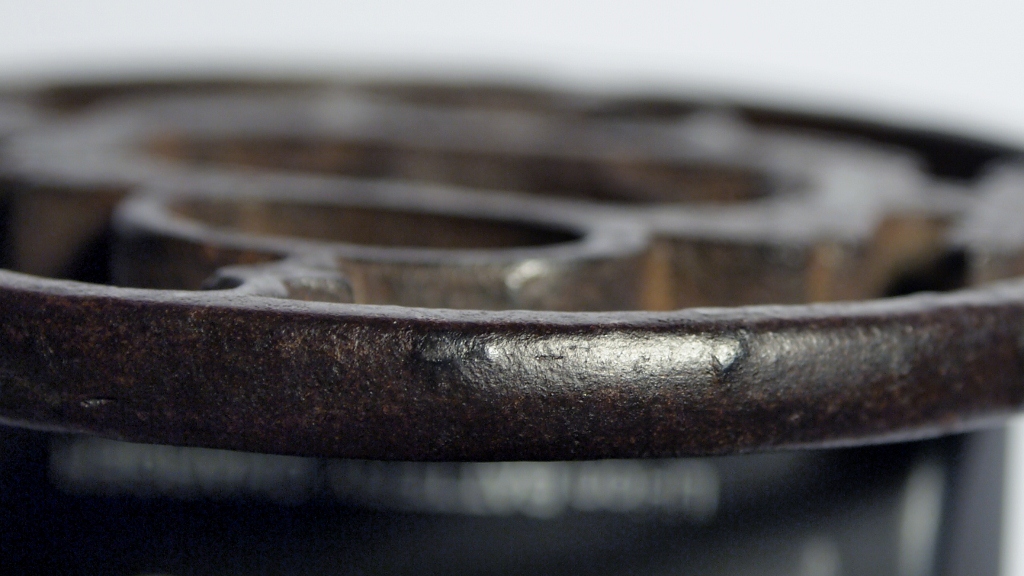
Hi Everyone, A friend of mine and long time collector of Nihonto and Tosogu wanted me to take and post on the NMB some nice photographs and a description of this tsuba that he let me borrow for awhile to study. I will begin with some basic information and some nice detail photographs of the plate and rim. I will then follow with my own kantei of the tsuba. Your own analysis, feedback, and opinions about the tsuba are always welcome. The tsuba has not been papered by any organization. Thank you. Basic Information tem Name: Wild Geese and Pine Trees Japanese Title: 雁に松地透 図鍔 (kari ni matsu ji-sukashi zu tsuba) Material: Iron (tetsu 鉄) Size: 7.0 X 7.0 cm, 5.5 mm at the rim Signature: mumei (無銘) Shape: Maru-gata (丸形) Openings: Ryohitsu ana (両櫃孔) Surface Finish: Tsuchime-ji (槌目地) Attachment: None General Observations Along the rim of the tsuba has many large granular iron bones (tekkotsu). The rim has a rounded square shape (kaku-mimi koniku). Overall the tsuba was a bit over cleaned by the previous owner before my friend specifically along the inside surfaces of the sukashi. It also has a few places where the patina is thin but overall not that bad. Yours truly, David Stiles