
Soshin
-
Posts
2,925 -
Joined
-
Last visited
-
Days Won
3
Content Type
Profiles
Forums
Events
Store
Downloads
Gallery
Everything posted by Soshin
-

New Tampa show
Soshin replied to Stephen's topic in Sword Shows, Events, Community News and Legislation Issues
Hi Jon, Was looking at the online catalogue during lunch and was impressed as well. I agree Bill has done a great job and love the website. I am very much looking forward to seeing more then a few lots in person before the auction. I will be around both Saturday and Sunday with some study pieces and may bring one more tsuba not shown in my above photo to sell or trade. Yours truly, David Stiles -
Hi Junichi, Good question I generally handle all of my iron tsuba with cotton gloves or a white cotton rag. I think this is specificly important with the iron tsuba with soft metal inlay work. For soft metal tsuba and other tosogu I would also use gloves. About two years ago I handled a real iron Nobuie tsuba and I had gloves on the whole time. Getting other people to do this with our collection might be difficult in a club setting. You did what I would recommend and that is clean it right after the club meeting. Yours truly, David Stiles
-
Hi Patrick R., Thanks for the reply. Good observation in regards to the upper part of the seppa-dai. I was just saying in the earlier post that for my tsuba I paid almost twice what the one sold for on eBay. Check Grey D. website if you want to know how much I paid for mine as I purchased it from him. I will PM you shortly about another topic. Yours truly, David Stiles
-
Hi Thierry B., Yes this was the eBay tsuba we were referring to that I placed a link to in my original post to update this topic. Would you care to comment more? The tsuba at Loin's Gate Armory discussed in my original topic linked above show some age compared to the one that recently sold on eBay. This is just my impession looking at the photos of the two tsuba with the same design. From my research I think the design likely dates from the mid Edo Period circa 1700s and was copied frequently during late Edo Period and the early Meiji Period. Yours truly, David Stiles
-
Hi Curran, I have noticed that this open work design is a fairly popular one during the late Edo Period. I was surprised the eBay tsuba went so high in bids ending at a price just a little bit more then half the price I paid for my tsuba. Comparing the workmenship alone of this tsuba to mine is like comparing chalk and cheese. Would be interesting to submit my tsuba for shinsa as I do known that Awa Shoami school did often work using popular designs and were renowned for their carved inlay work for which my tsuba displays much of that technique. Yours truly, David Stiles
-
Hi Everyone, I found this tsuba listed by Zen Gallery on eBay: http://www.ebay.com/itm/221186030694?ssPageName=STRK:MEWAX:IT&_trksid=p3984.m1423.l2649. I wanted to post it here for discussion as the auction has ended. The inlay, patina, and design of the sukashi isn't nearly as good as my tsuba of the same design. The shape of the upper part of the nakago-ana is strange. From looking at photos of the inside of the nakago-ana it looks like the plate and open work was made from cast iron. The chisel marks around the nakago-ana look strange and almost like they were intending to reproduce the marks around the nakago-ana of my tsuba. Comments and questions welcome. Yours truly, David Stiles
-
Hi Mauro P., Thanks for the reply and the link to the papered Kamakura tsuba example. The carving style is the same and is referred to as kōsuki-bori (甲鋤彫). This style of carving found on Kamakura tsuba should not be confused with Kamakura bori which is a style of carved lacquerware made in Kamakura and dates from the Kamakura Period. This carved lacquerware from Kamakura can look like the designs applied using the kōsuki-bori (甲鋤彫) technique on iron Kamakura tsuba. I know it sounds a bit confusing but that was how it was explained to me. Here is a Wikipedia article about Kamakura-bori: http://en.wikipedia.org/wiki/Kamakura-bori. Yours truly, David Stiles
-
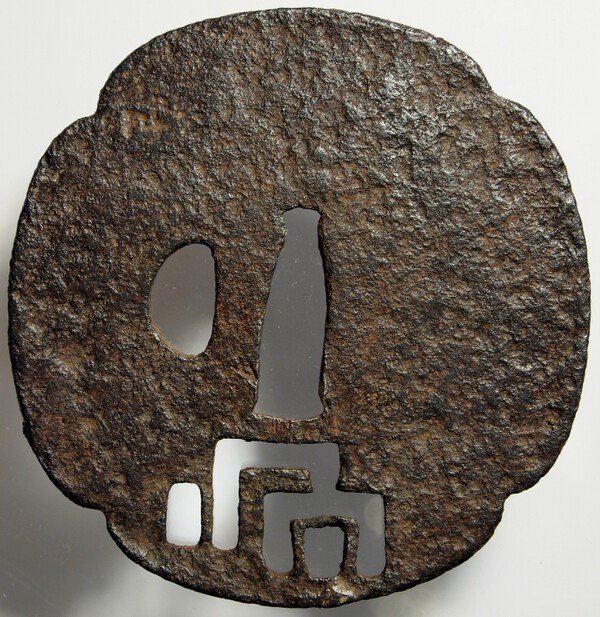
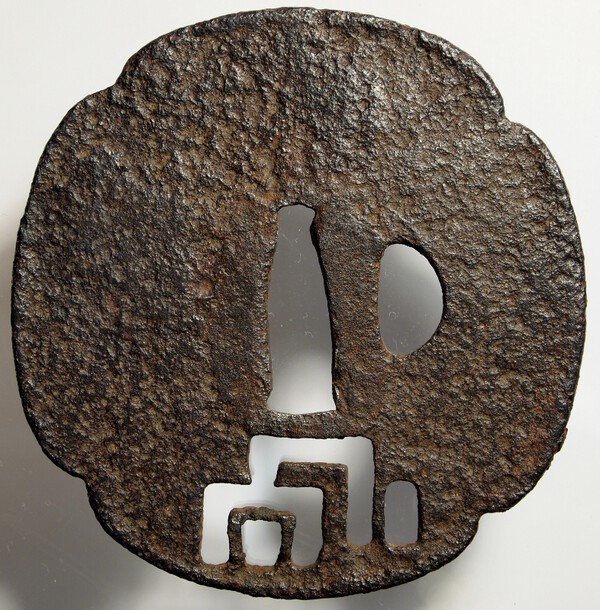
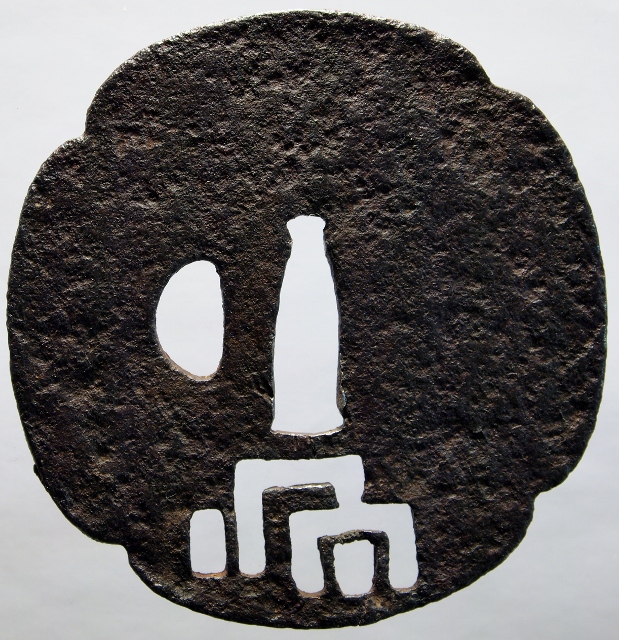
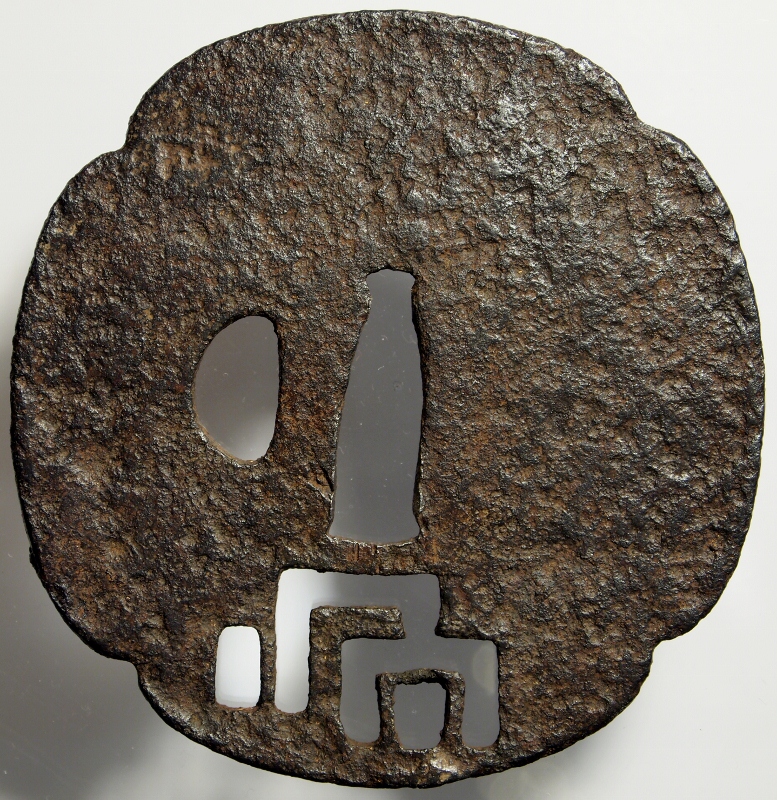
Hi Everyone, Here is a new photograph of the tsuba omote side after the cleaning process. The surface is still not good but I am sure it will now last much longer and none of the ko-sukashi design of the genji-mon was lost. I think it is a Kachushi tsuba. The turn up of the rim into a kaku-mimi koniku (rounded square shape) and the complexity of the ko-sukashi where indicators that it is a Kachushi tsuba were important details pointed out by Henry W. Dating this type of tsuba with damage to the plate is hard. I date this tsuba between the late Muromachi Period to the early part of the Edo Period. I am giving this as the age of piece due in part to thinness of the plate (3.0 mm), large size (8.7 cm), shape of the kozuka hitsu-ana, tekkotsu (yes iron bones and my work with a bone and ivory confirmed it isn't soft rust that is raised above the surface of the rim). This I hope addresses Brian's R. question about the telling the difference between tekkotsu (iron bones) and rust. Any red rust is much softer and removable with bone, ivory, or horn. The hardness and strength of the forged iron also makes me think it was made before the Edo Period. The Genji-mon while very popular in Edo Period was often done in a much more complex manor then it is displayed on my tsuba hence if it is Edo Period it is from the early part of that historical period. Yours truly, David Stiles

-
Hi Everyone, Thanks for all of the replies. I have removed more rust from the surface using bone and small pieces of antique ivory and have about finish the restoration process on this tsuba by rumbing with a white cotton rag. The original photograph was taken right after I finished boiling the surface with distilled water for 20 mintues to remove old oils and glue. I hope to post new photographs later today. Yours truly, David Stiles
-
Hi John S., Thanks for the nice early Namban examples. It is very helpful for the discussion. The first example had a very similar style of rim. Hi Pete K., Funny thing is you were on my mental list to show this tsuba to at the upcoming Tampa show. Thank you so much for posting photographs of Jingo/Shimizu school example using this style of carving technique on iron plate. A nice observation about that specific attribute of Jingo/Shimizu school in terms of the rim and how it transitions to the surface of the plate. Your examples provides a nice demonstration of this important identification point. In regards to shinsa I might bump up this tsuba to the April NBTHK shinsa based upon people's feedback about it. Having the results would be very educational. Ron STL, Thanks for the reply. Yes I did not notice the difference in thickness and size of my tsuba compared to the Kamakura-bori example of Jim G. website. I am going to try to get Jim G. feedback about this tsuba at Tampa show as well. Sorry you cannot make it this year. Yours truly, David Stiles
-
Hi Matt L., You bring up a good point by posting this tsuba which I would consider to be the typical example of the Jingo school workmanship and how they would execute a dragon design. Intresting enough the write up on RiceCracker website say the NBTHK attributed the tsuba to a later generation of the Jingo school. Keep in mind that I am not nearly as well educated as Curran C. and Micheal C. in terms of Higo tsuba. I have mostly just learned things from them. Yours truly, David Stiles
-
Hi Everyone, Thanks for the helpful feedback about the tsuba. It has been very educational. I will be bring it to the Tampa Show to get others opinions in person. I can think of a few people that might be intrested in taking a look at it. I might submit it to the upcoming NTHK shinsa in San Fanisco but I have some time to decide. Searching the Internet for examples I would agree that the kozuka hitsu-ana is shaped like the work of Jingo school but also that it might not have been original to the tsuba. Overall I am getting a strong pre-Edo Period vibe from the tsuba and was a bit surprised by the initial Jingo attribution. Yours truly, David Stiles
-
New Tampa show
Soshin replied to Stephen's topic in Sword Shows, Events, Community News and Legislation Issues
Hi Everyone, I am very much looking forward to the Tampa Show this year. I just wanted to post a photograph of the set of tsuba I will be bringing to the show this year for show and tell. One tsuba will be entering NBTHK shinsa this April. It's the tsuba in the middle of the photo labeled Higo (Hayashi). That's going to be a lot of old iron for a carry-on bag. P.S. Stephen I hope you feel better soon. Take care. Yours truly, David Stiles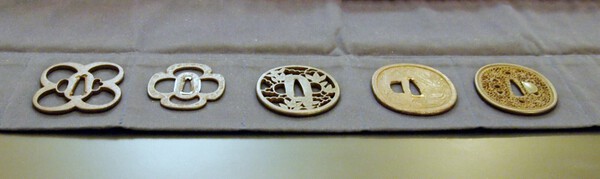
-
Hi Curran, I never address you question directly and I am not sure if my photos were helpful or not. The rim is raised above the surface of the plate but it is not very convex or domed in shape like my really nice Momoyama Period Namban tsuba. I will be bring both tsuba for you to compare and see what I am talking about at the Tampa show. I also noticed some interesting this evening after dinner that this tsuba had the rim decoration only on the omote and not on the ura side. The ura side by contrast is smooth. I have no idea what this means. P.S. I been searching the Internet and found the following Higo tsuba with the same shape of rim: http://www.shibuiswords.com/haynesTsu22.htm. Yours truly, David Stiles
-
Hi Patrick R., Tosa is a province in pre-modern Japan. The old paper is just saying that the tsuba was likely made there. Which in my opinion isn't all that helpful. "Tosa Myochin" is the Myochin school working in Tosa Province. They were well known for making Akasaka and Higo copies of average to very high quality. Check out the Sasano first book as he has some very nice sukashi examples of Tosa Myochin work. Hope you find the information helpful. Yours truly, David Stiles
-
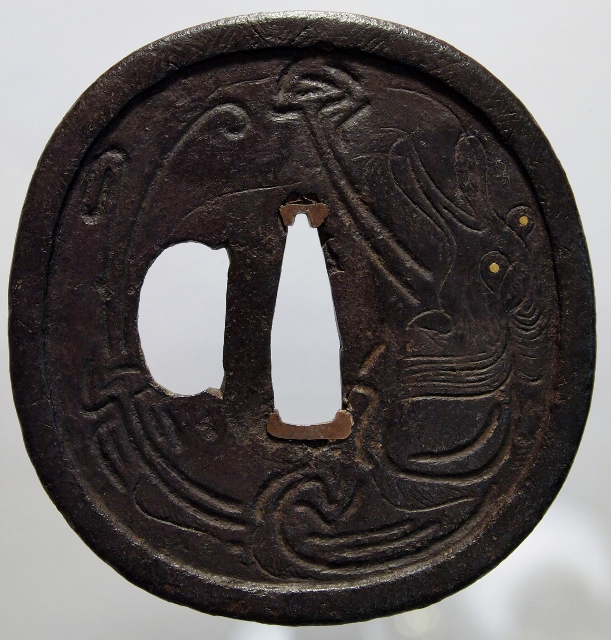
Hi Micheal, To answer your question here is a link to the other tsuba in the lot: http://www.militaria.co.za/nmb/viewtopic.php?f=2&t=14975. Both tsuba came from the same estate. Hi John, I love early Namban work in Iron. That vibe if true is a good one. :D Hi Curran, Here are the additional photographs I did very quickly after returning from work with the camera flash. I can email you and Micheal high resolution photographs if you think in would be helpful. Not sure if they are of any help but tsuba is still very photogenic and I love the dragon's expression. The tsubako was very skillful in my opinion. Yours truly, David Stiles


-
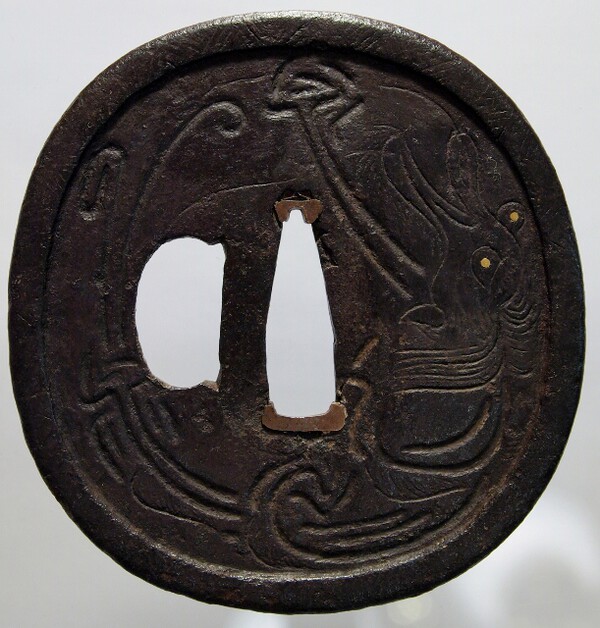
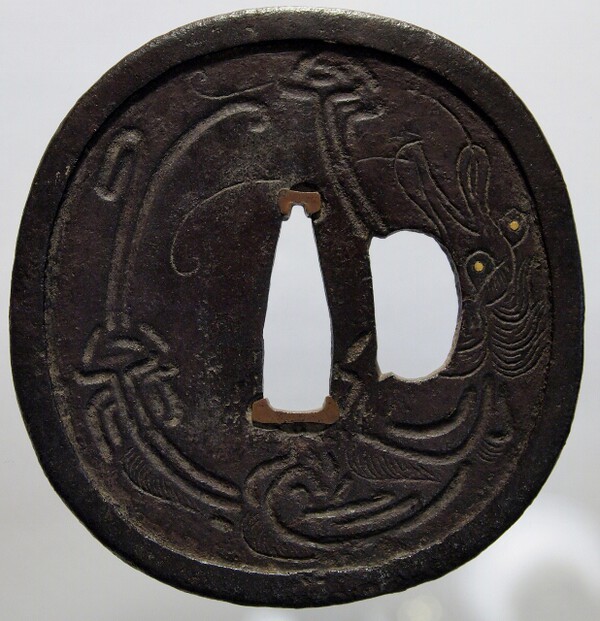
Hi Curran, Did the early Jingo school make Chinese style dragons using low relief carving? I really like the dragon design with the gold inlay eyes. The dote-mimi rim also has a interesting design on it which can be seen on my photos if you look closely. I can post more photos tonight after work. If they are not clear I can bring it to the Tampa show in a few weeks for you to see in person. Now it's back to work. Yours truly, David Stiles
-
Hi Everyone, Been doing some searching on the web myself. Here is a Muromachi Period tsuba with a Genji-mon ko-sukashi design: http://home.earthlink.net/~jggilbert/kamakura.htm. I also found the following Katchushi from the early Edo Period with the same design here: http://home.earthlink.net/~jggilbert/oldiron2.htm. I am not going to dispute the poor condisition of my tsuba but determining its age by the openwork design alone I think impossible. This is just my opinion and I am not going to submit this tsuba to shinsa due to its poor condisition. Yours truly, David Stiles
-
Hi Pete K., Thanks for the reply with the link. Reading the webpage on "Kamakura Tsuba" at Jim G. website was helpful. The last tsuba that he lists has a very similar dragon design without sukashi that he titles "Possibly proto Kamakura bori tsuba" has many similarities to my tsuba including the stylized design, inlaid eyes, and lack of sukashi. The rim of my tsuba looks more like the other Kamakura bori tsuba list on the webpage. The most notable is comical expression of the head and mane of the dragon. Well its time to start baking the pizza for the Super Bowl. Go Ravens! :D Yours truly, David Stiles
-
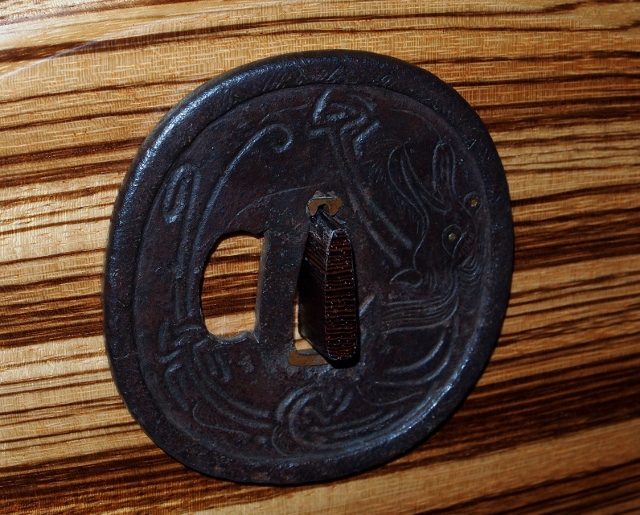
Hi Everyone, Here are some photographs I did this afternoon of the second tsuba from the Sloans & Kenyon Estate Auction lot I won. Here is what the auction catalogue said that this tsuba. I really don't know anything about Kamakura-bori tsuba other then that they don't date from the Kamakura Period but I really enjoy the dragon design with the gold inlay eyes. The surface of the tsuba looks like it has been lacquered at some point in the distant past. The measurements of the tsuba are 8.1 cm (Height) X 7.7 cm (Wide). The thickness at the rim is 4.5 mm and is much thinner at the seppa-dai. I do notice that the kozuka hitsu-ana was I think added later as it disrupts the design of the dragon on the ura side. Comments, constructive criticism, and questions are welcome and thanks for looking. Yours truly, David Stiles
-
Hi Christian M., Thanks for the reply. I think you are correct. Curran C. was nice enough to say the same thing to me via email. I really should take my time and study more and do less selling and buying. Yours truly, David Stiles
-
Hi Pete K., Thanks for the earnest and trunthful feedback. You have really help deepen my understanding of tosogu. I purchase the auction lot because of the second tsuba which I hope to post shortly as a separate topic. In the end it was all just hopful think on my part that I had something special. Hi Brian R., I don't consider myself a fittings or a sword man but I think you raise an important question that should be discussed. My objectivity went on bit of a winter vacation reading the lot description. On the bright side I have saved the tsuba from additional damage even if it isn't worth much. Yours truly, David Stiles
-
Hi Henry, Thank you so much for the links and the additional information it has been very helpful. Reflecting on Sasano words I would agree. I will get my copy of the book and reread that section. My tsuba is likely a really good late Edo Period revival Katchushi tsuba which just shows the skill of the tsubako skills in forging a thin iron plate with tsuchime-ji and tekkotsu. I don't collect tsuba based upon a specific time period and believe their are good quality antique pieces from all time pre-modern periods, groups, or schools. A example of this point is the following tsuba in my collection: http://dastiles1.wix.com/reflections-#!NTHKNPO-Kanteisho-Origami/zoom/c211q/imageuw2. I received positive feedback from the NTHK(NPO) and Chris B. after I submitted it for shinsa. I will still write the short newsletter article about it as I really like the tsuba. Is it alright if I use some of the information you have provided? I will site you and the NMB as the source of the information. I will try to get take photographs of the second tsuba from the auction lot today and will start a new topic thread about it. Yours truly, David Stiles
-
Hi Henry W., After I measured the rim thickness and the fact that it was thicker then the seppa-dai with a small turn up does make me think Katchushi. If it is a Katchushi tsuba the ko-sukashi would not be considered too overally complex. The patina and tekkotsu along the rim makes me think if it is Edo Period it would be the early part or even possibly the Momoyama Period as the kozuka hitsu-ana has a early shape as well as the overall thinness of the plate. I am of the opinion that these works from Momoyama Period or early Edo Period are not revival pieces. The term revival makes me think late Edo Period but I could be wrong with such an association. Yours truly, David Stiles
-
Hi Everyone, Here is the Ko-Tosho tsuba one of a lot of two tsuba I won at a local estate auction last weekend. The auction I won it at is discussed here at the on the NMB: http://www.militaria.co.za/nmb/viewtopic.php?f=3&t=14946. I had to remove some collection stickers and glue mixed with dirt and rust that were likely on it for the last 30+ years but the tsuba cleaned up nicely. I have also spent some time rubbing it a cotton cloth and using a old bone to clean off the active red rust. Here is the information about this tsuba from the action catalogue. Here is my detail measurements of the tsuba: 8.4 (Width) X 8.7 (Height) cm. The thickness at the rim is approximately 2.5 mm and the thickness at the rim is 3.0 mm. The tsuba display a wonderful hammer surface (tsuchime-ji) with many large granular iron bones (tekkotsu) along the rim and surface of the plate. The overall shape is uncommon for Tosho tsuba being a quatrefoil (mokko-gata). The shape of the rim I would describe as a rounded square in shape (kaku mimi koniku). The patina is characteristic blueish-black color intermix with deep browns often seen on Tosho tsuba. The small openwork (ko-sukashi) is of a genji-mon or scent symbols used in Kodo for different chapters of novel Tale of Genji. Here is more information on Kodo: http://en.wikipedia.org/wiki/K%C5%8Dd%C5%8D. Looking at the tsuba from the omote side The genji-mon ko-sukashi looks to be for chapter 11 of the Tale of Genji. Looking from the ura side it looks like the symbol for chapter 23. In terms of age I would say likely mid to late Muromachi Period. Please feel free to comment and questions are welcome. I am planning to do a write up about this tsuba for the JSSUS newsletter so any additional information or feedback will be helpful. P.S. That reminds me I need to pay my membership fee for 2013. Yours truly, David Stiles