
Soshin
-
Posts
2,934 -
Joined
-
Last visited
-
Days Won
3
Content Type
Profiles
Forums
Events
Store
Downloads
Gallery
Everything posted by Soshin
-
Hi Jean, I see two very similar designs to your tsuba in the book Owari to Mikawa no Tanko pages 112 and 113. Let me know and I can PM you a photo of these two pages. I also know that the three generations of Norisuke school in Owari would often use Yagyu designs and would do variations of those designs. This school was responsible for producing many of the later generation of Yagyu tsuba during the late Edo Period in Owari Province. Here is an example of a Ko-dai Yagyu tsuba in my collection on my website: http://dastiles1.wix.com/reflections-#!tsubaof-owari-provice/cxco. Yours truly, David Stiles
-
Hi Jean, The only Yagyu school is the Yagyu Shinkage ryu school of marital arts. Generally tsuba like these they are referred to as Yagyu tsuba. I would need to see the rim and inside of the sukashi as Yagyu tsuba would often show visible layers and tekkotsu. The design itself would also need to be listed in the Yagyu family design books. There is a few references I need to check in regards to the design once I return home. Regardless very nice tsuba thanks for posting. :D Yours truly, David Stiles
-
Hi Ford H., If you were a minister at a church I would likely attend much more often. Point taken I will keep doing my study and research to help developing my eyes and refine my taste. I would go on to say that I have made some progress with help from you and other senior members of NMB. In regards to the tsuba as my avatar it is currently in Japan at the NBTHK for shinsa. I would be happy when I get the results good or bad as it will be an important part of my as well as the person who sold it to me learning process. Yours truly, David Stiles0
-
Hi Ford H., I completely agree with this statement this is a very fundamental aspect of Japanese art in general. Still not going to bid on the eBay tsuba which is the topic. It is not in my taste or budget for that matter. A good discussion on "copies in Japanese art" could be its very own topic. Yours truly, David Stiles
-
Hi Pete K. and Ford H., Thank you. I have never seen forged iron carved with a katakiri-bori method mostly this method is used more often on soft metal tsuba. Ke-bori method is much more often used on forged iron tsuba. The NBTHK shinsa paper I think says ke-bori. On your other point I would agree and venture to say that this is more of a problem with tosogu collectors in the west. Specifically collectors like me who professionally have a background natural sciences. Here is a photograph that details the carving of the arabesque pattern. Enjoy... Yours truly, David Stiles

-
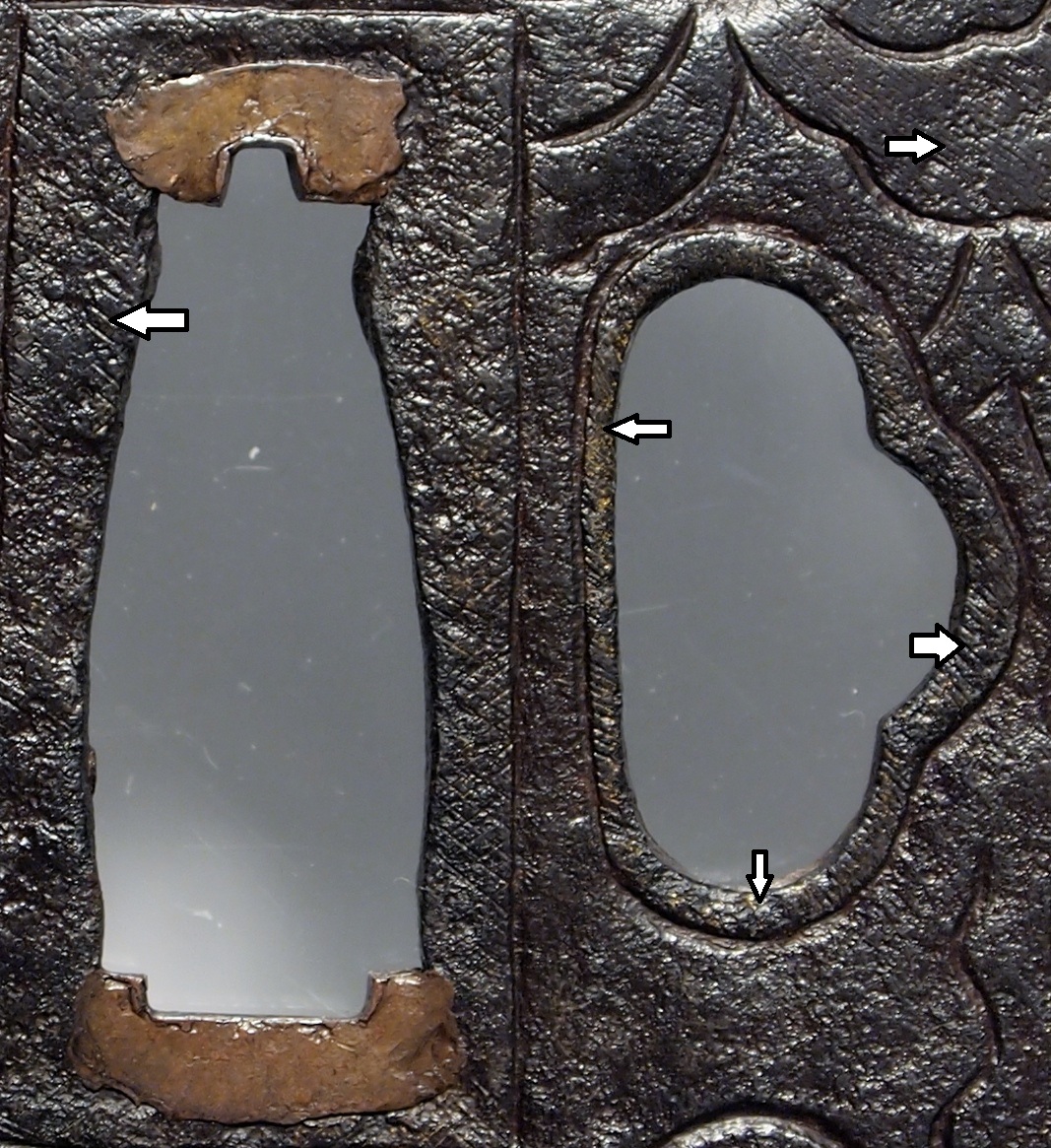
Hi Everyone, I was hopping to get feedback back about this from Pete K. or anyone else more knowledge and experience. What am I seeing here in the above cropped photographs highlighted by the white arrows. First I was thinking it was surface treatment for the application of gold inlays specific (kin nunome-zogan) but now I questioning and not really sure. The little gold that is there might have been rubbed of from a gold plated seppa at some point long ago when the tsuba was mounted on a sword. I notice in terms of file marks that covering the flower designs among the arabesque pattern they are all in one direction which would not make sense for the application of kin nunome-zogan. Normally a very fine cross-hatching pattern is used. It could have been some other surface treatment that has a decorative purpose I am not aware for. Keep also in mind that the plate does displays some nice fine hammer marks. Thanks for taking the time to reply with you opinion and suggestions as for what I am seeing. Yours truly, David Stiles
-
Hi Junichi-san and Curtis R., This is the most important point. Easier said then done but try to do more study... I recommend stopping by Mike Y. (i.e. Tetsugendo) table at the San Francisco show if you can make it. :D Yours truly, David Stiles
-
Hi Mariusz K., That was one of point I didn't state but is an important point the Nobuie/Yamakichibei forgeries are much better and I would consider some of them worth collecting. Many if not all of these Higo forgeries are just plain bad and would consider them not worth collecting. Good to see we are no the same page. In regards to the real Kaneie/Nobuie/Yamakichibei tsuba I collect only photographs and books. Yours truly, David Stiles
-
Hi Mariusz K., This is one aspect I don't like about Higo tsuba in general is that they are often copied and the copies are of such poor quality. This tsuba you linked to on eBay is another example. This is just my opinion. Yours truly, David Stiles
-
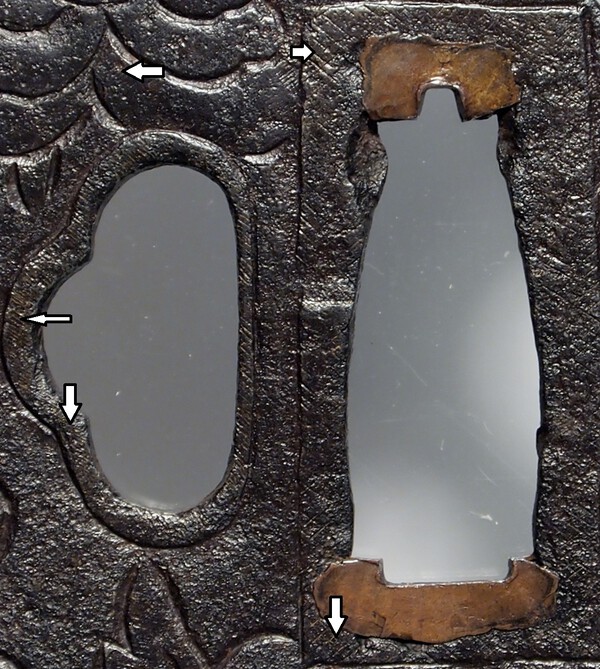
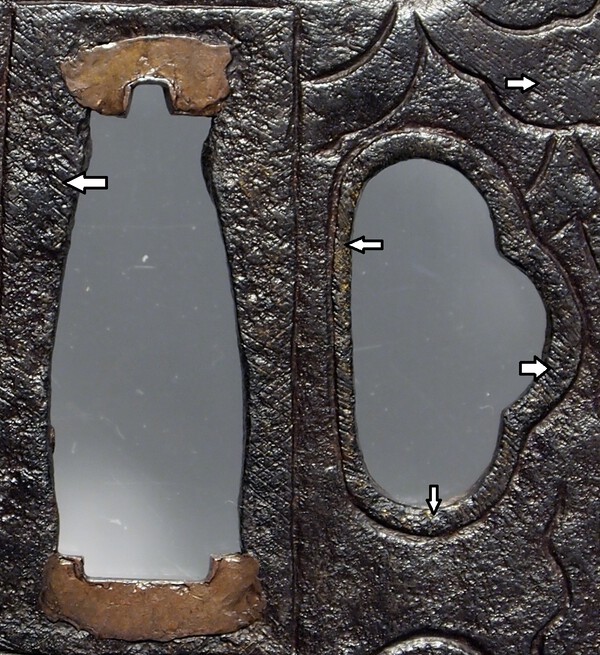
Hi Pete K., Went pack to the raw image files and did some copying, cropping, and editing. The photographs were taken at 42 mm after looking at the file information of the raw images. Here are two edited photographs of the seppa-dai and area around the kogai hitsu-ana. I added with while arrows the cross-hatching texture I was talking about on the surface of the plate around the seppa-dai and kogai hitsu-ana. Some of the arrows are also highlighting were gold is still present. I also notice even finer hatching texture on the surface on the petals of the peony but no inlay soft metal is still present there. Comments and feedback welcome. Yours truly, David Stiles
-
Hi Pete K., If the plate has been cleaned it wasn't a recent cleaning seeing how I have a 42+ year old photograph of the tsuba with the shinsa paper and it looks identical. I am going back to the raw images I have of the tsuba and see if I can crop a image showing the detail I am referring to along the seppa-dai. If that doesn't help I will looking around with someone with a nice camera and a maro lens set. If it was cleaned at some point it was to likely done to remove rust that had already damaged the inlays. Yours truly, David Stiles
-
Hi Pete K., I see the fine cross-hatching pattern the gold was inlay with around the seppa-dai as well as the kogai hitsu-ana. Small amounts of the gold inlays are still present. This is visible if you look closely at it in hand and is more apparent under low magification. My current photographs are at 40mm which is the maximum for my lens set. I would need to get a good macro lens to show the detail I am talking about. I'll try to bring this tsuba to the next show I attend for more people to see it in hand. Yours truly, David Stiles
-
Hi Everyone, I noticed somethings when I as examining tsuba this evening under low magnification. The worn gold inlay (kin nunome-zogan) is confined to the area of the seppa-dai and border around kogai hitsu-ana. I have seen this similar pattern of gold inlay on other early Nanban tsuba before. I also notice between the ke-bori carved designs the surface of the plate displays nice fine hammer marks (tsuchimei-ji). The rim displays both fine and linear tekkotsu. The photograph on http://www.finesword.co.jp/sale/kodougu/htm/1051_2000/1751_1800/1783/k1783.htm website shows a nice example of the thin linear tekkotsu found along the rim. Just some fun observations this tsuba is a keeper in my book. :D Yours truly, David Stiles
-
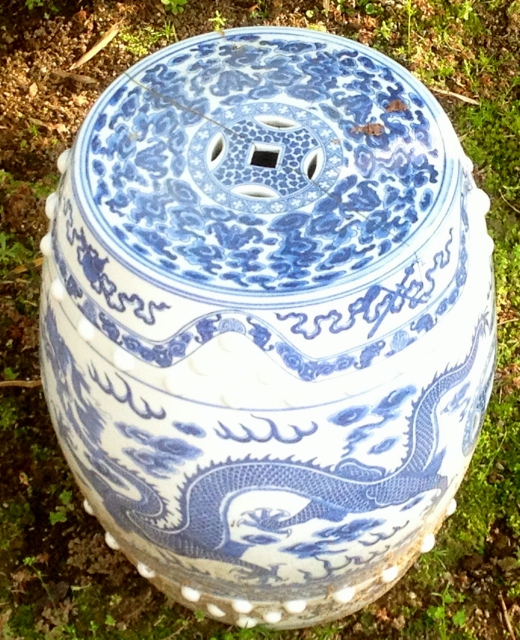
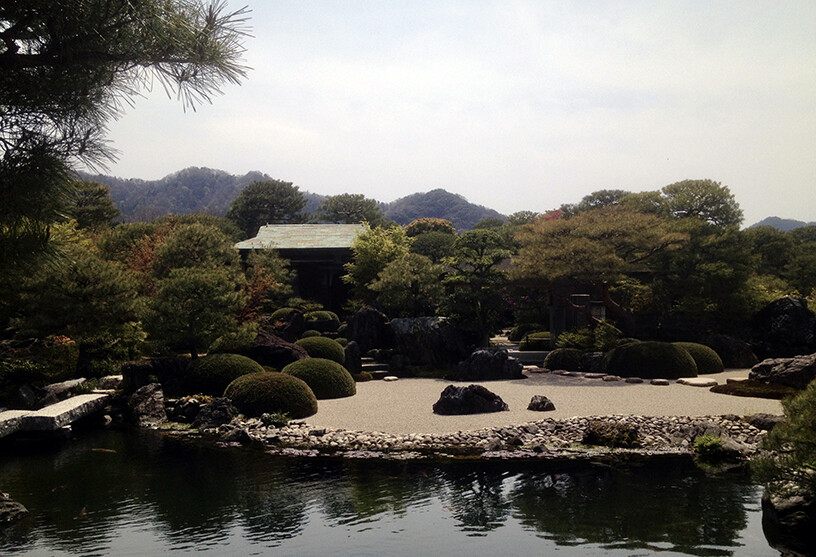
Hi Christian M., I don't see any scandal nor are things traveling swiftly.:lol: I agree with the NBTHK shinsa results and the observations made by Ginza Choshuya. I will be lucky to add much more information. Here is a photograph I did of a garden vase at Glover Garden in Nagasaki, Japan during my vacation. The garden dates from the Meiji Period. Notice the similarities in the shape of the design on the top of the vase to the center of the butterfly openwork design on my tsuba. Yours truly, David Stiles

-
Hi Martin, Thank you for posting your tsuba. What are the measurements including thickness? The thickness measurement I think should be expressed with a standard deviation and number of measurements as they are often don't have a uniform thickness. What makes you think it was made with Portuguese steel? The imported iron the Portuguese bough to Japan was often mined other places in east Asia and not from Portugal. Yours truly, David Stiles
-
Hi Guido S., Thank you so much for taking the time to reply. I think your right shu (手) means "hand, worker, help" as well as "means, way, trick, move, technique, and workmanship". Therefore the most appropriate English translation of the NBTHK shinsa attribution would be "no signature, southern barbarian workmanship". Yours truly, David Stiles
-
Hi Everyone, Ginza Choshuya contacted me via email late yesterday. Here is a link to their write up about the tsuba in Japanese: http://www.finesword.co.jp/sale/kodougu/htm/1051_2000/1751_1800/1783/k1783.htm. The photographs they did of the rim nicely display the details such as the tekkotsu. :D They were thinking it was a Katchushi tsuba done in a Nanban style which I agree with. They date the tsuba as being made during the early Edo Period. Comments and questions for discussion are always welcome. Yours truly, David Stiles
-
Hi John S., In answer to your questions. Style and extreme thickness of rim and thinness of the plate at the seppa-dai, kei-bori carving style, and ko-sukashi design makes me think it is a katchushi tsuba. The other two Kanji above "Nanban saku" I think are for "mumei (無銘)" but it is really hard to read given the writing style. I agree with you interpretation of what "Nanban shaku" means. It would seem the NBTHK was thinking this tsuba was made in Canton, China and exported to Japan. I was reading in Tsuba An Anesthetic Study that this was done in Hizen Province circa 1500. Hi Christian M., All of the abraded nunome zogan (which is seen on a few katchushi tsuba as well) along the plate and seppa-dai plus the design elements such as peonies flowers (botan) along a complex arabesque pattern of vines and leaves (karakusa) makes me think Nanban. Hi Pete K., Thanks for the information. I see where I was in error. Normally I get this right but was incorrect this time around. I will change my notes. In regards to the age I basically agreed when I purchased the tsuba but now have some questions specifically in regards to the NBTHK attribution. Normally NBTHK would just use the term "Nanban" on a paper to describe a Nanban tsuba from the Edo Period. Yours truly, David Stiles
-
Hi Christian M., Not comely sure I understand everything in your post but we completely agree on the most important point that this is a very good tsuba. The NBTHK felt the same way as Tokubetsu Kicho was the highest ranked paper below Juyo when it was issued. Hi Pete K., Thanks for rely. Wasn't sure which side was omote and which side in ura when taking the photos. Still not sure so your reasoning would be helpful and educational to the members and visitors of the NMB. While your at it what is your opinion on the attribution on this old paper written six years before I was born? Yours truly, David Stiles
-
Hi Richard G., Thanks for the reply. That is a good example of what I am talking about but that tsuba is considerably younger then my tsuba. I should contact Elliott Long about my tsuba as he has a intest in Nanban tsuba. The early Edo period age estimate of my tsuba by Ginza Choshuya I would consider very conservative. Noticing the similarities between the gold inlay, large size, and shape of seppa-dai my tsuba to my other early example might mean my dates from the Momoyama Period. Yours truly, David Stiles
-
Hi Everyone, Been spending my time over the weekend translating the NBTHK shinsa document. I noticed something interesting about the attribution. The direct attribution isn't "Nanban" but is "Nanban shaku". Does this mean the tsuba was made in a southern barbarian style? Also it should be noted that this the first Tokubetsu Kicho papered Nanban styled tsuba I have ever seen. On a related note does anyone have or know references for the early Edo Period tsuba maker referred to as Hizen Nobuie? I would like to do a comparison of workmenship. Yours truly, David Stiles
-
Hi Ford H., Great work! :D I hope you do well at the Shinsaku competition held by the NBSK. I didn't see any Shinsaku tsuba while I was in Japan on a two week vacation but I was able to visit three castles, and few museums, temples, and shrines. At some point I would like to add a modern tsuba to my website but in the mean time I need to get back to saving my money. I'll send you a email via your website which I have bookmarked when I'm ready to talk business. Who was the Japanese swordsmith who made the tsuba plate? Looking at the linked photographs you provided the hammer work on the plate surface looks really nice. Yours truly, David Stiles
-
Hi Henry W., The glossiness of the plate surface and the patina of this tsuba is just wonderful. The iron has a really nice feel to it in hand as well. I was kind of thinking the same thing. The kebori carving technique and ko-sukashi was used by Nobuie for his designs along the plate. If Nobuie ever made a Nanban tsuba it would look something like this. :lol: Yours truly, David Stiles
-
Hi Christian M., Yes that is the shakudo insert. It is not a inlay but a small sold piece of shakudo inserted into the very small space. Ginza Choshuya had this tsuba on display on the first floor of the store but I think it was recently arrived at the store on 04/09/2013. I shopped by on the morning of 04/12/2013 and spent the whole morning looking around viewing a few tsuba in hand and drinking some green tea. They had a display tag written in Japanese that said "Kachushi tsuba" and "Edo Jidai Shoki" if my memory is correct. I forgot to ask for the display tag. I have since emailed them in Japanese to see if they can email me the information they had on the display tag. Yours truly, David Stiles
-
Hi Tobias H., Good question from my experience these type of rectangular shaped seppa-dai are common on early Nanban tsuba. Here is another Nanban tsuba from my collection dating I think from the Momoyama Period. I have also seen these type of retangular seppa-dai on published examples in the NBTHK monthly journal and elsewhere. Yours truly, David Stiles