
Soshin
-
Posts
2,932 -
Joined
-
Last visited
-
Days Won
3
Content Type
Profiles
Forums
Events
Store
Downloads
Gallery
Everything posted by Soshin
-

Experiences with Tokugawa Art....sanmei.com?
Soshin replied to benatthelake's topic in Auctions and Online Sales or Sellers
Hi Ben, I purchased one tsuba from them a awhile ago circa 2006 that is no longer in my collection. The transaction had no problems. The price was high for want was a fairly unremarkable unpapered tsuba. I think you can find better deals on NMB or elsewhere on the Internet in my opinion. -
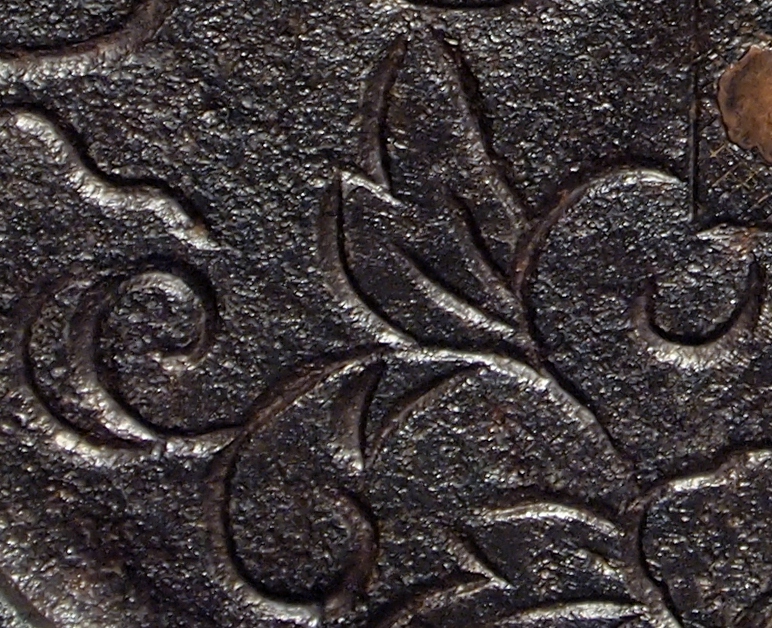
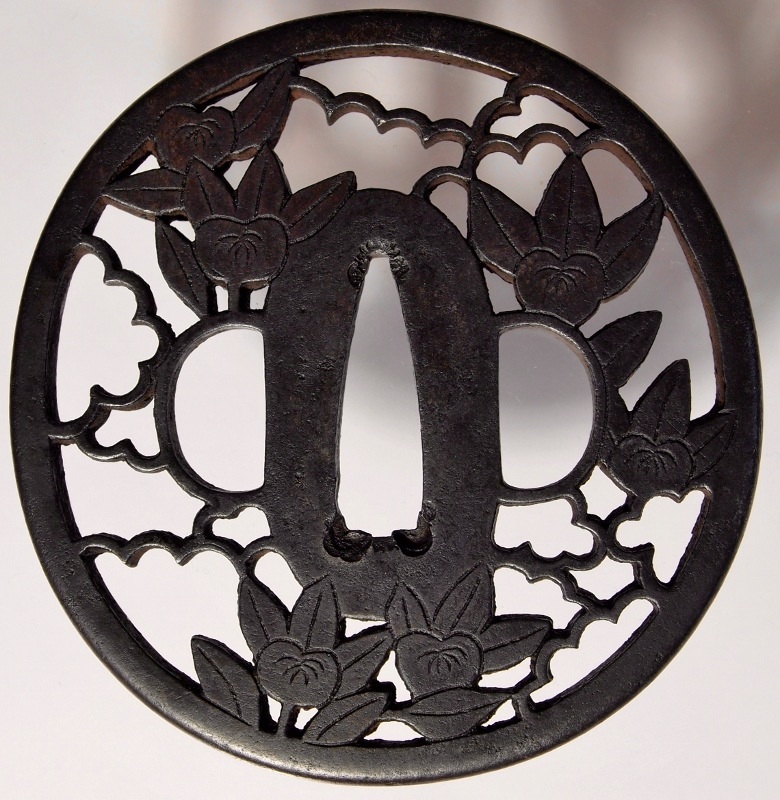
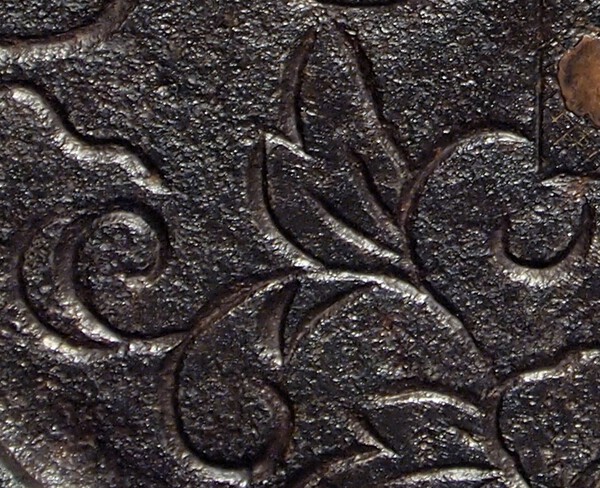
Hi Henry, Sorry for the rant on my last post. Here are my kantei points that make me think the tsuba is the work of either the Shodai or Nidai Nobuie. 1. The complex arabesque pattern mix with Omodaka done with shallow kebori (毛彫) carving on the plate surface. Very different then what you see on my nanban style katchushi tsuba which is kebori (毛彫) carving but is much deeper and technically superior on a plate that is just as thin. Notice also the light unidirectional filemarks along the leaves of the arabesque pattern. Something you also don't see on Nobuie tsuba but are encountered on some Shodai Yamakichibei tsuba. 2. The nicely turn up rim and the great difference in thickness between the turned up rim (4.0 mm) and the central nakago-ana area (2.5 mm). This is fairly common to many pre Edo Period Tosho and Katchushi tsuba. This is a critical kantei point as you don't see this even on the best Nobuie copies produced during the late Edo Period which have much thicker plate specifically near the nakago-ana. 3. The presence of fine tsuchimei-ji intermixed with ji-mon along the plate surface. I would suspect some iron bones tekkotsu (鐵骨) along the rim as well. I would expect to see them if you showed more photos of the rim at different angles and they would be of a granular type. This is in contrast to what is seen on my katchushi tsuba. Here is Ginza Choshuya photos that is display them nicely: http://www.finesword.co.jp/sale/kodougu/htm/1051_2000/1751_1800/1783/k1783.htm. I am referring to the bottom right photo on the web page. 4. The color of the iron patina is consistent with what I have seen of the Shodai and Nidai Nobuie. The first two photos are over exposed and color flushed out but the third photo is helpful in see the iron's real color. I hope people find this write up helpful and I could be all wrong on this as I did fall asleep at Pete K. presentation at the Tampa show 2 years ago until he started telling some jokes. :lol:
-
Hi Everyone, I have recently seen a few good photos of a Shodai Yamakichibei tsuba with NBTHK Tokubetsu Hozan papers by far it was the best pre Edo Period old iron tsuba I have seen. Herny's is a very fine second place regardless either tsuba is way outside of my league.
-
Hi Henry, Congratulations, I am thinking it says Nobuie (信家)! If so I be willing to trade all the tsuba on my website plus my first born child... well just kidding. I still like my nanban style katchushi (Hizen Nobuie) tsuba on my website: http://dastiles1.wix.com/reflections-#!Composite-View/zoom/c211q/images6p and could not part ways with it. This is my honest opinion only.
-
Hi Adam L., I really like it and at the time in Kyoto silver was a very expensive soft metal. That feature I have seen in other high quality pieces attributed to the Aizu Shoami school of the mid to late Edo Period. The head and sometimes the hands would be inlaid in silver. I have never seen feet. Here is a good example of what I am talking about on the Japanese Blog 鐔鑑賞記 by Zenzai: http://blog.goo.ne.jp/tsuba_001/e/2f99837f99a4374b1f71891eb4c8a303. I once had a Aizu Shoami tsuba of Fudo Myo-O that had his sword inlaid nicely in silver. It was from the same time period as this tsuba.
-
Hi Everyone, I did some major website updates. Here is the direct URL: http://dastiles1.wix.com/reflections-. Here is a list of the updates. 1. I added a email subscription feature to me website on the contact page. Here is the direct link: http://dastiles1.wix.com/reflections-#!contact/cvrh. The webpage has a photo of me standing by the giant Buddha of Kamukura, Japan. If you chose join the "Otaku Club" as I like to call it the email updates will be very infrequent, short, and contain only information about updates to my website. I will also never share or sell your contact information to any third party. 2. Added a write up and high resolution photos of a early Saotome school tsuba from the Momoyama Period. Here is the direct link: http://dastiles1.wix.com/reflections-#!Saotome-Sukashi-Tsuba-Composite-View/zoom/c5om/image1kg9. The iron on this tsuba is the best I have ever seen period. 3. Added the kogai to the other Japanese art webpage. Here is the link: http://dastiles1.wix.com/reflections-#!Other%20Japanese%20Art/cowz. Please feel free to contact me either by replying to this topic or PM. Enjoy the website it has been a real labor of love. :D
-
Hi Mike V., That is also a possibility that the tsuba plate is antique and was cleaned and the decoration were added at a much later date. Either way the tsuba isn't something very collectible in terms of antique Japanese sword fittings. Keep studing my website and others and buy a few books. P.S. I recommend the following website: http://home.earthlink.net/~jggilbert/tsuba.htm. It has a great amount of information and with many fine examples.
-
Hi, I think it means odd shape. I once had a papered tsuba with this shape. Thanks for posting photos of this nice tsuba.
-
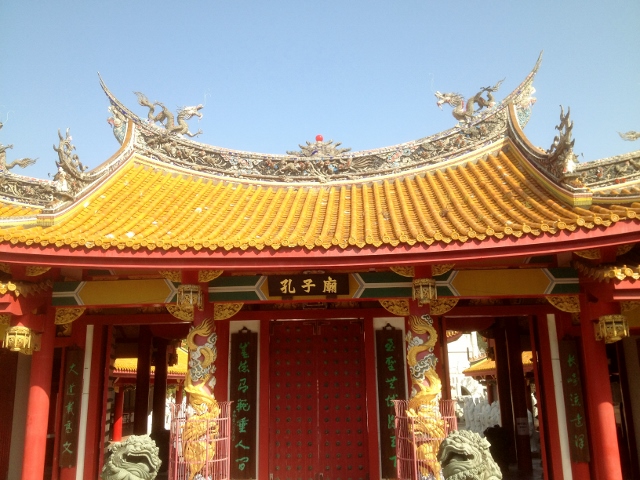
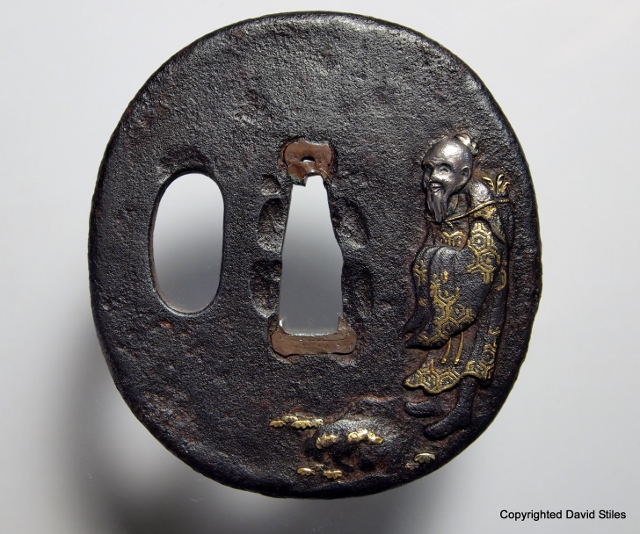
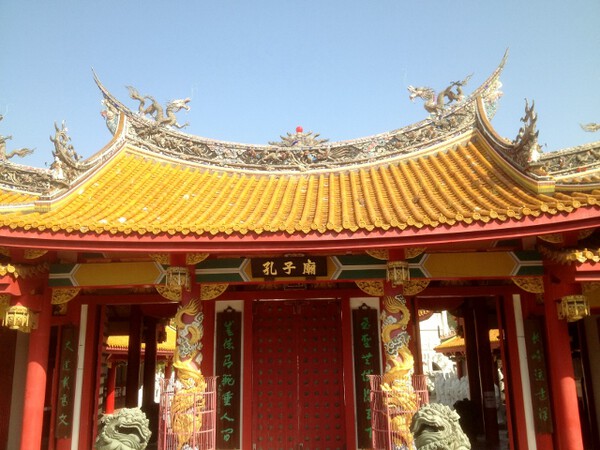
Hi Dan, No I don't think it is beyond the purpose of the topic to discuss the characteristics of the plate which is a significant part of the tsuba. The surface variation on this tsuba is the result of heavy hammering by the tsuba maker when he was forging the iron plate. This would have been done before any of the inlay work was done. While this is antique tsuba may be only around 150-200 years old the age would also enhance this original effect. Ford Hallan has been able to produce iron tsuba with a very nice simulated age effect through want I think is a patination process. There were also Edo Period tsuba makers that would apply a patina and other surface treatments with acid and heat to produce an aged worn effect. The Jingo school of Higo Province would often display a worn effect on its inlay work to make their tsuba look older. Hi Henry, Thanks for the reply. I have a large PDF copy of Henri L. Joly old book I will take a look at during my holiday. I been searching in The Art Appreciation of Japanese Sword Fittings by Shigeo Fukushi. I found a few fine Aizu Shoami tsuba with this type of silver inlay for the skin and hair of people as part of the design. One entry page 48 I think might explain the design and that is the Chinese teacher, editor, politician, and philosopher Confucius. In Japanese his name is Kōshi. Attached is a photo I did of the gate at a Confucian temple in Nagasaki, Japan. Some very beautiful architecture at the temple and museum.
-
Hi Christian M., Thanks for the replies. I started up my enigma machine and I have translated your comments to mean you like it. :lol: (This was only an attempt at a little bit of humor.) I have a little bit more experience with these type of kinko and the heavy hammer iron surface and the turned up rim make me think late Edo Period in my honest opinion. The Aizu Shoami would also often do this iron on iron high relief inlay technique as a base for their inlays of soft metals. The person on the tsuba could be the Chinese wiseman Laozi?
-
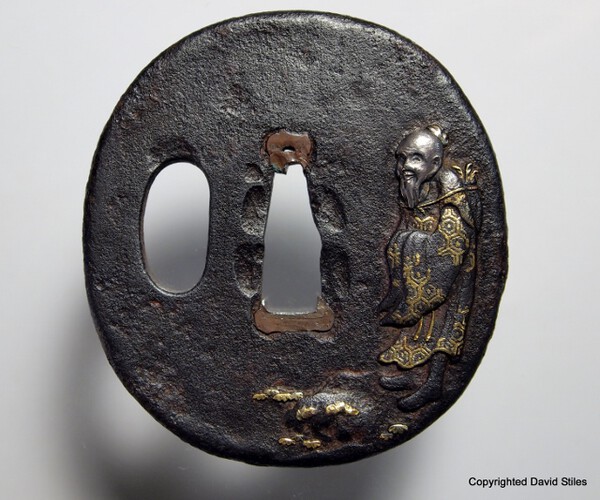
Hi Everyone, Here is a friend's tanto tsuba he wanted me to do high quality photographs of and post a topic about on NMB for feedback and information. He will also want me to provide a write-up about the tanto tsuba. The measurements of this small elongated shaped (naga-maru gata 永丸形) tsuba are 5.4 cm wide by 5.8 cm high. The thickness at the rim is 3.8 mm and approximately 3.0 mm at the seppa-dai and the rim displays a fine turn up. The man face and hair are done silver inlay and the patterns on the his robes and flowers along the streambank are done with gold inlays. To me the workmanship, techniques, and design are all characteristic of the Aizu Shoami school circa the late Edo Period. It is also of my opinion the quality and detail of the workmanship is very good. I am a bit surprised that it lacks a signature. In terms of subject of the design I not really sure. To me it looks like a old Chinese man collecting herbs near a streambank. Does anyone have a reference for this design and its meaning? My friend and fellow collector is interested in learning more details. Thank you for taking the time to answer my questions or post feedback about the tsuba.


-
Hi Mike V., To me it looks like Meiji Period or maybe early Showa work before World War 2. My best advice is to stop and purchase books on Japanese sword fittings or go to some of websites listed at the top of the forum. Check out my website (link is no my signature) it has many examples of antique Japanese sword guards from different historical periods.
-
Hi Everyone, Me and my wife was having dinner with a friend and fellow collector of Nihonto and Tosogu over the weekend and afterwards we were discussing this tsuba of mine when my friend pointed out something important that I did not notice until he pointed it out. The eboshi is in positive silhouette but underneath it there is a man face done in negative silhouette. The man is likely Ariwara no Yukihira. The face is shaped nicely by the ocean waves which are done in positive silhouette. What a wonderful tsuba! I agree with Dr. Tororigoye statement on the hakogaki. Another friend emailed me and said that a tusba like this would make a good cornerstone for my collection of iron tsuba. I fully agree. :D
-
Hi Pete K., That is my point they don't use a "Ko-Owari" attribution term. Look at Mike Y. really nice late Muromachi Period Owari tsuba on the Tetsugendo website. It also has the extract same attribution as my tsuba. Note I am not comparing my tsuba to his just the attribution on NBTHK papers. In the end it doesn't matter.
-
Hi John S., The tsuba you linked to reminds me of this one in my collection. http://dastiles1.wix.com/reflections-#!Composite-View/zoom/c5om/image1v33 I think my is Ko-Umetada because of the turned up rim and strange chisel marks on plate surface intermixed with hammer marks. It is unpapered and gold inlay designs have a strong Kyoto artist influence. At some point I will like to submit it to shinsa.
-
Hi Chris B., Thanks for the correction. I wasn't aware that Fujishiro family started into sword polishing that recently. I know that the Hoami family has been polishing and writing appraisals for many hundreds of years and worked directly for the Tokugawa Shogun. There are Edo Period docurments that discuss the attribution and appreciation of Yagyu and Akasaka tsuba but for most other schools or groups this didn't become wide spread until the Meiji Period. At that time the most common appraisal and/or attribution was in the form of a signed wooden storage box. Hi Pete K., If you check out my website I was originally thinking this tsuba was made in the early Edo Period. I was a bit surpised to see that they attributed it directly to Owari. To simply answer your question the lack of then stating "Edo Period" on the paper makes me think they think it is earlier. From my observations if they think a Owari tsuba is Edo Period they would have stated it as per my two above examples.
-
Hi Arnold F., Tosogu and nihonto attribution by the NBTHK are about the same age a product of the mid 20th Century but as you state Nihonto attribution is much older and date back many hundreds of years by the Fujishiro and Hoami families of sword polishers. I was waiting for someone to ask a all important question. Which was thicker the seppa-dai or the mimi? Generally speaking Owari tsuba have a thicker mimi. It was not asked until your reply. The overall thickness of this tsuba and the jigane is likely why the NBTHK was thinking this was a pre Edo Period work of the Owari school. If the iron bones would have been larger and more numerous and surface showed more hammer marks the tsuba would have likely been given a Kanayama attribution.
-
List of Participants 1. Mauro Piantanida, Point Score: 2/4 Correct Answers: Owari School, Owari Province 2. Hoanh, Point Score: 0/4 Correct Answers: None 3. Curran, Point Score: 2/4 Correct Answers: Owari School, Owari Province 4. W. Brent Tanner, Point Score: 1/4 Correct Answer: Nigaibishi 5. Uwe, Point Score: 1/4 Correct Answer: Owari School 6. Arnold F., Point Score: 1/4 Correct Answer: Momoyama Period 7. David Stiles (website write-up), Point Score: 2/4 Correct Answers: Owari School, Owari Province Participants Kantei Rank First Place: Mauro Piantanida, Curran, David Stiles, Prize: :| Second Place: W. Brent Tanner, Uew, Arnold F., Prize: Third Place: Hoanh, Prize: P.S. I am aware of the lameness of these prizes but the first place people only received half of the available points. Lets all keep up the studying. :D
-
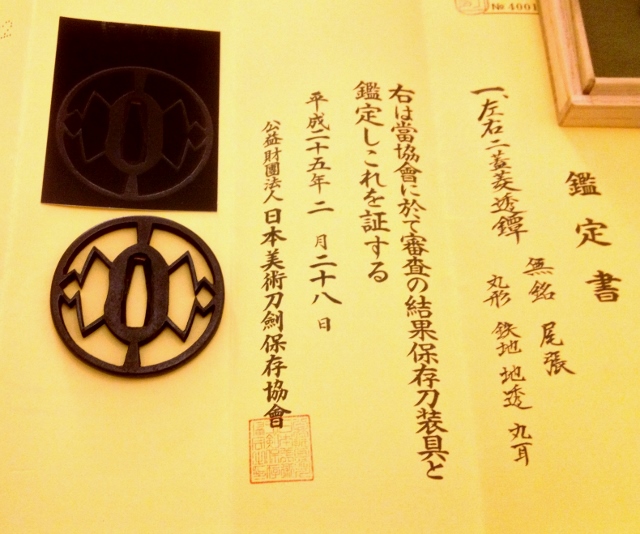
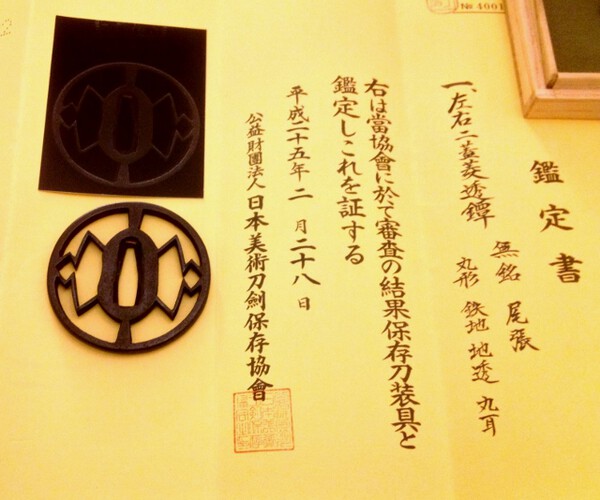
Hi Everyone, Here is my tsuba Kantei results write up. Also included below is a photo showing NBTHK Hozon paper along with the tsuba. Shortly I will also be posting the point score for everyone that participated in the tsuba kantei. Feel free to discuss the results and ask any questions. Tsuba Kantei Results 1. School or Group of Production (ex. Umetada, Kinko etc.) [Who] Answer: The tsuba has a direct attributed to the Owari (尾張). 2. Approximate Location of Production (ex. Yamashiro Province, Hizen Province, etc.) [Where] Answer: The tsuba was produced likely in or near the castle town of Kiyosu-juku (清須宿) in Owari Province (尾張國). 3. Approximate Period of Production (ex. late Edo Period, Middle Muromachi Period) [When] Answer: The patina of the iron is a nice purplish black in color and has the glossy texture characteristics of Owari-jigane (尾張地金). The rim displays a few subdued tekkotsu (鉄骨). The oversized kobon (gold coin) shaped seppa-dai and bold thickness of the openwork design has all of the characteristic of classic Owari (尾張) school of the late Muromachi Period to Azuchi-Momoyama Period (室町 – 安土桃山時代). I tend to think it was made more toward the Azuchi-Momoyama Period but the official attribution wasn't that specific. For additional reference here is a link to a Edo Period Owari tsuba papered by the NBTHK: http://www.e-sword.jp/sale/2009/0910_6049syousai.htm. Here is a second Owari tsuba for reference attributed and dated to the early Edo Period by the NBTHK: http://www.e-sword.jp/sale/2010/1010_6003syousai.htm. 4. Design Motif (ex. shippo, Daruma, etc.) [What] Answer: The positive openwork design of this tsuba is done in ji-sukashi (地透) and is referred to as “hidari migi ni gai bishi (左右二蓋菱)”. This design was commonly used as a family crests kamon (家紋) in fabric designs on clothes, flags, tents, and equipment during the Warring States Period (sengoku-jidai 戦国時代). References 1. Owari to Mikawa no Tanko. Okamoto Yasukazu. Copyrighted 1982. 2. Masayuki Hirako e-sword Website: http://www.e-sword.jp/english.html 3. Mike Y. and Cyrus C. Tetsugendo Website: http://tetsugendo.com/ 4. Tsuba An Aesthetic Study. Kazutaro Torigoye and Robert Haynes. Copyrighted 2007. 5. Wikipedia Article Mon (emblem) Website: http://en.wikipedia.org/wiki/Mon_(emblem)
-
Hi Alex, One thing I have noticed from practicing a style of Ko-Ryu Batto for 7 odd years is that my fuchi is well worn on my iai-to. Is this likely due to my left hand touching it when I grip the handle with two hands. For my next and final practice sword I would want a plain and strong fuchi likely made out of patinated iron. I don't think a shakudo fuchi would cut it in my honest opinion.
-
Hi Ken W., Thanks for the wonderful write up and checking out Haynes auction catalogues would be a good idea to identifity the tsuba in question and determine if it is Mito school or Aizu Shoami school work. As you stated which I was correct first and mixed up later. The overall design and composition is something I have seen in Mino kinko work but the workmenship is either Mito or Aizu Shoami.
-
Hi Arnold F., One thickness measurement was included in my write up about this tsuba for kantei. To state this again the rim (mimi) is the 6.0 mm and seppa-dai is approximately 5.0 mm. I just measured the seppa-dai thickness with the tsuba in hand.
-
Hi Matt, To me it looks like late Edo Period Aizu Shoami school work. Wish the patina was a bit better on the seppa-dai but overall not that bad. P.S. I have seen far worse tsuba come out of the woodwork.
-
Hi Everyone, The NBTHK Hozon paper just came today in the mail for the kantei tsuba. I am bit surprised by the shinsa results and some things on my website write up about this tsuba are wrong and need to be revised. I will be translating over this weekend the paper and will post my explanation along with a photo of the paper early next week (i.e. Monday or Tuesday) along with the point scores for all participants. Feel free to reply now with your answers for anyone who didn't reply in May. PM me if you have any questions. Thank you.
-
Hi Pete K., The design of the fruit with first three and then two leaves I think is significant to the kamon design. Here is a tsuba of mine that in going through NBTHK shinsa this month with a similar design as your box. P.S. Very nice kogai.