
Soshin
-
Posts
2,932 -
Joined
-
Last visited
-
Days Won
3
Content Type
Profiles
Forums
Events
Store
Downloads
Gallery
Everything posted by Soshin
-
Hi Denis, I was aware of the shippo design before this topic. The term shippo (七寶) is referring to the seven treasures that adorned the western paradise of Amida Nyorai in Pure Land Buddhism. The two major sects of Pure Land Buddhism in Japan are the Jodo Shu and Jodo Shin Shu there are others. I sold two iron sukashi tsuba in Nov-Dec of last year on NMB with this design. Both of these were made in the early to middle Edo Period. This was part of a quick holiday sale to purchase a Higo tsuba. The owners are on NMB so I hope they can post some of my photographs or their own of these tsuba. One was really simple and plain the other not so much. My tsuba I posted a photo of above dates to the early Edo Period made likely in Hizen Province this was the judgement of the store I purchased it from in Tokyo. The NBTHK Tokubetsu Kicho paper attached to my tsuba does not discuss age. Your tsuba I would date a little bit later likely mid Edo Period. I hope you find the information helpful.
-
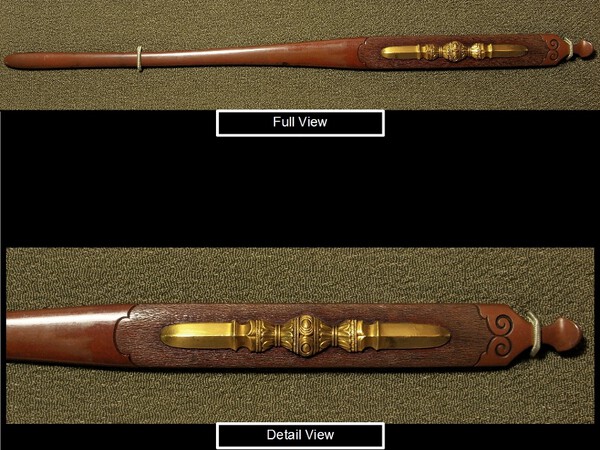
Hi Henry, Well the really nice Daruma tsuba sold off of my website so I needed to replace it with something Buddhist related. I am thinking the kogai was likely a custom piece made for a Buddhist Priest or someone who was a lay-priest. Hi Jamie and Brian R., Thanks for the nice comments. I really lucked out on this kogai that I won at auction. I forgot to state in my original write up that it is mumei (no signature) on the reverse side. Was wondering if more information about who could have made it and when be obtained by examining the techniques used? The warabite design at the top of the kogai is nicely carved using a katakirbori technique.
-
Hi Everyone, Via PM I was accused of being a iron only lover when it comes to tosogu. Well just to prove the private naysayer wrong here is something completely different that is new to my collection. I am still in the process of doing a write up of what information I have researched and conducting more research. Here is my write up in terms of what the design is. I am more confident of the accuracy of this information. Here is what I have written up in terms of the age of the kogai and what techniques were used to do the design. I am much less confident of the accuracy of this information. Please help and feel free to discuss.
-
Hi Pete K., lol :lol: :lol: ... Thank you so much for pointing out my funny typo before I added it to my website.
-
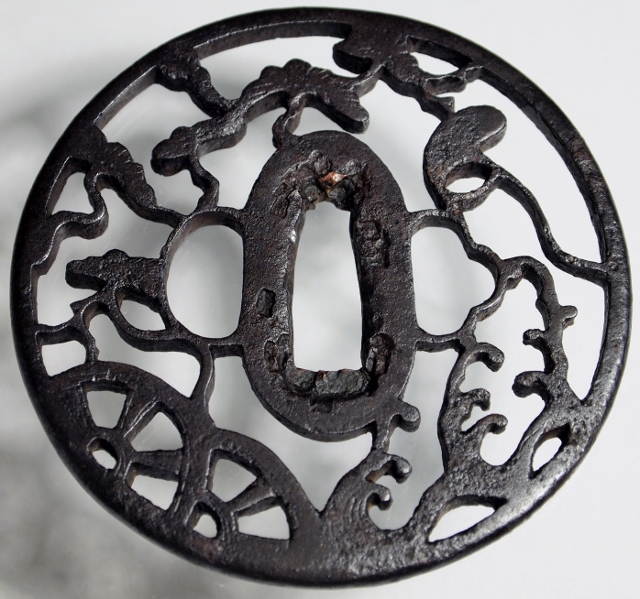
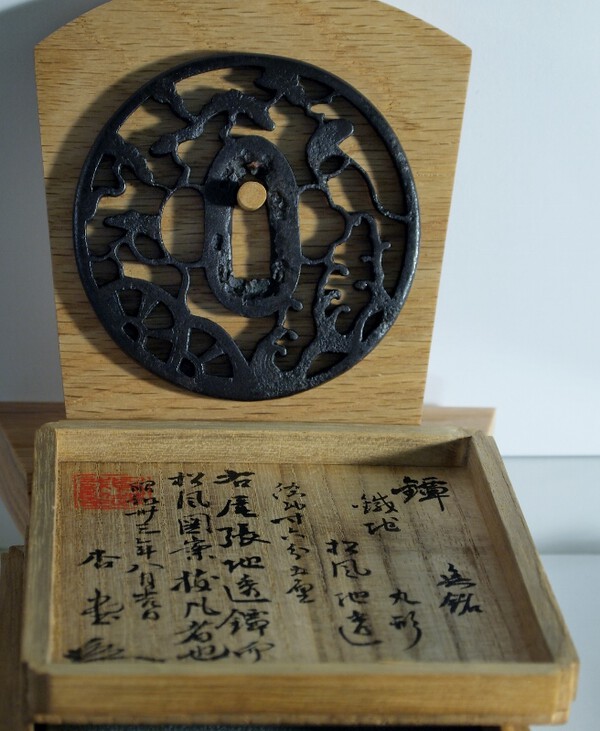
Hi Everyone, This afternoon I was able to take a some photos that are better in focus. The glossiness of the purplish/black patina makes the tsuba sometimes hard to focus when photographing. I love the dynamic characteristics of the waves and the windblown pine. It gives a bold energy to the openwork design I don't often see in Owari Sukashi tsuba. Enjoy the better photo. Feel free to comment and discuss. I will be adding this tsuba to my website over the weekend.

-
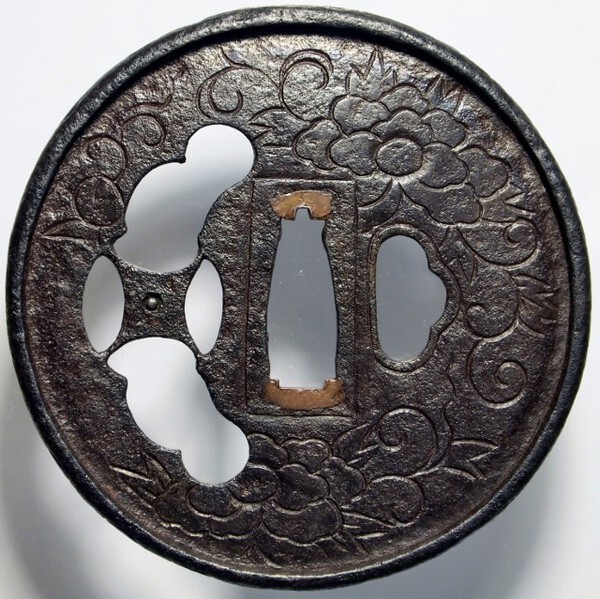
Hi Denis, Here is a tsuba that is part of my collection. From my iPhone for the first time. Note I didn't take the photo with my iPhone. Do you see the shippo design?
-
Hi Jean, I agree the surface of the tsuba and the signature looks strange to me as well and the surface is not tsuchimei-ji but ishime-ji maybe. Keep in mind I only have experience with iron tsuba (Umetada, Owari Province, Katchushi, and Tosho) I know next to nothing about Tanaka school. P.S. Purchase my first non menuki kinko tosogu last week. I am sure to receive negative feedback about it when or if I post photos of it.
-
Hi Justin, While the design would be common to the Mito school the workmenship is clearly Aizu Shoami or possibly Mino School. I should have stated in my original post. Age wise I would still consider this likely made in the late Edo Period.
-
Hi Lee B., To add to your comment I have seen solid gold sekigane before as well as.
-
Hi Chris K., In my opinion what I am seeing is a cast reproduction. That is of quality intended to fool collectors. I can't be sure from low resolution photos and not having the tsuba in hand. I hope the place where it was purchased has a return policy for a refund or exchange. P.S. I hope I am wrong on this but I don't think I am.
-
Hi Alexander, Well in my opinion I would date this tsuba to the late Edo Period circa early to mid 19th century. They were trying to capture the style that was polular during the Sengoku-jidai of the late 16th and early 17th centuries. The heavily hammer surface and turned up rim was very popular during this time period. The workmenship and style of the design is consistent with the Aizu Shoami school along with the Mito school they were both prolific and the styles and techniques overlapped greatly. Somestimes I can only tell the difference if the tsuba is signed with a signature.
-
Hi Everyone, I just updated my eBay auction with this information for the tsuba I am selling. Follow the link below at my website if what to know more. Normally a tsuba maker in most cases could fit a existing tsuba to a sword by the addition of one or more sekigane or by increasing the size of the nakago-ana. I met one tsuba maker that will do this as a service. On old tsuba you can often see signs the tsuba has been mounted on many different swords sometimes with different koshirea styles.
-
Hi, I would also need to agree with Lorenzo on this one. Wonderful tsuba and a very nice find on eBay! :D
-
Hi Mariusz K., I would need to agree with Mike Y. I would say Saotome School likely Momoyama Period or early Edo Period. This is just my opinion. P.S. I really love the iron on that tsuba. :D
-
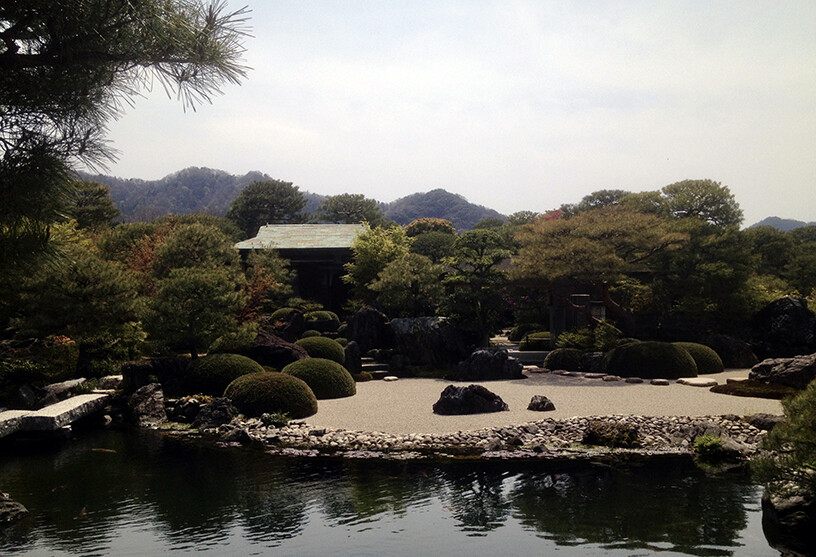
Hi Curran, Thanks for the reply. I think you are correct in terms of the openwork design is Matsushima and that this tsuba has a strong Kyoto artistic design. Short pine trees growing on small rocky islands are often resented this way in Japanese art. I was at a very similar location in Kyushu during part of my honeymoon. Here is a photo of one of the kujukushima islands near Sasebo, Japan. I was able to take this photograph while I was on the deck of a large tour boat. The sea was very calm unlike what is depicted on my tsuba.

-
Hi Everyone, Thanks for the information. Don't know much about the Echizen Kinai school will try to do some reading about this school. I need to state something that may not apearent to the general reader of NMB that I am sure Christian M. is aware of. When the term "late Owari Sukashi" is used it is referring to the time period around the Kanbun to Genroku eras of the Edo Period (circa late 1600s). To but this in more of a context the working period of the first generation master of the Hayashi school was during the Genroku era.
-
Hi Christain, I don't lave a copy of that book so I couldn't verifity the statement and he could have been confusing it with another book or which tsuba I had bid on eBay that Rich T. listed from his fine collection. Interesting thing about this tsuba is that Dr. Torigoye listed it as "Owari Ji Sukashi". While I agree the seppa-dai displays the classic "koban" gold coin shape everything else is atypical for a Owari Sukashi tsuba. The very fine kebori carving, thicking of the plate from rim to seppa-dai, and the purplish/black patina reminds me of early Hayashi school work. Early Hayashi school work also have this koban shaped seppa-dai up until the time of the third generation master Tohachi.
-
Hi Everyone, Just enjoying my Sunday afternoon after coming back from New York. I found some free time to take some photographs of a new iron ji-sukashi tsuba added to my collection. Here are the measurements: 8.1 cm round and is 4.6 mm thick at the rim and 5.0 mm at the seppa-dai. The surface as as nice magaki-ji with fine kebori carvings highlighting the pine trees, waves, and wagon wheels. The patina is a wonderful glossy texture and is purplish/black color. The second photograph is the tsuba with its hakogaki dated 1938 written by a former owner Dr. Torigoye. I would like to learn more about the lovely openwork design. A friend say that a very similar or possibly this tsuba was published in the Japanese book Nihonto Koza. If anyone as volume 6 that focuses on tosogu that would be great. Feel free to discuss and ask questions. Thank you.

-
Hi Jean C., To be as specific as to the artist is next to impossible with a unsigned piece like this. In my opinion it is a Bakumatsu era (Very Late Edo Period) Hamano school work of good quality. The different soft mental inlays look nice.
-
Hi, I hope this the first of many :D. I agree with David N. your tsuba is the work of Umetada Tadatsugu. He would often sign his work just "Tadatsugu". I can check Haynes's Index once I am home for more information.
-
Hi Everyone, As much as I like Pete K., wonderful piece I am with Brian R. please purchase a camera. If you worked with the old analogue camera I sure you can learn how to use a DSL in short order. I learned most of "technique" reading the manual and emailing questions to Richard G. and Rich T. Keep in mind I also practiced taking many photographs. Richard G. has a really nice PDF in the documents section of NMB that was very helpful. Just my two cents and the end of my ranting.
-
Hi Pete K., Thanks for sharing the katakiri-bori looks really nice on the shibuichi base. I would agree the illustration from the Meikan was likely taken from the fuchi in your fuchi-gashiwa set. Yours truly, David Stiles
-
Hi, This I think is related to meaning of a koku of rice that I stated above. He likely made tsuba as a side business to make extra money in addition to his appointment as a sword polisher.
-
Hi Everyone, Not sure if I should list this here or in the wanted section of the message board. Moderators and Adminstrators feel free to move it if it is in the wrong section. I will not be able to attend the upcoming NTHK shinsa at the San Francisco show and was wondering if I could find someone to take one or two tsuba from my collection to the show to submit to the NTHK shinsa. I would prefer someone who in the USA who might also be submitting things to the shinsa as it would be fairly easy for me to ship them the tsuba before the show in July. I can pay a reasonable fee for the service in addition to the cost of the shinsa and shipping. Please PM or reply to this thread if you or someone you know can help or if you have any questions. Thank you very much for taking the time to help.
-
:lol: :lol: :lol: