
Soshin
-
Posts
2,939 -
Joined
-
Last visited
-
Days Won
3
Content Type
Profiles
Forums
Events
Store
Downloads
Gallery
Everything posted by Soshin
-
Hi Justin, I would need to agree with Henry this tsuba is a mismatch in style from the handachi koshirae but not in theme. I have examine the tsuba in detail including the inside surfaces and I can't find anything that would make me think it isn't from the late Edo Period to Meiji Period Kamiyoshi school work possibility the work of the second master doing a popular Higo design and signed by kesho-tagane as he often did. It had a minor rust issue (common to Kamiyoshi tsuba I have read) in places on it but I have worked on it with bone and old ivory and it is fine with only minor pitting in a few places. The patina is wonderful and is textbook for the Kamiyoshi school. I currently have a sukashi Higo tsuba at NBTHK shinsa but this one I would consider is better in terms of the design and kebori carving workmanship. P.S. I will try to do some sunlight photos in my free time tomorrow and will post them.
-
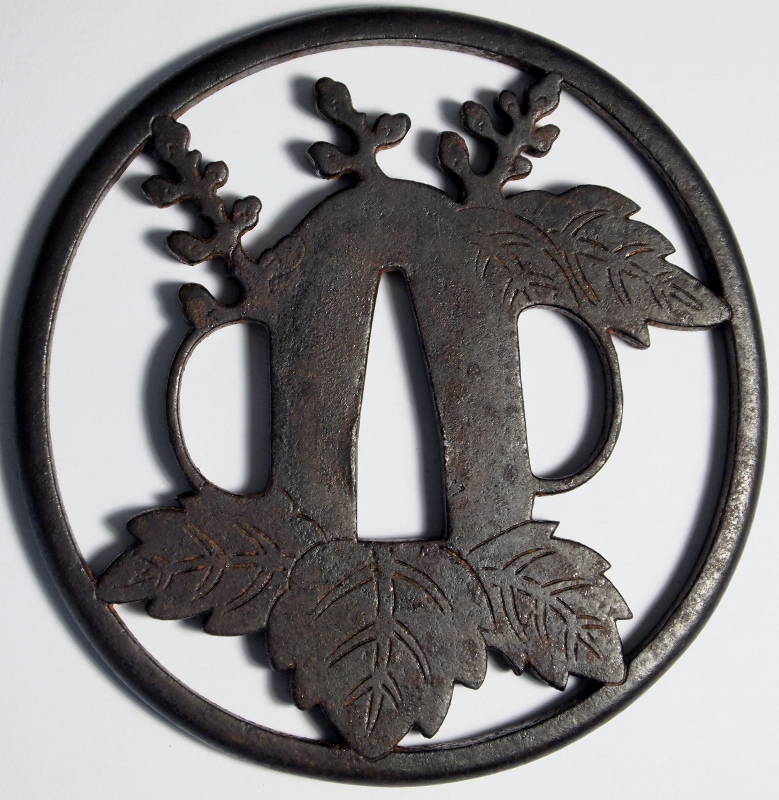
Hi Everyone, Here is the iron tsuba for the following koshirae discussed here: http://www.militaria.co.za/nmb/viewtopic.php?f=2&t=16704. The measurements of the tsuba are 8.0 cm wide by 8.1 cm high. The thickness is 4.6 mm at the rim and 5.0 mm at the seppa-dai. The ji-sukashi design is of a dancing paulownia (Nagekiri). The is fine line carving (kebori) used to highlight the design. The design was made popular by the Nishigaki school of Higo Province as well as the fourth master of the Akasaka school in Edo. This is tsuba I think from my research is the work of the Kamiyoshi school of Higo Province. A similar signed example can be found on page 249 of Early Japanese Sword Guards by Masayuki Sasano. The chisel marks around the nakago-ana only on the omote side I think can be attributed to second master Fukanobu of the Kamiyoshi school as there are seven clear marks at the bottom and four marks at the top characteristic of Fukanobu and not Rakuju the third master. P.S. I purchased the koshirae because I wanted this tsuba. :lol:
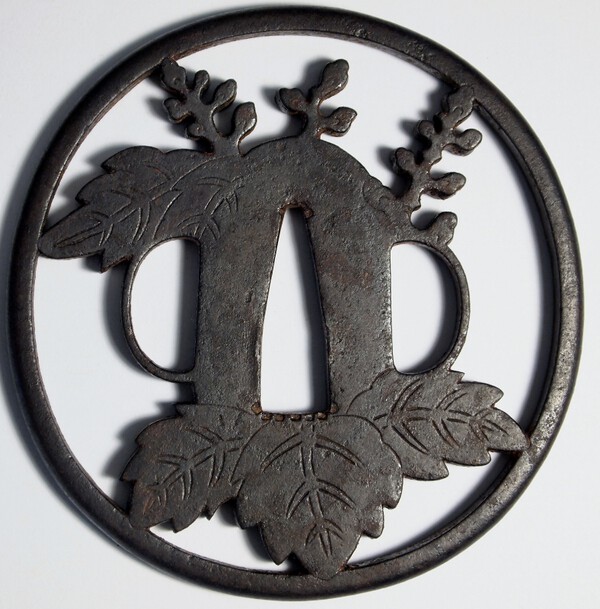
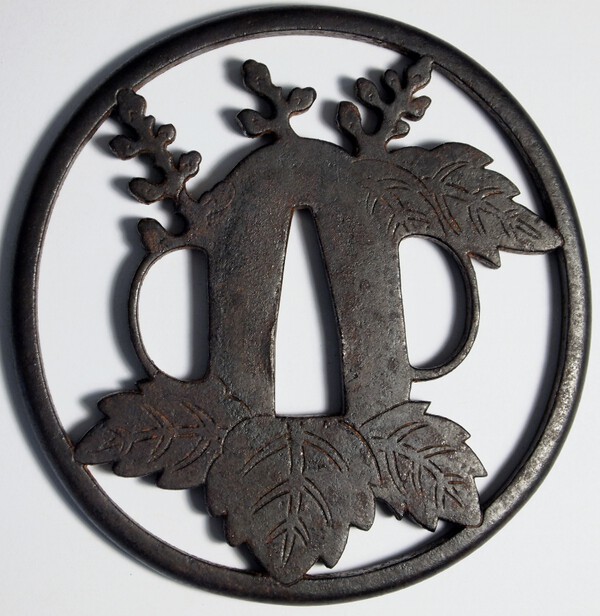
-
Hi Chris B., I don't know the answer to your question. I do know soft metal like shakudo and gold are often cast unlike iron used for tosogu. Shortly I will be posting the tsuba for this koshirae as its own topic and my educated opinion as to its origins.
-
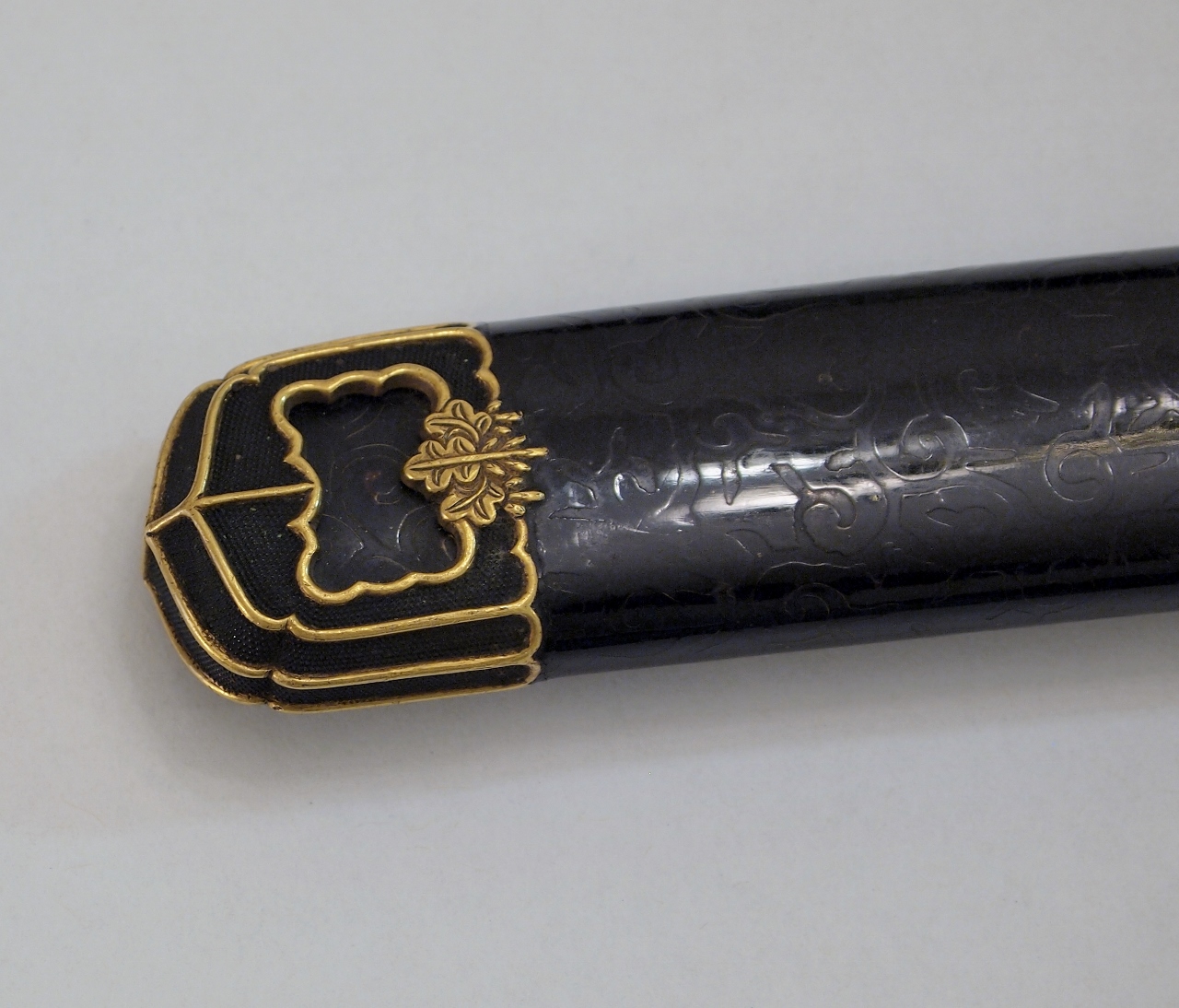
Hi Andreas, I did a double look at the areas that you highlighted and I stand by my statement. What I see in hand is a little bit of dirt and oxidation. The fussiness is likely my poor focus as the gold borders is much higher than the nanako base on all the fittings. Here is the zoom photo of the nanako from the end piece of the saya. The pattern is very regular and what you were pointing out in my photograph was a artifact of my poor photography.

-
Hi Guido, Thanks for the information. The stylistic elements are clear even though the workmanship is like comparing chalk and cheese. It looks like I have a high quality handachi koshirae made of gold and shakudo mismatched maybe on purpose with a iron Higo tsuba with a kiri-mon. Regardless I really like this set of kodogu. It will also makes it easier to find a set of matching menuki and kozuka assuming I can find something at the same level of quality. P.S. Thanks for the information Malcolm for the correct name of the end piece of the saya. The saya is remarkable but I don't know what that effect in the lacquer is called. P.S.S. Henry I was thinking of purchasing that book or PDF but I am so much in the "red" right now with my collection I will need to sell one or two tsuba.
-
Hi Junichi, Sorry I missed your reply. Here is the high resolution photo of the kojiri. The shakudo is jet black in color and the gold is a strong contrast. Hi Henry, I will take photos tomorrow of the tsuba and post my opinion as to its origins. Now it is time to sleep.

-
Hi Henry, Thanks for the reply. I was posting this for discussion with the hopes to learn something as I not knowledgeable in koshirae styles. I was just thinking it was a Higo koshirae because the Higo tsuba has a kiri-mon design in ji-sukashi similar to the kojiri. The kiri-mon was during the late Edo Period a pro Emperor symbol used by samurai in Higo and other provinces supporting the overthrow of the Shogun. The handachi style I was assuming was just generally popular during the late Edo Period. The soft metal kodogu reminds me of Goto school work mostly because of the high quality nanako in a shakudo base and with solid gold highlights. The fact all of these matched fitting of good quality are still together is something I consider remarkable.
-
Hi Everyone, Here is a composite of photographs I did today of a Higo koshirae I purchased from Japan. The tsuka was damaged and the menuki, kozuka, and kogatana were lost at some point. What is there now I think was meant to keep the matching fuchi-gashira together. All other tosogu are present and in good condition. The lacquer work on the saya is ... All of the fitting with exception of the Iron Higo tsuba have a fine shakudo nanako base with solid gold highlights. The iron Higo tsuba I will post later as its own topic later this holiday weekend. The full length wooden tsunagi will also be its own topic as it has some very interesting things about it.
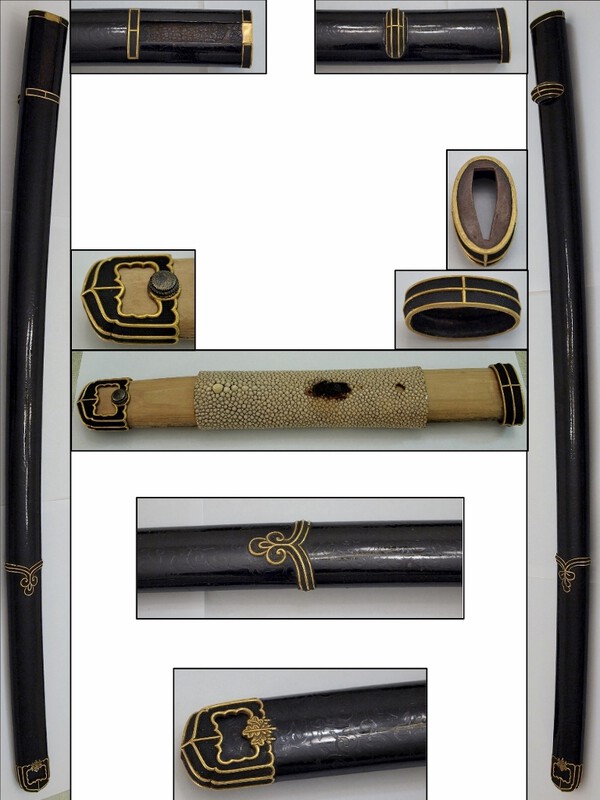
-
Hi Junichi, No rust can't get under the patina unless you are talking about sever damage such as rust pits to the surface caused by saltwater or acidic rain, which I don't see on your tsuba. It can get under lacquer and other surface treatments such a ibota wax. I have noticed that this will happen to modern fakes that that have been artificially aged but this is due to the fact that a correct patina was not applied to the surface of the tsuba in the first place. The second observation is very common and often seen on iron tsuba that have been mounted for long periods of time. Hope you find this information helpful.
-
Hi Brian R., Funny day with the typos. :lol: My wife found my pronunciation of that word even funnier being Japanese. I need to do some work on the tsuba as it has a minor rust issue over the long holiday weekend. I will also do some research in regards to the tsuba. I will take photos of the other fittings over the weekend and arrange a composite image. I will be sure to rename all parts with funny sounding names. :lol:
-
Hi Everyone, I was wondering about the best way to photograph a antique katana koshirea. Should I photograph each part or the whole thing at once? The koshirea is a matching, original, and almost complete so one photo together might be nice. Most of the koshirea is soft metal with the exception of the tsuba. Any advice, references, or examples would be helpful. I will have the koshirea on display at the upcoming Baltimore Japanese Sword and Cultural Show in late September at my display table. Thank you all for taking the time to reply. The photos will be used for my own reference and to facilitate online discussion on NMB.
-
Hi Chris, Point taken about the rim. I was also thinking it was a bit on the thin side as well. I should have looked at Grey's website longer and found the perfect example from the Holbrook collection. I think the link to the tsuba at the Silk Road website is a good example as well.
-
Hi Chris K., After reading your nice topic about Kishu Teimei tsuba I am wondering about this tsuba that was once in my collection. Here is the URL: http://www.japaneseswordbooksandtsuba.com/store/holbrook-tsuba/h268-edo-tosho-tsuba. It was only signed with a single Kanji character sada (定). Very different then some of the examples you provide. The workmanship in terms of the openwork design, rim and overall size reminds me of Kishu Teimei school. I have better photos of the tsuba but wasn't going to post them as I no longer own the tsuba.
-
 Hi Everyone, In my opinion the table prices are reasonable. On Friday I decided to purchase a table from Bill Green at the upcoming Baltimore Japanese Swords & Cultural Arts Show. I will have all the tsuba and other Japanese Art on my website (weblink below) at the show for September 20 and 21. I will also display something interesting recently purchased from Japan not listed on my website or NMB. I am very much looking forward to this show. Please feel free to contact if you have any questions. Thank you. :D
 -
Hi Mrs. Paul, I love the thousand money design made popluar by many fine artist from Hizen Province. If you look closely you can see them doing the hear no, see no, say no evil design.
-
Hi Everyone, This is just a friendly notice about a labor day sale on my website that starts today August 25, 2013 runs until September 2, 2013. All items with prices are discounted by 20% (website list price times 0.20 to obtain discount) but for members of the NMB the discount is 25%. Here is the direct link to my website: http://dastiles1.wix.com/reflections-. Please feel free to reply, email me via my website, or send me a PM with any questions. Thank you. :D
-
Higo or not, that is the question...
Soshin replied to Soshin's topic in Auctions and Online Sales or Sellers
Hi Everyone, Thanks for all of the helpful PMs. They were very helpful in making up my mind. -
Hi Grev UK, Good luck with your project. Let me either via PM or through my website if I can be of any help.
-
Hi Junichi, I have purchased tsuba from the eBay seller and found him a very good in terms of the sale and communication. The specific tsuba I would date to the late Edo Period. The surface has a tsuchimei-ji appied very strongly which was common to Mito school work during the late Edo. The large overall size is also consistent with this time period. In terms of actively this cannot be completely judged because thier are no side views of the rim. I think this would have been a good tsuba if you like the kamon design.
-
Hi Everyone, I was wanting some opinions about the following tsuba for sale on the internet: http://www.japaneseswordbooksandtsuba.com/store/holbrook-tsuba/h295-higo-manichibo-tsuba. I haven't purchased it but I am considering it. If I do decided to purchase it then I would need to sell something from my current collection. Check my website in regards to my current collection. Thank you for taking the time out of your busy day to offer your honest opinion as I am not knowledgeable in regards to Higo tsuba, different schools, copies and modern reproductions. P.S. I have permission of the owner of the website and tsuba to post this question on NMB.
-
Hi Pete, I completely agree but it is best not to enrage the tsuba fashionistas... Just a joke guys just relax... I was meaning this to be a light hearted topic. Not rehash old debates about if these tsuba were made by armorsmiths, swordsmiths, or virgin shrine maidens. The last one is my current working theory. :lol: P.S. Here is a link on my website to a NBTHK papered Katchushi tsuba of mine that has a very similar rim http://dastiles1.wix.com/reflections-#!Art-View/zoom/c211q/images6p. It also has signs of black lacquer as well along the plate.
-
Hi Everyone, Here is want I have for "gori no to" which is the design on the left. The above quote is a small part of a entry taken from Encyclopedia of Japanese Martial Arts by Dr. David A. Hall. P.S. John S. comment is true as similar style markers are often found in Japanese graveyards. Keeping in mind that cremation was often done and still done in Japan as part of a Buddhist funeral ritual so the term headstone would not be applicable in this case. P.S.S Barry T., yes I posted the ura and not the omote. I can post the omote later if necessary.
-
Hi Barrie B., I remember being told this was a important kantei point for Saotome tsuba. I think it was Jim Gilbert who told me two years ago at the Tampa Show. His website has some examples some papered: http://home.earthlink.net/~jggilbert/tsuba.htm.
-
Hi Alex, Here is the English translation provided by the NBTHK on thier website [http://www.touken.or.jp/]. Hi Brian R., How do you think I purchased this unpapered Katchushi tsuba.