
Soshin
-
Posts
2,931 -
Joined
-
Last visited
-
Days Won
3
Content Type
Profiles
Forums
Events
Store
Downloads
Gallery
Everything posted by Soshin
-
Hi Mariusz K., What type of Japanese sword or koshirae style would this Ko-Kinko tsuba be mounted on during the Muromachi Period? For example would it have been used on a early uchigatana or possibly a ko-daichi? Having a photo of a intact koshirae from the Muromachi Period using this type of tsuba would be interesting.
-
Hi John S., Your imaginary friend has a really strange name. :lol: P.S. My imaginary friend is named Yamakichibei (山吉兵へ). He thinks Bernard D. has a Choshu tsuba. He always likes to make me write his name using the correct kanji and hiragana.
-

Ebay, a good place to sell?
Soshin replied to Alex A's topic in Auctions and Online Sales or Sellers
Hi Everyone, Overall I think it is. I really can't do this hobby without selling once in a while. With said my website updates are almost complete. :lol: I find it a overall good experience. All the really nice things seem to have buyers before I even get to listing it on eBay. -
Hi Jean, Japan has many different aesthetics favoured by different samurai groups during it pre modern historical periods. The aesthetics of a Yagyu, Kanayama, or Ono tsuba are very different then Kyo-Sukashi or Higo iron tsuba but all of these very different aesthetics are equally valid in my opinion. This was one of the first impressions looking at Sansao first book on Sukashi tsuba. Jean C., There is also signs on the omote side of the tsuba being hit hard by a sword two or three times. Any cast iron tsuba being hit with a sword would have broke into pieces. Here is link to what I am talking about: http://www.ksky.ne.jp/~sumie99/tsubacastiron.html. The person in the article was able to break a cast iron tsuba with a plastic hammer. It may take me 16 to 18 months to get this tsuba ready for submission to NBTHK shinsa. I will post again when I am finished removing the lacquer and I have slowly naturally repatinate the surface.
-
Hi Christian M., Thanks for the additional photos of my tsuba. Funny to learn that this tsuba once had papers. I first viewed this tsuba at the Tampa Show this year and fell in love with it. This love was reinforced for me when I saw Jack F. exhibit of Yagyu tsuba from all three production periods at the Baltimore show in September. I do disagree with one point and that is my overuse of "Tsuba an aesthetic Study" I didn't even use it as a reference in my kantei write up. Hi Jean C., The above statement was intended as a light hearted joke. Humor is a hard thing to communicated across cultures and I sorry I didn't intend any disrespect. The question of it being cast is pointless. It was recently lacquered and the lacquer is still in the process of being removed by the former and by me the current owner. If anyone is taking advice from this website or any other website on the internet about antique Japanese swords and not independently thinking about the facts and do their own book and in person research they are setting himself up for big trouble. This is not an attach on NMB but just a general statement about the internet. Hi Pete, I have a copy of the book you linked to. It is a fine reference on Yagyu tsuba.
-
Hi Christian, We agree in the most important point that is a nice Yagyu tsuba example. The other details would be a interesting discussion topic for a new thread. There are a few later Yagyu tsuba copies signed Bushu. Most of scholarly work done in Japan thinks Yagyu tsuba came from Owari Province. This is due in part to the documented Yagyu Shinkage Ryu swordsmanship being formally associated with Owari han and its training of samurai. Sasano in his books as well as others have put forward that many of the early Yagyu tsuba were made by independent artisans located in Owari Province including members of the Ôno school. I would not be completely surprised upon submitting this tsuba to shinsa if it comes back as being attributed to the Ôno School. Hi KM, Thanks for the reply. Keep in mind if carving was very crisp it wouldn't be a Yagyu tsuba. I like the fact that some carving is interrupted by iron bones and other features of the iron. The tsuba is not in the best condition but is still a really nice and classic example of a Yagyu tsuba in my opinion. I am planning to have this tsuba in my collection a very long time. :D Hi Henry W., Thanks for the quick reply. I will give a 3+/4 score for the quick reply. :lol:
-
Hi, I would agree with Guido S. likely a mercury gilding which is a real technique when used not to simulate Shinchu Hira-Zogan (flat brass inlay). I hope I am wrong but to me it looks like a quality Japanese reproduction.
-
Hi Fred D., Do you have Haynes Index? If so I would look up the ID listed by Grey D. as Haynes would often have some dates listed with the entry sometimes from dated examples of the artist's work. In my opinion based upon the style of the design I would estimate middle to late Edo Period circa 1670 - 1864. During this time the Choshu school with it's many subschools were very popular.
-
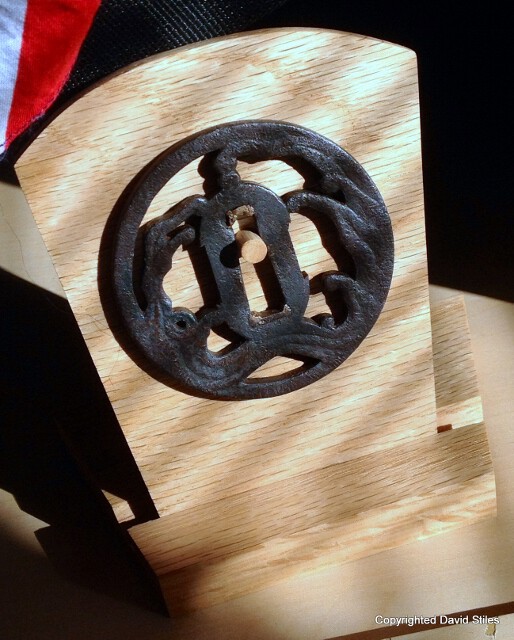
Hi Everyone, Here are the list of participants and Kantei point sources along with a smiley face rewards. :lol: 1. Henry W. Point Score: 3/4 Reward: :D 2. Paul B. Point Score: 0/4 Reward: Remarks: "Yagu" is I think the sound I made when I hit myself with a set of nunchuks in Karate class. Here is a YouTube video of what I am talking about: http://www.youtube.com/watch?v=oXvxtTTiMks. 3. Jean C. Point Score: N/A* Reward: Remarks: *Answers reminded me of someone under oath in a court of law trying not to self incriminate himself. Making it very hard to judge. 4. Alex A. Point Score: 2/4 Reward: :| 5. Christian M. Point Score: 2/4 Reward: Remarks: Love that you included the a picture but didn't include all of the information. 4. Mauro P. Point Score: 3/4 Reward: :D P.S. Here is a photo of the Yagyu tsuba ura side this afternoon in Sunlight near a window. Enjoy.
-
Hi Everyone, To wrap up this informal tsuba kantei. Here is my is a write up of my opinion with additional photos. I will come up with the point scores and smiley face rewards shortly. P.S. I used the following references for my write up Owari to Mikawa no Tanko by Okamoto Yasukazu and a article written by Markus Sesko on this blog: http://markussesko.wordpress.com/2013/07/31/yagyu-tsuba/.
-
Hi Fred D., Very nice Choshu tsuba. Thanks for sharing. P.S. Grey D. does run some fine deals on his website.
-
Hi Guido S., Very nice! Thank you for sharing. You had a very nice trip to see the DTI and NBTHK exhibit this year. Next time I go to Japan I hope it will be in October so that I can attend the DTI. :D I was thinking of updating this topic with news. I found a matching handaichi tsuba and o-seppa at the Baltimore for this koshirae and then quickly sold it off to cover the cost of the show and a new tsuba. I still have the original mismatched tsuba from this koshirae which I will be submitting to NTHK-NPO shinsa next year.
-
Hi Mike Y., Very nice thanks for sharing. :D
-
Hi Brian R., The tsuba has a very good provenance that includes a high end international auction house but I would not say foolproof. Notice the following word in the title and body of the topic. Informal Hi Everyone, Thanks for the participation so far. I will post my opinion as to the kantei of the tsuba later in about a week. I will post better photos over the weekend the current photo was taken with my iPhone.
-
Hi Everyone, I would like to do a informal tsuba kantei of a tsuba new to my much smaller more focused collection. Here is the basic information about the unsigned iron tsuba that is unpapered. Basic Measurments: 7.4 cm X 7.2 cm, thickness is 4.5 mm at rim and 4.8 at seppa-dai. Rim Shape: Square shape. Other Noticable Features: Very sandy and hard iron with lamination layers of the iron visible along the inside surfaces of the openwork and to a less extant the rim. The rim also display iron bones. What I am looking for in the answers is the approximate period of production, area of production, openwork design, and school or group that made the tsuba. Each bit of information is one point. I will write up a detail answer to all of these questions and added up the scores after a week or so. PM me if you have any questions.

-
Hi Christian M., I agree this tsuba is a interesting and a very appealing example of Ko-Kinko work. Comparing the seppa-dai shape and size it is similar to early Kanayama tsuba from the Muromachi Period. The tsuba has a very robust and functional feel to it for a soft metal alloy guard. Hi John S., I was reading the article you link to. I find it intresting that along with arsenic there is also gold as a heavy metal impurity in yamagane.
-
Hi Henry W., I have been using the plain cotton rag method lately on a Kamiyoshi tsuba I cleaned rust off of. I have heard of the pocket method as well and have tired some of that as well on this tsuba. Something else I have heard was the use of a horse hair bush but I have never tired this.
-
Hi Mariusz K., I wanted to get a tsuba to help fill out my Muromachi Period Tsuba webpage: http://dastiles1.wix.com/reflections-#!Muromachi%20Period%20Tsuba/ck77. One thing I have noticed is how much the nakago-ana has been altered on my Ko-Kinko tsuba. It looks like the nakago-ana was once longer and wider but was then hammered down and made a bit smaller to fit a smaller nakago. I am thinking it was likely done in the Edo Period so that the tsuba could fit a wakizashi. In the Muromachi Period it would have been mounted on a uchigatana with a larger nakago. Just some additional ideas I was thinking about today.
-
Hi John S., Thanks for the paper refernce. I read the abstract and historical background sections and found it helpful. The Japanese term irogane basically means soft metal alloy which would include yamagane as well a other soft metal alloys.
-
Hi John S., Outside of Hirata school which did some early work in yamagane I only know the Nishigaki school would work in other soft metals during the Edo Period. The Hayashi would work in soft metals only rarely. I Google searched "irogane" and Mariusz K.'s PDF showed up. In the PDF the word "irogane" is used once in the title and isn't defined. :? Could you or possibly Mariusz K. give me an basic English definition for this term? Is yamagane different than irogane? You need to be be really basic as I mostly collect old iron. Thank you for the understanding.
-
Hi John L., You are correct it is ex. Skip Holbrook collection via Grey. The more I look at it the more I think the tsuba is a good example Ko-Kinko work circa mid to late Muromachi Period that shows some significant features that were later masterfully incorporated and expanded upon by Hikozo the 1st generation master of the Hirata School in Higo Province during the early Edo Period. The rim which has a very nice smooth glossy finish to it appears to be cast as part of the tsuba itself and is clearly defined by the change in finish and texture. The body (ji) of the tsuba itself has more of a fine stone texture (ishime-ji) topped with a layer of black lacquer. The overall shape of the tsuba that is incorporated into the openwork design is also very well executed in my opinion. Some of the above observations were made by Dale G. (NMB member) at the local Japanese sword club meeting this afternoon. Would love to see other peoples examples of Ko-Kinko with comments that might have affected the development of Hirata Hikozo masterful work. :D
-
Japanese Dealers and Negotiation
Soshin replied to Derek's topic in Auctions and Online Sales or Sellers
Hi Derek, Done most of my sales in person. Think war but with good green tea for all. :lol: -
Hi John S., Yes I agree most of my collection is of the old iron type. I enjoy the texture of the thin plate done with black lacquer and the thick glossy smooth rim is a nice contrast. A previous owner (well respected US collector) had some very specific ideas about who made it... I don't agree with them but I really like the tsuba regardless which is in the end what really matters in collecting art.
-
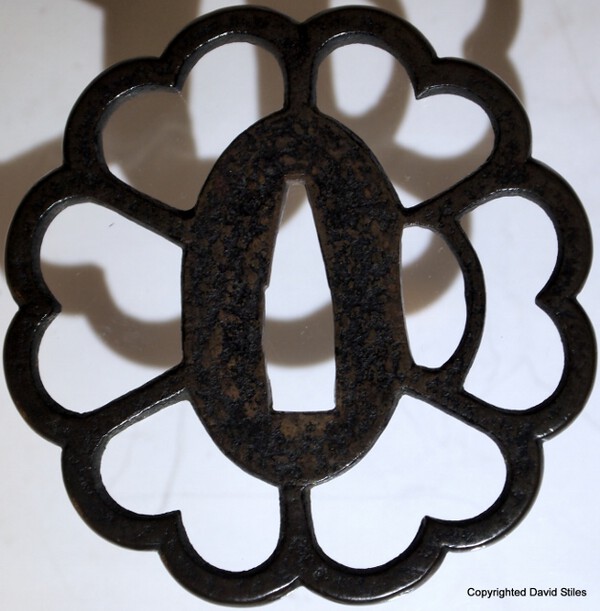
Hi Everyone, This is a new tsuba added to my collection this week. I am currently researching it. It is a soft metal kinko tsuba made of what I think is yamagane (unrefined copper) which has been textured and covered in a layer of black lacquer. The lacquer is in good condition and covers the sukashi design well but has thinned a little bit along the seppa-dai mostly on the omote side. This was likely happen when it was mounted and remounted on more than one sword. The rim is very dark, wet, smooth, and reflective. It is beautiful to view in hand. The measurements of the tsuba are 6.8 cm wide by 6.8 cm high. The thickness at the rim is 4.0 mm and thinner at the seppa-dai at around 3.0 mm. It is mumei and I have no idea who made it or how old it is. If the tsuba is yamagane along with the lacquer and the half moon shape of the kogai hitsu-ana it might be Ko-Kinko work but I am unsure. If it is yamagane and from the Edo Period it might be made by the Hirata Higo or Shoami schools. Thanks for looking and any educated opinions on what group or school made this tsuba or it's age would be welcome.



-
Hi John S., Been studying Ko-kinko lately myself. Looks nice to me but I am not a expert. Hope you are enjoying DTI and Japan in general.