
Soshin
-
Posts
2,928 -
Joined
-
Last visited
-
Days Won
3
Content Type
Profiles
Forums
Events
Store
Downloads
Gallery
Everything posted by Soshin
-
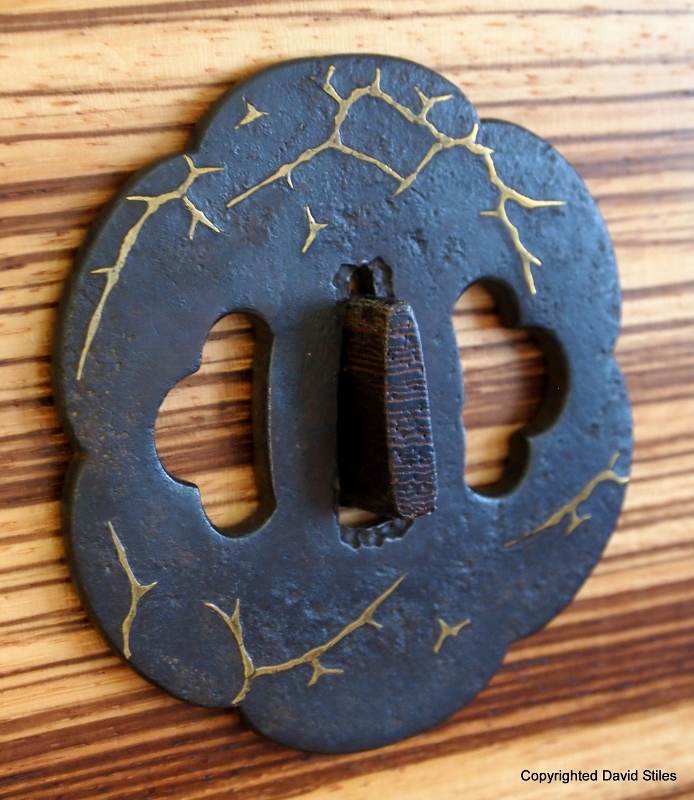
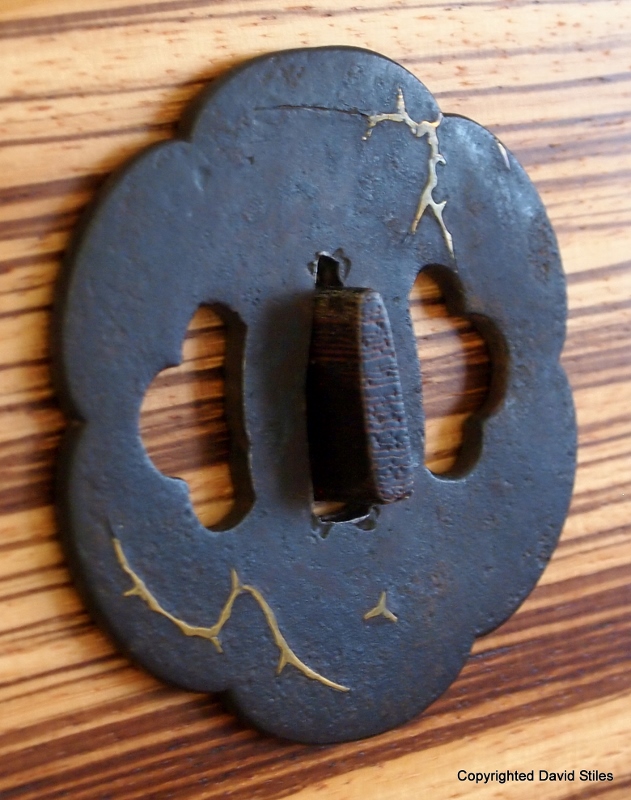
Hi Everyone, I would agree with the lightning theory as to what the brass inlay design represent. The overall shape of the tsuba is a uncommon one in Japanese it is referred to as mutsu-mokko gata (六つ木瓜形) [six lobed mokko shape]. From reading Grey's short write up of Skip's tsuba Suwa Ikuhei often made tsuba with odd kotsuka and kogai hitsu ana shape similar to my friend's tsuba.
-
Hi Everyone, Does anyone know what the brass inlay in a pseudorandom dendritic pattern represents on my friend's tsuba? I have seen this pattern on Hayashi and Kamiyoshi school Higo tsuba before. The earliest Higo tsuba I have seen with this inlay design was a tsuba with an attestation to Hayashi Matashichi (林又七). Thanks again for all the help. P.S. I found this other tsuba from Holbrook collection by Suwa Ikuhei: http://www.japaneseswordbooksandtsuba.com/store/holbrook-tsuba/h299-higo-suwa-ikuhei. It has very similar brass inlays and the patina of the iron from what I can see in Grey's photos is similar.
-
Hi Jean C., Thats something I noticed as well but in hand the iron feels nice. Here is an example of the more smooth refined iron typical of Higo tsuba.

-
Hi Pete K. John L., Thanks for the information. The example Pete K. gave is remarkably similar. Another reason to buy Ito's book. :lol: I have noticed similar inlays on a Kamiyoshi school work included a gold inlaid tsuba in this style by Rakuju the third master of the Kamiyoshi school. I looked up Suwa Ikuhei in Haynes's Index and found the the following information. Did the Suwa school developed from the Kamiyoshi school?
-
Hi Everyone, I local friend of mine that collects nihonto and tosogu wanted me to take and post some nice photos of his tsuba on NMB for feedback. It is from a Higo style koshirae. The measurements of the tsuba are 7.3 wide by 7.9 cm high. The thickness at the rim is 3.4 mm and thickens toward the seppa-dai at 4.3 mm. The tsuba is nicely inlaid with brass in a pseudorandom dendritic pattern. The two photos of each side are taken under very different artificial and natural lighting. The patina of the iron is very nice in my opinion. My first impressions of this tsuba is that it the work of the Kamiyoshi school of Higo Province. Comparing it to two tsuba in my collection in terms of the feeel of the iron and color of the patina helps confirmed my Kamiyoshi school attribution. I would date to around to the late Edo Period or early Meiji Period. Please feel free to discuss. Thank you.


-
Hi Curran, Sorry don't know anything the about story related to the to the very nice kozuka. I really love the nice contrast between the gold and shakudo on the reverse side. I have only seen this on the best examples of kinko work. Did the museum have any information about the design? P.S. I am assuming this is part of a museum collection.
-
Hi Christian, Sorry about you missing out on this tsuba. I have miss out on more then a few nice tsuba. I have a book that came out in 2007 by the NBTHK-American Branch with a large article written by Jim Gilbert on Yagyu tsuba. Not sure this is the same thing. I am also not sure if I should submit this tsuba to the upcoming NTHK-NPO shinsa or wait and have it go to the NBTHK. Hi John, I am fully aware of what your taking about which is a condition issue that will not resolved anytime soon.
-
Hi Thierry, Nice set of tsuba but in regards to the first one I will need to trust you on it as it looks complete unreadable to me. :?
-
Hi John S., The mimi of any Yagyu tsuba is kaku-mimi (square rim) which is what my tsuba has. Later examples started to show more rounded rims that are called kaku-mimi koniku (rounded square rim). This characteristic was one of the original design requirements by Yagyu Ren'ya. The iron texture, patina color, and shape of the seppa-dai points to the Ōno school in Owari Province. Here is a papered example: http://www.finesword.co.jp/sale/kodougu/htm/1051_2000/1751_1800/1796/k1796.htm. Now at shinsa the NBTHK is not going to be that specific with their attribution of my tsuba and will only likely state "Yagyu" on the paper. P.S. I have been studying Yagyu tsuba in hand and via books lately. The ones in hand were owned by old time US collectors. Many had Hozon or Tokubetsu Hozon papers.
-
Hi Chistian, I disagree having a few from this school some that were papered. My tsuba is likely first or second period Yagyu tsuba made by the Ono school. The pervious owner was thinking secord period. But in the end I am going to see what the NBTHK says. If NBTHK says it's "Yagyu" but you are truly correct then good old Norisuke will be smiling from beyond the grave. :lol:
-
Hi Jean C., No I was wrong I tested with a magnate and it is iron. I used another part of the guard as a positive control and the copper sekigane as a negative control with in magnate experiment. I am now thinking copper was scraped across it and left a little bit of copper residue which made me think the underlying metal was another copper insert. In books possessed by the Yagyu family it states that early Yagyu tsuba were tested by by placed on a wooden block and pounded and cut to test their strenght. Sasano doubted this claim even though it was part of the family historical records. In Owari to Mikawa no Tanko Okamoto Yasukazu discusses that a "yakite-kusarashi" rough surface is applied to Yagyu tsuba. A early special term was also used to described this rough text of the forged iron as "kusari-arashi". No problem I will keep everyone updated when I submit this next year. Here is a link to Mike Y. site he has just recently posted a papered Yagyu tsuba for sale: http://tetsugendo.com/. It has a really nice 360 degree view. You get the idea of the glossiness of the iron when you view Mike's 360 degree view which is very clear on my tsuba as well in hand. :D
-
Hi Bob, That was bit of what I was hintting at in my original post. If this Umetada tsuba was from one of the generations of Shigeyoshi in iron or soft metal or one of the other top level artists I would go for the shinsa for sure. If it was a nice Ko-Umetada tsuba I would yes as well. What got me into selling is seeing nicer and nicer examples in hand and not having the money. :lol:
-

Pair of fuchi kashira I got on eBay for 155.36
Soshin replied to Nihontocollector19's topic in Tosogu
Hi Andrew H., Always remember you almost always get what you pay for in the gallery of zen. -
Hi Bob, That is a hard question and I might not be the best person to ask. Mike Y., Bob B., Curran, and other high level collectors and/or dealers pass more high end pieces and money through their hands in one weekend then what I see in a whole year. I sold a NTHK-NPO papered tsuba at a fairly sizable lost in October. I more than made up for it on two other tsuba I sold one papered and one not earlier this year. In the end I seems to just break even when all is said and done. The best advice I can offer take it or leave it is if you're interested in learning more about the Umetada school I would submit it and see if it papers. If it does or doesn't I am sure you will learn something. P.S. Again I would like to state nice tsuba. I wish there were more like it on eBay. :D
-
Hi Bob, I almost bid on this tsuba on eBay but didn't as I am not allowed to get anymore tsuba until the Tampa show. Umetada Narishige is a middle level Umetada artist of the mainline school located in Nishijin, Kyoto working during the mid Edo Period. It is my opinion that the tsuba in question has an aesthetic signature and the workmanship is consistent for this artist but shinsa is the best approach to confirm this. The next overseas shinsa is at the Tampa show next February in the USA. It is being run by the NTHK-NPO.
-
Bernard D., I have very much loved the tsuba you have listed from your father's collection. Thank you so much! :D
-
Hi Fred D., I am not completely sure and love the idea of throwing such "curve balls" at shinsa teams visiting the USA. Ko-Tosho and Tosho often have a thicker seppa-dai then the rim this is opposite from any nanban tsuba that is early or otherwise I have seen. This much thicker seppa-dai compared to the rim clearly matches the characteristics of your tsuba with a single simple ko-sukashi design. The silver inlays and additional opening cut differently could have been added later. This I wouldn't call is an embellishment but a change in aesthetics from when the tsuba was originally made. If I remember correctly Curran had a Ko-Tosho tsuba up on eBay that once had a silver inlay. A long time researcher of Nanban tsuba PM with the opinion that my "Nanban shaku" attributed tsuba with NBTHK papers was likely a altered Ko-Katchushi tsuba with added Nanban style decorations along the outside of the dote-mimi as well as the botan and karakusa pattern on the plate was added later likely during the early Edo Period. This was also when the shakudo insert was added to the butterfly ko-sukashi that has a central shippo design motif.
-
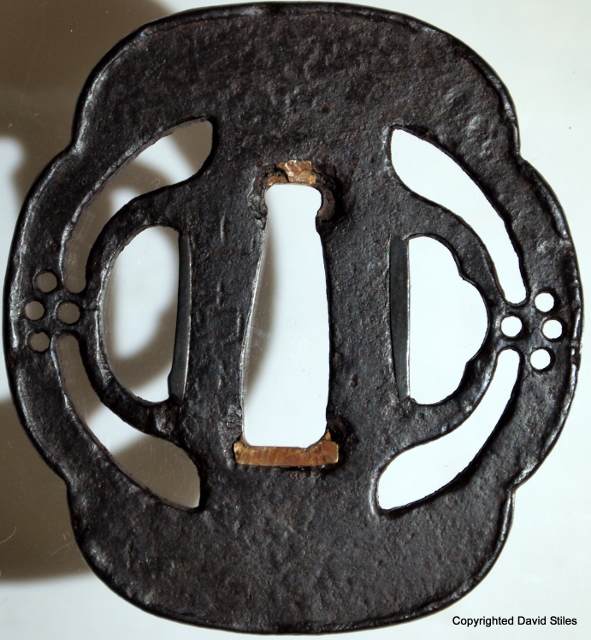
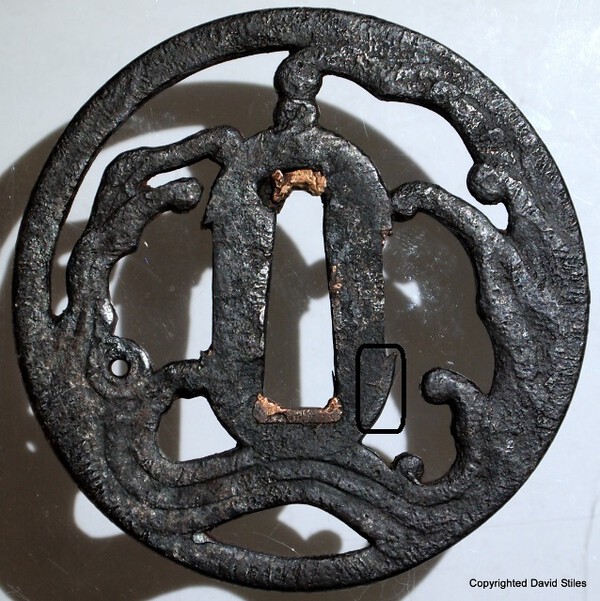
Hi Barry H., You might have seen this tsuba at the Tampa show this year because the previous owner if I remember correctly had it at the show. I have noticed that to with the inserts. From examining the guard some more in hand I noticed that the following area along the seppa-dai is a copper insert that has been patinated and colored to match the near by iron of the seppa-dai. I have it highlighted in a black box in the photo below. It is little more noticeable on the ura side. Hi Peter B., There are two very similar tsuba to mine on page 151 and 152 of the book Early Japanese Sword Guards Sukashi Tsuba by Masayuki Sasano. In the same blog they had another Yagyu tsuba from page 153 Sasano's book with a variation of this basic standing wave openwork design with a background of a wheel. Here is the link: http://blog.goo.ne.jp/tsuba_001/e/1a1cca2fa73ecda86386c5a0b47009d2. I hope this topic is good food for thought and meaningful discussion.
-
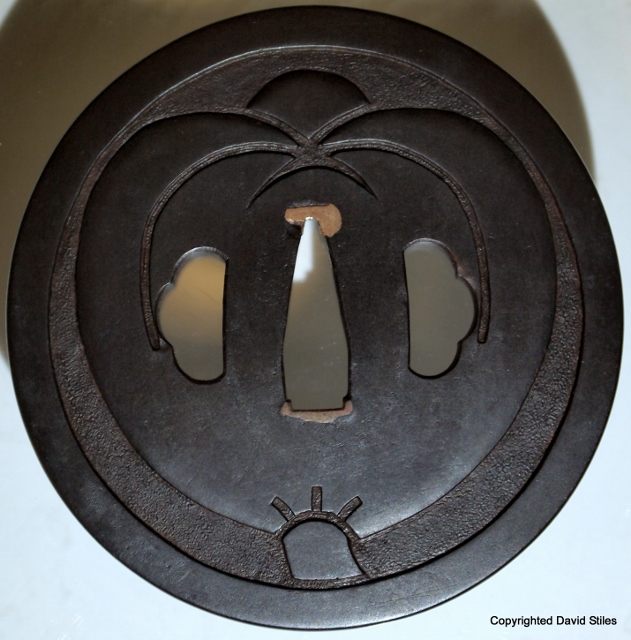
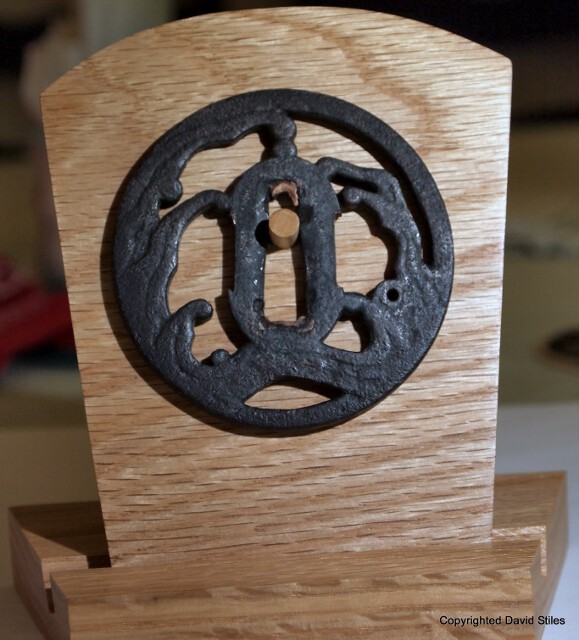
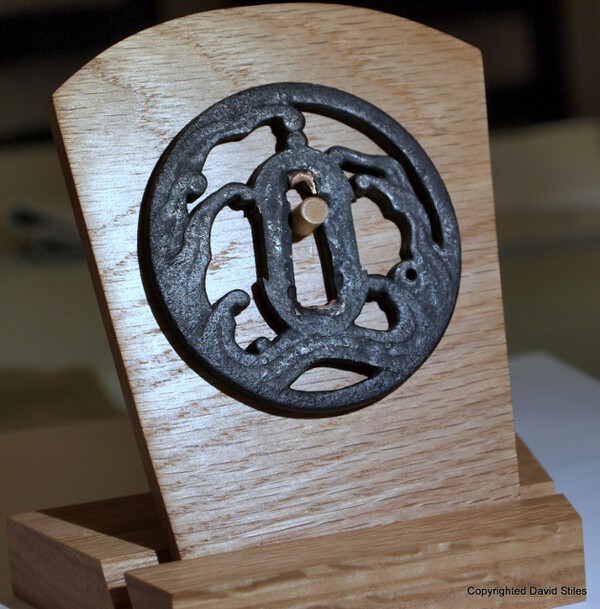
Hi Everyone, Here are some photos I was able to take today of a classic Yagyu tsuba in my collection that I will be soon adding it to my website. I consider my work done on this tsuba in terms of removing the vintage lacquer/paint. I am suspecting this was added on the tsuba likely around World War 2. The dynamic boldness of the openwork design of a standing wave along with the texture of the course sandy iron I find very appealing. The massiveness of this tsuba is remarkable given the small size of 7.4 cm. I don't think the ura side will ever look as good as the omote side given what was done to it but time will tell and I am planning to keep this tsuba for a very long time. I am planning to submit this tsuba some time next year to the NBTHK for Hozon level shinsa. I also came across this Shoami tsuba with a similar design in a Japanese tosugu blog by Zenzai: http://blog.goo.ne.jp/tsuba_001/e/f31b9fa18f775ab4123970412b37f8c0. It might date from about the same time period of the late 1600s to early 1700s. The seppa-dai shape is very different then my tsuba which I feel indicates the Shoami attribution but regardless is a nice tsuba as well. Enjoy.


-
Hi Fred D., No I have seen Ko-Shoami tsuba with both types of sukashi with thin and thick plates with brass, gold, and silver inlays before. Most latter Shoami tsuba only used positive sukashi from my observation. I would be interested in how they attribute and date your tsuba at shinsa. Are you going to the Tampa show this year?
-
Hi Fred D., I fairly sure Henry W. is correct. I would place your fine tsuba in the Ko-Shoami group also given the abstractness of the openwork design. The use of lead inlays I find very interesting. My two tsuba above clearly indicate in my opinion that early Namban tsuba developed from katchushi tsuba group during the Azuchi-Momoyama Period.
-
Fred D., Thank you for starting this interesting topic with your fine tsuba that I think is Japanese made. :D I have high standards when it comes to Namban tsuba. Here is a early Namban tsuba now in my collection that is from the same old US collection that is now in Tokyo for Tokubetsu Hozon NBTHK shinsa in December: http://dastiles1.wix.com/reflections-#!Composite-View/zoom/c5om/image2px. More information is on my website. I also have this early Namban like tsuba example that Ginza Choshuya in Tokyo said was early Edo Period. It is also in my collection and has a older NBTHK Tokubetsu Kicho paper dated 1970: http://dastiles1.wix.com/reflections-#!Art-View/zoom/c211q/images6p. To me I like to call it a Namban Ko-Katchushi tsuba and might be much older than the early Edo Period. It has signs of old black lacquer along it surface much like other Ko-Katchushi tsuba.
-
Hi Mikolaj, Can your tell if the lacquer clear, black, or dark green in color? If the lacquer looks original to the tsuba and there isn't major red rust developing under the lacquer I would just leave it alone. I currently have one lacquered tsuba in my collection which was originally lacquered and it is therefore left alone. If you think the lacquer was recently painted on the tsuba I would try to remove it but you need to be very careful with the skakudo rim in terms of the solvent used to remove the lacquer and touching the rim with your hands as it will also caused major discoloration of the skakudo. In the end I wouldn't work on such a tsuba because of the skakudo rim. Having a professional tsuba maker do restoration work on it might be a good idea. I hope you find the information helpful.