
Soshin
-
Posts
2,935 -
Joined
-
Last visited
-
Days Won
3
Content Type
Profiles
Forums
Events
Store
Downloads
Gallery
Everything posted by Soshin
-
Hi Junichi, Well no I not trying to strong arm your comments. Thank you adding the word "opinion" which is important. I have no idea if it is shoshin or gimei nor do I really care. I like the workmanship and the design of this tsuba that is all. I love the mei and kao which has its own artistic merit in my eyes. In my opinion this tsuba is a classic example of a signed tsuba that isn't worth the time, money, or effort to paper to determine if the signature and kao are true. I will set with my books, ask around NMB, and look at examples to develop my own opinion but that is all. P.S. The NBTHK publishes a book of tosogu and nihonto that receive Juyo level papers each year. Here is an example from Grey's website: http://www.japaneseswordbooksandtsuba.com/store/books/b419-juyo-token-nado-zufu-33-nbthk.
-
Hi Junichi, I suggest your reword you comments more like an opinion. :x Having one example provided by Mike Y. and a single reference book can't make you qualified to judge a work is gimei or shoshin. Why make a Kao so very different if you were trying to make a gimei to defraud people? Also keep in mind that I have been a member of the American Branch of the NBTHK longer then you have been in this hobby. I not saying I been a member very long but that you are still new to the hobby and you should pause before calling someone tsuba a gimei.
-
Hi Everyone, A friend sent me some photos of some of his Akasaka collection. Sorry can't share any of this photos. He thinks my new tsuba is either third or early fourth generation master. To me my tsuba has a rounded classic koban shaped seppa-dai which is also characteric of third master Tadatora died circa 1707. His work like the first two masters were all unsigned.
-
Hi Mike Y., Thanks for providing photos of such a nice example. This adds evidence to the hypothesis that there was multiple artist using the "Seiryuken Eiju" mei in sosho style with very different inlaid kao.
-
Hi Everyone, That some really bad openwork.... P.S. Jeremy, Google "Soten Tsuba" to get my joke. Please don't take it personally. Here some great examples. http://www.google.com/imgres?imgurl=http://www.nihontoantiques.com/images/tsuba%25204%2520coopy.jpg&imgrefurl=http://www.nihontoantiques.com/forsale%2520tsuba.htm&h=1315&w=1066&sz=944&tbnid=dBFRiTiMj9mTzM:&tbnh=90&tbnw=73&zoom=1&usg=__fXvcho_SOa82FUtcnzuN_TVgvAs=&docid=Y1z_nm-69uUEnM&sa=X&ei=PGhLUojZLoX64AOh5YDwAg&ved=0CDcQ9QEwBQ
-
Hi Everyone, In technical work the devil is in the details. The eBay example has what looks like a uniformed thickness of 5.0 mm compared to my tsuba that that starts out much thinner at the rim 3.5 mm and gradually increases in thickness to 5.2 mm at the point of nakago hitsu-ana. I just measured my tsuba with a pair of digital caliper. This is just something interesting I noticed. I am going to think on this a bit.
-
Hi Jeremy, It might be black paint used to simulate the patina that would be applied on real tsuba. Just an idea.
-
Hi Jeremy, To me the tsuba looks like a cast copy circa the Taisho to Showa Period. The signature is I think a gimei added later after the tsuba was cast from industrial iron. The right side I think reads Edo ju (江戸住) the left I can't read. I hope I am wrong.
-
Hi Jeff J. and Brian R., Thanks for the replies and the information. The eBay tsuba looks almost like a copy of my tsuba. The detail isn't nearly as good looking closely at the pattern. The same thing can be said for the mei and chisel marks around the nakago-ana as well. I am not sure if this loss of detail on the eBay tsuba is because it is copy of some kind or had some serious rust damage that was later overly cleaned. Brian R., I think you are right there was likely more than one or two artist using this name. A workshop like the Akasaka school had during the same time period is a strong possibility. You can see a great deal of reparative originally Higo openwork designs in late Akasaka school (workshop) work. Regardless I traded/purchase it as I really like the workmanship and the artistic nature of the mei and kao.

-
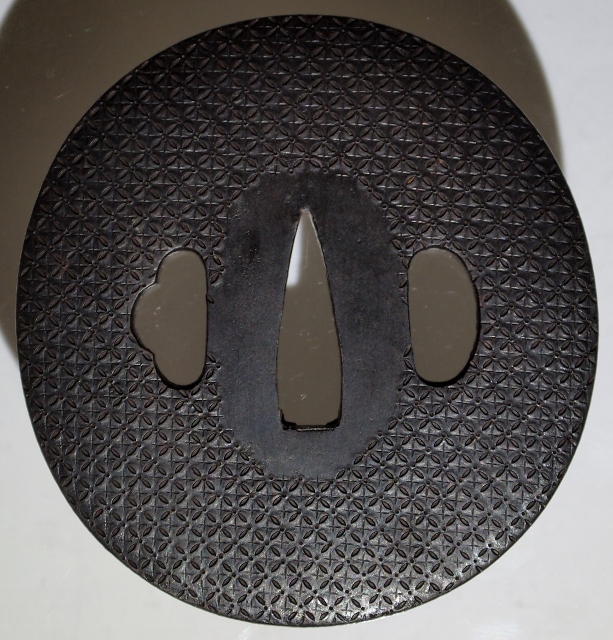
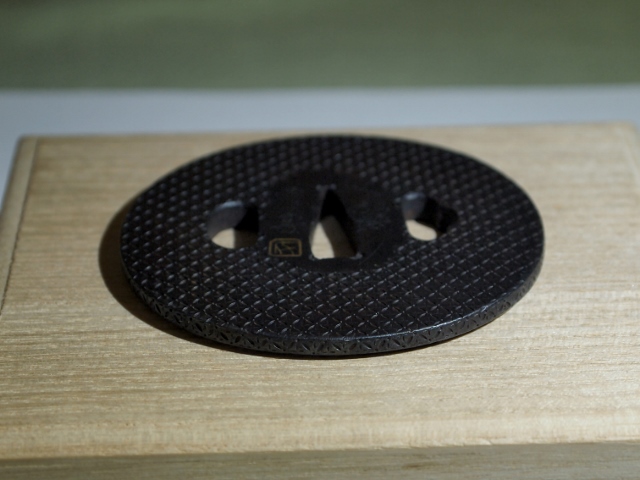
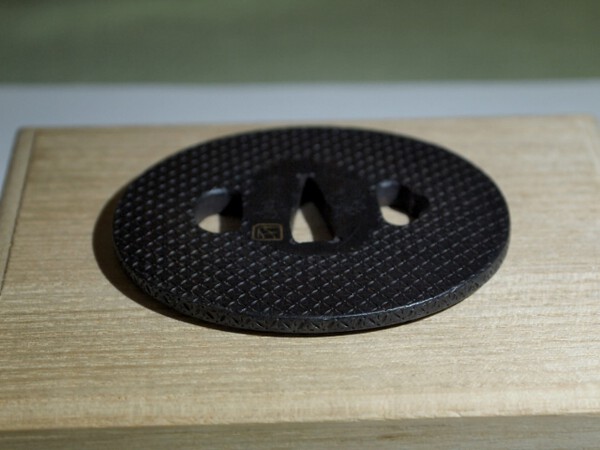
Hi Everyone, Not working because of the government shutdown in the USA. Here is photos of a new tsuba that I was told was made by Eiju (榮壽) a member of the Tetsugendo school during the late Edo Period. Haynes has his working period in this index from 1775 -1800. Here is a link to the discussion of the mei in the translation section with better views of the mei: http://www.militaria.co.za/nmb/viewtopic.php?f=15&t=16939. The signature done is sosho style as well as the hira-zogan kao in my view are works of art. I have never seen this type of copper inlay done at this small a scale. I also really like the texture pattern on this tsuba as well as the forge and patina of the iron. It measures of the tsuba is 7.2 cm wide by 7.5 cm high. The thickness at the rim 3.5 mm and thickens towards the seppa-dai which is 5.0 mm. The same design that is on the surface of the tsuba is also along the rim. Enjoy comments and questions are welcome.


-
Hi John L., Thanks for the correction. I will check my copy of Haynes Index. I might be furlough from my federal government job tomorrow. If so I will do some photos of this fine tsuba and post in the tosogu section for all to enjoy.
-

kodogu is still strong in Japan
Soshin replied to raiden's topic in Auctions and Online Sales or Sellers
Hi Pete, Thanks for sharing something more in my area of focus. Love that iron! :D -
Dear John L., I checked out Haynes Index and H06606.0 is Hamano Naoharu. I think you might have the wrong index reference. I find the difference in the Kao between the gold and copper hira-zōgan so great that it might mean there were two different artists using the name Eiju around the same time period with very different Kao and different Shosō mei styles. When the differences are this great in my opinion it rules out the gimei explanation as there is do intent to deceive with so many clear differences.
-
Hi Sebastien V., Thanks for the reply with additional information. One final request could someone provide the kanji for the mei "Seiryuken, Eiju"?
-
Hi John S., Pete K., and Henry W., Thanks for the additional information really not sure about this tsuba in terms of the theme of the openwork design. It could be the Noh play Takasago or a tea ceremony reference or both. The rim display some fine iron bones. Here is a photo of the rim where I have a few highlighted with black circles as my focus was far from perfect.

-
Hi George M. , I think you are likely right. I was reading the Wikipeda entry for Takasago (play):http://en.wikipedia.org/wiki/Takasago_(play) and found that an alternative name of the famous Noh play is Aioi Matsu (twin pines). The setting of the play is a early spring evening which does make sense.
-
Hi Malcolm, Thanks for the information. I did some searching and came across this thread on NMB as Brian R. (AKA. Birthday Boy) has suggested: http://www.militaria.co.za/nmb/viewtopic.php?f=15&t=16453&p=144904&hilit=Seiryuken+Eiju#p144904. :lol: I also came across this tsuba on eBay: http://www.ebay.com/itm/380727639266?ssPageName=STRK:MEWAX:IT&_trksid=p3984.m1423.l2649 without a kao. Both signatures look very different and not as dynamic or elegant from a Shodo perspective. I have taken one class in Shodo and I think I am at the yellow belt level. I will try to get more opinions of the tsuba at the Tampa show next year. The detail level of the carving in iron is amazing and with such beautiful patina is remarkable. Regardless of the signature it is a nice tsuba. :D P.S. I found this tsuba in a discussion on the old NMB site: http://militaria.co.za/nihontomessageboard/viewtopic.php?t=1303&highlight=eiju. The tsuba that is the last one on the page. The Kao is similar but the mei isn't as well done but that might be a condition issue. My tsuba is in excellent condition I will post about it later in the tosogu forum. The chisel marks are also lacking around the nakago-ana for this example compared to my tsuba.
-
Hi Brian, Thank you for the translation. I will do that.
-
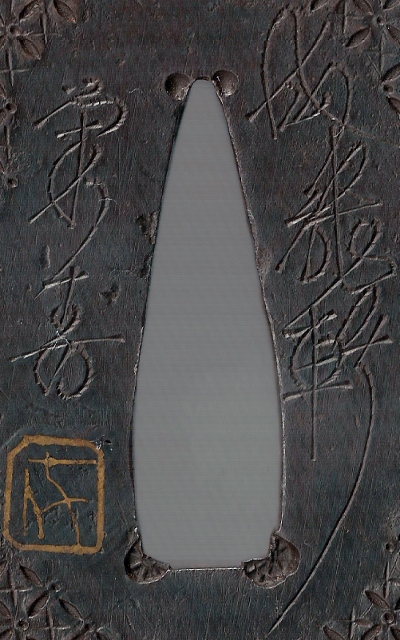
Hi Everyone, Here is a new tsuba added to my collection that has a wonderful mei and a inlaid copper kao which is a work of art in its own right in my opinion. The problem is I can't read it as it is written using either Gyosho or Sosho style and not the standard Kaisho writing style. I know this style of mei was popular during the late Edo Period. The chisel marks around nakago-ana on the omote side only is also very specific adding a so called hidden signature to the tsuba. I was able to talk to Bob Benson about this tsuba and he help me with the right side of signature which I think says "Seijuken". He also made the comment that the signature look authentic and is related to the Tetsugendo school. I didn't get a chance to ask him anymore details as he was getting busy at his table at the Baltimore show this past weekend. Below is a high resolution scan of the mei, kao, and nakago-ana. Comments, questions, and translations are welcome. Thank you for the help.

-
Hi Arnold F., Thanks for the reply and joining the discussion. That is true and was discussed in The Art Appreciation of Japanese Sword Fittings by Shigeo Fukushi so I might be off in thinking the theme is Jittoku. To me the crescent moon implies a night scene of some kind. Do they have tea ceremony at night? This is a real question I have never study the tea ceremony in any detail. I examined the inside surfaces of the sukashi but don't see any separation between the layers. In Tsuba An Aesthetic Study by Robert Hayes and Kazutaro Torigoye this is characteristic of the first two generations of Akasaka masters only. Starting with the third master onwards the school did not use this method to forge the iron plate of the tsuba. I was taking a look at the book Tsuba no Bi and found two examples by the Sandai Akasaka master pages 92 and 93. Both examples display a similar very thick rounded rim as my tsuba. No thickness measurements are provided for the two examples. I am going to check the two Sasano books and reply with any helpful information for the discussion.
-
Hi Henry, Thanks for the reply. You could be right about the openwork design. I did a search for "Daowu" and came across a set of Koan compiled by the Japanese Zen monk Dogen. I will try to do more reading on the websites I have found. I am sure Koan were in general a popular design theme for art in the Edo Period. The darkness might be my new light source used in the photos. It is a LED lamp based light source. In terms of the workmanship of the tsuba the great thickness and much smaller nonfunctional kogai hitsu-ana along with characteristic straight and stiff openwork makes me think Ko-Akasaka in terms of school attribution. The previous owner was thinking 3rd generation Akasaka master but I can't be that specific and have seen similar tsuba with just a Ko-Akasaka attribution by the NBTHK.
-
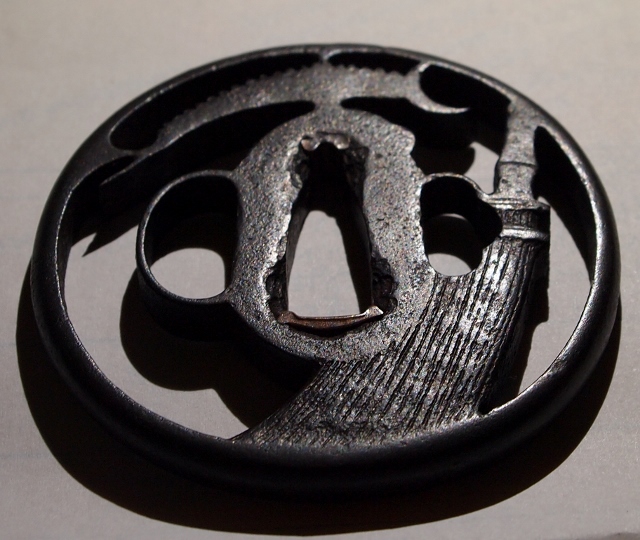
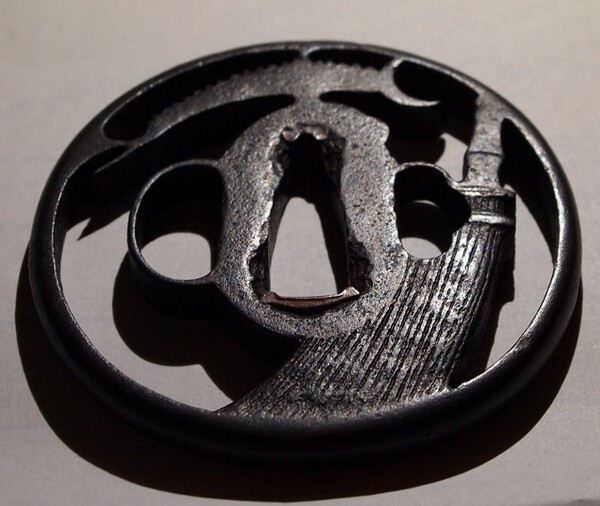
Hi Everyone, I was able to do some photos of a new tsuba picked up last weekends Baltimore Japanese sword show. The measurements are 7.1 cm wide by 7.2 cm high. The thickness of the rim ranges from 6.6-6.8 mm and is 7.0 mm at the seppa-dai. The rim is round, thick, and bold displaying a few fine iron bones. The sukashi is a mixture of robust and fine. The iron is well forged and has a nice blackish-brown patina with a glossy luster. The openwork design is interesting and related to the Chinese Buddhist monk Jittoku. He is often represented by a broom and is regarded as a incarnation of Fugen Bosatsu. I came across this after reading The Art Appreciation of Japanese Sword Fittings by Shigeo Fukushi. The other elements in the of the somewhat abstract design are a pine tree and a crescent moon. Does anyone know how these additional designs are related to Jittoku? The line carvings along the broom is a nice touch which leaves with me the impression that the broom is much closer to the viewer then the pine tree and crescent moon. Please feel free to discuss and thanks for reading.

-
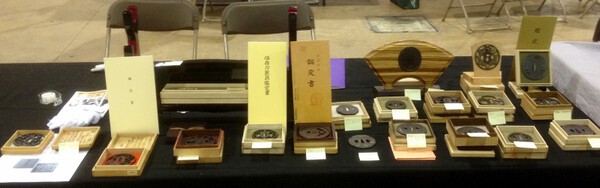
Hi Everyone, I think it was a good show and I was able to break even money wise. I traded/sold two tsuba, kogai, koshirae, and katana stand. I have five new tsuba added to my collection as well as a Japanese art book. The tsuba range in age from the late Muromachi Period to the late Edo Period. From what I heard the attendance wasn't great but I do hope they have another show next year. There is a photo of my table setup on Friday.
-
Hi Everyone, I pass this tsuba on to Bob Benson for NBTHK Tokubetsu Hozon shinsa submission in October. Will keep everyone updated what I learn. I am interested in what they say about the openwork design.
-
Hi Everyone, 2:00 AM and can't sleep as a specific tsuba is on my mind. Tomorrow is my last day at the show. I will let any two tsuba go for $1,200 cash with exception the set of consignment tsuba and the Momoyama Period Christian Nanban tsuba which has a new cash price of $1,200 down from $1,500. P.S. Gabriel L. thanks for the wonderful write up. The kogai has already sold from my table.