
Soshin
-
Posts
2,939 -
Joined
-
Last visited
-
Days Won
3
Content Type
Profiles
Forums
Events
Store
Downloads
Gallery
Everything posted by Soshin
-
Hi Alex, Here is the English translation provided by the NBTHK on thier website [http://www.touken.or.jp/]. Hi Brian R., How do you think I purchased this unpapered Katchushi tsuba.

-
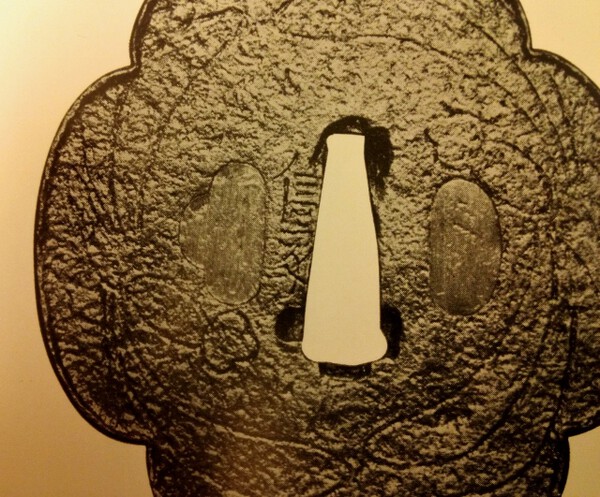
Hi Everyone, I just want to post a scan of a Juyo level Ko-Katchushi tsuba featured in the NBTHK monthly magazine issue #679. I would consider a tsuba like this my goal in collecting old iron tsuba. I have two Katchushi tsuba with a few similar features as this tsuba. Two with a lacquered surface and one which also has an identical style of rim that has a mid level paper by the NBTHK, but I would consider this example the complete package and an apex I haven't reached in my collecting of old iron tsuba. I just wanted to share a scan of this fine tsuba and hopefully spark a discussion among like minded collectors on NMB.

-
Hi Everyone, I have decided to return the tsuba that is the topic of discussion and trade it for a tsuba from the same collection on Grey's website. I had good and fair experience with the NTHK in the past accept thier judgment. I fully recommend Grey Doffin he is a wonderful and fair person to deal with many fine tsuba still unsold on his website.
-
 Hi Chris B., I would need to agree with Josh. If NMB had a like button I would be liking this topic as well. Looking forward to bring a few tsuba and maybe a kogai for shinsa next year at the Tampa show. :D
 -
Hi John and Junichi The Umetada school was based in Kyoto originally and was started by Umetada Myoju. It emerged from the Ko-Umetada school which developed from Muromachi Period Ko-Shoami group. The school latter had branchs in Choshu as well as other Provinces such as Musashi in the capital Edo. They often copied designs that were popular in the area using Umetada techniques. Umetada was never a formal branch of the Choshu school. The basis of my information is the NBTHK Tokenbijutsu monthly magazine which had four issues focus on the Umetada school. They had about ~15 issues focused on the Choshu school. I can lone them to you Junichi if you pay for postage both ways.
-
Hi Mike, What are the measurements of the tsuba? The type of brass inlay does look like Heianjo shinchu zogan tsuba style. Check out other peoples posts here and you would get the idea of the correct orientation the tsuba should be in photos. The third photo is correct the other two are incorrect unless you are posting a tachi tsuba. From what I see and can't see in your photos I would date your tsuba to the early Edo Period. This is just my educated opinion. P.S. I am currently researching a early Tenpo tsuba that has a Heianjo style inlays of brass with a very deep color of imported Chinese brass. The color of your brass inlays looks more like domestic Japanese brass of the Edo Period.
-
Hi Ford H., Yes I do I am looking at the pink color failure paper from the shinsa and was simply stating what was selected. Hi Chris B., Yes very good point.
-
Hi Everyone, As I should have stated before the last two judgments I completely agreed with that the NTHK shinsa panel made. One was for a tsuba (2012) that passed and the other was a wakizashi (2006) that failed. This time around I disagree but I am free to do so even to the point of submitting it to the NTHK-NPO or NBTHK. I was thinking about mailing it back to Grey Doffin but I will wait until Baltimore Japanese Sword Show and return it to him in person if I come to that conclusion from my own study of the tsuba in hand. I reviewed my original photos of this tsuba and they were badly out of focus much like the photo Ford posted done by Grey so I will try to take new photos next weekend as I am busy this weekend with a family pic-nic. If the tsuba was not traditionally made the NTHK shinsa panel would have selected "Fake Work" and/or "Poor Quality" under the reasons for rejections. They only selected "Modern Made" as the reason(s) for rejection. Hi Kunitaro-san, Thank you so much for providing additional information about the making of that masterpiece. :D
-
Hi Chris, I fully agree with your quoted statements I might just do that and resubmit it to the NTHK-NPO. It makes no sense to fail something just because it is modern but clearly made using traditional materials and techniques. This is not to say my tsuba is modern as I don't think it is just not that old (i.e. 150-120 years old). Hi Justin, It comes down to how many large books you can carry on a airplane. The books used for kantei are really large. I have two such books in my reference collection for tosogu and I can't imagine trying to fly from Japan to the US with such large set of books. I also remember being told a long time ago that if the NTHK can't identify something they will default to failing it. With all due respect to the NTHK this was what I was told followed by personal stories of people submitting failed items from the US shinsa to the NBTHK or even to the NTHK in Japan and having the same nihonto and tosogu later pass. I am not anti NTHK but it is like any other organization and made up of people that are imperfect and can make mistakes. I will better remember my interactions with Jim Gilbert at shows because he really like my early Nanban tsuba at the Tampa show this year (check my website for more information). I really should have submitted that tsuba to the NTHK shinsa last weekend. With that said I am still looking forward to the next NTHK shinsa which I hope I will be able to attend as I find them good learning experiences. Live, lean, and keep collecting. :D
-
Hi Justin, No I am of the opinion that no group should be doing international shinsa. They all should be in Japan. This is how I feel and I am sure other people would agree and disagree based upon personal experience. In regard to this tsuba I think it is worth submitting NBTHK if I decided to keep it in my collection. I am not looking for a return on my investment but an expansion of my knowledge. I don't see this tsuba failing NBTHK shinsa the worst possible attribution is "Kodai Higo" the best case attribution is a specific attribution to a Kamiyoshi school tsubako or a late Hayashi tsubako. On the NTHK fail paper there was a selection for why it failed. Range of selections included: "Fake Signature", "Fake Work", "Poor Condition", "Poor Quality", "Cast", "Been in a fire", and "Modern Made". Only "Modern Made" was selected. I like the tsuba and if it was poor quality they would have marked it.
-
Hi Everyone, Thanks for the examples Ford H. This was the person I was think about. I find his work a wonderful visual meditation and should be considered the apex of Shōwa Period art in the realm of tosogu. To bring thread back on topic. I can confirm all of Curran observations using a small hand magnifier that I bring to shows. I would go on to say that under magnification cleaned rust pits on plate surface are clearly visible. I will go back to the high resolution raw images to see if I can generate a small section image of the plate that is low enough resolution to post. that shows what I am talking about. If anything this tsuba likely is a bit over cleaned by Skip Holbrook when it was in his collection.
-
Hi Everyone, I have the tsuba and the paperwork. Here is the complete write up about my tsuba is which is the topic of the tread. The person that handled the tsuba for me really liked it and said I should keep it. One person who replied above has emailed how much they like the tsuba and other interesting tidbits. In the end I am going to think about it a while and decided if I want to return it as the person I purchased it from has a return policy, is a honest dealer, and frequents the NMB. I would ask for store credit in the amount equal to the purchase price. Here are some photos of the tsuba by the dealer: http://www.japaneseswordbooksandtsuba.com/store/holbrook-tsuba/h180-higo-kamiyoshi. Please feel free to offer your opinions or helpful comments. Does anyone know of a tsubako making Higo style copies in the Showa Period? I don't know many off the topic of my head. There was one guy who is no longer living but was a living national treasure in the Showa Period that would often work in the Hayashi/Kamiyoshi school. I have some examples of this works in the NBTHK monthly Magazines that I need to find on my bookshelf.
-
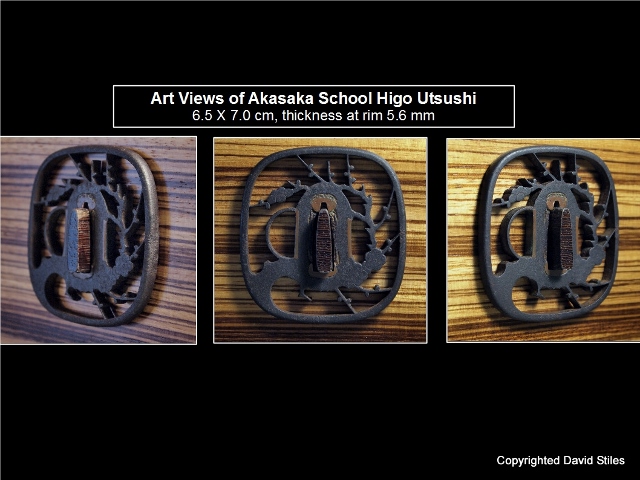
Hi Ford H., Thanks for the reply. The design itself is from the Haynes and Nishigaki Higo schools but the techniques used to produce the design are of Akasaka origin. Primarily I am referring to openwork style in terms of the sharpness of edges and angles. In the Higo schools the openwork angles would be more rounded. The other aspects I discussed are also applicable as being characteristic of Akasaka school. Therefore the use of the term utsushi isn't applicable as the techniques used to make the Higo design are Akasaka and not Higo in origin. I like how the rim of the tsuba makes a frame for the main design of the art. I remember visiting a Japnese style garden and some of the views of the garden were framed in windows in a similar way. Much like how a painting or other framed artwork would be displayed on a wall.
-
Hi Everyone, I just wanted to let everyone know I updated my website with a new tsuba. It is a mid generation Akasaka tsuba (i.e. 5th to 7th generation) done in a famous Higo style. Here is a draft of my write up for when I list it on my website. Comments and questions are welcome. Please check out the homepage of my website for more information and additional high resolution photos. The link to my website is below.

-
Hi Junichi, I would go with Umetada Tadatsugu as Pete K. recommended. Another thing to check is the tickness of the seppa-dai vs rim. On all the Tadatsugu tsuba I have seen the seppa-dai is much thicker than the rim. P.S. Welcome to the darkside...
-
Hi Everyone, Found another early Edo Period Owari tsuba with NBTHK Hozon papers listed on anothers dealer's website. I like the openwork design. Here is the URL: http://samurai-nippon.net/T-399/index.html. Like my above examples it states early Edo Period on the NBTHK Hozon paper. This is different than my tsuba shinsa results which indicates classic Owari Sukashi which is pre Edo Period circa late Muromachi to Momoyama Period. Sorry I had to think back to a happier shinsa result after the bad one I received this past weekend.
-
Hi Ford H., Thanks for the clarification of your views. It is helpful for understanding and cooperation. The results of the shinsa was not favorable but I am not going to elaborate until I have the shinsa worksheet in hand to examine and post the full results for educational purposes. It should be noted that going into this I knew next to nothing about Higo tsuba in general. I think this purchase and submission was a good but very expensive lesson. The price tag now is $650 USD (tsuba price plus shinsa fee) which is not easy for me to forget given my small budget for such things. In answer to your question about the NTHK shinsa team. I only know one member of the team that handles tosogu and he is Jim Gilbert. Here is a link to this website: http://home.earthlink.net/~jggilbert/tsuba.htm. He is a very knowledge collector for many years and is the current President of the New York Token Kai, Vice President of the American Branch of the NBTHK, and likely a long time member of the NTHK. I am sure Tom Helm can contact you via PM with the names of the Japanese members who are on the tosogu shinsa team and their qualifications.
-
Dear Ford H., Thanks for the reply and expressing your opinion about the tsuba in a constructive and articulate manner. I do disagree on one point that the discussion of this tsuba is unimportant. It is important to the learning process and I think other members can benefit that is why I started the topic in the first place. If the admins of the site or Brian R. feel otherwise they can delete the topic. I am going to wait until I have the NTHK shinsa worksheet in hand as I don't want to paraphrase NTHK shinsa team's judgement.
-
Hi Everyone, I was told via telephone the NTHK shinsa results for this tsuba yesterday. I will post a write up to this topic once I get the tsuba and the paperwork back from SF show sometime next week. I sure it will be an interesting learning experience. Please feel free to discuss while I wait for the return of the tsuba and the all important paperwork.
-
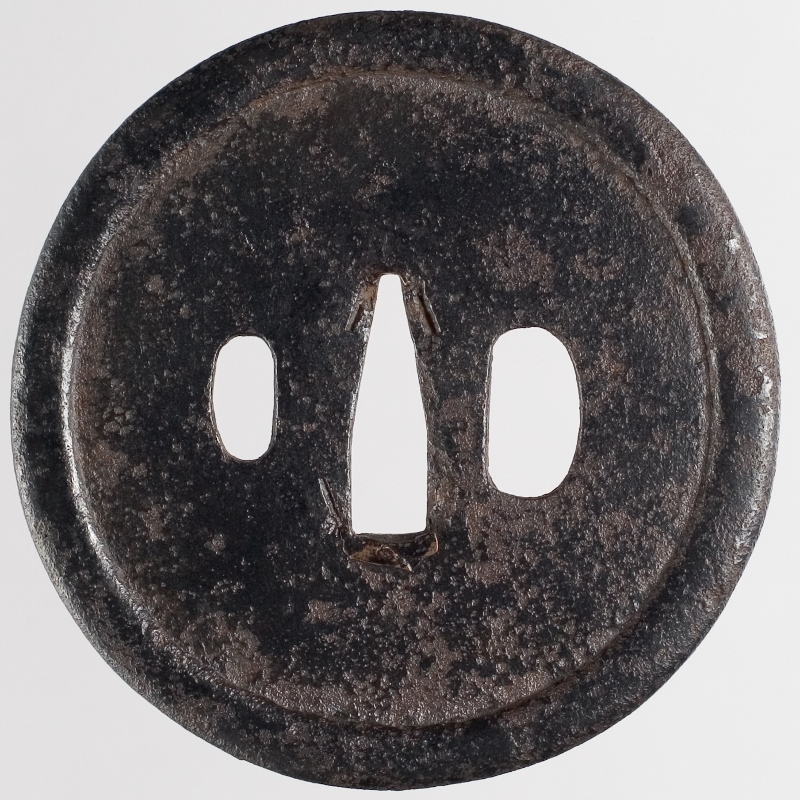
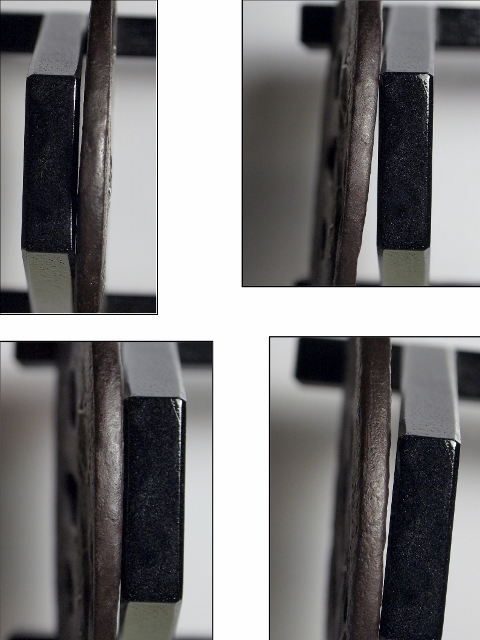
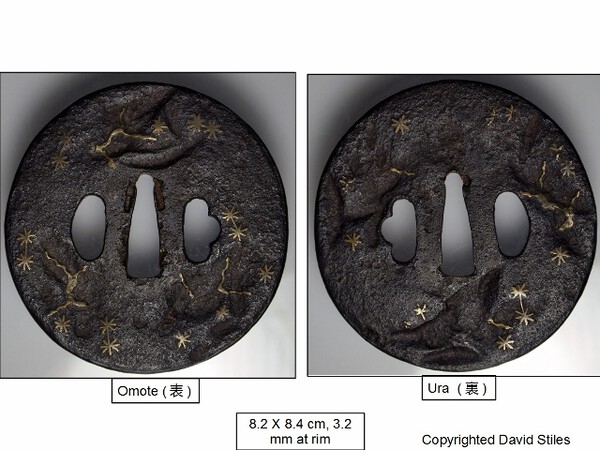
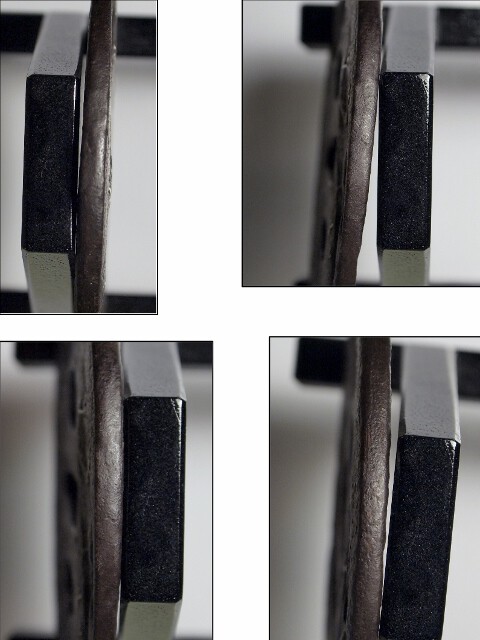
Hi Everyone, I came across this old topic while searching the NMB for information on Tenpo tsuba. My tsuba display some similarities of the other tsuba displayed. I purchased this tsuba last weekend at a local Washington DC auction house. The auction house item report dated the tsuba at 17th Century (i.e. 1600s). It comes with a old collectors tag likely older than me. I think it an early example of the Tenpo school that shows fair amount of similarities and crossover with the Heianjo shinchu-zogan school of Kyoto located in Yamashiro Province. Noticeably how the brass is inlaid which is noticeable in one inlay that has been damaged on the omote side at 4:00. The brass has a dark old color often found in imported brass from mainland China. Its color reminds me of a Onin tsuba I once owned. The plate surface of tsuba has a layer of black lacquered applied a long time ago and strong hammer marks along with large hot stamps of unknown design. The brass has been inlaid into the large hot stamps. They have been hammered and circular punch marks been applied. The measurements for the tsuba are in the first photo. The second photos shows the wonderful actively along the turned up rim that included linear shaped iron bones and folding lines. There are also folding lines on the inside surfaces of the ana similar to the above examples. Comments and questions are welcome. I really love Tenpo tsuba. :D
-
Hi Thierry B., Nice collection. Thanks for posting a link to the photos.
-
Hi Everyone, I talked to Bill Green over the telephone for about an half hour about the new Baltimore Japanese sword show. I was not able to meet with him last Saturday when he was visiting the area. I had a very bad cold and didn't want to give it to anyone. I am planning to attend all day and into the evening on Friday and Saturday of the show. Being a Tsuba Otaku that I am I will be bring a fine set of tsuba to show anyone interested. This will includes a nice Akasaka tsuba I have never discussed on NMB. P.S. Just quick note about forum rules. It is generally a requirement of the NMB to include a first name and a single letter of last name on every post.
-
Hi Steve, So in a nutshell it's clear to you that Henry's tsuba has a mixture of different mei styles used by the Shodai and Nidai. My posted examples are marked in the book as belonging to the Shodai. Yours truly, David Stiles
-
Hi Junichi, I think there has been fair bit of misunderstanding and confusion and I take full responsibility and blame for that. I will leave it at that. Now back to the tsuba. In my original write up the workmanship of this tsuba indicates in my opinion that this tsuba was made in the late Edo Period. When I say this I am basing this on comparison of this tsuba to other signed pieces that display similar or the same workmanship that are signed and attributed to Aizu Shoami school. When I state late Edo Period I referring to the approximate period of about 1770-1868. Silver while a precious metal was often used by the Aizu Shoami school at this time period as a metal to highlight important parts of the design.
-
Hi Everyone, Yes it took me about 10 mintues to find these two example in my small library.... Needless to say this variation in the mei isn't all that uncommon as some people might think. :lol: