
Soshin
-
Posts
2,934 -
Joined
-
Last visited
-
Days Won
3
Content Type
Profiles
Forums
Events
Store
Downloads
Gallery
Everything posted by Soshin
-
Hi Everyone, If I remember correctly there is a famous tsuba by the Shodai Yasuchika (i.e Tou) with a elephant design. Once I am home and can search my books I will post a photograph of it. These tsuba posted maybe trying to copy this. Yours truly, David Stiles
-
Hi Pete K., This ranking of the Goto, Ko-Goto, Waki Goto, Kyo Kinko, and Kyo Kangushi is really nice and helpful thank you. I remember having a similar conversation via email with Curran C. in regards to the Hayashi school of Higo Province as I will have a Higo tsuba of mine enter the NBTHK tosogu shinsa next month. Curran was able to create a similar hierarchical structure. Let me know and I can summarize and hopefully produce a similar hierarchical list for the Hayashi School taken mostly from our email exchange. Yours truly, David Stiles
-
Hi Curran, This website sells iaito (i.e. training swords) for Budo and also reproduction fittings in Japan: http://www.japanesesword.net/default.asp. All of the reproduction fittings are made in Japan. Here is a Yagyu tsuba reproduction from that website: http://www.japanesesword.net/TAKE_NI_YAGYUGASA_TSUBA_p/017-t82.htm. Does it looks like your friend's tsuba? Yours truly, David Stiles
-
Hi Henry W., I have never seen a copper late Edo handachi koshirae before. The lacquer work on the saya is also really nice. Ian, is the handle wrapped with clear lacquer leather? Yours truly, David Stiles
-
Hi Ian C., How large is the tsuba? To me it look like a Ko-kinko tsuba but I would love to have a forntal view of the tsuba unmounted. Thank you very much for time. Yours truly,
-
Hi Ron STL., I like the tsuba the design and gold flat inlays (hira-zogan) are nice. I think it is a later Umetada school work circa the middle Edo Period. Yours truly, David Stiles
-
Hi Junichi-san, Here is some good examples of the Hirata school fittings with enamel work: http://www.silk-road.us/hirata.html. I once in a while have a reread and another look at the examples as they are really nice. The Hazama or Kunitomo Teiei I am not a fan of but I do respect other peoples tastes and interests in that type of work. In the same way I and a fair number of Japanese collectors, other readers of NMB that have contacted me like Kamiyoshi Higo work while other people on the forum don't. Yours truly, David Stiles
-
Hi Everyone, To expand this topic for more of a discussion beyond the tsuba I was wondering what type of other fittings would have been used along with a tsuba like this in a Sengoku-jidai era koshirae? Are their many intact utilitarian late Muromachi to Momoyama Period "Sengoku-jidai" koshirae left to study? Did the koshirae lack menuki? A list of good references is also very helpful. Yours truly, David Stiles
-
Hi Currran, I love the new wave tsuba. I am thinking Ko-Kinko but it might be Higo. Either of which I don't know much about but I am sure you can teach me a thing or two. The Hazama tsuba which I saw at the Tampa show is not my thing but to each his own this also applies to the gnarly iron tsuba that is the subject of this thread. Yours truly, David Stiles
-
Hi Jean, Well I might have used the more flowery term "fine tsuchimei-ji" to refer to what is in fact age appropriate rust pitting of a some what smooth iron plate treated with a layer of black lacquer that is over 450 years old. Regardless this natural aging of a forged iron plated is what I would consider the Japanese Wabi-Sabi aesthetic. I hope and prey that you or Ford, Lorenzo, or anyone will not be able to duplicate this natural age effect in their work shop or the Japanese antique sword fittings hobby is in real trouble. :lol: (Waring: The previous statement was intended as a joke.) If you want to see what I would consider good migaki-ji (smooth finish) please refer to these other two treads I have discussing Higo tsuba I own. The first tread is for a Kamiyoshi tsuba: http://www.militaria.co.za/nmb/viewtopic.php?f=2&t=15214&start=0. It is the best example and has two techniques used on one tsuba. The Kamiyoshi tsuba has places with a doeskin like surface they would use a different term to describe that surface. The second is for a Hayashi tsuba: http://www.militaria.co.za/nmb/viewtopic.php?f=2&t=14486&start=0. It has only the smooth finish. Hope you find this additional information helpful. Yours truly, David Stiles
-
Hi Richard G., Well having a tsuba with such a great provenance and/or being in a KTK publication just wasn't in the cards. :lol: Given the fact that I been calling this my Sengoku-jidai tsuba the late Muromachi to Momoyama Period time frame for production is I think applicable. The Sengoku-jidai is a period in Japanese history that don't have fix dates of beginning and ending. Some scholars included or not included the Onin Wars circa 1467-1477 and then ending around the battle of Sekigahara in 1600. The information above about the Sengoku-jidai is gathered from the recent book Encyclopedia of Japanese Martial Arts by Dr. David A. Hall. The histiocal information has allowed me to start to put my study of iron tosogu into a greater historical context. The lacquer I was assuming was original but it could have been relacquered more then once over the course of its functional lifetime. I do notice that from looking at the nakago-ana that this tsuba has been mounted on more then one sword. The other openings also might not be original. Your Ko-Katchushi tsuba is just wonderful thanks for sharing the link. I just love your VR images. How big and how old do you think your tsuba is? Yours truly, David Stiles
-
Hi Richard G., Thanks for the reply I do notice that we have somewhat similar taste in tsuba. I will make a mental note to remember when writing about this tsuba that the provenance is the Ex. Richard K. George collection. Was it ever published in a KTK yearly publication? I really like your photograph of this tsuba which is very nicely done. The photograph also includes a scale as Curran C. had requested for which I forgot about. Can I email you a request for a high resolution jpeg of your image? Thank you very much. P.S. I would love to hear your impressions about the tsuba in terms of quality, age, and attribution as I consider you very knowledgeable. Yours truly, David Stiles
-
Hi Brian, What "ones" or "one" are you referring to. I just need some clarification what you are talking about. Yours truly, David Stiles
-
Hi George T., I would consider myself fairly knowledge in old iron tsuba but not in signed kinko tosogu. Would the gimei tsuba be considered a good, average, or poor example of katakiri-bori technique? The detail shown in Pete K. scan is just wonderful would it represent an exceptional example of the technique? Yours truly, David Stiles
-
Hi John S. and Pete K., Thanks for the additional information and scan is really helpful as a shoshin example of Yokoya Soyo as well as Goto Seijo work. Early on I didn't get into kinko tosogu as I know there are many fakes and gimei. I don't know much about kinko tsuba but I am willing to learn so keep it coming and thank for you time. :D Yours truly, David Stiles
-
Hi Pete D., I agree the right mei does looks different then the left one. The left one was likely added much later by someone other then the tsubako likely a conman. Having the left gimei removed by a professional sounds like a good idea. If you do please post before and after photos on NMB. Yours truly, David Stiles
-
Hi Pete, I think the tsuba would look better as a mumei. I can only read one Kanji on this poor carved mei and that is saku (作). Needless to say I am not expert on Edo Period Kinko tsuba. Yours truly, David Stiles
-
Hi Curran C. and David; Here are the much better photographs. Yes Curran C. I agree the first photo I did with the on camera flash was really bad and looked like a police mugshot. After taking and editing the photographs I realized that I forgot the scale you requested in the photographs. To aid the the scaling both are 35 mm photographs. My measurements are included above in my original post. One thing I noticed that the copper sekegane that were added later were lacquered black to match the plate surface this is a fairly common observation on older nicer tsuba. David your tsuba looks like a classic Satsuma tsuba. Very functional with none to minimal decorative design. If I remember correctly they often didn't lacquered their tsuba and used a patination process to protect the surface. Most lacquering of tsuba were done first by the Ko-Katchushi group as well as other early groups that emerged from Ko-Katchushi group such as the Kamakura-bori and Onin groups. Please feel free to comment. P.S. I found this very similar tsuba on Jim G. website it is the fourth tsuba from the top. He describes his tsuba as Ko-Katchushi crica late Muromachi Period. http://home.earthlink.net/~jggilbert/oldiron2.htm Yours truly, David Stiles

-
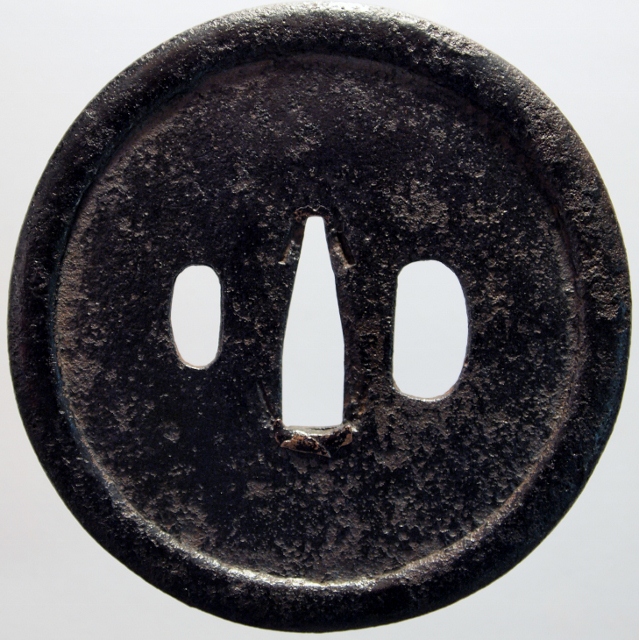
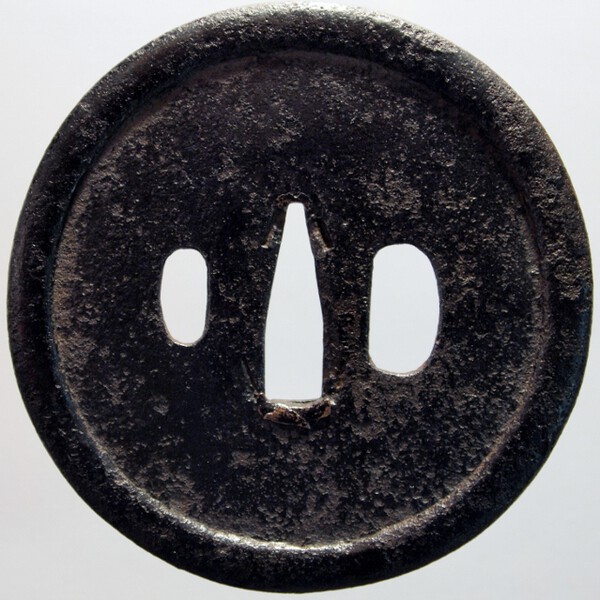
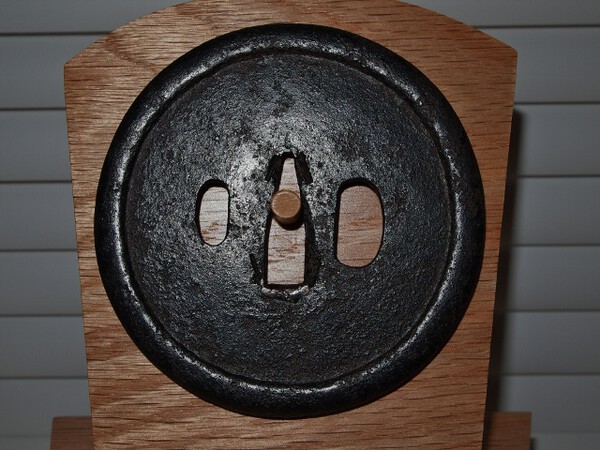
Hi Everyone, Here is the second and very different tsuba I purchased from the 2013 Tampa Show. It was a unexpected purchase on Sunday as the show was ending. Here is the first photograph I have of the tsuba. I will post more tomorrow once I have my camera and equipment setup. The measurements on this large iron tsuba is 8.6 X 8.6 cm. The thickness at the nakago-ana is 3.0 mm and the thickness at the dote-mimi style rim is 4.4 mm. The surface is covered in black lacquer with a little bit of age appropriate rust pitting in places that disrupts the black lacquered but overall the surface is intact. The color of the patina is a dark brown to black in places that still have lacquer. The plate is well forged with a fine tsuchime-ji surface and the dote-mimi style rim is turned up nicely. The plate unlike many Katchushi tsuba lacks any ko-sukashi designs and has a very utilitarian feel to it. The tsuba was intended to be mounted on a koshirea that had a large kozuka and a smaller umebari "horse needle". Not sure but I think the umebari was likely added later and the large kozuka hitsu-ana is original. In conclusion I would date this tsuba from looking at examples in my reference library and the Yamabushi website thanks Boris M. and Andy M. from the middle to late Muromachi Period. Likely during the opening years of the Sengoku-jidai after the Ōnin War (1477) but before the rule of Oda Nobunaga (1568). Comments and questions are welcome. Yours truly, David Stiles
-
Hi Junichi-san, I had a beginging class in Shodo and my teacher had a 6th Dan rank. I would agree about differences in mei over a long working period but major differences in a kao is something else. The kao was used as a cypher/trademark by the artist an were made difficult to copy to protect against forgeries. Artist would be required to reproduce this kao for the duration of a career unless a title or rank change forced them to use a different kao. Anyway ignore the mei and kao and look at the quality of the workmenship because I agree with Rrobert M. and Brian R conclusions. Just trying to be helpful. Yours truly, David Stiles
-
Hi Junichi-san, Not a kinko guy but this observation of yours should answer your question. I hope your offer wasn't much. Yours truly David Stiles
-
Hi Everyone, Just as a quick notice. I have updated with a composite image and additional information about Kamiyoshi school. Thanks for reading and enjoy... :D Yours truly, David Stiles
-
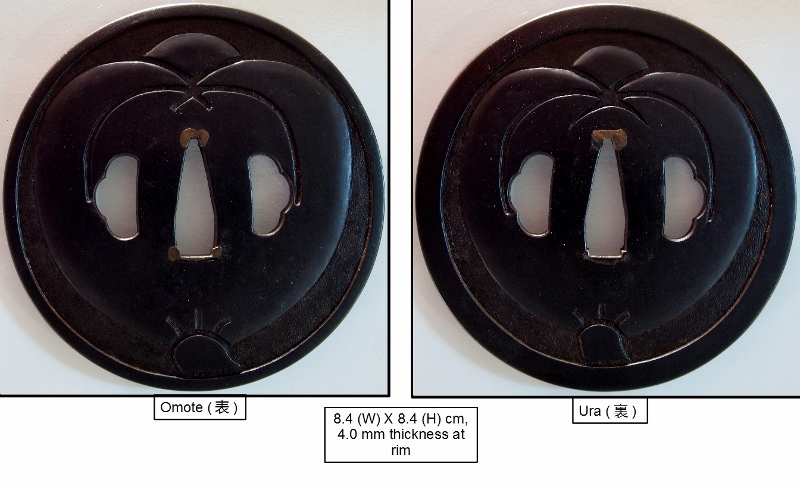
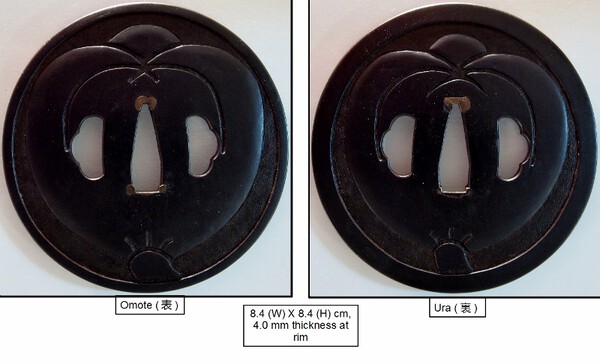
Hi Everyone, While waiting at home because of a snow day yesterday I spent some time looking at this tsuba in hand. It turns out that the tachibana mon designs as well as the rim are not identical. I didn't really see the differences until I had put together a composite image of both the omote and ura side by side. Once I return from work I will post the composite image and my impressions. I will also list more information about the three generations of Kamiyoshi Higo school that I found. ____Edit___ The composite image has been added. Something I find really interesting is the somewhat different rendering of tachibana mon design including the rim on the omote and ura sides. I also notice the difference in overall size of the tachibana fruit relative to the doeskin background and smooth rim borders almost all ka-mon designs. The precision of the tsubako to create this effect using a similar but not identical rendering of the same design is remarkable in my opinion. I always love to discovering new things about a tsuba. I think a good tsuba like a good nihonto is like this. I was reading in Sasano first English translated book page 23 that the first generation didn't sign any of his work and that many were coping works of his teacher 3rd Hayashi master Tohachi. There are a few signed examples of the second generation Kamiyoshi work. The third generation Kamiyoshi was so great that he was often called the second Matashichi. The book Higo Kinko-roku says that the metal in his guards has a beautiful patina and that hew was extremely skilled in both zogan and open-work techniques. Yours truly, David Stiles
-
Hi Ford, Well I do feel guilty about once saying Higo tsuba are a bit over rated as I now have two in my collection that I really like. It is always good to keep learning and growing in this hobby. Yours truly, David Stiles
-
Hi Ford, I really enjoyed the story associated with the design on the box. Thanks for putting this together it has been a nice read. Do you think Unno Moritoshi tosogu is under priced given his other items such as this box? Are their many of his pieces in private collections? I love MFA collection of tosogu including including works by Unno Moritoshi. P.S. Here is my favorite tsuba: http://www.mfa.org/collections/object/tsuba-with-design-of-enma-o-demon-and-sinner-9966. Yours truly, David Stiles