Bazza
-
Posts
2,868 -
Joined
-
Last visited
-
Days Won
28
Content Type
Profiles
Forums
Events
Store
Downloads
Gallery
Everything posted by Bazza
-
Rare nihonto&tosogu books in Finland
Bazza replied to Veli's topic in Auctions and Online Sales or Sellers
All - I remember a Per Terje Norheim (sp?) nearby in Sweden many, many years ago. I have often wondered if he is still active. If not, I guess his books could have migrated... Regards, BaZZa. -
Henry, no wuckin furries, Mate. You're cool. Bestests, BaZZa.
-
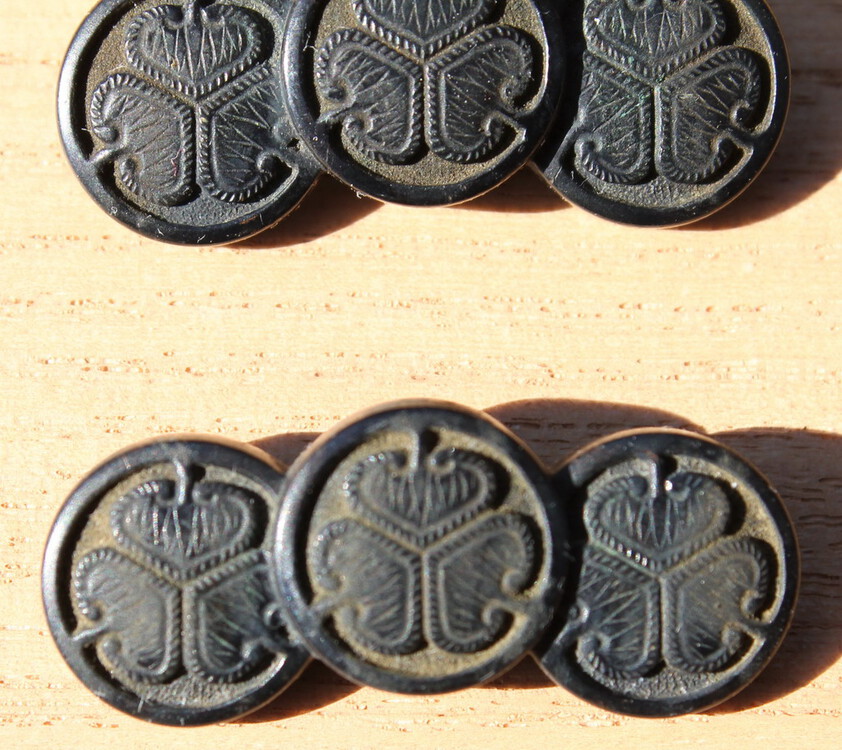
This is all a very interesting discussion about iron tsuba. Over many years I've observed kinko tosogu, particularly shakudo nanako, that seem to have some "grot" all over the surface. Study under magnification clearly shows such grot, and gentle probing with a sharp toothpick reveals a waxy type residue that comes away. Some while ago I acquired a wakizashi with excellent mumei shakudo nanako fittings in a mitokoromono set. The menuki were considerably obscured with a "grot" that appeared to have dust etc etc embedded in it. It was a miracle the menuki were still there as the binding had pretty much rotted away. Again, observation with a 10x loupe and gentle probing with a sharp toothpick clearly showed "something" that came away from the surface. The menuki were very much obscured compared to the kogai and kozuka. Having observed this stuff was one thing, but I have never attempted to clean it off. However, these menuki cried out for rescue. I've attached two images that show the before and after. My question here isn't so much about the cleaning (which people seem most reluctant to go anywhere near where shakudo nanako is concerned), but whether (say) ibota wax was originally applied to shakudo nanako to either improve or preserve the polish on a finished piece. The next question is, if this is so, what happens to such wax over 150 or more years?? The two images here clearly show some stuff has been removed from the surface of the menuki, and having once been removed it became obvious that the kogai and kozuka were also coated with "something", but I have left these as is for the moment as their appearance is acceptable. The tsuba on this wakizashi is also shakudo nanako (Momoyama Ko Kinko) and it too has "something" coating it. Is it simply the dust of ages combined with oils from handling and decades of neglect that present this appearance, or does it originate from an original treatment of the pieces when they were made??? Regards, Barry Thomas aka BaZZa

-
This Week's Edo Period Corner
Bazza replied to Bugyotsuji's topic in General Nihonto Related Discussion
On a par with breaking up suits of armour. A friend has a magnificent 16th century Myochin kabuto with its mempo that were separated from the rest of the armour, I presume to make a better profit for the seller... Regards, BaZZa. (aka Barry Thomas) -
Tanegashima Help - Original Matchlock?
Bazza replied to Windycity's topic in Tanegashima / Teppo / Hinawajū
Do we think that the serpentine has been bent at some stage of its life??? I've not seen one with the "wiggle" that this one displays. I'm betting the barrel is by a Kunitomo artisan - the bamboo-shaped flash shield locking pin is on all three of my Kunitomo guns. Also, the mon is I think KASHIWA (White Oak) - I have it on one of my guns and will try and get a picture up. Regards, BaZZa aka Barry Thomas. -
I think this has ended quietly and decently, as indeed it should. Having been on these many and varied electronic/internet forums since 1995 I have assiduously recorded in great detail and at great length (dozens of pages, hundreds of megabytes) numerous discussions on the subject of this thread as well as hundreds of others. I did it in this instance as I very early on realised the central importance of correct polish for the restoration and preservation of Nihonto and for my own education went out of my way to compile these electronic discourses for posterity, as I knew the opinions expressed would never be written up anywhere else. This thread has been little different to those I've recorded over the last 17 years in terms of the pros and cons. For my personal journey I have in the meantime had numerous of my own blades polished by different sources and have bought blades already polished. The worst, most abysmal polish (seen in another collection here in Oz) was by a little-known American. The second worst was on a (later) Tokubetsu Hozon wakizashi from a Japanese source. My experience has been wide and varied at a personal level and it has taught me much and I do my best to share it with my fellow Aussie collectors on a one-to-one basis. Now, to put it on the record - I take my hat off to Chris Bowen and in terms of this thread I sit firmly in his camp, as it were. His vast experience on the ground in Japan and his interactions with artisans across board at all levels of Nihonto and restoration skills over many years are unparallelled and undeniable. I have assiduously recorded Chris' writings since his earliest days as an internet presence with his token_kenkyu_kai discussion list and as a person who has never been to Japan and am unlikely to do so for varied reasons, have devoured his personal experiences with all manner of artisans. For those who have never experienced Chris' earlier personal recollections moving amongst the artisans of Japan I want to record here how grateful I was for the tremendous commitment of his time to convey these to Westerners. This commitment is still evident to me in his large presence here to inform and enlighten all of us sharing this passion. In the same breath, I take my hat off to Brian for his Solomonesque wisdom in keeping us under firm control and for a similarly Herculean task in administering NMB. Finally, I have particularly enjoyed this thread, even if it amounted to a same-same update of earlier discourses... Best regards to all, Barry Thomas (aka BaZZa).
-
Many years ago I watched a TV program made in Australia by a still-popular science show where it was claimed that the samurai used ball-milling techniques to pre-process the ore used to make swords. Even a professor from a famous Australian University was on the program talking about it. I phoned the very attractive researcher/presenter to tell her this simply was not true, and all she wanted to do was get me off the phone so she could "move on". No interest whatsoever that she might have been guilty of peddling sensationalist untruths. Does any Aussie remember this show??? I also wrote a letter to the professor asking what his sources were, because I had no such information in any of my references, nor had I heard of it in all my years of study and collecting Japanese swords. No reply. I still have the video and my copy of the letter I wrote somewhere in the chaos of my "library". I can only think that somewhere, somehow, someone confused naturally occurring "sand iron" with the manufactured product from a ball-milling process. Now I suppose someone will tell me that the samurai DID use ball-milling... I hope Simon strenuously resists any kind of sensationalising. I wonder if a reading of "Musui's Story: The Autobiography of a Tokugawa Samurai" would add a social dimension to Simon's research into the samurai era. Incidentally, I just discovered that Musui in this story was the father of Katsu Kaishu, the captain of the ship to the USA escorting the first Japanese delegation to San Francisco in 1860. Regards, BaZZa aka Barry Thomas.
-
The apprehensive look on the face of the figure on the tsuba seems to say it all... BaZZa.
-
Sean, Not hiragana. Looks like cursive style of kanji called gyosho, if my memory serves me correctly... I'm sure someone else will hit the nail on the head... Regards, BaZZa.
-
HAHAHAHAHA - no, but I once sold a tanto to afford a "new" (as in another) car for myself. That tanto was 'bought cheap' and 'sold dear' 30 years later. The car depreciated to 'rust bucket' status in 5 years... The immutable reality of automotive 'investment'... Best regards to all the newcomers, Barry Thomas aka BaZZa.
-
This Week's Edo Period Corner
Bazza replied to Bugyotsuji's topic in General Nihonto Related Discussion
I am most jealous of the gun!!! Ron, it looks like a Kunitomo piece; at least, it appears nearly identical to my Kunitomo gun signed KATSUMASA. Is yours signed?? I love these shorter, heavier pieces with the internal coil spring. Very neat, streamlined appearance. Regards, Barry Thomas. -
> - what is the cause of the "ripples" you can see on the kisaki? Could it be a corrosive agent, traces of a faded hamon, or just marks left by age and water? The ripples, Dear Sir, are IMHO heavy corrosion caused by rusting. Even though unsigned I'm struck by the good sugata of this blade. A good shape speaks, at a first glance, almost above all else. If the blade has quality (I see an indication of sugu hamon) it may well be worth a polish. I have seen equally or even more severely rusted blades come through a polish and turn up trumps. Of course, all sorts of disasters may well be waiting in the steel, but... I know I'm not going to get back all the money I've put into polishing blades, but Nihonto are an ineffable and captivating Art that give much back in appreciation for money spent. And unlike large amounts of money spent on fine wine, Nihonto keep on giving without a hangover... Your sword needs to be seen "in the hand" by someone very knowledgeable. Do please keep us in touch with your ongoing findings. With regard to the just previous email, some of our swords here back from Japan in a very bad condition "as found" have had a pit or two left in as the polisher kept the conformation intact. It is a small price to pay to bring a good sword back to life even if one would not wish the pits to be there. Best regards, Barry Thomas (Melbourne, Australia.)
-
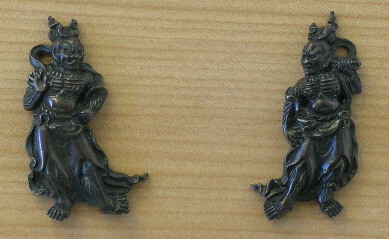
The best pair of menuki I have ever personally discovered came to me on a wakizashi of almost indescribable mediocrity and poor quality... Regards, Barry Thomas aka BaZZa.
-
I'll have a wild stab and say it looks like a sanmei with a fukurin rather than a solid piece as "yamagane" would suggest. Regards, Barry Thomas aka BaZZa.
-
Polisher signature in strange location
Bazza replied to patrick7813's topic in Military Swords of Japan
I have a ca1600 Kanemoto katana in Shingunto koshirae that has a polisher's mei with date Taisho 6 (1917), so it appears it was occasionally done well before WW2. I think I have a note somewhere of a polisher's mei in Meiji period?? I recall seeing a sword with a mokume pattern done in that place where the polisher's mei occurs and have a photo of it somewhere... Regards, Barry Thomas. -
This Week's Edo Period Corner
Bazza replied to Bugyotsuji's topic in General Nihonto Related Discussion
Photos, yes please!! To be candid, I have steered away from this thread because of its immensity (111 pages!!) and the paucity of my time, but tonight decided to have a peek. Having enjoyed the discussion on matchlock guns I'm sternly reminding myself that I promised long ago (? string of excuses) to put up pictures of my three Kunitomo guns - two by the same artisan Katsumasa. So, Chris, there is a meikan for gunmakers??? There is a long story with me and teppo. It begins with avoiding them like the plague because they were primitive things compared to swords!! Then in the Nanka Token Kai newsletter under John Grimmitt (or was it Hawley's day?? Either way a very long time ago) there appeared a series of articles on teppo by Keith Mueller, a collector in Phoenix, Arizona. These articles opened my eyes (it goes on all the time...) that there were indeed high quality Japanese matchlocks other than Udonju. Serendipity not long after that brought a lovely gun under my gaze and I acquired it. Around the same time I missed a kakaezutsu to my eternal regret, but it is still around somewhere. On its massive barrel was a large copper 'sheet on-lay' of a man riding a sea dragon. I still have some poor photos somewhere. There is another one in another State I have seen. What I enjoyed in the last two pages was the discussion on simplicity. These three guns of mine are not elaborately decorated. They are quite simple, yet elegant, and of superb workmanship. I have not at all been attracted to guns with lots of decoration. I guess the same feeling is with those who collect iron sukashi tsuba rather than Edo virtuoso kinko. But I begin to ramble... Thanks for the great discussion and I'll drop by more regularly. Best regards, Barry Thomas aka BaZZa. -
Star Stamped Sword Gassan Sadakatsu Rikugun Jumei Tosho
Bazza replied to Ed Hicks's topic in Military Swords of Japan
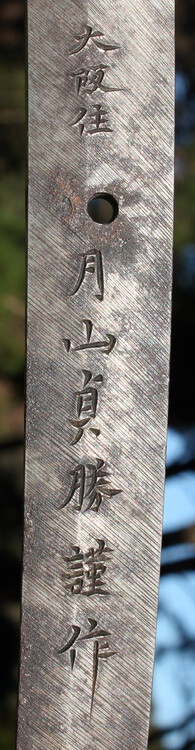
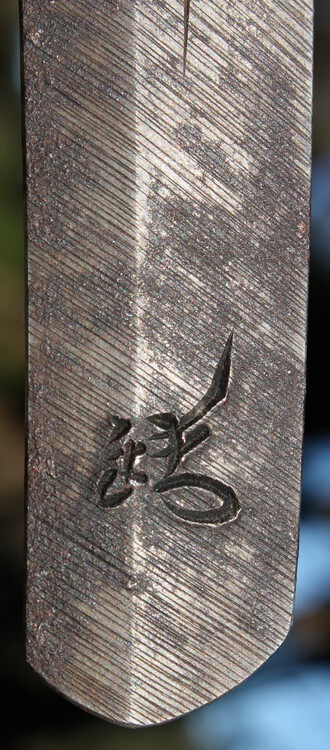
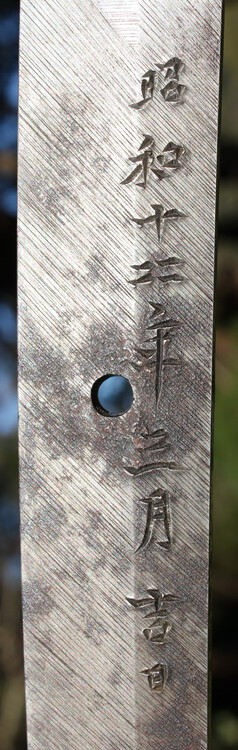
For the benefit of the discussion and with apologies for the delay, here are some pics of my Gassan Sadakatsu dated March 1939. It has a NBTHK Hozon paper. I suppose this infers it is made by Sadakatsu himself, but as Chris Bowen said of the subject sword under discussion in this thread: “Most likely this is a daisaku. It would still be considered a work of Sadakatsu, nonetheless, and would paper as such. No shame in that....” I have always considered my sword as made by the hand of Sadakatsu himself, but now I begin to wonder… If anyone wants the full high resolution image please PM me with your email address. Best regards, Barry Thomas.

-
Star Stamped Sword Gassan Sadakatsu Rikugun Jumei Tosho
Bazza replied to Ed Hicks's topic in Military Swords of Japan
Gents All, A very interesting thread indeed, as I have a Gassan Sadakatsu katana dated 1939. Polished in Japan it has an NBTHK Hozon paper. I've not been able to study the mei presented here due to other commitments, but I doubt the blade in question is by the hand of Sadakatsu because he died in 1943. Many blades in his later years were most likely made by his son, Gassan Sadakazu II. Put "gassan sadakatsu" (with quotes) into google to pull up more information, including a lovely tanto on Darcy Brockbank's website. I'll try and put up photos of my sword tomorrow. Regards, Barry Thomas aka BaZZa. -
This picture also reminded me of Roger Robertshaw's sandai Mutsu Tadayoshi wakizashi that I saw in Sydney a couple years ago. Quite the most stunning hada I've seen in my years of miserable existence... Does anybody else who saw Roger's sword think the same?? Regards, Barry Thomas. aka BaZZa.
-
Now, Dear Sir, how about some pics of your Mutsu no Kami Kaneyasu?? Please... Regards, BaZZa.
-
A question on Yari spear tip sizes.
Bazza replied to kusunokimasahige's topic in General Nihonto Related Discussion
Looking at this I am reminded of a "pillow" spear or "hand" spear I had for a time, called I believe a "te yari". It had similar furniture, but the point was a largish arrowhead with a short tang. With a pearl-shell chip lacquered pole it had a Meiji look about it. I couldn't initially recall the name so I went looking for it on google. I also found some other links on yari that seem appropriately placed in this discussion: http://www.koryu.com/library/harmstrong1.html Then I found reference to a book by Serge Mol titled "Classical weaponry of Japan: special weapons and tactics of the martial arts" Then another essay on yari http://www.yachigusaryu.com/essays/yari ... d_use.html And another http://home.online.no/~rogelia/yari.html One of the 47 Ronin apparently carried a te yari http://www.maqld.com/legend_of_the_47_ronin.htm So that's my little ramble around some interesting reading I haven't seen before. I hope it is of interest to some of our members. Regards, BaZZa. -
A bottle opener?? As in beer bottles???? Bestests, BaZZa.
-
Acquiring a Tanegashima (Japanese matchlock)
Bazza replied to estcrh's topic in Tanegashima / Teppo / Hinawajū
Eric and all, A friend brought to my attention another English language book about tanegashima. It is less about the gun itself than about how it came to be introduced to Japan by the Portuguese. "The Bewitched Gun - the introduction of the firearm in the Far East by the Portuguese" Rainer Daehnhardt Texto Editora (1994). No ISBN number It is bi-lingual, being both in Portuguese and English laid out in side-by-side columns. A very interesting thread, thank you all. Regards, Barry Thomas aka BaZZa. -
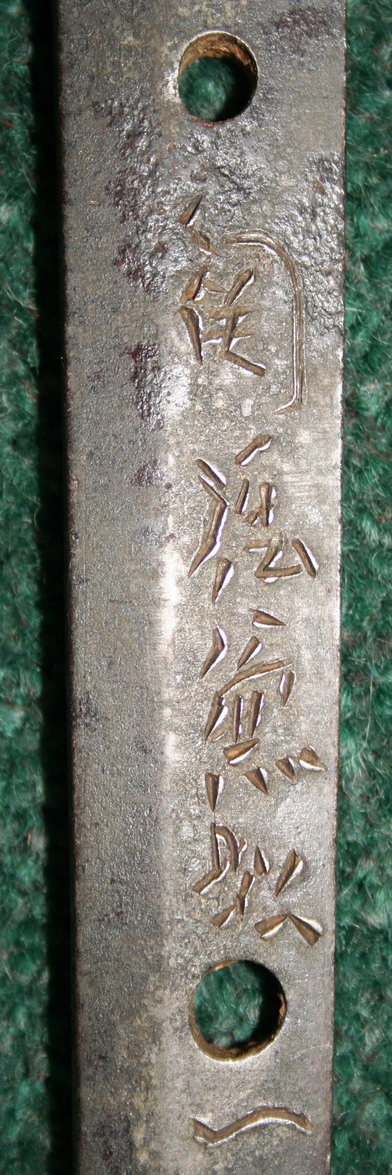
Dear Brethren, I almost hesitate to put this up, but it may be of general interest. I've just seen perhaps the longest shingunto in my experience and when I looked at the blade and signature I thought "Chinese repro". Then I looked over the koshirae and, yep, it's genuine shingunto. What made me think it might be Chinese was one of the most dreadfully cut mei I've ever seen. The owner thinks it is a Shinshinto blade, but I think it is a Showato. Perhaps the owner thinks it is Shinshinto because of the three mekugiana. I can't find any reference to the smith anywhere bar a single mention on this Board. I think the tachi mei reads SEKI JU KANEMATSU KAZUNORI SAKU, and if a Showato would be perhaps the longest I've personally seen. The blade is not dated. The blade is 74.5 cm long and the tang 26.2 cm. The other surprise was how straight the blade is. I would appreciate hearing if anyone can confirm my Showato guess and the reading, and if such a jumbled mei has been seen by anyone else. I've attached some pics. Best regards, BaZZa.




-
This sword is currently offered in a private sale on ebay, Item No 320622011717 Regards, BaZZa.