Matsunoki
-
Posts
3,848 -
Joined
-
Last visited
-
Days Won
71
Content Type
Profiles
Forums
Events
Store
Downloads
Gallery
Everything posted by Matsunoki
-
Totally different blade.(I made the same mistake🙂)
-
Please show the nakago as well.
-
Hello Peter That is a difficult question to which there are several potential answers. Basically it depends on two things - How long do you want to spend doing it….quickly or spread over time? Do you wish to achieve the absolute “top dollar” for each piece in your collection or instead take a swings and roundabouts approach? I’m speaking from the position of having been a dealer in Japanese Meiji Art for over 35 years and also having just sold my own collection of said Japanese Art. If you wish it to be done quickly and with as little pain as possible a top class auctioneer is your best bet. It is likely that they will achieve the best current market prices but of course they will take a large cut out of the proceeds. A “one owner collection” is a great attraction for auctioneers and you could doubtless negotiate a good sellers commission (but I doubt you will influence their buyers commission). If your were prepared to do the cataloguing for them it would ensure correct descriptions and save them a lot of work. It depends a bit on the overall value of what you allow them to handle. Another option is to find a dealer that will take them all……advantages include no commissions to pay, no descriptions to do, immediate payment(if you find the right dealer) but you will not get top dollar for obvious reasons…he has to make his margin and he is investing a lot of money up front. You could let a dealer pick over the collection and select what would doubtless be the best or most desirable pieces but then you get left with the rest….and word quickly spreads that “x bought all the best bits”….. The next option is to sell them yourself, one at a time to known contacts and friends, or maybe via this Forum. That requires a lot of your time over a longer period and can be frustrating. It can also cause you problems with dissatisfied customers….some people like to play games sadly. But it can be fun if you can relax and enjoy it. Observations of the “For Sale” section of this Forum suggests that things don’t exactly fly off the shelves right now….the market is slow or depressed for a wide variety of reasons….mostly all the crap that is going on in the world making people nervous. This slowing of the market is not specific to just Japanese Swords. It also depends on the quality of the collection. Things that are seriously good will sell more quickly…there are always rich people looking for the very best. Things that are cheap will also sell quickly for the obvious reason. Things that are caught somewhere in the middle market are the toughest and that’s where an auction might be better. There is no perfect solution…..each has its own pros and cons.….…… Just a few ramblings. Good luck with whichever route you take. All the best Colin
-
A lesson on 'mokume-gane' from an unexpected place
Matsunoki replied to Fuuten's topic in General Nihonto Related Discussion
Gotcha! I really should pay more attention. Now I feel even more stupid than usual 🙂🙂 -
A lesson on 'mokume-gane' from an unexpected place
Matsunoki replied to Fuuten's topic in General Nihonto Related Discussion
The tsuba above is multiple layers of different alloys which are revealed when carved deeply in guribori style. See this link https://www.mokumegane.org/e/guribori.html -
It certainly looks like corrosion of some sort or maybe a stain. Doesn’t look deep. Doesn’t really look like spider rust as that always shows up “rust orange” (or black if neutralised). Does look as if it is creeping across the blade. Does it exist along the mune? Does it exist all along the blade? Are there pits within it? Just wonder if the inner saya has been contaminated with something that has crept across the blade from it resting on the mune. Something acidic?
-
Swords of the 47 Ronin
Matsunoki replied to Utopianarian's topic in General Nihonto Related Discussion
I agree completely. We could spend a lifetime looking for an available true daisho from samurai times. I suspect most “daisho” worn by most samurai didn’t even have matching koshirae….simply a long sword and a random short sword that looked close enough! They didn’t have the money for anything else. -
Swords of the 47 Ronin
Matsunoki replied to Utopianarian's topic in General Nihonto Related Discussion
The phrase “true daisho” has always niggled me. I assume by true daisho we mean matching blades by the same smith. Do we also mean blades in the same style and/or forged at the same time? I’ve never seen an actual accepted definition of “true daisho” and no definition of daisho that I’ve seen even mentions same smith etc. I always thought a daisho was simply a long sword and a short sword in matching koshirae, either katana/wakizashi or Tachi/Tanto Has anyone ever seen a “true daisho” excluding gendai and Shinsakuto? Anyone actually own one? -
Thank you both. interesting to see Kaga oshigata that suggests they did use this type of hardening with full muneyaki and the subtle variety of jiri (excluding the suriage examples of course) Good spot…definitely the mune machi has been moved up a bit….but they did not attempt to create a new hamachi at that time. Of course it could have had a small previous full machi okuri as well. This would contribute to the apparently slightly low mekugi ana. In hand I still feel the nakago is not shortened but it’s a close call and I would not bet on it. Many such wakizashi had rather short stubby nakago at this time I believe. Possibly had the nakago edges reworked, definitely had the mune machi moved up a bit. Almost certainly Muromachi. Anyone else …..please feel free Thank you all. Colin
-
Please excuse my increasing misunderstanding……why are we comparing the nakago of a large shinshinto katana with that of a typical muromachi period hirazukuri wakizashi? Surely wildly different sugata hundreds of years apart.
-
Thank you Michael, please persevere with my lack of knowledge! The second oshigata you show (Bingo Fuyuhiro?) is certainly very interesting with the very similar hardening and lively muneyaki. I can see how that nakago could be shortened and reworked to perhaps give a more Soshu feel and a Masamune Mei added?? …..now removed ….leaving behind a confusing nakago? That would also explain the mekugi ana appearing to be a little low? But why use an obviously inappropriate jiri? …….oh, I’ve just noticed your word “finally” above…..sorry!
-
Thanks Kirill, as confirmed above ( Jacques) the nakago jiri is indeed typical Kaga…..I didn’t know that. My initial searching cannot find a similar Kaga Kiyomitsu hamon (either sword or oshigata). My library is very small. If you have any spare time could you show me one? Greatly appreciate your help. All the best. Colin
-
Its strange, in hand it isn’t nearly as “apparent” as in the images. On the ha edge there has been some deep erosion by rust roughly halfway along which I think is what makes that edge looks far worse. The mune edge appearance has been a bit affected by the rather clumsy removal of the Mei. However the mune edge at the jiri does look to taper a bit more sharply than perhaps it should. No changes in any patina nor any noticeable signs of reworking but then if was done a few hundred years ago there wouldn’t be! Thank you both….it makes me look more closely.
-
Thanks Michael, I will look at Fuyuhiro. To help me if you have time please could you say why you think nakago is reshaped…..which areas? I was convinced it was original except for the removed Mei.
-
…..but as Mark said above….. it’s best to leave the blade in the shirasaya and the tsunagi in the koshirae…..that’s the way it’s safest and it’s the way it’s meant to be.
-
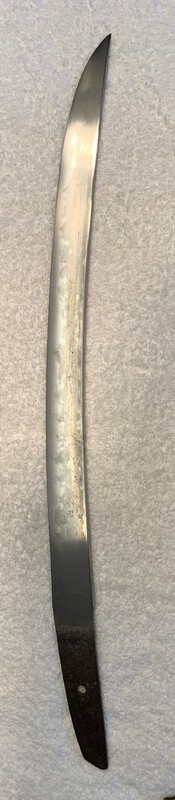
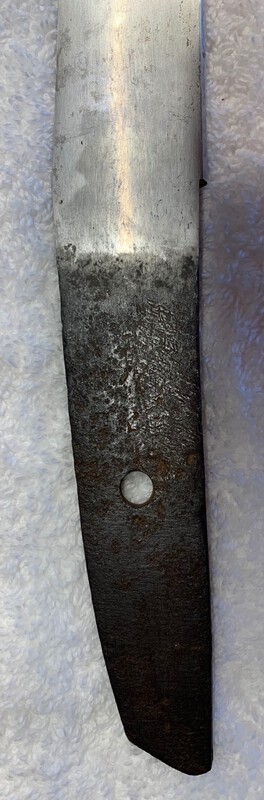
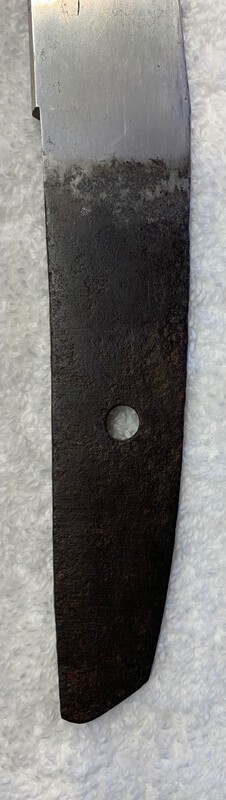
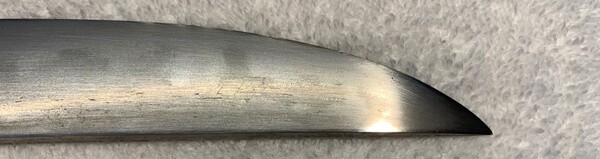
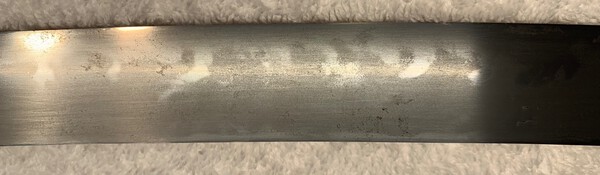
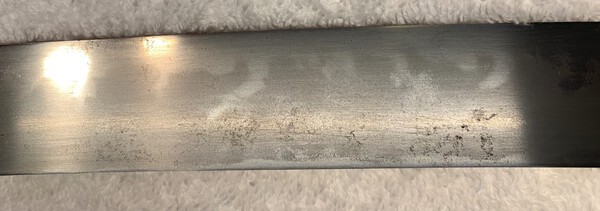
Hello from the UK I am showing this sword hoping for some help figuring out what it might be. All opinions welcome. I should at least venture an opinion….Muromachi Mino den but maybe Soshu?? It is truly a very wild blade but quite reduced from many polishes (no hamachi, greatly reduced kasane and motohaba). There is full length nie mune yaki, the mune is Mitsumune, the nie based hamon is not quite hitatsura (in my opinion) but there are tobiyaki and copious ji-nie clouds away from the hamon everywhere. Hada is not visible in this condition….typical “as found condition” for the UK….sorry! Nakago is ubu but it has obviously had a Mei removed…odds on it was Masamune! The koshirae is silver mounted with Inaba? Kamon (but at right angles to usual?) If you tap the images you should get higher resolution. Nagasa 42cm Motohaba 3.1cm remains Many thanks. All the best. Colin






-
You could also use the blade of a plane as a scraper on the tsunagi if the plane itself is too unwieldy…..or buy a custom scraper…..but as above….don’t sand it. Go with the grain, not against it. Cutting the tip won’t help if the “jam” is at the habaki end….it will just spoil the aesthetics of the tsunagi. To my eyes it is the depth of the tsunagi blade that looks a bit bigger and the kissaki looks different. Gentle approach….little at a time. You can sometimes “feel” where the jam occurs and even hear it….seriously!
-
The best Itomaki No Tachi koshirae that I’ve ever seen. Goodness knows what the blade was. Thanks for showing it. Is there a story behind it? Where is it now? (Don’t all kitchens have these things in them?🙂)
-
Gaikotsu Katana? Help, info needed
Matsunoki replied to Bridges's topic in General Nihonto Related Discussion
Hi Noah Bit more info on this thread- -
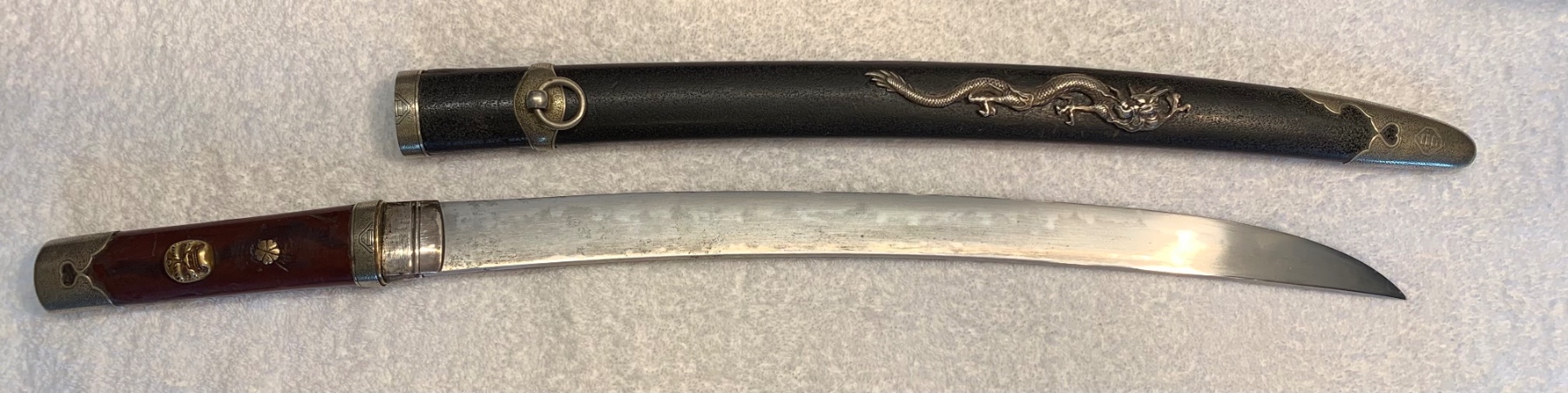
Although impressive at first glance, this is a Meiji period piece made for sale to the Gaijin present in Japan who obviously did not have the expertise at that time to differentiate between “tourist piece” and serious metalwork. The details on the saya and tsuka are usually pressed from a brass type alloy and soldered on and then subsequently very cleverly patinated to resemble true mixed metal inlays. The saya and tsuka are often given a thin wash of gilt or silver plate. The finished article can look very flashy if in good condition but the patination and gilding is usually so thin it wears off easily. The overall quality can be judged by looking at the horimono of a dragon. They are “in the same camp” as the pressed shiremono kozuka. They represent an interesting period when Westerners were keen to buy “anything” and the artisans of the time were keen to satisfy that demand as economically as possible. Blades are sometimes forged but often just a piece of unhardened steel with a hadori hamon polished on for effect. Sometimes a better quality blade is used which often has a serious fault somewhere.
-
Hi Bjorn I posted this actual Tachi on the Forum a while ago…..how did you miss it🙂🙂🙂🙂?? Included some images showing that type worn and some research done by others. It’s all in this link- Best wishes. Colin
-
Thanks for the unnecessary sad face Franco but I’m not going mad. I think the OP has edited his original post to change “iron” to “copper alloy”See his reply……
-
The Connoisseur's Book of Japanese Swords
Matsunoki replied to DTM72's topic in General Nihonto Related Discussion
Dan, many thanks indeed. All the best. Colin -
Can you show us an image of the blade and the tsunagi aligned next to one another? Do they look the same…..same dimensions?
-
If the kozuka is made from iron (and many were) the magnet will stick. If not, it will not. I suggested you try the magnet as you thought it was made from iron and it’s an easy way to tell. Kozuka are also made from many varying alloys….shakudo (usually glossy black in colour often with nanako plates), shibuichi (colour varies hugely from pale grey to dark olive green), sentoku (a brassy colour), silver, even gold in rare cases…….and other alloys that the experts on metallurgy on this forum can tell you about. Just put “kozuka” into the search facility on this forum and have a look around.