Matsunoki
-
Posts
3,797 -
Joined
-
Last visited
-
Days Won
70
Content Type
Profiles
Forums
Events
Store
Downloads
Gallery
Everything posted by Matsunoki
-
Wrong, - but it can certainly be be “declared” as doubtful - unless you put yourself on the same level as NBTHK. You are using one comparative example where there is no certainty that it is the same smith….a smith no-one seems to have ever heard or traced (until Steve found one sword) and yet you are reaching a defInite conclusion. Ignoring the actual calligraphy, the actual Mei is different By your own admission mei can change, especially as age advances. So do you know the whole career of whoever this smith is (or isn’t)?
-
I’m not trying to change anything……just suggesting we don’t jump to unfounded unproven illogical conclusions. You refer to “my elucidations” - are you saying I’ve made things clear?……. What does it mean by elucidate? transitive verb/intransitive verb. If you elucidate something, you make it clear and easy to understand. [formal]
-
Sorry Brian!!!!!….I genuinely don’t understand so I’m asking. How can we logically deduce this sword is gimei based on a single comparison to a possiblly different smith? We can certainly guess it’s gimei…..but what if it’s another obscure smith that has not made it onto the radar? ……..or that smiths calligraphy changed over the years (quite common I believe)? I haven’t seen any factual evidence yet to support gimei but I agree it’s very doubtful this blade was forged by the smith Steve has kindly located. Steve….I totally agree with all that you said in your earlier post. ……But we still have no clear idea regarding the age of the blade and until we get full sugata images everything else is highly debatable. It will probably remain debatable even after that.
-
Another uninformed massive assumption. But of course you are right Jacques, as usual. I will respect the request of our moderator and refrain from engaging with you further. Byeeeeeeeee🙂🙂🙂
-
Just saying what my brain thinks my eyes see on these two images - The nakago patina does not look faked or Showa to me. The nakago patina looks to get stronger as it heads towards the jiri with deeper corrosion ie older The upper nakago patina looks weaker (newer) especially above the upper ana…..probable machi okuri The nakago looks oddly skinny…..I still believe it has been reduced in depth to create new machi The hada does not look showato to me The hamon does not look showato to me Possible long yakidashi?…hamon appears to narrow and to become more suguha Not a bad sashikomi polish Decent soft metal kashira (does the fuchi match??) Menuki?? But JohnC we need better images - Lay the blade flat and take images from directly above it looking straight down on it, not at angles looking along the blade. We can then see the true shape. Closeups of both sides of kissaki showing boshi Maybe then the more experienced on here can contribute constructively.
-
Sorry Brian, sorry JohnC. …….just my sense of “fair play” getting the better of me.
-
Utter rubbish. Anyone (including me) could perform a passable machi okuri in a couple of hours with a couple of files. Simply reduce the depth of the nakago as it approaches the machi….at either (or both) the ha or the mune edge and simply file a new pair of machi. You could have them as deep/strong as you like depending on how much you reshape the nakago. Yes, the nakago would look slightly reworked and it would not be as perfect as a smith would do it but it isn’t rocket science….it is simply a metalworking skill. Just to be clear - I AM NOT ADVOCATING THIS AND WOULD NEVER DO IT MYSELF……but in the real world of old Japan I’m sure it was done imperfectly thousands of times…..especially on “ordinary” swords like this one. ….and how about practising what you preach by re-reading your own words in my post above. YOUR OWN WORDS.
-
WW2 Japanese army older sword
Matsunoki replied to Swords's topic in General Nihonto Related Discussion
Impossible to say. Can’t really tell how good it is anyway from these images. It’s mumei, suriage and a rather awkward sugata…..possibly not the most desirable item. More important is to realise that a polish can uncover all sorts of flaws…blisters etc…..so it’s a bit of a gamble. Eyes wide open and fingers crossed if you go for it. Good luck if you do! Colin -
David…..sorry but my knowledge is lacking beyond what I’ve already said. I hope others can offer opinions. All the best Colin
-
Jacques 1. I thought that Kazu-ichi mono referred to actual swords not swordsmiths. Am I wrong? 2.Over the many hundreds of years there are thousands of smiths that would not qualify as “artists” but that doesn’t mean they didn’t make decent swords does it? ie swords well above the Kazu-uchi mono category 3. You are looking at exactly the same images as the rest of us……please re-read your own words as follows- “You have to rely on the clues you have, not on what you think you see on the pictures.” “When I don't know, I keep my mouth shut and I don't venture into wild theories.” “To be honest, you can't tell anything about a sword if you don't have it in your hand.” …..putting this sword forward as a possibly modified showato based on inadequate images seems a pretty wild and baseless theory to me and pretty stupid given that a good showato (probably gendaito based on what we can see) is worth more than a wakizashi by a minor smith.
-
I would have thought that there are several very obvious answers to this. 1. reworking a nakago is far cheaper than getting a new sword 2. it’s his sword and he liked it - and didn’t want to junk it 3. reworking a nakago can be done by untrained hands and thus would not even require a smith (I’m not saying it would be done properly…..but possibly required quickly in battle circumstances) etc etc …..and you are making a massive assumption that this smith (whoever he is) only made kazu uchi mono….can you substantiate this? Evidence?
-
Morning Dale re the “dots”……they only appear on the three side panels that give the impression of being “folded over” so I wonder if they represent some form of welding punch…..bit like a modern spot weld? ….just a thought. All the best Colin
-
Learn some manners and humility. As for the rest of your reply …it makes no sense whatsoever in the context of this discussion.. Do you actually read what you type?
-
Luca….. What a coincidence ! Translation says it’s bamboo. Puzzle solved David?
-
David….I’m no tsuba expert but this looks a real puzzler and I look forward to the opinions of the guys that know. I would offer the possibility that the flora in question could be one of the more weeping variety of bamboo. The leaves certainly look like bamboo. I hope you get clarification. all the best. Colin
-
Firstly, thanks for calling us idiots…….. although it would seem that you are able to tell an ana is perfectly circular from your statement “I have already provided pictures of kamakura ubu swords with only one mekugi ana this one being perfectly circular” although I’m not sure why the mention of a Kamakura sword with one perfectly circular ana is relevant to the nakago in question…..we are not debating the perfection of their geometry. Secondly, please answer question one……in what way are these two mekugi ana instructive ie what do they actually tell us. Thirdly would you agree that when you can see an ana is clearly heavily tapered it is more likely to be punched than drilled?….or are you suggesting the use of a tapered drill?
-
Please look at the cross section of the tsuka just above the habaki. You will see the criss-cross rays that only occur in that form in ivory. Scrimshaw is usually fashioned from whales teeth …..which this definitely isn’t. Walrus has a much coarser grain and areas of a more crystalline structure which are not present in these images. It is possible that they have used a small piece of bone for the mouthpiece on the saya for convenience but you won’t see blood vessels in the main saya or tsuka. The more modern copies and fakes, mostly from China are sectional bone but the Japanese had no need to use such a cheap material or production method when putting this amount of effort into fine carving. They did make later inferior examples using bone …….but this is not one of them…..they had terrible carving by comparison. I have handled very many of these both as a dealer and restorer.
-
Overall that looks a nice Tanto. Can we see a few images of the whole blade (both sides) in decent lighting please?
-
In one image surely we can see fumbari and a distinct reshaping of the nakago? But in the other image it looks as if the hamon ends at the hamachi……re-hardened???


-
Ray is right. It is 100% definitely ivory and a quite good quality Meiji tourist piece. (dating from late 19thC). These hardly ever contain a good blade and likely this is a cheaply made unhardened contemporary one or a poorer quality older one. Again as Ray says, blade usually glued into tsuka and I’ve never handled one with a signed blade - so don’t risk damage by trying to hammer it off! Apart from the political stigma attached to ivory nowadays, it’s a nice example and before we banned it in the UK it would have fetched around £1000.00
-
Please give us the benefit of your expertise as these two statements are a bit confusing. Q1. In what way are these particular mekugi ana instructive? Q2. Which beliefs regarding mekugi ana are time to throw away? Thank you.
-
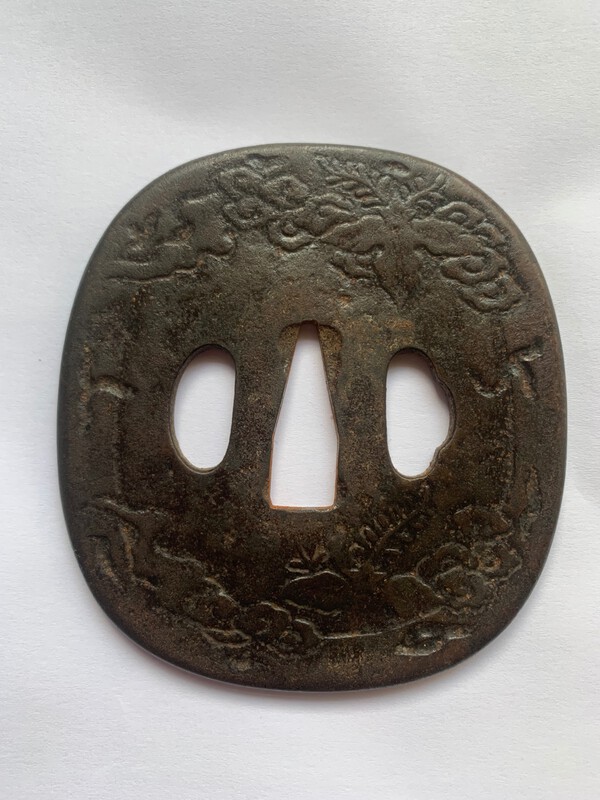
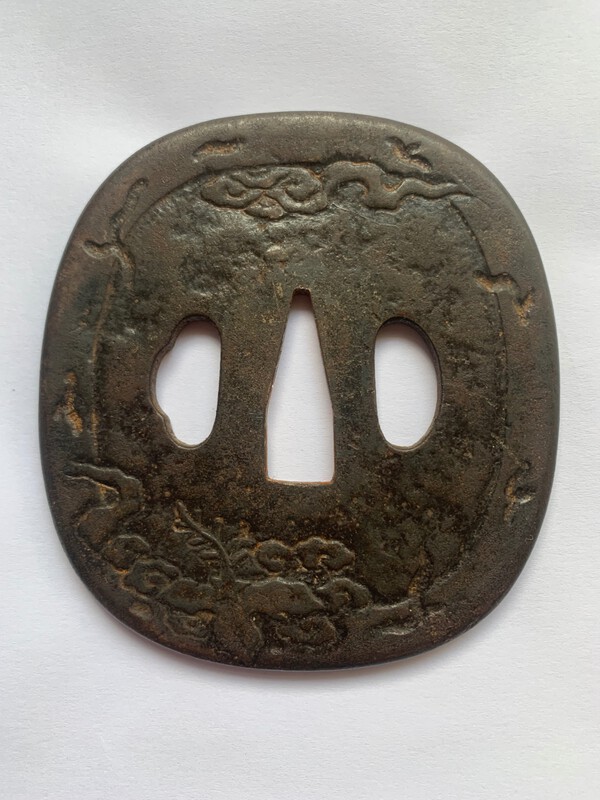
Thanks Dale….those wriggly designs around the rim puzzled me …..but now they make total sense…..just like when you pull the bark off an old log and can see where the various “bugs” have eaten it. Cant quite understand the Pauwlonia blossom floating among clouds…..maybe symbolic of the Emperor…..the sword it came off was a type carried by Imperial loyalists of the Bakumatsu period leading up to the Meiji restoration. Bruno, Greg…thanks for chipping in. Anyone give me an idea re age? All the best. Colin
-
Hello from a chaotic and laughable UK….I’m guessing our political/financial adventures have reached the wider world!!! Anyway that isn’t the topic here. My knowledge on iron tsuba is negligible so can I please ask for your help on this one? It comes off a very nice blade that has a modest koshirae. Anything you can tell me will be greatly appreciated. Thank you. All the best. Colin This is the sword it comes from just out of interest- H83.8mm W78.2mm T4.54mm at mimi
-
How do you know how he handles it and what oil he uses. ? He could be wearing mask gloves and condoms while handling it for all we know. Paz….this seems a bit “uncalled for”. Chris is simply offering advice to help preserve the sword. Warren may well already be aware of what is needed but we can see uchiko in the earlier pics and we know that the cheap stuff can scratch a nice polish. I’ve never seen condoms mentioned in sword care advice, you are the first to quote such practice.
-
John- I can offer no opinion on the stamps and marks or why they are there or who put them there but for my money this is an older traditionally made blade. It looks an ubu sword and it’s a wakizashi…..not commonly produced for the military. The nakago patina and shape do not suggest Showa nor Taisho to me. All the best. Colin