Matsunoki
-
Posts
3,546 -
Joined
-
Last visited
-
Days Won
66
Content Type
Profiles
Forums
Events
Store
Downloads
Gallery
Everything posted by Matsunoki
-
Bruce….you’re not alone there. The UK is fast becoming a borderless over-populated lawless shambles where the majority don’t give a damn and hardly anyone does their job properly. I’d better stop there but I feel I’ve got that off my chest!!! All the best. Colin
-
PS…..meant to say don’t oil or clean the tang…..just leave it alone and keep it dry.
-
Your sword is actually a wakizashi…..it’s too short for a katana. It also appears unsigned. Being realistic, an unsigned wakizashi is not high on most collectors lists unless it’s something special and from the images it is difficult to tell. Others with more knowledge than me will hopefully comment. Overall it is in neglected condition and to restore the whole package….blade and mounts…would be pretty expensive plus in Sweden I’m not sure how easily you would find reliable restorers. That could mean sending it to USA or Japan which adds more to the costs and usually involves lengthy waits. Add to that the current problem many of us have in actually sending swords around the world with carriers and airlines refusing to handle them, customs staff impounding swords etc. I think your best bet is to preserve what you have. Keeping the blade dry and lightly oiled to prevent further rust is the most important thing. Don’t leave it dripping in oil- a light film is best. Stabilise any of the mounts that need it…..spilt saya or tsuka can be carefully glued if necessary etc. Please don’t be tempted to try do it yourself restoration to the blade. That requires a very experienced specialist and it’s easy to cause serious damage to both the blade and it’s value! Do you intend to collect or is this a one off possession? Just my opinion! All the best. colin
-
Samurai katana (??length??) in Han-dachi mounts which are similar to Tachi mounts but worn as a katana (or wakizashi)
-
Collecting with vision issues
Matsunoki replied to dschumann's topic in General Nihonto Related Discussion
Drew, sorry that you are facing this health challenge, I hope the degeneration progresses slowly. I feel you should answer a simple question…”will collecting give me pleasure that outweighs the frustration?”. Sometimes I think it’s best to look for reasons to do things rather than not do them. You don’t have to acquire loads of pieces….maybe just a few that you really like. Sometimes even one lovely thing is enough. I speak from a position of experience (not with MD)……..Plus I’ve just emerged from a near death experience in hospital with severe food poisoning……made me even more determined to squeeze as much as possible out of life. I wish you well. Colin. Ps stay away from takeaway chicken noodles. -
Dale…..many thanks indeed. I learn something new every day. Trouble is I can’t remember what it was🙂. Many moons ago I had a collection of Namban tsuba….mostly intricate dragon designs….and was amazed at what detail was achieved. Back then in the UK they were regarded as one step up from rubbish but I liked them. Thanks again. All the best. Colin.
-
Interesting thread….got me thinking. Please educate me …….if it was cast wouldn’t it shatter when hammered to resize the nakago ana or insert the copper spacers (sorry…can’t remember the correct name)? This one has been well hammered and I thought cast iron shattered very easily. Thanks in advance. Apologies if it’s a dumb question.
-
Hi Jack, welcome to the “club” In addition to the excellent advise above I would suggest giving yourself time to figure out exactly what your preferences are. The subject of tsuba is wide ranging…..do you like iron tsuba, just sukashi tsuba or maybe soft/mixed metal tsuba. Flashy and magnificent Meiji period art tsuba……it goes on…… Likewise fuchi/kashira. Once you know what really appeals….and you will find out in time…….you can concentrate on your chosen subject. Buy things you really like and you’ll have a massively enjoyable time. Enjoy. Colin.
-
Hi John Some lovely tsuba in that link. I love the one with fish. Trouble is lots of the “tribute” output is damned near as good as the real thing. Nightmare!……but ultimately does it really matter if the quality is “right”?….maybe financially …but usually all of these good mixed metal pieces sell simply on their design and quality irrespective of Mei don’t they? Difficult to believe they were made by human hand sometimes. In this “advanced” day and age we will never see anything close to these being made again…..except for Ford of course!!
-
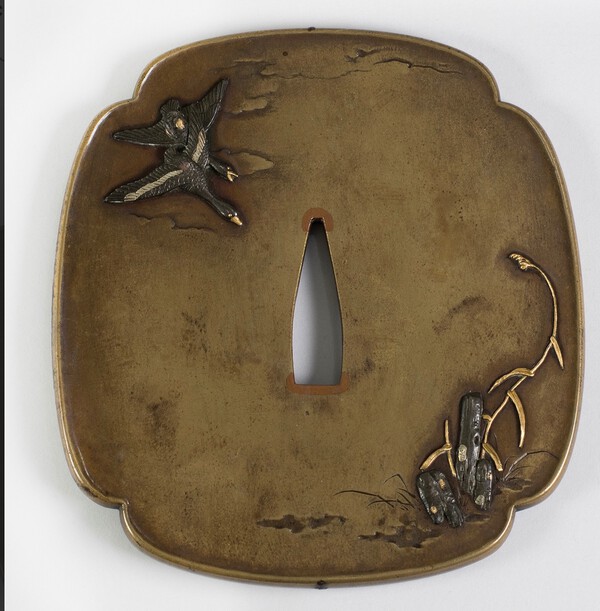
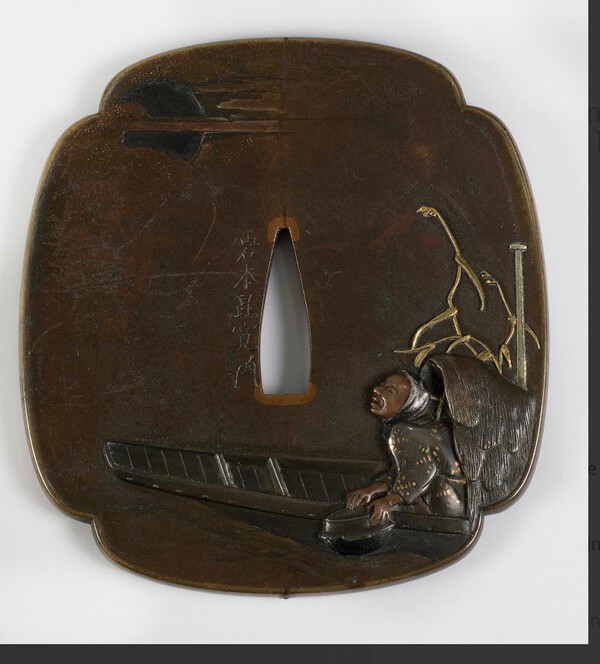
Just for interest, here’s another carrying the Konkan attribution that I once owned.
-
Hi John. Anything with a nocturnal fox on it gets my vote. I believe this tsuba shows a fox admiring its reflection in the moonlit water having “decorated” itself with some flora. However, honestly, lovely as it is I don’t think it’s good enough to be by Konkan…..but I’d buy it!
-
Hi Chris Below is the entry in Haynes giving much info. Sadly 99.99% of pieces carrying his signature are fake or “tributes” or “school of” or “after” etc etc His work is truly unbelievable…..a top drawer metalworker.

-
What makes a collection good?
Matsunoki replied to Tsuku's topic in General Nihonto Related Discussion
Hi Tsuku you ask two questions really- firstly your topic title asks “what makes a collection good” ……I would say one that makes you really happy. But then secondly you rephrase a little and ask “…what makes…a truly outstanding collection” which is a bit different and I would say one that contains examples of the finest [whatevers] ever made. The first can perhaps be achieved without being a multimillionaire and brings much fun and pleasure. The second usually requires much ££££, is far more stressful and imo less enjoyable just my thoughts…… -
I’m confused…..nothing unusual there. I think Ford was saying the dragon/ken was “glued” to the kozuka body with the matsuyani. The actual dragon/ken I think was a cast made from Bizen yaki clay….which looks very much like russet iron if fired in a certain way. Ford….is that what you are saying? All the best Colin
-
Hello again Mike I reckon there is a good chance the material in question is the dense fine “red” clay that is famously used in making Bizen ceramics. The particle size means it can take a very fine moulding and from the images the colour looks about right. It’s also very robust. Have a look at…… https://en.wikipedia.org/wiki/Bizen_ware and see what you think. All the best. Colin
-
Were ninja-to used historically?
Matsunoki replied to Oaken's topic in General Nihonto Related Discussion
Hi Christian please excuse my ignorance…..but what is matsuyani? I’ve not encountered that before…..but there is a lot I’ve not encountered before!! I still reckon a straight shortish blade worn across the back would be easier…..no chance of snagging or encountering friction on a curved saya……but then again I’m not a Ninja😊😊😊 so what do I know ? thanks for looking, -
Hi Dale….what is this actual design representing?
-
Collection Dispersion Stories
Matsunoki replied to Peter Bleed's topic in General Nihonto Related Discussion
As apparent from MichaelR’s sad story, friendship and money often don’t mix well and it can be very painful. I speak as an ex dealer in many things Japanese but over the years I formed my own collection of various things….netsuke, cloisonné, metalwork etc. As a dealer my philosophy was to offer nice items at sensible prices and be happy with a reasonable profit. I always preferred to sell to other dealers. Over the last two or three years I’ve sold all my collections…..all of it ……and now just enjoy swords again. I sold all of it to the small number of dealers who I had both bought from and sold to over the years. The reason I went that route - not all dealers are rogues. Those closer to the top of the tree are usually exceptionally knowledgeable, have a superb customer base and are keen to acquire good things especially if they come from a private collection - dealers have no emotional ties to either me (nor I to them) or the items - the money is “there and then”…..no waiting (that was my condition) - no auctioneers delays, commissions, unsolds etc - dealers generally don’t whine when they make a mistake….they know it happens now and then I’d had some superb fun putting the collections together…I was selling the items not the memories. I took a loss on some things, made a gain on others and roughly recouped the outlay overall. I was happy with that. As years seem to pass more quickly now I will soon be confronted by the need to sell swords…..that’s a different ballgame nowadays…..hmmmmmm All the best.Colin -
Were ninja-to used historically?
Matsunoki replied to Oaken's topic in General Nihonto Related Discussion
Throughout history, which is littered with constant human violence and warfare, “specialists” have always existed no matter what culture or era ….and they continue to do so today……Rangers, SAS, SBS, MI5, CIA etc. It is entirely reasoanble to assume that the same thing happened in feudal Japan. Reading through this thread much credence is given to “opinions” which seem to be taken as fact. Quotations from published literature….which are again simply opinions. “Ninja-to didn’t exist” “ninja invented in 1950s” etc etc The type of weapon you carry depends on what you are trying to achieve and the situation in which you wish to achieve it. A long katana has obvious drawbacks in a confined space, a yari is tricky if climbing walls etc etc Unless we were there we can only speculate and keep an open mind (in my “opinion!”) However (and only for entertainment) I would like to describe a sword I owned many years ago that now, looking back with a little bit more knowledge, had some features that could align to what is sometimes perceived as a Ninja-to. The blade was about 20” long, totally straight, stout with a simple but strong gunome hamon. Ko kissaki. The saya was matt black lacquer with a definite slightly rough texture. It had two kurigata….one as usual and one at bottom of saya. The tsuba was small a rounded diamond shape in black iron with no decoration. No kogai , kozuka etc. the short tsuka had black same, black Ito and black iron fuchikashira. Although short, the tsuka/nakago had two mekugi ana. Back then the big question was always “is it signed” so an operation to remove the tsuka commenced. It took a long time and much hammering with wooden blocks etc It was unsigned but ubu but had been securely glued into the tsuka with what appeared to be a type of lacquer….hence the trouble removing it. It was a grubby total sleeper so not tampered with until it fell into my hands. If I was climbing a wall or something similar this sword worn securely over my back (two kurigata)and easy to draw (straight blade) would fit the bill maybe. Who knows. Wish I had taken photos back then. You’ll have to use your imagination. All the best. Colin -
Are organizations obsolete
Matsunoki replied to Peter Bleed's topic in General Nihonto Related Discussion
Hello Michael Thank you for your comprehensive reply. For sure I am one of the older grumpier less energetic ones….I understand that very well! Things have certainly changed in many ways since the days of my first collecting adventures. Yes technology has often replaced face to face and has undoubtedly damaged the Arms Fairs (I haven’t been for ages). I have bought swords from Japan but I don’t like it! Buying a sword when all you can see is a strong hadori polish fills me with unease….but I accept that’s how it is now. We must just ask more questions and hope for accurate answers….and then hope it actually gets here! Anyway no point debating….that’s how it is. I disagree with the statement regarding the reasons for not facilitating “for sale” or advertising. Allowing this to happen or acting as facilitator but not actually getting involved would not make the Token “commercial”. But…..that’s how it is. Regarding Members selling to one another….I have no idea who the members are or where they are. Yes if I came to a meeting I would meet a few but the logistics of travel make this exceptionally unappealing. That brings me on to the topic of inter-member contact……I bet I’m not alone …..Paz was mentioning feeling lonely in his hobby. If we do nothing else can we not get our members in touch with one another….provided they want to? Again do we need to set something up if this Forum has a club facility built in? I look with envy at our American (and other) friends…..the discussions and contacts within this Forum….. I fully appreciate that a sword “event” is a non-starter for all the reasons we have both highlighted. Given the lack of volunteers and active participants a solution that requires little such resource (this Forum??) is desirable…but that brings us back to the lack of active participation………please don’t expect me to sort out anything vaguely technical…..but I will try to write something interesting for the journal. I’m sure I can entertain some people and doubtless upset others🙂🙂🙂 Thank you again for your time replying. kind regards. Colin -
Are organizations obsolete
Matsunoki replied to Peter Bleed's topic in General Nihonto Related Discussion
Sorry baba….you’ve lost me mate! Am I losing the game or the plot?…..or both? -
Are organizations obsolete
Matsunoki replied to Peter Bleed's topic in General Nihonto Related Discussion
Brian please see my point 6 below. Hi Paul….blimey time flies does it not? It was a superb event but as you say, difficult to repeat now financially and with the sparse volunteer resources not to mention sponsorship etc. I’ve joined the UKToken because I want to support it - I believe this organisation is essential on many fronts….leading, teaching, sharing etc and also because we are moving forwards into an ever increasing climate of legislation regarding what is seen as offensive weapon ownership etc However despite the successful efforts you mention regarding regional meetings I do believe other opportunities may exist to increase membership, inter-member contact and communication and funding…..not to mention learning. Just a couple of suggestions which I have floated already and where I can’t see anything apart from benefits to both the Society and its members. I thus come back to them and would like to know the reasons why they are held back. This is in no way a criticism of anyone or of the considerable efforts being put in by the same few people (as usual…..it’s always the same folk doing the spadework) 1. Allow advertising and “for sales” in the Journal 2. Consider publishing a separate “for sale” list more frequently than the journal 3. Officially and visibly widen the current Token mission statement to include Gendai and Shinsakuto. Maybe even military swords. The interest is huge in these fields and I do not understand the need to specifically focus on antiques swords. Whether we like it or not that does still sound a bit elitist? 4. Maybe have a table at the Birmingham Arms Fair or London Arms Fair to both try and attract new members and to allow members to offer swords for sale or trade for a fee 5. Allow members to access a list of other willing members giving basic contact details to facilitate discussions/interaction etc. As I mentioned to you, I just spent a fantastic day with a fellow member and I’m sure other members would derive similar pleasures from such 121 contacts in the absence of being able to attend official meetings. 6. Open a discussion with Brian on this forum. He recently muted the possibility of using the “Club” facility to in effect set up specific closed sub-forums. Could the Token benefit from the superb opportunities for communication that this forum allows? By all means take this discussion off this Forum…..although I would love to know how many other members are “hiding” on here! Get involved ……it’s fun! (Well, mostly!) All the best Colin -
Are organizations obsolete
Matsunoki replied to Peter Bleed's topic in General Nihonto Related Discussion
Going back many many years I recall an event organised by the UK Token at the Swallow Hotel in London. I reckon at least 35 years ago. It was I guess similar to the many USA sword shows that I envy. I vividly remember a large room full of tables with swords for sale…..by dealers and collectors. Swords were “on show” as were fittings and armour. I believe there were lectures and demos as well…..but I was too preoccupied with the “for sale” room! It was a massive success I believe….but of course took much organising. I’m not sure if such an event could be staged now for many disparate reasons…..resources, enthusiasm etc but I do wonder if our Token Society could include a “for sale” section in its journals which might generate extra income which might fund other activities and generate a hell of a lot more interest and contact/interaction between members, especially those living in far flung wastelands (like me). Lets be honest, nothing gets us going as much as the opportunity to actually buy something….if we are speaking the truth. Also focusing on whether to buy or not also makes us study and research. At that event something made me smile. A dealer said to me something like “what the hell do I know, a Kabuto I just sold for £2k just resold for £6k”. We all love a bargain don’t we🙂? Im sure this has been kicked around before…apologies for resurrecting it. All the best Colin -
Surprised no one has mentioned that (imvho) it also depends heavily on how good the polisher was. It is he after all that puts the final edge on the hamon….unless the smith himself did it?
-
Hi Paz like you I am a token member but sadly nearly twice your age! what follows are simply my views and opinions which I realise and accept don’t count for much Your question is a simple one but yet it goes to the very heart of enjoying this subject ie “what am I actually looking at?”, “what can I see?”, “what is there that I can’t see?” and more worryingly “what is being concealed?” Important to remember that the smith will determine what the hamon is and the activity within it. It is the polisher that will determine what we can (easily) see. A trained and time served polisher is a mixture of sheer genius and magician. They can take a grey steel bar with scratches and chips and transform it into a lovely sword. However as in Star Wars, there is a dark side where many serious flaws can be hidden…..often driven by ££££. Your sword was in sashikomi polish, an “older traditional style” where largely the actual hamon is gently enhanced to enable all its activities to be easily seen. In appearance it is “softer”, more subtle but imo beautiful. That could be the simple reason your hamon did not leap off the blade at you. The fashion nowadays (which I personally struggle with and don’t understand) is the keisho/Hadori style where one of the final polishing stages involves using a rougher stone to impart the “white” effect on the hamon thus creating a dramatic clash between the colour of hamon and the ji. However it can make it damned difficult to see what the hamon actually is. You are looking at the polishers “interpretation of the actual hamon”……which could vary dramatically from what the actual hamon really is. Many people prefer this drama but it sure adds to the difficulties when viewing a blade. This technique can be used to create the illusion of a hamon which has dropped off the blade, also to create the illusion of a boshi when it shoots straight off the end and even to conceal hagiri and other flaws. When you are looking at many images both on this forum and on Japanese dealers sites you are usually looking at a polishing effect which tells us very little about the hamon and other tempering activities. It is then necessary to hold the blade in suitable lighting and peer at it whilst twisting and turning it in the hope that you can see what is underneath ie see what the smith created. You can gather I’m not a fan!……but that’s the current trend! So, my advice, don’t judge a blade based on the polish….the polish can be gentle or harsh, appropriate or inappropriate, well done or less so. Look through what you first see to see what is really there and if you can’t see what is really there…walk away. Here is a link to a super site, I recommend you read everything on it. https://nihontoantiques.com/Japanese-art-sword-restoration/polishing-techniques/ Enjoy your journey. All the best. Colin