Ray Singer
-
Posts
5,374 -
Joined
-
Last visited
-
Days Won
147
Content Type
Profiles
Forums
Events
Store
Downloads
Gallery
Everything posted by Ray Singer
-
Additionally, rather than using uchiko I strongly recommend that you use a microfiber cloth to remove the old oil before reapplying new oil. https://www.adorama.com/cpcml.html?gclid=CjwKCAjwiN_mBRBBEiwA9N-e_tw6odnwm2ZOjyEGCjjEsrHZIOEQClclLpzt3omRBiEZowAhMICebhoCs_8QAvD_BwE
-
It is very good that you asked here first. Please see the article below. http://www.nbthk-ab.org/Etiquette.htm
-
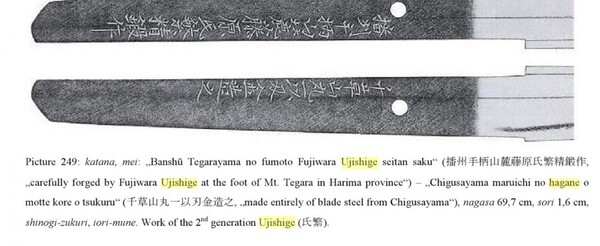
播州手柄山麓藤原氏繁鍛之 Banshū Tegarayama Fumoto Fujiwara Ujishige seitan kore
-
千草山丸一以刃金造之 Chigusayama maruichi (no) hagane o motte kore o tsukuru Made fully with material (steel) from Chigusayama.
-

Some Top Items Changing Hands
Ray Singer replied to Jussi Ekholm's topic in General Nihonto Related Discussion
As far as the discrepancy between Tomonari and others, I would note that the Tomonari is only ranked as a Juyo Bijutsuhin. Juyo Bijutsuhin is a deprecated ranking and is not equivalent to Juyo Bunkazai. Some Jubi would even have a challenge passing Juyo today. I do not know which of the Tomonari Jubi this was, however there is at least one which is only osuriage mumei, compared with the Tomonari Juyo Bunkazai which I believe are all signed examples (and would be expected to command a higher purchase price). -
Morihisa - 守久
-
I see the sword has been relisted from a Miami location. Any idea who see the seller is? To be clear, I have no personal interest in this Komonjo sword, just curious about the dealer. Best regards, Ray
-
You may want to consider vintage obijime as an alternative. Nice old obijime can often be found for around $5 each.


-
Lost sword * Edit * Found
Ray Singer replied to Surfson's topic in General Nihonto Related Discussion
Very sorry to hear this happened Bob. Likewise, I'll keep an eye open for this one and will also share this post in the Facebook groups. Best regards, Ray -
Tachi By Hachidai Tadayoshi With Zokumei (1836)
Ray Singer replied to Ray Singer's topic in Sold Archive
Withdrawn from sale. Please move this post to the Sales Archives section. Thank you, Ray -
Nagasone Okisato (長曽祢興里). Ie. a portion of the mei used by Kotetsu.
-
Hi Harry, To elaborate on the quick comment above, you would not want to have a new mekugi-ana drilled into the nakago of an antique blade by anyone. It is not generally advisable to fit blades into pre-existing antique koshirae. Where are you located? If you are in the US I would recommend John Tirado (https://www.facebook.com/johntiradosayashi/) to have a new koshirae made. You can also have this work done in Japan via an agent such as Paul Martin (http://thejapanesesword.com/) or Mike Yamasaki (http://tetsugendo.com/). An agent can also help locate appropriate tosogu. Kind regards, Ray
-
You do not want to do this. Commission the assembly of a new koshirae fitted to your sword.
-
Another osuriage mumei attributed to the shodai. https://www.aoijapan.net/katana-mumei-hizen-tadayoshi-1st-generation/
-
For my part, I'm only going as far as saying that it is suriage / o-suriage without taking the position that this was definitely intended to deceive.
-
Appears to be by Kanabo Masazane. 金房隼人丞正真 Kanabō Hayatoryō Masazane http://www.kandatoukodo.com/nihontou/katana20.html
-
This is a tsuba signed Tosa (no) kuni ju Myochin Munetoshi. 土佐国住 明珍宗利 http://www.militaria.co.za/nmb/topic/7626-tosa-kuni-ju-myochin-munetoshi/
-
Looks like a torokusho (registration license) for a mumei wakizashi of 44.5cm in length. This is not any type of appraisal document / kanteisho from a sword-related organization like the NBTHK or NTHK.
-
I am not sure I would consider this to be ubu. The nakago has clearly had its shape modified, even if the majority of the nakago is original. At minimum, the nakago-jiri has been truncated and the blade is suriage. The hamon also appears to run into the sabigiwa, as best as I can see from the photos. Also, as Paul said perfectly above, the textbook Hizen-to workstyle was established later. It was really Omi Daijo who refined the approach. If in fact this was done with the intention to deceive, it is not a stretch to imagine someone would have been trying pass off the sword as a Rai, Awataguchi, etc (high-quality Yamashiro blade). Sword scholarship in the past was not at the level it is now. If the blade we are seeing now previously had something like a Hon'ami kinpun mei to Rai Kunitoshi, there may not have been many at that time who could say that it clearly looks like a Hizen-to.
-
Strongly agree with George's comments above. Bonji are typically carved like horimono rather than chiseled like a mei (as in your example). Devout buddhists may have a bonji, an invocation/mantra or both added in relation to their faith. I don't think the bonji on this sword has a relation to where it was made (ie. a Senju Kannon bonji would not indicate that the blade is Yamato Senjuin). Like George, I believe this simply indicates that an owner at one point was a devout Buddhist and chose to have this added. I can recall both Buddhist inscriptions on osuriage nakago and ato-bori horimono with Buddhist themes which I believe represent the same scenario.
-
Bonji are very frequently see on the nakago of swords due to the osuriage process. Looking through the Juyo books, there are dozens of examples and there was a beautiful Soshu Fuyuhiro with bonji on the nakago at the recent Tampa show. As far as one that was part of the original nakago, which I believe is the question, please see attached. I'm pretty sure we have discussed this sword here before.

-
One more attached. Looking through the Juyo books, bonji on naginata are not all that uncommon.

-
Bonji do appear within the blade of naginata. I am attaching a photo of a Nobukuni naginata (naginatanaoshi) from my collection. A bonji would not be placed on the nakago for reasons of lacking space. In the case of the Kokuho Nagamitsu naginata, the bonji on the nakago is believed to be contemporary with the blade and not added later. Yamato Senjuin smiths did not generally sign 'Senjuin'. Regardless, that mei would read 千手院.

-
Example of a bonji originally placed on a nakago. Kokuho Nagamitsu.

-
Attempting to identify an old blade.
Ray Singer replied to Matt House's topic in Translation Assistance
Matt, if the signature is authentic this link will give you the likely working period when your sword would have been made (Muromachi period, perhaps Eisho circa 1504-1521). If you search online for Bizen Ietsugu you will find other helpful information. https://books.google.com/books?id=46IYtI0nkiEC&pg=PA102&lpg=PA102&dq=Bizen+Ietsugu&source=bl&ots=BRGfXc_RRq&sig=ACfU3U1F5wYMZxW-itCqXrxhTXdw6D7cQg&hl=en&sa=X&ved=2ahUKEwiywMPUquvhAhWStlkKHRsWDcQQ6AEwC3oECAUQAQ#v=onepage&q=Bizen%20Ietsugu&f=false