Bugyotsuji
-
Posts
14,780 -
Joined
-
Last visited
-
Days Won
309
Content Type
Profiles
Forums
Events
Store
Downloads
Gallery
Everything posted by Bugyotsuji
-
Ed, and others, just enjoy Guido's Netsuke for a while more. They have been offered for us to look and learn. They don't get much better, unless you have serious resources. I have nothing of that quality.
-
Steven, a sweet lacquer Hyotan. Personally I like gourds, but no-one has shown much interest in the ones I have posted elsewhere! Not popular in the West? (Having invited Chad to go and get shot at over on the INS site, Guido said "Don't bother", without giving a reason. This could potentially make me look stupid in front of all. Not a problem as I am fairly stupid. My advice would be to avoid the politics and group dynamics there, and like Rudyard Kipling's cat, walk your own path at all times.)
-
A Very Rare Teppo Pill Lock
Bugyotsuji replied to watsonmil's topic in Tanegashima / Teppo / Hinawajū
The closest I can find to the Mon is a Gunbai "Kara Uchiwa in a thick circle". 太輪に唐団扇 The uchiwa came from China and became a battlefield pointer for generals such as Takeda Shingen. According to various references, the most famous families who used variants of this were the Kodama, early on, and the Naito Murakami and the Okudaira. Also Yashima and Yoshino. You would need to consider which families were still active at the early half of the 19th century.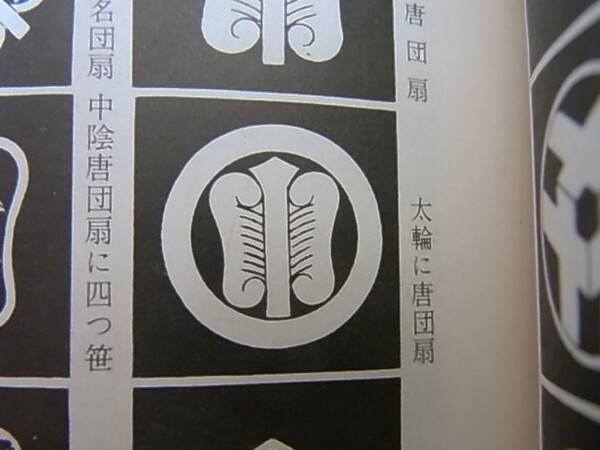
-
Clever joke and interesting insight. Many thanks. Japan is so often found in the accumulation of tiny detail. Not dollars but yen. Not yen, but sen. Not sen but rin. Not potatoes but grains of rice. Then throw in thought, concentration, sense and artistry... Love it.
-
D T I 2015
Bugyotsuji replied to Guido's topic in Sword Shows, Events, Community News and Legislation Issues
To answer your question Guido, no, there will not be a national NBTHK meeting that weekend. -
Excellent. Many thanks. Can someone change the title of this thread, please, as Sanskrit is a very different question and no-one will ever find these charts otherwise?!
-
Bizen Swords Exhibition At The Japanese Sword Museum Nbthk (Japan)
Bugyotsuji replied to Gokaden's topic in Nihonto
Was given one complimentary copy. Bought three more at the local sword meeting, NBTHK slightly reduced rates. And no, the editing was still not perfect! Aaaarrrggghhhh.....


-
Well, at least I can tell you it's upside down...
-
This looks very nice.
-
It was published by the Sano Art Museum on 25 August 2015.
-
Bizen Swords Exhibition At The Japanese Sword Museum Nbthk (Japan)
Bugyotsuji replied to Gokaden's topic in Nihonto
PS The above book should be available at the NBTHK Tokyo Sword Museum too. 備前刀剣王国 "Bizen Token Ohkoku" Color, 73 swords, 188 pages, J/Eng Bilingual, 2,800JPY. -
Bizen Swords Exhibition At The Japanese Sword Museum Nbthk (Japan)
Bugyotsuji replied to Gokaden's topic in Nihonto
http://www.sanobi.or.jp/shop_article/ Yes, this one is advertised on the Sano Art Museum site. -
What the man said, oh, and forget the bit about Kamakura Period.
-
Nihon No Bi: Nihonto (The Japanese Sword)
Bugyotsuji replied to Paul Martin's topic in General Nihonto Related Discussion
Will probably buy mine over there. -
Tokubetsu Kichi Nitei-Sho Certificate
Bugyotsuji replied to kissakai's topic in Translation Assistance
Migi wa to kyoukai ni oite: (This) on the right is what this (our) organization Shinsa no kekka: (concludes from) (as a result of) examination; Tokubetsu kicho kodogu toshite: to be an especially valuable small accessory Nintei suru: we certify (the above) -
Tokubetsu Kichi Nitei-Sho Certificate
Bugyotsuji replied to kissakai's topic in Translation Assistance
One line each? I'll go first, then... 活花図鍔 Ikebana Zu Tsuba. -
Shipping swords from Japan to Canada
Bugyotsuji replied to b.hennick's topic in General Nihonto Related Discussion
Any luck in the end? *****To the USA? Any further ideas? (Not Canada in this case) Japan Post, EMS? UPI? What do most Japanese sword shops use? Just as an aside, is it possible to put one in your suitcase, or box it separately and put it in the hold? -
佐倉家士 細川忠義作 Sakura Kashi Hosokawa Tadayoshi Saku Well, that's my guess, but I had to work with my books and the internet.
-
Yes, Ian, very true. People's names, and place names here in Japan can be a nightmare too, understood only by the select few. Nigoru also means "voicing", and it happens with English loan words too. A word like 'news' has a voiced Zzzz buzz at the end in English, but the Japanese have removed that to make it sound like, not nyuuz, but nyuuss. De-voicing? They do it with bag, (baggu) which becomes back, (bakku) and bed/bet beddo/betto. A 'close-up' shot becomes a 'cloze-up', on the other hand. But getting back to Jigane for example. Someone suggested today that it might be the Tokyo word for Jihada!
-
PS Great article on rendaku, Jussi. One good learning one for me was my mix-up between Kosame and Kozame.
-
No.1 at Aoi Art he states he has no idea of the age, but with his iron jingasa he says "late Edo". Which would you choose? No.2 on eBay says it was made between 1900 and 1940.
-
Hi Jussi, good luck with your Japanese studies. It's really fascinating, isn't it. Your bible sounds like a useful discovery. Somehow we have to get exposed to Japanese as much as possible and pick up the rules between the lines. I have heard it said that very young children pick up their mother tongue pretty quickly, even by the the age of three, but it's when they enter the classrom and get laughed at by others that they start learning the exceptions to the rules. Over the years I have had too many J friends to count, but of those there is only one who would stop me and actually correct my language usage. A funny guy, but his Japanese was particularly delicate and deliberate, and when he spoke it was as if he was enjoying expensive French cuisine. Sometimes I feel really confident in Japanese and then the next moment I find myself suddenly completely out of it. Well, that happens in English too! One fascinating thing for me, though, is watching two Japanese disagreeing over the accent to a word, for example. Like meeting a Japanese person who dislikes fish, It releases me from the pressure of some kind of heavy concept and frees me up to enjoy things a bit more. OK, I'm waffling. I'll get my coat!
-
Already caught it, Jean. Many thanks.
-
Recently doing some translation work, I noticed that I was getting different answers from different people and different books on certain words. For a Japanese person it is simple to read and understand this 棒樋 without vocalizing it. Any translator into Romaji though, has to write Bo-hi or Bo-bi, choosing either one or the other, in the knowlededge that it might become a textbook influencing the future. Nagayama Kokan's book says Bobi, and the only example where -hi is used in there is with the groove in a Naginata, ie Naginata-hi. All of his other usages in the book, The Connoisseur's Book of Japanese Swords, such as Futasujibi are -bi. An illustrated book by Gakken is more explicit, but different again, giving 1. Bohi 2. Soebi 3. Tsurebi 4. Futasuji-hi 5. Koshibi Recently I came across the word jimon. Is this the popular word for activity in the ji? Someone corrected me and said no, that there is ji, and jigane, and there is hamon, but no jimon per se. It sounds funny, he said. I was advised to change them all, which I did. When the proof came back they had all been changed back again to jimon. Do you read the nakago date as Nen Gatsu Hi or Gatsu-bi or Gatsu-jitsu? There was more, and more controversial, but perhaps this isn't the place to get into too much detail; I was just hoping to discuss the lie of the land in general. Other members may have better examples. When I was told that there is no final agreement on many words within the sword community in Japan, then it was that I began to understand the pressure on me or everyone to 統一 'to-itsu' (unify/standardize), ie come up with a standard word that we will all stick with, for the purposes of this one publication anyway. Is there a fear that troublemakers will step in and begin to ask more and more difficult questions if they see a chink in the chain fence? Is this a difference between east and west Japan, Kanto and Kansai, or is there some other factor at work? Is it a function of whoever is chairman of the local sword society? Does each society deveop certain word habits? My sword teacher says that some sword experts in Japan are sticklers for correct usage, and their opinion can sway everyone else in the near vicinity. I suspect that Japan is on the other hand a very forgiving society, where no-one will pick you up for mistakes, unless you are unlucky in who you meet. There is a tension around swords, though, manners being extremely important, for the sake of safety and respect for tradition at the very least. Is it a matter of 99 smilers and forgivers and one red-faced, overworked policeman? The floor is open...
-
The follow-up is winding down but never-ending. Now they have begun to understand that I want it to be right as much as possible in the detail, and more and more fine-tuning questions are coming back down the pipeline. Phoof... In this heat the hairs are getting up my nose.