Bugyotsuji
-
Posts
14,634 -
Joined
-
Last visited
-
Days Won
293
Content Type
Profiles
Forums
Events
Store
Downloads
Gallery
Everything posted by Bugyotsuji
-
Kuroda Han, Yo-Ryu, Kakae-Oh-Zutsu
Bugyotsuji replied to Bugyotsuji's topic in Tanegashima / Teppo / Hinawajū
Geraint, yes indeed, it is quite a bit heavier than the 7.6 kg 20 Monme which I am used to. It can be fired from almost any position with the right technique, but they will expect this one to be fired mostly standing up. Last year I fired a 50 Monme and it nearly took the life out of me. The first opportunity will be in the autumn/fall when the weather makes fighting in armo(u)r more bearable. Will post a pic if there is a good one. -
Kuroda Han, Yo-Ryu, Kakae-Oh-Zutsu
Bugyotsuji replied to Bugyotsuji's topic in Tanegashima / Teppo / Hinawajū
Reply from Mr Urabe just now, who says that my e-mail has fitted together three similar-looking names which he now realizes must be the same person. He says he will correct his list for the next updated version of his booklet. What is good for me is that one of the names, a Kojima Denpei, slightly different Kanji, is recorded as having studied in Nagasaki, and having made a gun at/for the Fukuoka Han in Ansei 3, ie 1857, giving us a rough time bracket of Bakumatsu. -
This gun, at 30 Monme, weighs in at 11.4 kg. On the barrel are two Sangai-bishi 三階菱 Mon in gold and silver of the Ogasawara Han. There was a branch of Ogasawara in Kokura, Kita-Kyushu. Registration paperwork shows Hiroshima, and there were Ogasawara there too, but the Jinshin registration mark of early Meiji (1872, Meiji 5) was struck in Fukuoka, where the Yo-Ryu were centered. The founder of the school was 安部家 the Abe family, and it spread to Tosa Han, Kariya Han (Aichi), Fukuoka Han and Akizuki Han. This Yo-Ryu school used them not only for firing ball, but also 棒火矢 bobiya/bohiya, iron-tipped fire arrows/bolts. The 16th successor and present active head of this school of gunnery is a good lady by the name of O-no-Ue, 尾上. Yo-Ryu big guns can be recognized by the octagonal flaring shape of the muzzle, the flat cliff-cut of the front of the stock, and the exceptionally small grip. Yo-Ryu gunsmith names often begin with Kojima 児島, and they are recorded as having worked in both Fukuoka, and Fukuyama in Hiroshima. In this case it is "Kitae Makibari, Kojima Denpei Shoko", which is not recorded, so I have just contacted Mr Urabe in Shikoku, the author of the best Meikan IMHO, to ask him if he feels the need to update his lists. In good condition, but some small damage to the trigger and surround which the restorer is working on this week. This gun will probably be fired inside the local Budokan at the Kobudo-Sai in November this year. (The photo shows a top-quality Jingasa of the Kuroda Han, with the two well-known Fuji-domoe 藤巴 Kamon and the generic white ishimochi sun ball, 石持, often 黒餅 black 'kuromochi', but here lacquered in gold.)


-
Kayaku-dameshi (Gunpowder tester)
Bugyotsuji replied to Viper6924's topic in Tanegashima / Teppo / Hinawajū
Jan has something else that could be added to this thread, I suspect. -
This thread is quite educational (and interesting) for me. Some lovely examples shown here. Thank you. There seem to be so many permutations of what was possible. Wonderfully inventive, the Japanese, within accepted but largely unspoken parameters.
-
Been building this one
-
Edo Period Corner Part II
Bugyotsuji replied to estcrh's topic in General Nihonto Related Discussion
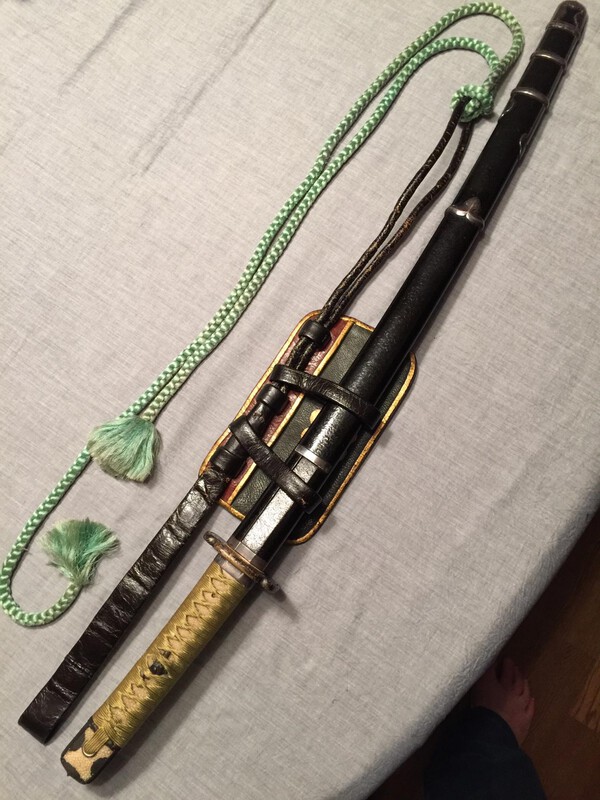
Boring! No slipping one past you gentlemen! Grrrr... Yes, spot on. Slides open, hing(e)ing on the metal pin, and can fit most sizes of Nakago I guess. The bands would serve to lock it on to any blade. The size would make for a solid grip in two hands. Actually I thought I could see some Roman lettering on the cross-headed hinge-pin, suggesting 1930s to me. Might have another chance to see it today. -
Edo Period Corner Part II
Bugyotsuji replied to estcrh's topic in General Nihonto Related Discussion
No, sadly Brian it got used. Today I saw an object that I could not get permission to photograph. Private collection. Mystery object challenge. Plain Ho-no-Ki tsuka, no traditional bindings or fittings. Extra large. Five or six mekugi holes in a line and one large mekugi. Two removable copper bands like those on a Hinawa-Ju gun barrel. A metal pin through the tsuka near the plain kashira end. Any volunteers? -
Do Things Move Slow At The Nbthk?
Bugyotsuji replied to bigjohnshea's topic in General Nihonto Related Discussion
Chatting with someone on the NBTHK board yesterday about this topic. (A dealer in London had recently expressed anger to me at the delays to Shinsa.) Apparently six of them come together for three days every two months, judging swords at one time, fittings another, etc. There is an increasing number of swords waiting for appraisal apparently. One thing that has really slowed down the process is owners making subsequent claims regarding the state of returned swords. "This mark was not on the shirasaya when I sent it away!"... etc. A fairly recent and growing trend, I was told. Ideally the blade and sheath should be minutely photographed and dated and mutually agreed before sending off, I thought, but who has the time and the patience for that, when there is no limit to the magnification possible? -
Morita San, a living national treasure! Wonderful job. Thank you so much for your help.
-
No, definitely not pickled beans, Jan...
-
Paul, there are lots of photos on this web site and elsewhere showing pans and lids. Do you have the old pan lid? Can you post a photo of your gun? They swing open away from you, hinged with a hollow pin at the far end of the pan block.
-
Ah, that would explain it. Many thanks. (No-one replied to poor Justin's request, so I thought I would step in and take any flak.)
-
Perhaps Nihon Shosha...? 日本商舎
-
Oh I am glad it fits. The first one of the nine above, right? (Tokuoki/Atsuoki from Kyoto.)
-
Sesshu Ju Kuni-...xx Agreed.
-
John, can you get two or three closer shots of the Mei. The first character is visible, the second is fuzzy and... where is the third, down left? Is it a Kao? A very pretty object, by the way. There are nine metalworkers starting with 篤 Atsu in one of my books here by the way. 篤興 篤良 篤旨 篤昌 篤明 篤行 篤二 篤弘 篤義
-
Kago Yari By Kunishige
Bugyotsuji replied to Bugyotsuji's topic in General Nihonto Related Discussion
The angle on the Nakago-jiri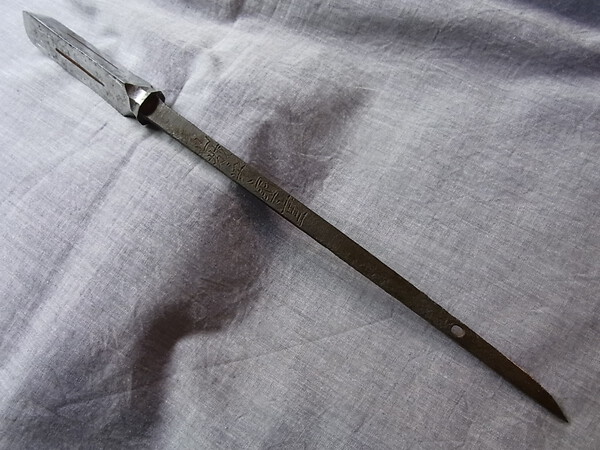
-
Kago Yari By Kunishige
Bugyotsuji replied to Bugyotsuji's topic in General Nihonto Related Discussion
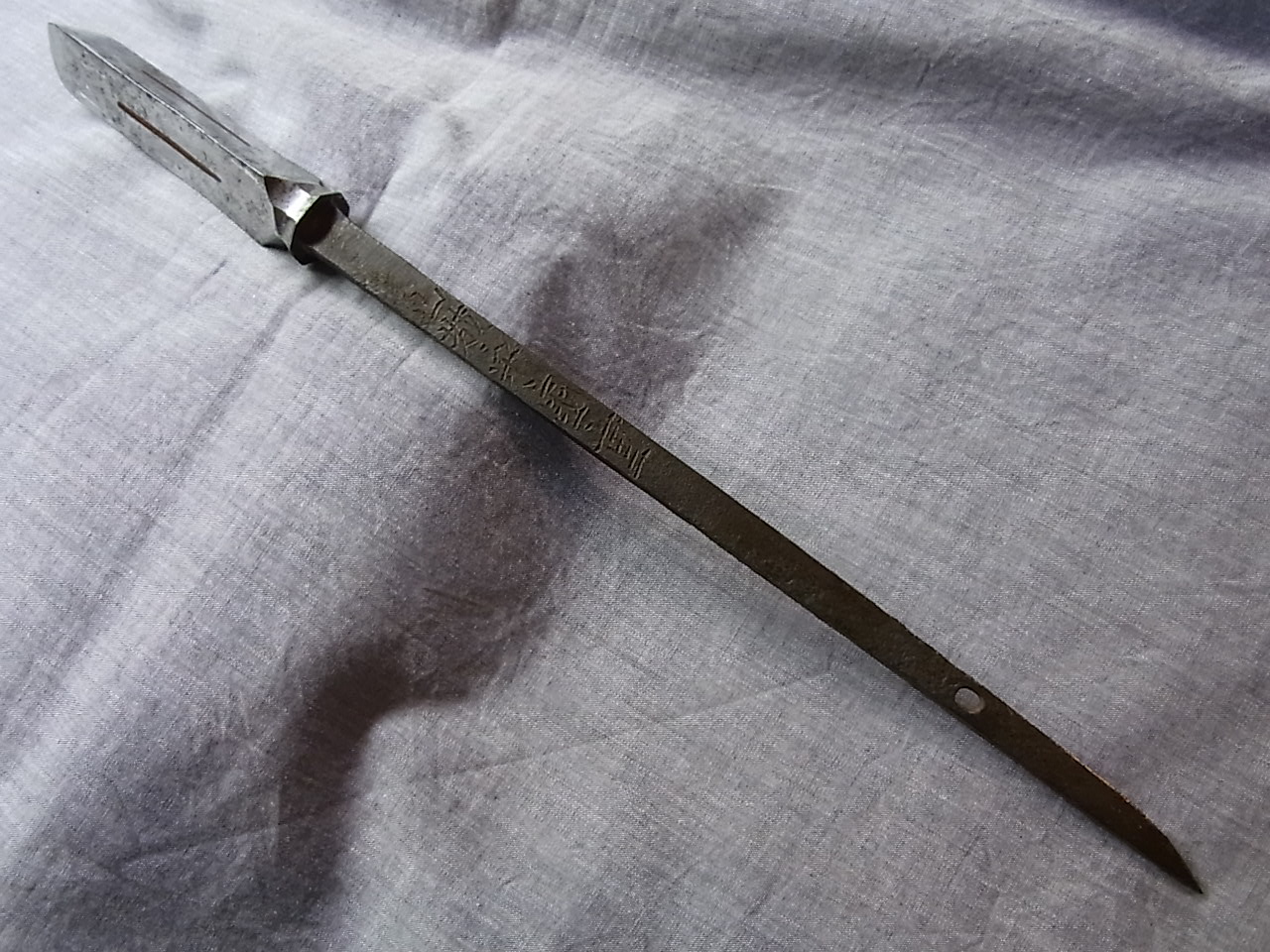
Very quick update on this yari. I took it round to the sword sensei for consultation over polishing and we were discussing the possible smith again, and the way the nakago has been cut off with a diagonal finish. Sometimes spears are rusted into poles in in such bad condition that a cut is made right across and through the shaft and the nakago, he said. In this case it would appear that the person who maybe did this made the assumption of Mizuta Kunishige, and thus ended off the remaining part of the nakago at an angle with that in mind. The Mei, however, compared to Oshigata and Mei references, is more likely a mid-Edo Bushu/Musashi smith, he said, possibly connected with Yasukuni. -
My biggest mistake was trusting a 'financial adviser' 'friend' who pushed me into investing 80,000 USD of my savings, among other things, and then scarpered. Took me years to get over the shock of that, especially as he had told me he would guarantee the initial investment, and I had told him the money was for my daughter's education and thus I wanted a decidedly low-risk investment. Still have his signed letter agreeing to pay me back... Since then I have learned to be a little more circumspect. Having a J wife has helped me learn too. As for sword-related purchases, two rusted arrowheads a couple of years ago take the cake, I guess. Chinese fakes with the latest upgrades. But as the Japanese say, if you have learned a lesson from your purchase, then the money spent is school fees. 授業料 Jugyo-ryo.
-
October 2014?
-
Chatting with a couple of guys at the dinner last night who had come from Hakata (even though the Kyushu bloc was not part of the Taikai). Both really interesting and active in very different fields. The one sitting next to me grew gradually drunker on Shochu, (the other guy was drinking Sake from a small wine glass) but he lit up when I asked what swords he collects. "Three factors rule my choice in swords", he announced. "Number One is スタイル (style)." Here I had to stop him. "Why are you using a Katakana foreign word? Isn't there a Japanese word?" "Well, the Japanese word is TAIHAI, but most people would not understand it and you probably won't find it in your dictionary," he replied. "So I say sutairu (style). That is the most important factor for me. The moment that I set eyes on the Heian JIdai Ken I was glad I came all this way." (I DID find taihai 帯佩 in my handy dictionary by the way, but he said the characters were wrong!) "Number two is Tetsu-aji," he said, "the quality/appearance/texture of the iron in a blade. No particular area of sword manufacture. Koto, especially those of the Kamakura Period have a wide variety of impurities in the them, and it is this lack of consistency that I like, as opposed to the smoother blend in Shin and Shinshinto swords." "And my third criterion is the Hamon. Suguha if possible. I do not like flamboyant Hamon..." I told him it was refreshing to chat with someone with a clear philosophy, not necessarily following the crowd. Or was he just phrasing things in a different way?
-
The Convention just finished. The first sword was a Mumei Heian blade, a "Yamato Ko-Ken" from Yaegaki Jinja. Beautiful. The leading edges had Hamon, but the waisted part seemed to lack them, either right from the beginning of time or from Togiberi. A heavy object it was indeed! Tokubetsu Juyo Token. Sweaty time at the dinner when they asked me to give the toast in Japanese. Had five minutes flat to learn my lines. Talk about nervous tension! You could have run a light saber off my system.
-
Edo Period Corner Part II
Bugyotsuji replied to estcrh's topic in General Nihonto Related Discussion
I have a feeling it is being recycled, but there might be an extra lock set in there somewhere. For a pistol, right? Will ask, Brian. Oh, and Jean, believe me, you do not want to go there. -
Edo Period Corner Part II
Bugyotsuji replied to estcrh's topic in General Nihonto Related Discussion
No, luckily this time surprisingly no-one was hurt, Ray. Brian, the simple answer is that the middle section blew into many pieces and got lost in the long grass. The foresight section, and the breech with pan and lid were found. The gun stock splintered and shattered. I took some photos, but that was considered a breach of etiquette.