Bugyotsuji
-
Posts
15,183 -
Joined
-
Last visited
-
Days Won
325





.thumb.jpg.77d8b8ceaccc15be659eed179b42bff3.jpg)


About Bugyotsuji

Bugyotsuji's Achievements






-
Definitely looks like it Russ.
-
Chinese Cannon - Pictures Added
Bugyotsuji replied to Kiipu's topic in Tanegashima / Teppo / Hinawajū
If the barrel was tied down in any way, it would be difficult to reload after firing without tipping it upright to pour the powder and shot down the barrel. But perhaps it was pushed out of a hole in a shield, and with leather and padding tied around both the barrel and over the protrusion, that could have softened the recoil? -
Chinese Cannon - Pictures Added
Bugyotsuji replied to Kiipu's topic in Tanegashima / Teppo / Hinawajū
This bronze long barrel was at a dealer friend’s house in Japan hidden amongst other stuff, and it was love at first sight the moment I spotted it! “How long have you had it?” I asked, and he replied, “Oh, not long, are you interested in it?”, in a slightly surprised voice. -
Really interesting discussion! The manuscripts above look scribbled, rubbed out, overwritten, even altered, especially around the name Masamune. But then Sadamune, Hiromitsu, Akihiro, Masahiro, etc., seem to plug into Masamune and follow on the tradition.
-
Chinese Cannon - Pictures Added
Bugyotsuji replied to Kiipu's topic in Tanegashima / Teppo / Hinawajū
Sri Aniruddha, this is excellent information. You have moved the story forwards with vital important detail. Yes, the small block is iron, and could well have been set into the muzzle end at a later date. Why I don’t think it is a sight, although I can see the groove you mention, is that it is underneath the barrel, relative to the touch hole. It reminds me more of a projection to stop recoil when placed on the top edge of a wall or ledge of some kind. (Unless it was an elementary mistake!) Also they were so inaccurate they may not have needed a sight. Thank you. -
As for marugata, how common was that for Namban tsuba? Another for sugata comparison,

-
Agreed. They look almost Roman with those hinged, hanging cheek flaps. The top sections were originally retractable, but I have had a couple that were lacquered over. Yours does not have a reinforcing bar across the top but it does have orikugi on either side. Nice to see some original padding and egawa edging.
-
Just for creature comparison…

-
An unusual and interesting example and yes they look like goblin heads (and legs!?!?!) although I suspect they are a Shikami version. Too many Namban threads! Aaarrrggghhh… they all need to be centralized somewhere!
-
Brian, thanks for the heads-up. Do we need to know what our password is (I don’t think I do) or will the system automatically log us in with what it knows, plus the confirmation email address?
-
A nice example Julien with plenty of study points. I’ve had several of these over the years but although I find them fascinating they do not seem to get the appreciation they deserve. Why? Not quite a kabuto, or not decorative enough? Thry were certainly used in the Bakumatsu period when full armour was proving unwieldy on the modern battlefield, but I have struggled to find any evidence of pre-Edo use of this kind of evolved forehead (and optional cheek) protector.
-
translation on a cute little umeshu bottle please
Bugyotsuji replied to lonely panet's topic in Translation Assistance
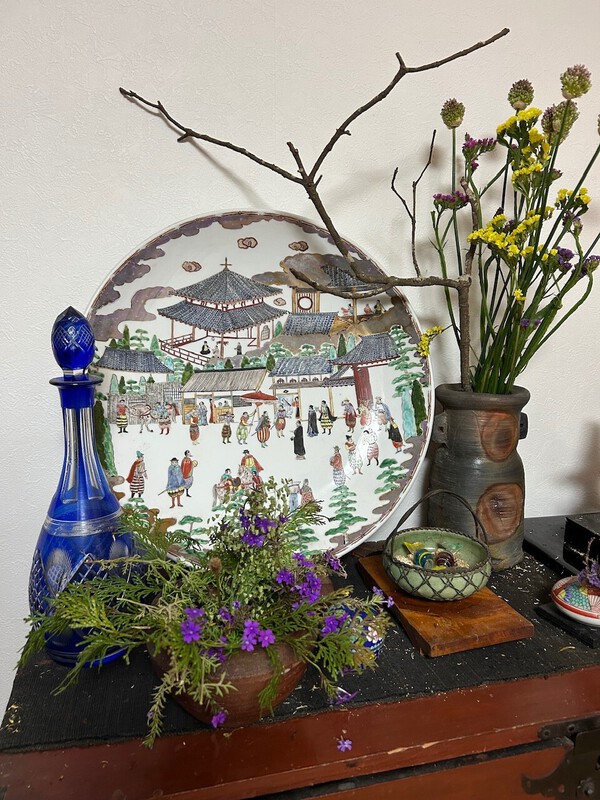
Bizen is generally unglazed, earthy or rusty brown. Not sure what to call yours, blue brushwork on an off-white clay, possibly Satsuma? Pottery is not one of my strengths! A sweet little tokkuri, agreed! -
Says link is suspicious…
-
Tsuba in everyday objects - the culture of Tsuba
Bugyotsuji replied to Spartancrest's topic in Tosogu
Bizen Yaki yes, but the flask could be either Edo or Satsuma Kiriko. (?) It’s the wife’s, and she just plonked it there, and I never asked because she always says she doesn’t know. *Apologies for thread drift away from Tsuba themes! -
Tsuba in everyday objects - the culture of Tsuba
Bugyotsuji replied to Spartancrest's topic in Tosogu
Or as the original photo above, you can put them on a stand.