Bruce Pennington
-
Posts
14,500 -
Joined
-
Last visited
-
Days Won
175
Content Type
Profiles
Forums
Events
Store
Downloads
Gallery
Everything posted by Bruce Pennington
-
Chris, I’ve been compiling one, from the various sources. I was wondering how to post it to make it available to anyone. It’s in the beginning stages, but growing.
-
I don't know why it's sideways, but its 2 poorly struck "Ko" stamps. You can see the "feet" of the top one, and faintly see it on the bottom one. Then you can see the "box" well on the bottom one, but neither are showing the "+" at the top.
-
James, I’ve never seen that stamp either. Mind if I post it on the Aresenal Stamps pinned thread?
-
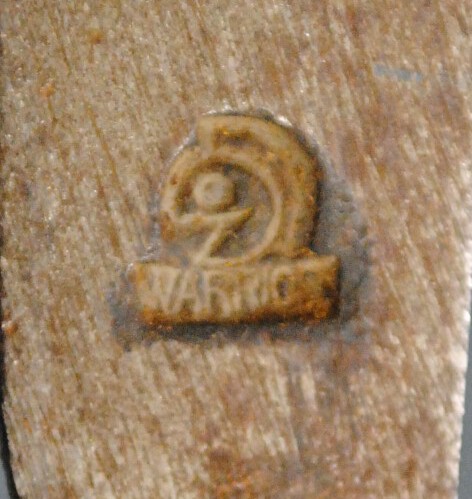
I have seen that little square once or twice before, and no one knew it's meaning either. Upon zooming in, I thought it was a miniature of the "Warrior" stamp, but it's fliipped horizontally, if so. My guess is that it's a TINY kokuin, swordsmiths' personal mark, or it's an unidentified inspector stamp. Seems too small to be a contract company mark. Paul, any chance you could get an old toothbrush and see if an dirt will come out of that square? I'm not proposing that you damage the patina, or shine it up, but if there is just some dirt and grime that will come out, maybe it will reveal a little more detail. Maybe someone can translate the kanji in black?
-
That's interesting, Steve. I had not known that. And after re-looking at the pic of the full blade, I don't see the swirling lines of damascus. I was going off the close-up of the fuchi. I would like to hear from someone who reads Japanese. The kanji look like junk, as does the nakago. Dave, could we get a good focused shot of a close-up of a section of the blade? The full-length one is just a tad out-of-focus.
-
The serial number on the habaki is classic Chinese fake. The “grain” is Damascus steel which is also used in many Chinese reproductions, never by the Japanese. Sorry dude!
-

Levels Of Quality For Showato
Bruce Pennington replied to Nihontocollector19's topic in Military Swords of Japan
Andrew, For Showato, I think mostly it boils down to the beauty of the blade. If it's beautiful, someone spend a good deal of time on it. Of course there are some factories that had a reputation for quality like Mantetsu and Shrine swords. -
Koa Isshin Mantetsu Odd Fittings?
Bruce Pennington replied to sebastian33's topic in Military Swords of Japan
I have seen them in leather combat saya as well. Officer's were allowed to buy custom fittings for their blades, and you will find quite a variety out there. Your price is probably in the mid to low-mid range. It should sell at that price, but a "quick sell" should probably be lower. -
Koa Isshin Mantetsu Odd Fittings?
Bruce Pennington replied to sebastian33's topic in Military Swords of Japan
Sebastian, You are right that it's a Mantetsu, Koa Isshin, dated Spring 1943. What is it about the fittings that you think are out of place? Does the blade not fit in the saya properly? Missing seppa are common. My dad's Koa was missing all tsuba and seppa, the saya band and the ishizuke. I've since replaced them all. From what I can see in the pictures, the gold seppa needs to be flipped. The side facing the saya needs to be facing the tsuba. -
Please Identify The Sword Gunto Ww2
Bruce Pennington replied to antiquegallery's topic in Military Swords of Japan
I would be interested to hear from David or George Trotter on this one. While the Gifu and Seki stamps look legit, the star stamp is poor. The kanji for date and name look decent, but I've never seen a gendatio made for a gunto with the second hole in the nakago! The blade has the look of a showato, but maybe that's just due to use and out of polish condition? The tsuba and seppa are poor quality for such a gendaito blade. This is an odd-ball to me. I'm puzzled. -
My First Gunto Blade Signed
Bruce Pennington replied to DanielGJ's topic in Military Swords of Japan
Very beautiful Daniel! The smith obviously put some real effort into making this! The Seki stamp means that it was made in a non-traditional way in some form or fashion. Very nice. -
The characters don't look Japanese to me, but I can't read Japanese, so who am I to say!!! The koshirae look authentic as does the tsuba, but the kanji looked added, like very recently. There are people out there who will take a perfectly good gunto and "spice it up" with etchings and fittings. Sad. But I could be wrong. Waiting with everyone else for a real expert to opine.
-
This is something that has always interested me, too, Mark. Thanks for bringing it up. Hopefully someone with knowledge on the subject will enlighten us!!!
-
Type 95 Brass-Colored Tsuka Discovery!
Bruce Pennington replied to Bruce Pennington's topic in Military Swords of Japan
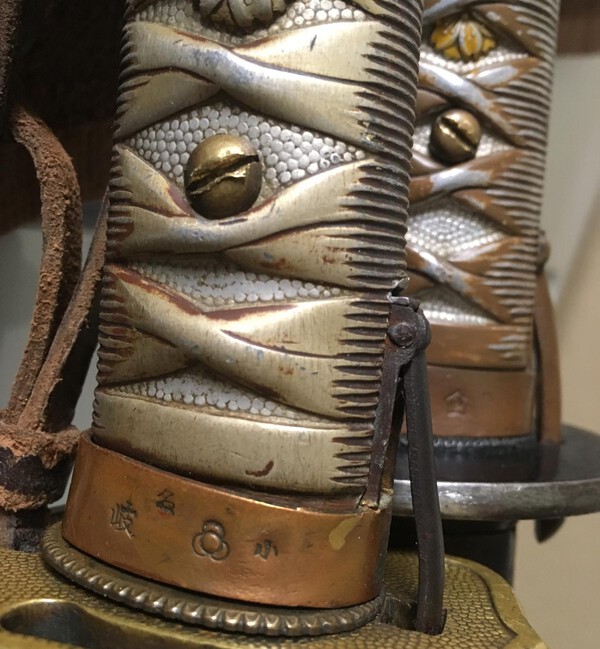
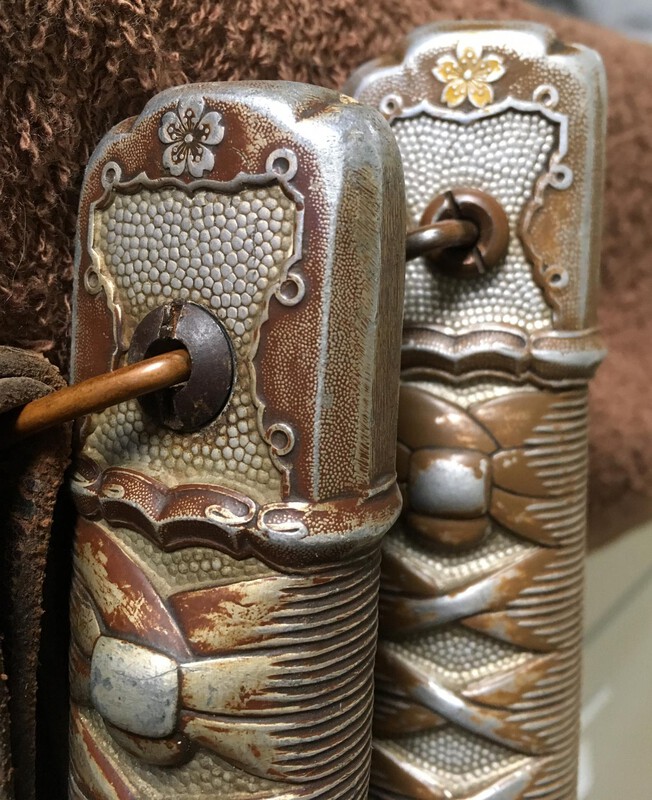
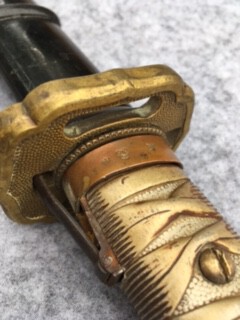
Neil, you nailed it buddy! Nick Komiya, over on Warrelics, confirmed your point, saying that they used oxalic acid to anodize the aluminum to prevent corrosion, giving it a yellowish color! I might even have a lead as to why this is only seen on early production blades: From Nick: "The army had Riken to thank for making aluminum the robust material it had become for field use, but when Riken tried to renew its patent in 1939 (patents were valid only for 15 years), citing that it's investment in two new large factories had not yet been fully amortized, the army prevailed upon its Minister to block this renewal. Riken's patent in those days restricted Almite processing to designated production facilities only and the army saw that as a very unwelcome bottleneck for expansion of its military production capacity, not to mention the extra cost of patent royalties to Riken" The Armlite (copyrighted name of the oxalic acid treatment) patent was blocked in 1939 and it seems the army discontinued the treatment to speed up production, which would fit what we already know about the severe shortage of gunto in those early years. -
We have all seen numerous Type 95s with brass-colored tsukas. Most are fakes and have many other signs proving them to be so. But I have a Nagoya side-latch that I KNOW is legit, yet the tsuka has that yellowish, brassish tint to it. Well, I was examining another guy's 95 on the facebook page that has this tint too, but everything else looks pretty good. In the discussion I was asked for some pics of my Nagoya. WELL ... after taking some pics and seeing some close-ups, I realized that where the surfaces get rubbed or contacted a lot, the yellowish coloring is rubbed off and it is clear the handle is real aluminum! So, something along the way has caused the surface to yellow - possibly a chemical reation to the original paint-job? possible oxidation for an aluminum type that yellows this way? It has made me more cautious, now, to jump to conclusions about other 95s just because of the brassish color to a tsuka. There must be other indications about fakery before I'll label somebody's 95 as a fake.
-
Help With Blade Measurement
Bruce Pennington replied to DanielGJ's topic in Military Swords of Japan
Agree with both: From The Japanese Sword Index - * Japanese Unit Conversions ** 1 shaku = 11.93 inches (30.30 cm) 1 shaku = 10 sun 1 sun = 1.193 inches (3.03 cm) 1 sun = 10 bu 1 bu = 0.119 inches (0.303 cm) 1 bu = 10 rin 1 rin = 0.01193 inches (0.0303 cm) Note: 1 shaku is commonly approximated to be 12 inches (1 foot) SWORD BLADES CLASSIFIED BY LENGTH Daito ( katana, uchi-katana, tachi, no-dachi ) - nagasa over 2 shaku Shoto ( wakizashi, chisa-katana ) - nagasa between 1 and 2 shaku Tanto - nagasa under 1 shaku So, a waki is in the range of 30.3 - 60.6 cm -
That's really gorgeous Augusto! I can't see anything else to tell you about it. Maybe someone with knowledge on the smiths can give you some info on him.
-
Any Shin Gunto With "battle Scars"?
Bruce Pennington replied to PNSSHOGUN's topic in Military Swords of Japan
Couple more type 95's with damage here: http://forums.gunboards.com/showthread.php?1002922-Battle-damaged-sword -
I agree, after looking at the underside, it looks metal inside.
-
Wow! I’m tempted to say it’s reproduction- gold paint is off the edge a bit - but never heard of this. Where’s Neil?!?! If there’s a variation, he’ll know about it!
-
Japanese Swords, Buying Opportunity Or Not
Bruce Pennington replied to phunixx's topic in Military Swords of Japan
I agree - assuming all are legit, that is a steal for all 4. The knot is likely from a kyu-gunto, pre-WWII, a similar one is in Dawson's book, pg 407. From the limited view of this picture, they SEEM legit. -
Any Shin Gunto With "battle Scars"?
Bruce Pennington replied to PNSSHOGUN's topic in Military Swords of Japan
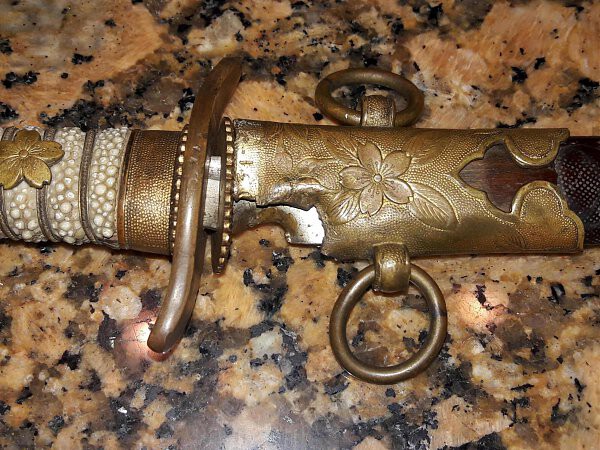
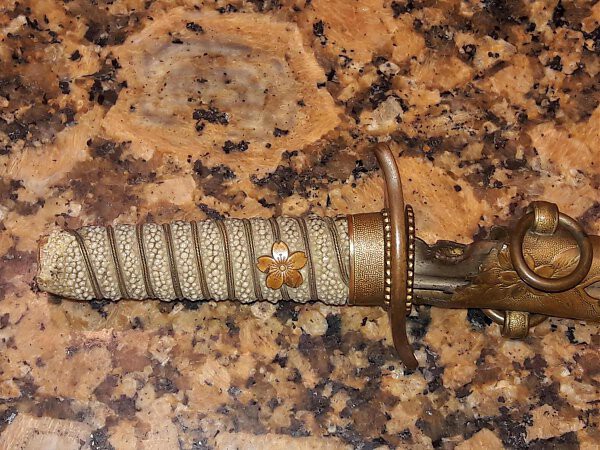
Here's a navy dirk, posted by "Clay" at Gunboards: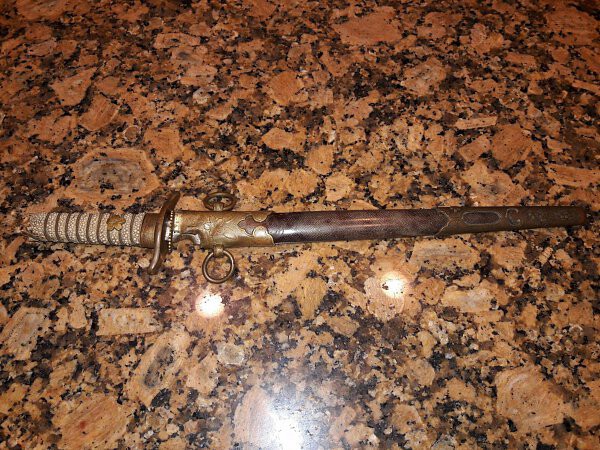
-
Interesting stuff David! It fits my Star stamped blade. Like to see if anyone has a Star stamped blade dated prior to that.
-
Fabulous info George, thank you!!!
-
Anyone Seen A Koshirae Like This?
Bruce Pennington replied to PNSSHOGUN's topic in Military Swords of Japan
Agree with Stephen. The ito and ribbed-same’ could be modern rebuild. It looks newer than the rayskin. I have seen the skinny tsuba before, mostly on the smaller “formal” 98’s. It’s a nice looking rig, whether new or original.