Bruce Pennington
-
Posts
14,285 -
Joined
-
Last visited
-
Days Won
170
Content Type
Profiles
Forums
Events
Store
Downloads
Gallery
Everything posted by Bruce Pennington
-

Arsenal Mark on RJT sword Fittings
Bruce Pennington replied to george trotter's topic in Military Swords of Japan
Yes of course. Just presented as another piece of evidence to add to the growing pile of evidence. -
Arsenal Mark on RJT sword Fittings
Bruce Pennington replied to george trotter's topic in Military Swords of Japan
I realize my post of quotes from Leon Kapp was a bit confusing. They came from email conversations about star-stamped RJT blades and Leon's observations after polishing one. I listed his book so guys would know who he was, but the quotes weren't from the book. Sorry for any confusion! -
Maybe caused by something it was exposed to? I just thought it was painted because of the straight line through one of the sakuras and how it follows the edge of the perimeter so perfectly (except for the sakura):

-
Yes, he responded yesterday (from one of my messages, don't know which one), and said he'd notify the owner. I just checked and he hasn't modified or removed the sale pages of either one, though.
-
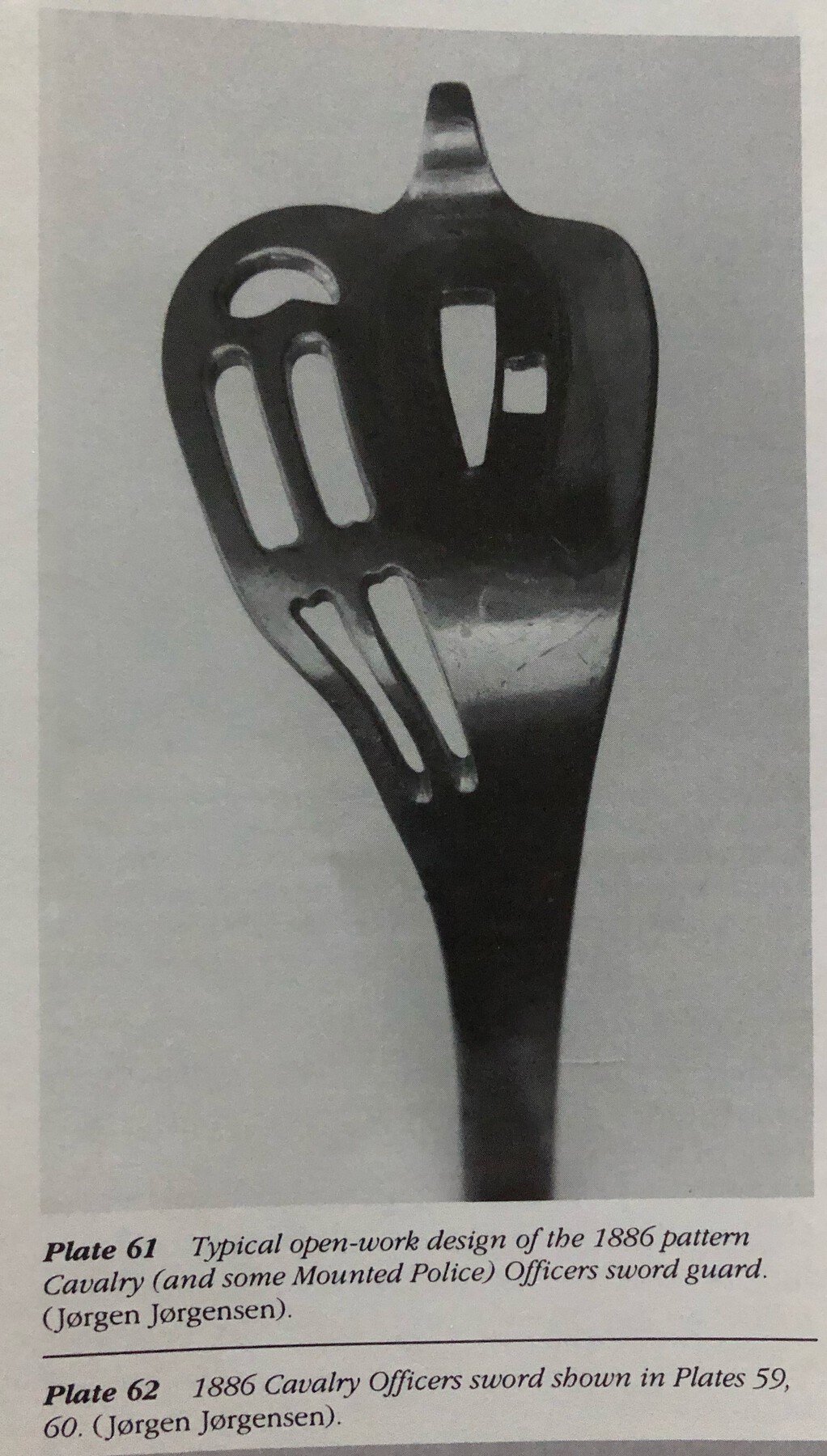
Jaime, The fittings are legit! 1886 Cavalry Officer sword, Fuller & Gregory, pages 50-51: A bit rare. I'd love to own this! Also, that blade shape is a know shape (I'm terrible at nihonto) and I've seen a couple of these on various posts in the Nihonto forum. If I could find one, I'll post the link to it. I can't speak to the mei, but the officer that owned this wasn't concerned about that or he wouldn't have worn it. This is a legit very early cavalry sabre (Type 8?), late 1800s vintage.
.thumb.jpeg.a3959f02b7d55ea371e63dc498a69b0d.jpeg)

-
koa isshin mantetsu hada
Bruce Pennington replied to lonely panet's topic in Military Swords of Japan
Neil, the photo is from Ohmura's page: http://ohmura-study.net/998.html -
Wow! It looks original, showing as much wear as the rest of the tsuba. Might very well lend some evidence that SMR had a shop making fittings, as some have suspected for a while. On another note, what the heck would cause that much wear to a tsuba? It looks like it was dragged behind a truck on a black-top road.
-
Type 94 2nd Haikan & Tassels
Bruce Pennington replied to PNSSHOGUN's topic in Military Swords of Japan
That's cool, John! I had to look at the others for a bit to see the difference, but I see it. -
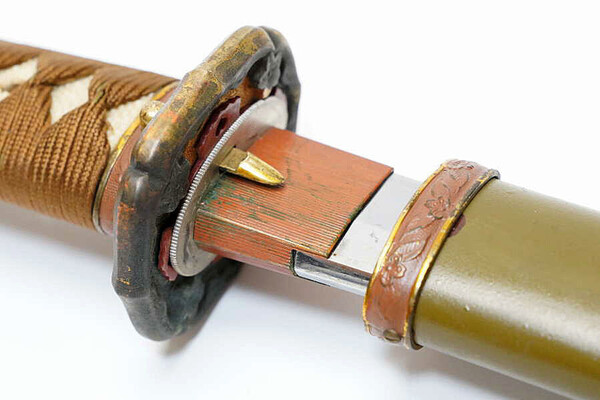
I apologize, guys, for hijacking this great thread with officer stuff. But it's the only one going, so hopefully we can work them both here. This one on a '43 Mantetsu Koa Isshin: Bad focus on the kabutogane, but it looks like it was painted black, too, but mostly worn off by now.

-
koa isshin mantetsu hada
Bruce Pennington replied to lonely panet's topic in Military Swords of Japan
Thanks Hamish! Ben, this discussion is way out of my league, but that was my Mantetsu David referenced, in case you might want some photos or something. -
Arsenal Mark on RJT sword Fittings
Bruce Pennington replied to george trotter's topic in Military Swords of Japan
George, Leon is a togishi! “I was taught by yoshindo’s favorite polisher, Takaiwa Setsuo in Tokyo. He also helped get good stones for me and I bring polished items to Japan for his comments. Moses Becerra taught me how to do a sashi komi finish and some other things. Those two taught me everything, but it still took about 5 or 6 years before my polishes became satisfactory.” Another tidbit about stamping: “Another point based on what Yoshindo said. He said that the star stamped blades were inspected by Kuniie who stamped them if they met with his approval. So I think that means that the star stamped blades went to Kuniie who checked them and stamped them if they met his standards. They were from smiths who were given tama hagane too. So I wonder if the army’s long list of inspection conditions boiled down to a simple quick visual inspection of the finished blades by Kuniie.” -
Thomas, and John! Nick Komiya at Warrelics said it could be what you say - Kazutada - and Guy found the same reference in Sesko's book. It's now part of Stamps of the Japanese Sword, ver 8.1, to be released in the future.
-
Thomas, Doesn't look like you're following this thread, so the quote should send you a message. These hotstamps usually mirror the smith's name. Do you have a photo of the mei and the nakago?
-
He's stuck a Suya Shoten/Kokura handle on that Nagoya blade and trying to sell it again. https://www.ebay.com/itm/114737295938?hash=item1ab6e03242:g:~JcAAOSwCbBgWUAJ
-
Request for kanji assistance please
Bruce Pennington replied to Denis V's topic in Military Swords of Japan
Also, Takehisa is one of the know smiths with the "W" stamp. I have no record of a Kanehisa with the stamp (doen't mean it couldn't happen, of course!). -
LOTS of fakes on fleaby right now. But a repeat offender is Consignments-with-us. I've send him a message on 2 of his sales. We'll see how he replies. https://www.ebay.com/itm/333980029498?hash=item4dc2c2d23a:g:nRwAAOSwKBBgih5l and https://www.ebay.com/itm/233987298807?hash=item367abad5f7:g:qmIAAOSwzf9giiEx
-
Michael, do you have the blade? If so, please post photos and the mei, thanks!
-
Request for kanji assistance please
Bruce Pennington replied to Denis V's topic in Military Swords of Japan
Japanese sword index has it as Takehisa: They have 4 oshigata of Kanehisa and none use this kanji. -
That's an interesting article Jacques I checked Wikipedia, though, and they don't mention acid treatment. "Damascus steel was the forged steel of the blades of swords smithed in the Near East from ingots of Wootz steel[1] either imported from Southern India or made in production centres in Sri Lanka,[2] or Khorasan.[3] These swords are characterized by distinctive patterns of banding and mottling reminiscent of flowing water, sometimes in a "ladder" or "rose" pattern. Such blades were reputed to be tough, resistant to shattering, and capable of being honed to a sharp, resilient edge.[4] Wootz (Indian), Fulad (Persian), Fuladh (Arabic), Bulat (Russian) and Bintie (Chinese) are all names for historical ultra-high carbon crucible steel typified by carbide segregation."Close-up of a 13th-century Persian-forged Damascus steel sword Tha'ts just a small sample of the article. Maybe guys are imitating the look of Damascus steel by using the acid treatment. Sorry for diverging off topic, but I've never gotten educated on what Damascus steel really is before.
-
Thomas, I too would like to see more of the blade, and the nakago.
-
It doesn’t look like Damascus steel to me. It does look like something treated with acid though. The writing looks legit, can someone translate? The first one looks amateurishly made though. I could be wrong on all the above.
-
Arsenal Mark on RJT sword Fittings
Bruce Pennington replied to george trotter's topic in Military Swords of Japan
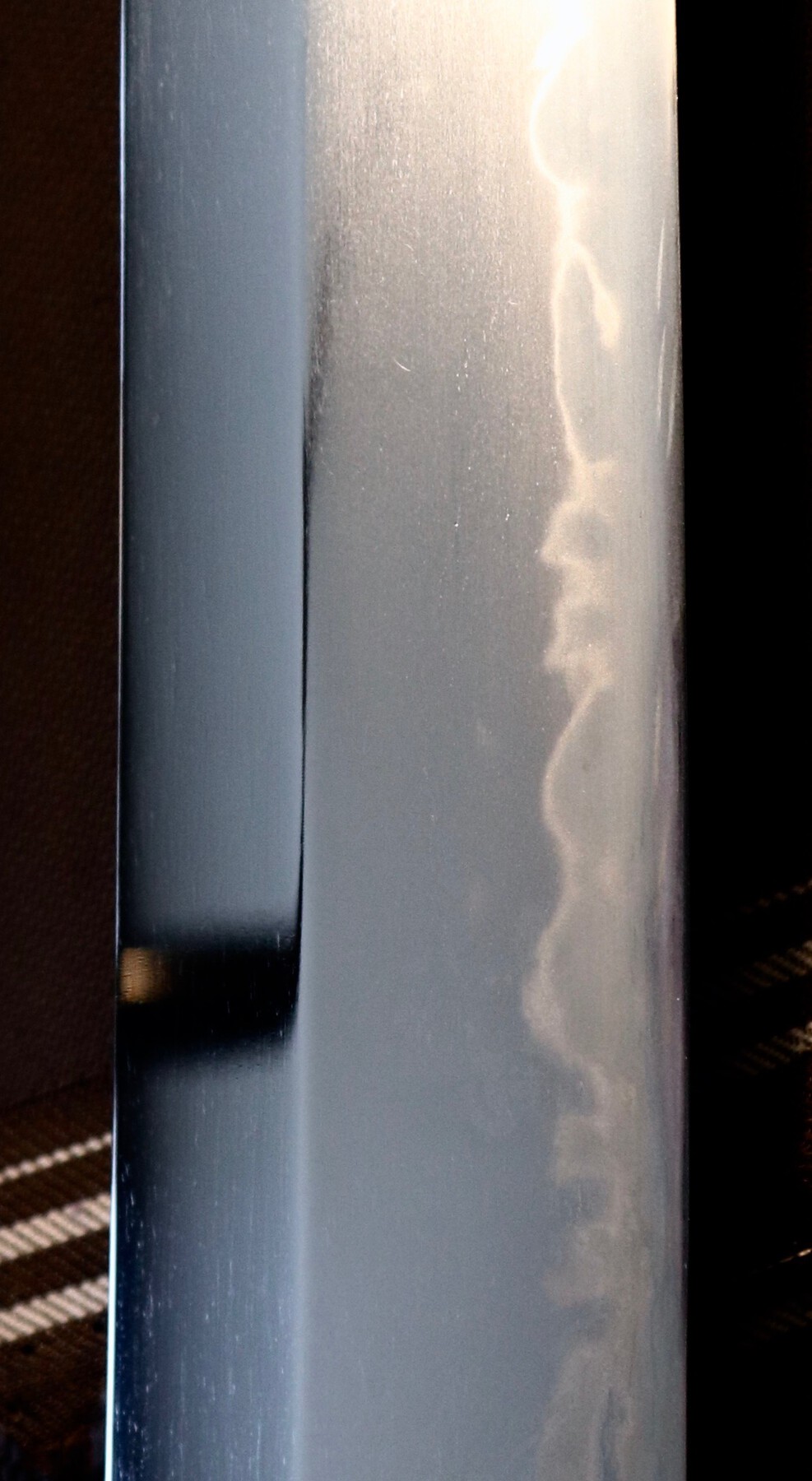
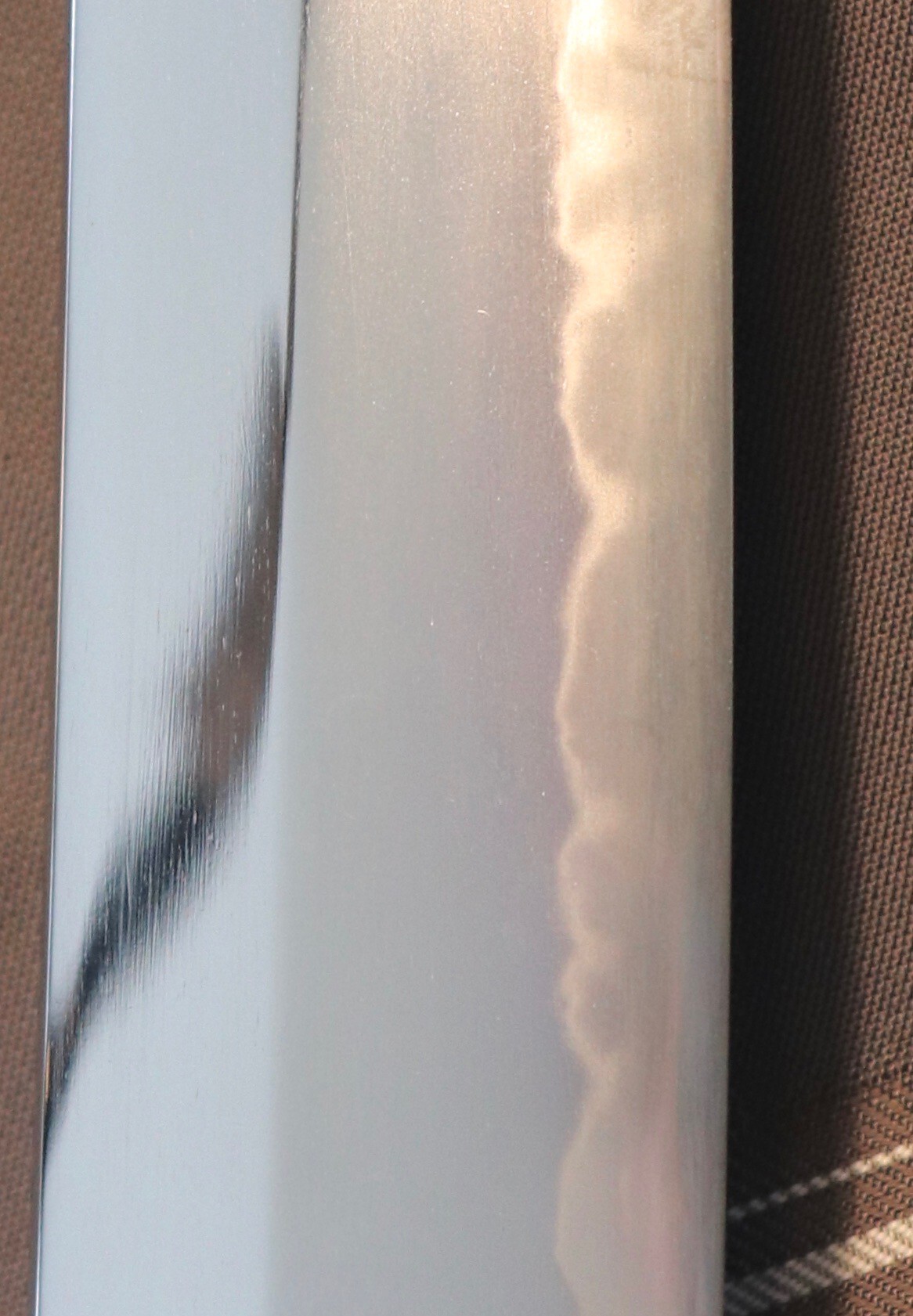
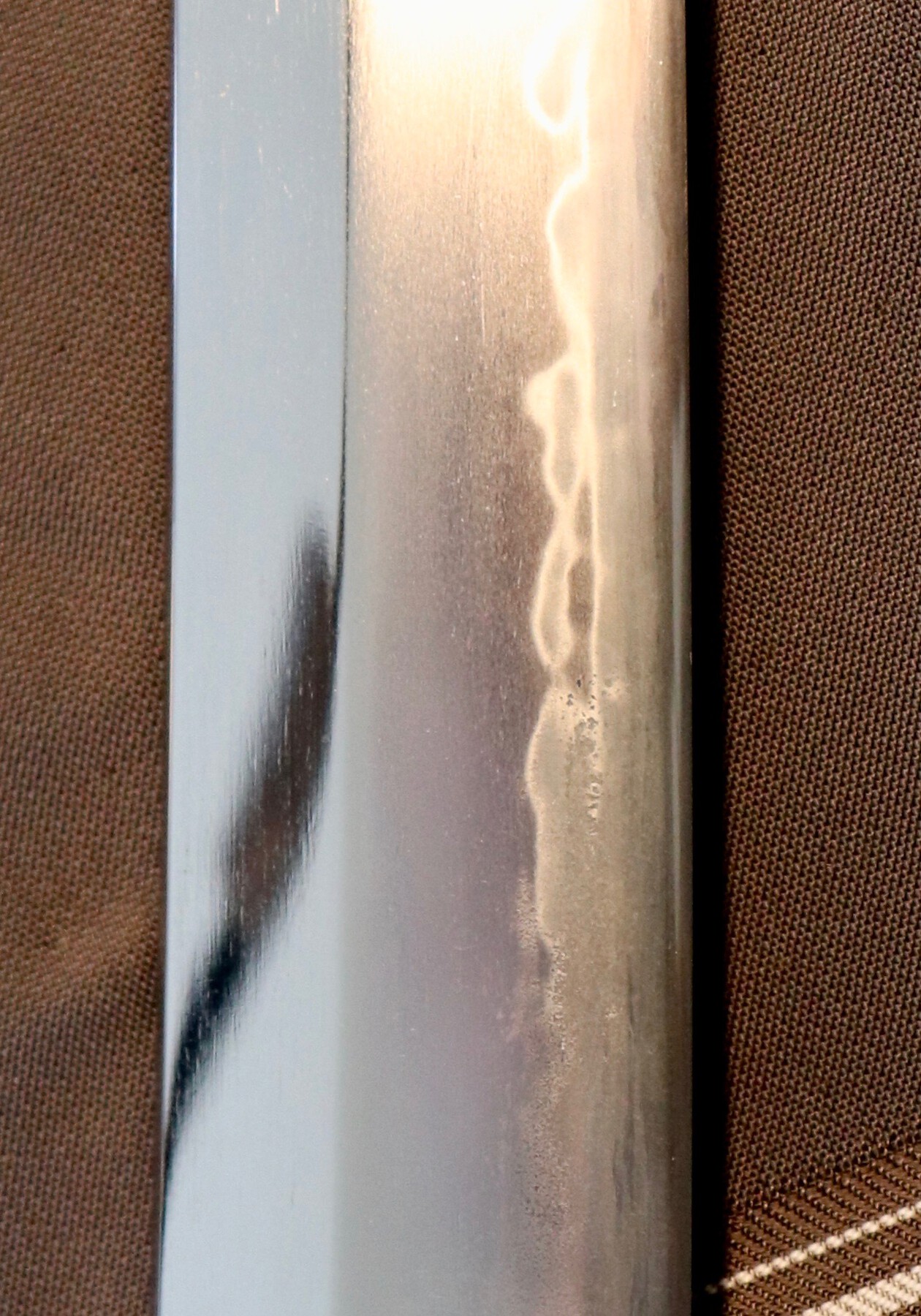
Wanted to pass along something from Leon Kapp, of "Modern Japanese Swords and Swordsmiths" Kapp, Kapp, & Yoshihara (I'm not pushing the bookstore, just posting the book). It reinforces what we've already learned about star-stamped blades being made traditionally: " I just finished polishing a star stamped blade for Leo. The mei is (star stamp) Chikuzen ju Kajiwara Hiromitsu saku, and the date is August of 1943. It is a well made sword and about 26.25 inches or 2.2 shaku (which seems to be a popular length for gunto). I bet that this smith is related to the Kajiwara polisher. Chikuzen is the Fukuoka area where the polisher is too. I am sure this is a tama hagane blade for several reasons. 1) Very hard steel 2) Forging patterns are visible in the ji 3) The hamon has a good clear and complex nioi guchi First of all, the blade is hard. There were a few hakobore or small chips which had to be removed, so I know the blade is very hard. I have polished some Seki stamped (RR track) swords, and they are much softer. Modern gendaito are hard and similar to this one. Second, there are patterns visible in the blade and I think they are from forging and folding the steel. You can see what looks like some fine itame hada in most parts of the blade. The steel’s appearance looks like a typical gunto from the 1930s to 1945. The RR track blades have no patterns, but do have occasional small marks in random places in the steel which I think are areas where the steel was compressed locally by the hammering to shape the blade and edge. Occasionally there are traces of a short single straight hada line which could easily come from the RR track puddled steel. The steel does look rather different. This looks very different from the RR track type steel. The color is good. Third, there is the hamon. This hamon has good clear and strong nioi. It forms irregular shaped gunome all over the hamon, and there are ashi, irregular gunome and the strong nioi area is very wide. Generally, with RR track steel, the nioiguchi is narrow and the active part of the hamon is restricted to a narrow band. In addition, the nioi guchi is generally much weaker. This type of hamon looks like it was made with tama hagane steel. So, in conclusion, I am very sure this star stamped blade is made from tama hagane. I’m sorry I didn’t get better photos and need to make some kind of small photo setup to get decent images of hamon and jihada. The hamon photos show the strong nioiguchi and a lot of activity. The jigane photos show the tight but visible pattern in most of the blade. The mei is there to show the star stamp." ..... ". I now have a Seki stamped blade and another star stamped blade here to be polished, so we can look at this with more samples soon. I also have other blades waiting so it will be a bit of time before I can get to those polishes. I am very sure this star stamped blade is tama hagane. I mentioned that the star stamped blade is much harder and similar to good tama hagane gunto. That is a subjective observation but a very clear thing to experience when you polish them first hand."


-
Dang, these are high quality craftsmanship.
-
That's an excellent photo Trystan. And thanks for reminding me - these are both made by the same company!
-
Easiest one I know: http://ohmura-study.net/900.html

.jpeg.805357402d60c8890903a40963521dd0.jpeg)