Bruce Pennington
-
Posts
14,223 -
Joined
-
Last visited
-
Days Won
169
Content Type
Profiles
Forums
Events
Store
Downloads
Gallery
Everything posted by Bruce Pennington
-

Arsenal Mark on RJT sword Fittings
Bruce Pennington replied to george trotter's topic in Military Swords of Japan
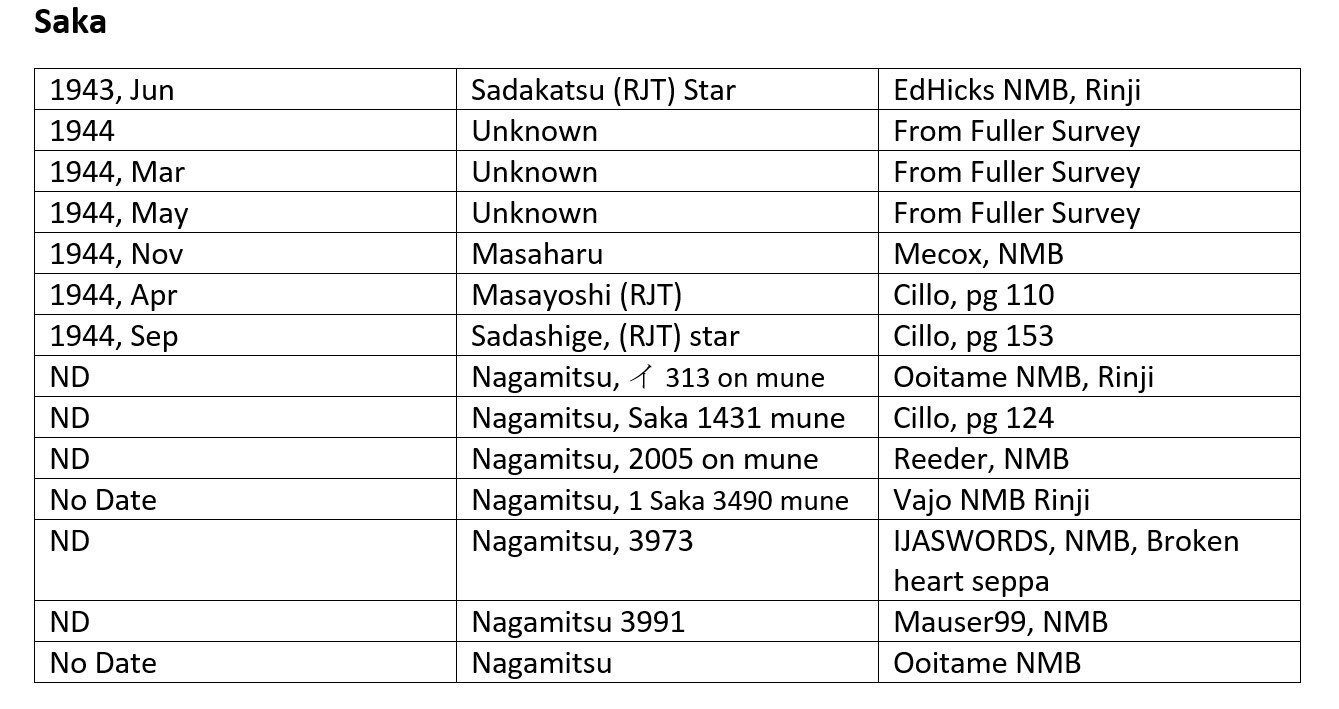
I have 6 dated and 7 undated "Saka" stamped blades, whereas undated blades of the other arsenals are rare. Although, all 7 of the undated ones are Nagamitsu. What are you thinking in reference to Osaka? I did some checking of the rest of the 60+ Star-stamped blades on file and the massive majority of them ARE dated. Interesting. The undated ones seem to be evenly distributed between Nagoya, Seki and Kokura with no clear pattern. Here's my Saka record:
-
Arsenal Mark on RJT sword Fittings
Bruce Pennington replied to george trotter's topic in Military Swords of Japan
After running the issue by Chris Bowen, his objection to the stamp simply being an Army Material stamp, verifying the steel in the blade was Army supplied, is that it isn't seen on any other blades outside the RJT program. I personally don't know enough about the Army's steel supply operation to know who else might have been supplied with their tamahagane, but I have come to the idea that regardless of the origins of the stamp (yes maybe it was invented and codified into the regs as a Material stamp), it seems to have been adopted by the RJT inspectors and therefore, it became a mark of the RJT program. If no one else in sword-making-world was using the stamp other than RJT guys, then essentially, for swords, it is an RJT stamp. On the issue of so many un-stamped blades by RJT qualified smiths, Chris proposed another option: "Here is something else to think about: Yoshihara Kuniie was the inspector for the Kanto region. He was also the head smith/instructor at the Army’s Number 1 Tokyo arsenal, where several smiths made swords as RJT in house, so to speak. I have seen many of these blades, always signed Tokyo Number 1 Arsenal, without star stamps. I think I have several. If the star signified tamahagane usage, they should all be stamped. I have seen a few Kuniie (Nobutake) blades with a star, but the operating theory as to why only a few are found with the star is that these were most likely made at his home forge, rather than at the arsenal itself, and “inducted” into military service the same as all the blades made by RJT smiths working at their home forges across the country." Yet, as I just re-read that, I can see it doesn't work for smiths in other prefectures. This idea only works for the smiths in the Tokyo 1st area. But it could still be one of several potential reasons for un-stamped blades by these smiths. Like other areas we know of, there could very well be more than one answer to the question. -
David, I don't think the other kanji fit anything along the line of these grades. The kanji for plum, the Second Grade, is: 李, at least in modern Japanese. The First Grade, bamboo is: 竹. Tsuru, the Special Grade is: 鶴, again modern kanji. The ones you are seeing on my chart are katakana which are single sounds, mostly used to spell words with Western origins, as I understand it. But it was worth investigating! I am with you, in that I think the Yamagami brothers were using the "matsu" to advertise the high quality of their product. I got a reply from Chris Bowen on the question. While he didn't have any hard evidence either way, like us, he doesn't feel it would have been an official Army stamp but more like a stamp used at the forge. From Chris: "- the army supplied the tamahagane to the RJT smiths as you know. My understanding is they supplied one grade, not several, at least for contracted blades. Commercial sales would surely have enabled various grades to be purchased however. The lack of any Tsuru or other stamps which would correlate with the grade of tamahagane is glaring. - there was no requirement for army blades to specify any grade of steel. No one else was doing it- no doubt others would have followed suit if this was advantageous. - it is more likely that this is some sort of acceptance stamp, either privately at the Yamagami forge, or used locally. It could also signify something else related to the location or other private and unique feature important to the Yamagami forge."
-
Show Us Your High Class Gunto
Bruce Pennington replied to lonely panet's topic in Military Swords of Japan
Gorgeous John, but very peculiar with that black lacquered ray skin on the tsuka! -
I’ll run it by @cabowen. See if he’s heard of it.
-
Cosmoline for Showato Blade
Bruce Pennington replied to Kaz S's topic in General Nihonto Related Discussion
If you are just an Inquiring Mind and want to run your own experiment, I'd follow your last idea and get a junker. But if you simply are curious as to the effects of years of cosmoline, I'd ask these guys who had gunto coated with it: Robinalexander on this thread. Mad Dog on this thread Davidequis on this thread MarcoUdin on this thread Waljamada and Zook on this thread. There are more. These are just from the first page of 3 pages in a "cosmoline" search of NMB. -
Blue/brown tassel is that of a company grade officer (Lt-Capt). Blade looks quite old.
-
Now thats deep Sori
Bruce Pennington replied to Alex A's topic in General Nihonto Related Discussion
pics posted for posterity: -
The stamp is unique, meaning I've never seen one like this before.
-
While reading the book recommended by Peter - @BIG - Book found HERE - I came across this discussion about a survey done in 1933 looking for available tamahagane. In it, he discussed the various grades of tamahagane: “High quality tamahagane is sold out, there are only stocks below the 4th quality level.” It should be noted that there are different qualities of tamahagane crude steel as a result of the steel production in the tatara furnace, which are briefly listed here: tsuru (“crane”) = Special Grade, matsu (“pine”) = First Grade, take (“bamboo”) = Second Grade, ume (“plum”) A = Third Grade, ume (“plum”) B = Fourth Grade, Off Grade, Others. Maxein, Otto. Samurai Swords for the Material Battle . Books on Demand. Kindle Edition. I think David might have been in the ballpark with the "pine" thought, but maybe it's a stamp showing the grade - First Grade - of steel the Yamagami Brothers were using in their blades. This clicked for me after we've discovered the RJT star stamp was an Army stamp, not just an RJT stamp (although no one else was using it on blades except RJT), but it was a stamp verifying the fact that the steel used was Army-provided steel (which for the RJT program had to be tamahagane). So...... could this Matsu stamp be something along that line? Maybe their particular inspector had stamps for grades (although we don't see any blades marked with other grades) or maybe it was put there by the brothers, for marketing/bragging rights, to highlight the high grade of tamahagane used in their blades?
-
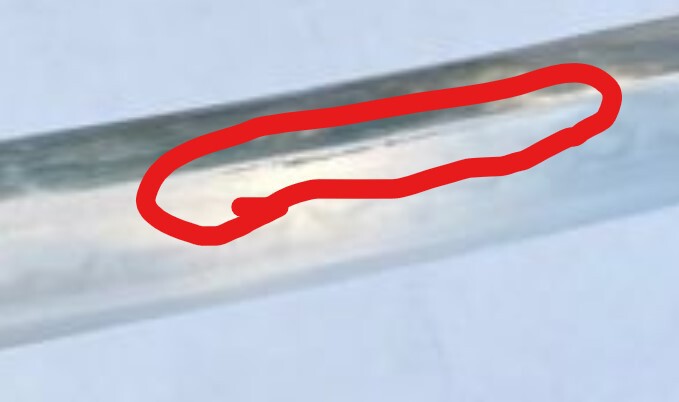
I could be wrong. They may be black stains, often seen on blades, or sometimes reflections in photos can cause false images. But this is what I was talking about. The photos really are too low dpi to see clearly.

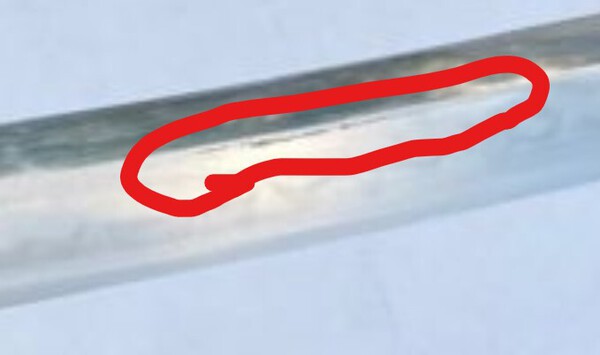

-
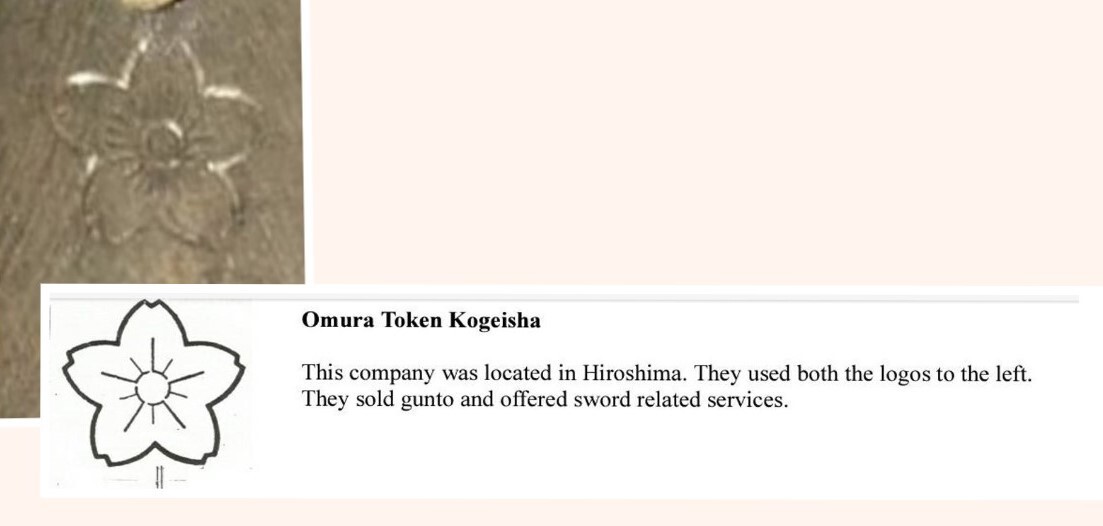
Noticed this while proof-reading the Stamps of the Japanese Sword document. Could this large sakura be the logo for the Omura Token Kogeisha? It is rare to find shop logo on nakago, but not unheard of (Suya Shoten and Yasugi Steel come to mind, even the Goto Tanren jo "5 measures").
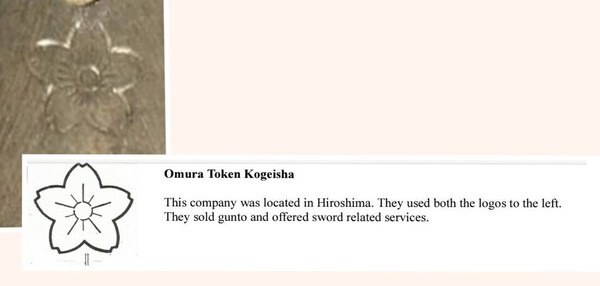
-
I'd put the 2 gunto at $2,500, so the rest for the memorabilia? I don't shop in the other areas, so I couldn't speak to that. The kaigunto is a bit worn with gold guilding worn in many places; the tsuka in worn condition. I'm not a nihonto guy, but the blade seems to have 2 or 3 big flaws (kizu?), but an interesting hamon. The polish is likely the WWII polish, and so the blade would look quite nicer with a modern one. But most of this is above my pay-grade.
-
Been enjoying the book, thanks again @BIG. Fascinating discussion: "To smelt 10 tons of iron sand to approx. 2.5 tons of tamahagane, 12 tons of charcoal are needed.82 For the production of charcoal whole forests are cleared, which dramatically changes the landscape. Accordingly, Shichiro's report says: “Almost all the trees in the mountainous region have been felled except those belonging to the Tabe family, and it has become very difficult for the Torigami Branch Factory of Yasukuni Steel Production Company to obtain charcoal. However, the Tabe family has no problem supplying charcoal because they have vast lands and forests in the mountains. In the same way, iron sand can be extracted from their land.”83 Maxein, Otto. Samurai Swords for the Material Battle . Books on Demand. Kindle Edition. This came from a 1933 survey of available tamahagane, of which there was none to be found at the time.
-
Did some checking in my files and I do have an iron tsuba one a Tokyo blade which fortunately has a copper fuchi. I found 2 - an Iijima Shoten Co. and a Mizuno gunto. Don't know yet if the other contractors made them, though that only leaves Suya Shoten. Still digging.


-
The ones make in the Seki area, Nagoya Arsenal, were mostly made by the Seki Token Co. (if I have that name right). But they have Nagoya arsenal stamps and Seki stamps on the fuchi and blade. This one was put out by someone under the Tokyo 1st Arsenal, and I can't say I've ever seen who made them for Tokyo.
-
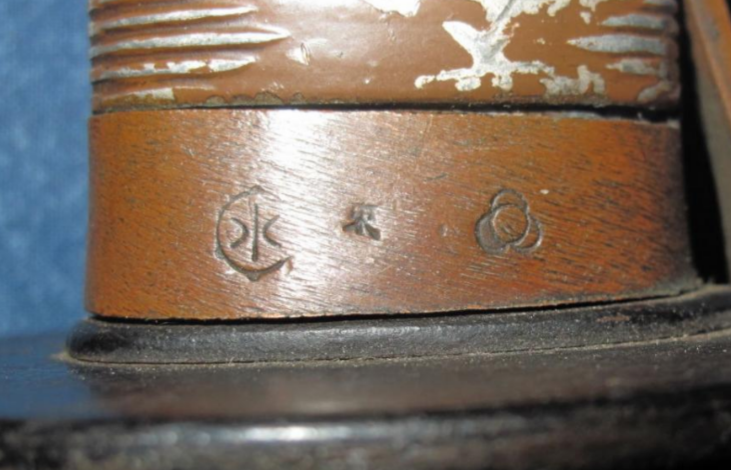
Little stamp by the blade serial number is the "TO" of the Tokyo 1st Army Arsenal. Can't clearly see the fuchi (collar above the handguard), but I assume it's steel, not copper. Sometimes there are faint stamps on these. Any chance? I've never heard which contractor made the iron tsuba models for the Tokyo arsenal. Maybe @Stegel or @Shamsy can enlighten us!
-
And just a follow up, I am not saying anyone was rude here, it simply reminded me of a time when I was in the past
-
Ha Ha! Reminds me of a time quite a while back when I was commenting on a topic I really didn’t know, and one of the guys bluntly, should I say rudely, asked me why I was even commenting and I should stay out. I let him know that was pretty rude, and he linked to a earlier conversation where I had said exactly the same thing to him! He was quoting me! Ha!
-
Show us your nice Gendai blades
Bruce Pennington replied to IJASWORDS's topic in Military Swords of Japan
Wow, that was a great kantei lesson! -
Wow. An Excerpt: "The 154-day successful siege of Port Arthur is considered the greatest military achievement of General Nogi Maresuke, who committed seppuku in 1912 after the death of Emperor Meiji in the tradition of the samurai to serve his master even in the other world." Maxein, Otto. Samurai Swords for the Material Battle . Books on Demand. Kindle Edition. I did not know this was done even in times of success.
-
The UK Amazon link wouldn't let me buy, but this one works for the USA: https://www.amazon.com/Samurai-Swords-Material-Battle-Gendaito-ebook/dp/B0963Q1F9Q/ref=sr_1_1?keywords=samurai+sword+for+the+material+battle+ebook&qid=1622390213&sr=8-1 Just ordered it, thanks Peter!
-
That term is sometimes used to describe blades like items #2 and 4 in Richard Fuller's list of 9 ways blades were made during the war:

-
Geoff, The "Na" or "名" is the inspector stamp of the Nagoya Army Arsenal. There were a few Army Arsenals overseeing sword production throughout the country. Swordsmiths in areas surrounding the arsenals sent their swords (or the Army picked them up for shipment) to the arsenal where they were inspected and either fitted out, or moved off to shops for fitting. The Army assumed control of all sword production in late '41/early '42, and the inspection stamps of the Seki Cutlery Manufacturers Association (SCMA for short) tapered off while arsenal inspector stamps take over. Although we are starting to think the Gifu in Sakura stamp might actually be the stamp used by the SCMA after the Army absconded with their Seki logo. Inspectors of the Nagoya arsenal began using the Seki "関", although in a much smaller size. I don't know if I addressed your question or not. As to Seki smith blades, they were like any smith. I imagine there might have been low-skilled smiths that simply made showato, but all the smiths we have studied seemed to have made both gendaito and showato. The main problem is that gendaito took much more time to make while showato could be made more rapidly to fill Army quota demands. But there are plenty of examples of gendaito from plenty of Seki smiths.
-
By the look of the tsuba (hand guard) it’s a Type 98 Japanese Officer sword. More pics would help.