
Bruce Pennington
-
Posts
14,280 -
Joined
-
Last visited
-
Days Won
170
Content Type
Profiles
Forums
Events
Store
Downloads
Gallery
Everything posted by Bruce Pennington
-
I would have been fooled by the blade, though badly "polished" with a power buffer. But the nakago (tang), like Brian said lacks anything that looks Japanese. I found the last name: 天祐 (Amasuke)
-

Help identifying
Bruce Pennington replied to R-Carpenter's topic in General Nihonto Related Discussion
Probably a fake, or a best, an "island made" sword. But Island swords don't, in my experience, have mei (except for the actual Java swords, and this isn't one of them). So, if this mei turns out to be gibberish, then it would be a fake. Photo flipped for a look at the mei:
-
Rather than a mon, I believe this to be, probably, a Chosen (Korea) Sonin-level official sword. Confusing, though, because it seems from the side view, that there is a 10-petal sakura on the backstrap. Do you have photos of the handguard pattern, and a straight shot of the backstrap? Dawson shows the Chosen swords on page 346-8. Navy Admiral swords can have the kiri, too, but their floral patterns are different than this (page 264).
-
The Mysterious "w" Stamp!
Bruce Pennington replied to Bruce Pennington's topic in Military Swords of Japan
Wow Noah, great find! And once again, an example showing no rhyme or reason as to why the mark is put right side up or upside down. Here's the only other 19 I have on file and the mark is the other way around. Note both have the Tokyo 1st "TO" but different other stamp. Were they early, personalized inspector stamps? Or shop logo? This new one looks like the katakana I "イ" , but it's got an extra small stroke at the upper right. What do you see @Kiipu or @BANGBANGSAN? other one for the record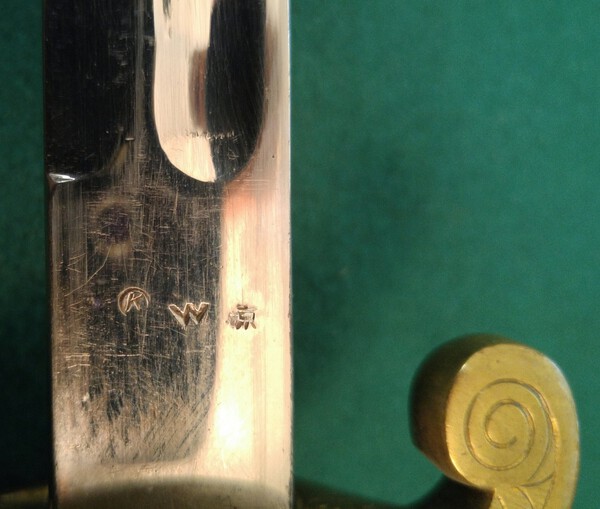
.jpeg.8e542dfb76feda70b84de3777e5b83a9.jpeg)
.jpeg.9b84960438cb40c933483672c4204cab.jpeg)
.thumb.jpg.9b41e3efd8ecac2d413db6d2758c1991.jpg)
-
I’ve been told that oil will stop the rust too. Your pictures don’t show the extent of the rust, but if it was mine, I would try to rub the rust down as far as possible, and then the oil will do the rest. The trick is being able to rub the rust down without rubbing off the paint. You don’t want to do more damage than has already been done to the remaining paint job.
-
I've been sick for a few days, and trying to take care of elderly, sick in-laws at the same time, so haven't had much free time lately. You're in good hands, and the info and advice all the guys are giving are spot-on.
-
It’s a good one, Jay.
-
My condolences buddy! I don’t think I’ve ever seen anybody get bit by three fakes before. Will the seller take them back?
-
Type 19 but scabbard is 6” too long
Bruce Pennington replied to Bridges's topic in Military Swords of Japan
I had initially wondered if this blade looked shorter than normal, too! I suppose this isn't in your possession, Noah? Would be nice to know the nagasa and compare to a known Type 19 length. -
@Chris1980 Chris, is there a date on the other side? Could we get a photo of it and a shot of the whole thing with fittings for the files? Thanks!
-
Type 19 but scabbard is 6” too long
Bruce Pennington replied to Bridges's topic in Military Swords of Japan
Even the saya seems longer that usual. Slightly different, but I own a Type 32 that came in a Type 19 saya. The blade is longer than the saya, and the end of the saya was cut to allow the tip to stick through. I think mine was likely done by Bubba, as there are other patch-work and piece-together issues.

-
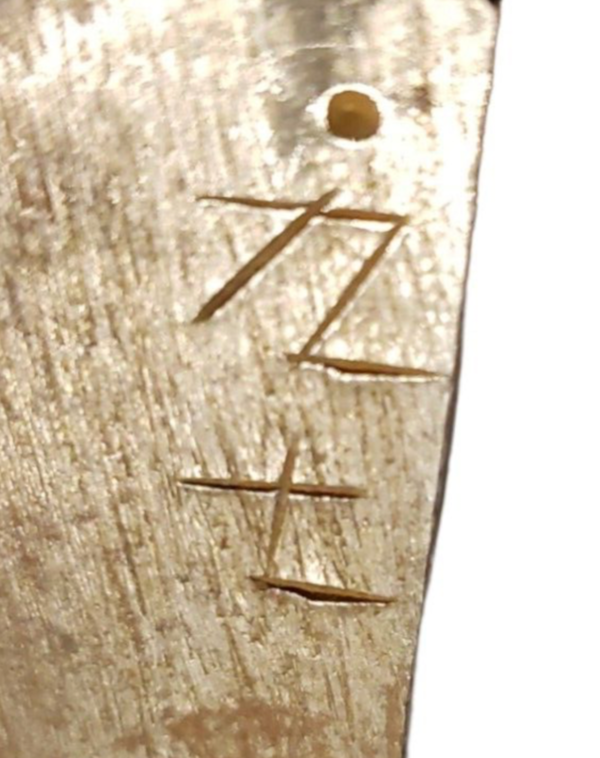
So, the plot thickens! Thanks to @John C, we have a third, "97". But the interesting thing is that it's on a blade in Type 94 fittings. For a while, I couldn't remember what thread I had seen similar numbers, but I figured it out. It's the same style crude numbering as the two posted by @robinalexander and @Stegel. But theirs are Type 95 coppers. After Stegel pointed out the offset machi: I realized we are likely seeing a private purchase NCO blade, by an officer, during the severe sword shortage of the transition from the kyugunto to the Type 94. The WWI styled sword knot fits the timeframe as well. The 3 blades were probably made by the same shop (Suya Shoten?) or arsenal team, hence the numbering. The rest of the blade fits a 95 blade with bohi and tempering, but no real hamon. At first, I thought we were seeing a zoheito, but with the offset machi, I'm convinced it's from the Type 95 team.
.thumb.jpg.c5f7f229e38127dd4e8b7070aaf7e54d.jpg)
.thumb.jpg.90088bd7eced7f2a9d1020d4546831f1.jpg)
.thumb.jpg.f5f21272f9a5ab17c0ca75a62d0829d7.jpg)
.thumb.jpg.d5382305fc53ca3bf81e3180862d5fa5.jpg)
.thumb.jpg.eccf63d3b00e37aeec1b10a7c6b9bf52.jpg)
.thumb.jpg.26ac20e75aa2211f2f36251f10a013cc.jpg)
.thumb.jpg.32986870b52d0277395c1a662f491dad.jpg)
-
Thanks Evan! Nice Rinji seishiki! Nagamitsu made some good looking blades, for sure. And you're right, that stamp is the "Saka" of the Osaka Army Arsenal. I've added yours to the survey and files, thanks again. We'll need @SteveM @Kiipu or @BANGBANGSAN for the surrender tag.
-
Yes, I agree. I was hoping someone in other fields might recognize it, but it seems no one does. So I could use it over on the military side.
-
Sakura Chuso release button
Bruce Pennington replied to PNSSHOGUN's topic in Military Swords of Japan
Nice example, and a really nice Kyu! Well-made fat seppa and rain-pattern habaki. -
Karl, I have seen quite a few gunto with that gold cord. I believe there is even an NMB thread on it. There are some seen with a red cord. Many believe it comes off the sword bag, but whether is was put there by the original owner or by a returning G.I., no one knows. I've seen so many, I'm starting to wonder if it's been done by the owners and might have some meaning or significance. But it's a big unknown for now. Thanks for the extra photos! Maybe one of the guys that study traditionally made blades can comment? To me, it seems to be a nicely made showato, in other words, non-traditional. You'll find most WWII gunto are showato, as they had to industrialize the swordmaking industry to meet a massive demand for swords. As to Kevin's observation, I have seen a number of smiths with blades in both Type 98 and Type 97 fittings, along with even civil fittings. They say the Seki area produced 70% of all WWII blades, so it is easy to see that they likely supplied swords to the full spectrum of buyers.
-
We'd enjoy seeing shots of the whole sword and fittings Karl, if you'd honor us with some photos! A couple of close, clear shots of the temper line (hamon) would help also. The blades with the large Seki stamp, like yours, are probably not made in the traditional manner. There have been some rare exceptions, but the vast majority of them seem to be well made, non-traditional blades. So, if a smith was cranking out large numbers of blades for the war effort, using non-traditional methods, it's unlikely (not impossible) that he was using tamahagane. But we're talking odds and chances here, since it's not possible to know conclusively. There are some guys at NMB that are really into metallurgy and steels that may be able to comment, but if the smith didn't specifically say on the mei (signature line), then we don't really know what steel was used.
-
How to tell if a NCO Gunto is real?
Bruce Pennington replied to Gendai's topic in Military Swords of Japan
What the guys said above. If you're considering a buy soon, then posting is your best defense. If you have time to study, start with Ohmura's pages on the Type 95. Only 5 of them, but some immaculate examples of workmanship and stampings for comparison to a prospective item you might be considering. Non-commissioned officers Gunto - Ohmura site -
John, I haven't tried tracking that. Might be worth looking into!
-
Wow (@<@) 1 mil for a spirit blade!
Bruce Pennington replied to tokashikibob's topic in Auctions and Online Sales or Sellers
Yes all Samurai roll in their graves, and monkey's hang their heads in shame, at this guy's posts. -
Wow, what an odd-ball. The blade is much nicer that a "normal" fake, if this is a fake, and the bohi is much better than a fake. The Chinese fakers really like to number the habaki, but that Kokura stamps sure looks right, though I can't say I've ever seen one on a habaki before. The matching numbers on habaki and drag are standard for Type 32s not 19s. Also the metal of the handguard, looking at the edge, seems like steel? or is that just paint? There's something odd about the floral pattern on the backstrap, too, and there is no dimpling on the backstrap. But, again, I don't study these, so please disregard all the above. Posting pics for the future. That sale post will go dead some day.
-
1875/type 19 kyu gunto- real or fake?
Bruce Pennington replied to Pika007's topic in Military Swords of Japan
I see them, and I think I've found the mon, but don't know what it means. So, I'm still flummoxed (ha! has that been posted in the Word of the Day, yet?) that the petals are rounded, yes elongated, and don't have the indentations at the end, even on the mon. Artistic license, I suppose. If you don't know the meaning, I'll post on the Mon thread.

-
Thanks Thomas, you've probably explained this to me several times over the years! And now we have another one of those out-of-sequence anomalies. The sequencing seems to start over with each year: 1889 Kanemasa 5 95 1889 Kanemasa 7 17 1890 Kanemasa 3 10 1891, Mar " 5 169 1891, Jun " 5 178 1891, Aug " 4 59 1891, Aug " 6 173 1892, Nov " 1 220 1893, Dec " 5 331
-
Excellent, and beautifully done, thanks buddy! Sorry to be a pest, but how about a clear shot of those on the kake?
-
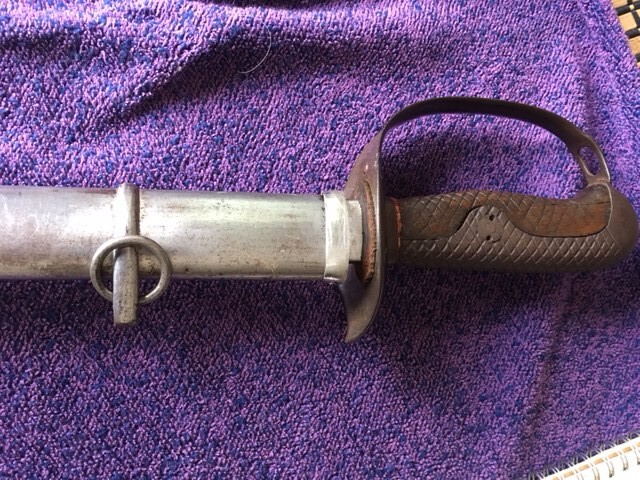
Ed, An approximation for the date can be made from the fact the blade is Showa stamped. In my survey, there are 176 undated, stamped blades and only 50 dated ones. Of the dated ones, they range from 1935 to 1942 and 1 in 1945, but the majority (41 of them) are dated 1940-41.



.jpg.50da19d37333f13a9c8e29c4d16fd2cc.jpg)



.jpg.20b6a62465138c33db9aec0b87e2e31c.jpg)
.jpg.84d4bde8f5139ea367fb5ec93fc45059.jpg)
.jpg.22181febce6aa23dfca4f445daf8d3a7.jpg)
.jpg.7412bf0b8d2dfb5a08d8254aae26773a.jpg)
.jpg.3a136f0bcb2b7eaa161d69f7ecdfa80e.jpg)
.jpg.1d4d63f7315ef7b845c6e454745befb9.jpg)
.jpg.f757ef4cbb59a4b9f56159ec06662f47.jpg)