


SteveM
-
Posts
4,393 -
Joined
-
Last visited
-
Days Won
98
Content Type
Profiles
Forums
Events
Store
Downloads
Gallery
Everything posted by SteveM
-
"Take" is not a very intuitive reading for the 2nd kanji of the name, whereas "toshi" is a much more common reading. In the absence of any other information, I think most people would assume Nobutoshi is the likely and probable reading. So, its just a very understandable error on the part of Slough.
-
Maybe 縣囗大井神社之印 A stamp from Ōi Shrine, which used to be ranked as a "prefectural shrine". https://www.ooijinjya.org/ The vertical bit next to it is a just a repeat of the "good luck in war" phrase.
-
Top right corner (vertically) 祝入営 Congratulations on joining the army 祈武運長久 Pray for everlasting luck in battle Under that is the recipient's name. I can't get the first character of the name. Something 囗谷達夫君 (Maybe Hishitani?) Tatsuo is the given name. The rest are names, slogans, and a poem next to the drawing of the sword たゞ身にもてる真心を 君と親とに尽くすべし All I have is my sincerity, and I devote it all for His Majesty and for my parents Can't get the stamp. A closer picture of it might help.
-
If I recall correctly, your sword had Izumi written with the characters reversed, right? Something like 泉和 when it should be 和泉. My gut feeling is that the kanji would have been written by a Japanese person (possibly Chinese person) with the intention of selling the sword overseas. Or, at least, selling it to a foreign customer. The signature looks plausible enough to foreign eyes, but Japanese people, particularly those from Osaka, would notice the error instantly. Actually, Izumi is a funny place name because there are several ways it can be spelled, depending on the usage. The inversed kanji might catch some people off guard. But as I said, foreigners would be especially vulnerable to this. Maybe an unscrupulous dealer had the name added at some point in the sword's history, but purposely inverted the kanji to give himself plausible deniability that he was trying to perpetuate a fraud. Or, it might have been added by a Chinese fraudster. A Chinese person wouldn't intuitively know that the Japanese place name is written 和泉, as it's a spelling that is unique to Japan, so it could be a careless mistake. Well, it could be a careless mistake made by a Japanese fraudster also, but its a little less plausible. Anyway, the important thing is to focus on the sword itself. Your sword might be worth considering having the fake signature removed. When the signature is removed, you can then submit the sword for authentication. You can submit it to the NTHK already, and they will evaluate it regardless of the signature. But the NBTHK in Japan won't give you any kind of judgment until you remove the fake signature. (They'll send it back to you with a pink card telling you your sword is a fake). So the NBTHK sort of forces you to get the fake signature removed before they will spend some time appraising it. Its a controversial policy that deserves some debate/reform, but I'm not in charge of the NBTHK.)
-
General Officer’s Sword Translation Help
SteveM replied to chgruener's topic in Translation Assistance
濃州住行宗鍛之 Nōshū -jū Yukimune kitae kore. Means: Yukimune of Nōshū Province made this WW2 smith. -
The group that issued this paper has been mentioned a few times on the board before. https://www.militaria.co.za/nmb/search/?q=銃砲刀剣研究会&quick=1 Needless to say, if you owned a Muramasa sword you would want to get it authenticated by the NBTHK. Especially if it were 2020 (when this paper was issued) when it was still super easy to submit swords to the NBTHK. There would be no reason to seek the authentication of any group other than NBTHK...unless you didn't like the NBTHK's judgment.
-
I have had a few paid translation requests come in these past few months, thanks to the forum. So I'm sharing the wealth with a donation to NMB, who makes such connections possible.
-
Here is a papered (hozon) kinpun-mei Aoe Ietsugu wakizashi. https://tokka.biz/sword/ietsugu2.html
-
Yes, if its a verifiable name. This one is from around 15 years ago. https://www.e-sword....1110_6000syousai.htm
- 1 reply
-
- 2
-

-

-
Machine divots around the nakago-ana
SteveM replied to ZH1980's topic in General Nihonto Related Discussion
Not to spoil the fun, but I think your tsuba design is plum blossoms. Usually many buds/flowers on spindly, upturned branches represent plum tree blossoms. Kind of a quintessential design (late winter, looking forward to spring which is just around the corner). from https://wakeidou.com/pages/412/
-
Assistance on Translating the Sayagaki on my New Nihonto
SteveM replied to Zoglet's topic in Translation Assistance
Sorry, I know virtually nothing about Nariaki. I only know he is a few generations from Nisshū. What little I know comes from this site below https://meitou.info/index.php/本阿弥 -
Assistance on Translating the Sayagaki on my New Nihonto
SteveM replied to Zoglet's topic in Translation Assistance
生中心在銘 時代承元之頃 成章添状付 Ubu, zaimei Circa Jōgen (1207-1211) With paper from Nariaki (Nisshū's great great grandfather) Small typo in Jan's post 照 > 昭 -
There is no such surname/clan in Japan. That is a mistranslation of Ii (double "i"), pronounced "ee" as in beet.
-
Tomotsugu (友次) for sure.

-
Middle one is 翁. Can't make out the other two. 翁 means "old man", used (somewhat self-deprecatingly) by aged artists.
- 1 reply
-
- 3
-
-
富久=とみひさ= Tomihisa. Wakayama only lists two of these artists; Tobari Tomihisa, and Kuwamura Tomihisa. Wakayama doesn't mention any Tomihisa from Chōshū, so the smith who made Ian's tsuba is a slight mystery (meikan more?). 友久 (Tomohisa) and 友義 (Tomoyoshi) are different smiths altogether.
-
Wakayama lists a mid-Edo era metalsmith named Kuwamura Tomihisa (桑村富久)
-
Sayagaki is signed by Bizan in May of this year, which means it must have been written by Hitoshi SATO who uses this art name. See the thread below for more background information.
-
Fukuda Kanetake 福田兼丈
-
Mid-Muromachi Period katana - Bingo Mihara School link
SteveM replied to VRGC's topic in General Nihonto Related Discussion
Your initial question was valid. The "standard" for Mihara Bingo blades would be a predominantly straight hamon, which at first glance this definitely appears to have a predominantly straight hamon. Nagayama says for Ko-Mihara: "Temper lines are a narrow chu-suguha". For Sue-Mihara: Temper lines are relatively narrow chu-suguha". (He says Chu-Mihara are rarely seen). So you'd be right to assume it ought to be straight, or predominantly straight, which, looking at the photos, your assumption would be validated. If there are gunome or pointed shapes hidden in the hamon, you'd want the shop to show those, because those would be "interesting" considering the attribution. So I'm not sure if its the photos, the polish, or the description that is bad here (or a combination of these). Anyway, the photos show a predominantly chu-suguha, and it doesn't quite match with the description, but it does match the attribution, so definitely confusing. -
He was appointed "official court artist" in 1906, when he was 70 years old. He used that on signatures until he died some 11-12 years later. There are a lot of examples on the internet. If you look for "teishitsu gigeiin" you will find some other examples.
-
塚本一貫斎起正 Tsukamoto Ikkansai Okimasa Date is as Jean wrote in his post.
-
Sword Rubbing Oshigata & Medicine Case
SteveM replied to Rjizzle10's topic in Translation Assistance
Should be oriented this way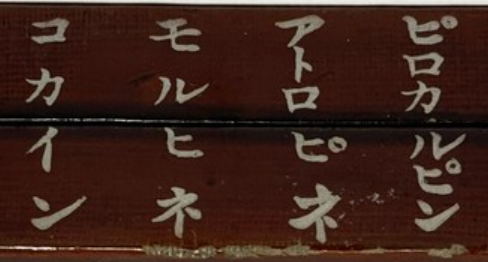
-
Sword Rubbing Oshigata & Medicine Case
SteveM replied to Rjizzle10's topic in Translation Assistance
Nothing of value on the paper. The English is an accurate translation of what was written on the sword from which the rubbing came from. The case is a medicine case, and the vials are (left to right) Morphine Cocaine Pilocarpine Atropine Morphine (again) blank The box is pictured upside-down, but the writing matches with the vials. Turn the box (or the photo) rightside-up, and it will read (again left-to-right) as Cocaine Morphine Atropine Pilocarpine -
帝室技藝員 ていしつぎげいいん Imperial artist, official court artist

