


SteveM
-
Posts
4,361 -
Joined
-
Last visited
-
Days Won
97
Content Type
Profiles
Forums
Events
Store
Downloads
Gallery
Everything posted by SteveM
-
The theme is called Fujimi Narihira (富士見業平), and is from the Tales of Ise, section 9 "Journey to the East" (東下り). The subject is court noble (as well as noted poet, governor, and Lothario) Ariwara no Narihira. At mount Fuji in the month of May, he notices the mountaintop still has snow on it, and he remarks: Fuji is a mountain that knows no season. What time does it take this for, that it should be dappled with falling snow? 時しらぬ山はふしのねいつとてもかのこまだらに雪のふるらん https://www.city.takamatsu.kagawa.jp/kyouiku/bunkabu/rekisi/naiyou/yorozuan/yoro02/yoro02.htm http://www.arc.ritsumei.ac.jp/opengadaiwiki/index.php/%E5%AF%8C%E5%A3%AB%E8%A6%8B%E6%A5%AD%E5%B9%B3 https://en.wikipedia.org/wiki/Ariwara_no_Narihira The attendant is unnamed, and I don't think is crucial to the theme. Sometimes Narihira is depicted alone, and sometimes he is with multiple servants. I wouldn't read too much into the theme as social comment. I think it is just a poetic piece, one that any educated person would have been familiar with at the time.
-
For year I would say 2603 (nisen roppyaku san) nen. Followed by 春 (haru) = spring
-
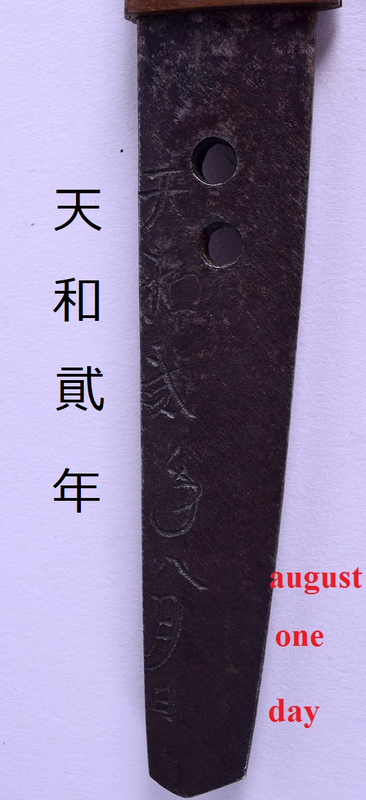
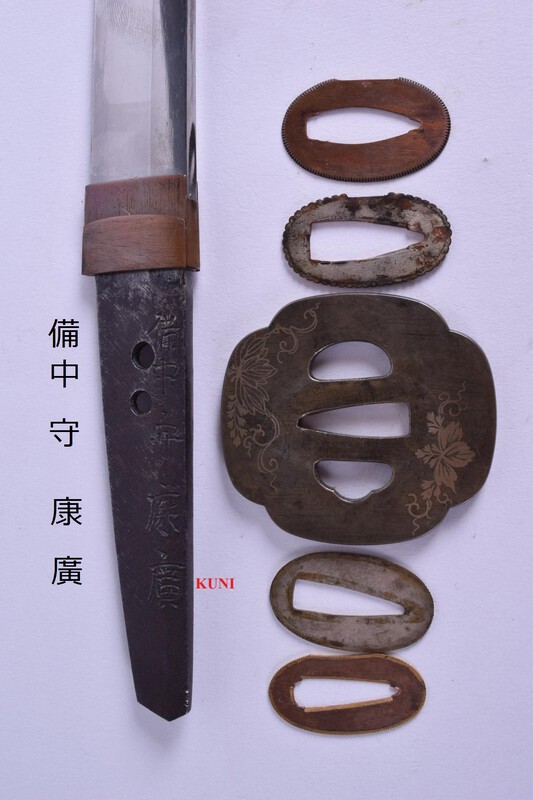
And hopefully these will complete the picture If you have the month, its a safe bet that what precedes it is the year. The Japanese years are not nearly as daunting as they may sound. There are about 250 Japanese era names, all using two kanji. If you can pick out just one of the kanji, you can usually narrow it down drastically. In this case, both 天 (ten) and 和 (wa) are readable, so if you have the list of era years its a fairly easy task to pick out the era on your sword. The kanji for the number two (貮) is a bit tough, being the complicated variant of the number, but this too is a process of elimination. So if you've made it this far, the last kanji in this set almost has to be "year", even if it looks impossibly fancy, as it does in your sword. https://en.wikipedia.org/wiki/List_of_Japanese_era_names Its almost a given that the other side will include the kuni (region) followed by the smith's name. Like the era years, the number of kuni is limited, and so this too becomes a process of elimination until you get enough experience to read the kanji themselves. The famous sword-making region of Bizen (備前) is a very common thing to see on a sword, and your sword, which bears the place-name of Bichu (備中) is from near this region. Reading the smith name is something that only comes with a lot of practice. Kuni was a good guess, being a fairly common kanji found in names. For me, the hiro (廣) was more obvious than the yasu (康) at first glance, because the hiro is fairly well-cut and recognizable. The yasu part looks like it was made using a couple of shortcuts, so it caused me to look twice before I got it. Mind you, I still wouldn't know if the mei is legitimate or a forgery. This is another level of skill altogether. With swords on the auction sites, I would be very cautious.
-
Matt has provided a very good transcription of the sayagaki; which basically says the writer thinks this sword can be attributed to a smith named Katsumitsu working in the Eiroku era (1558-1570). The name of the person who wrote the sayagaki is Hon'ami, and if you search the internet a while you can find out more about the Hon'ami family. This particular sayagaki was written in 1978, which means the writer should logically be Hon'ami Kōhaku, but the signature does not look right to me. From the way it is written, it looks like the writer is hinting very strongly that this sword was made by 4th generation Katsumitsu, first name of Tarōbei, active in the Eiroku era. https://nihontoclub.com/smiths/KAT107 It also lists some background information about the Katsumitsu line, and it lists the sword length.
-
obverse 兼元 Kanemoto 地刃健全優刀也 Jiha kenzen yūtō nari (healthy blade, elegant sword) reverse is just sword measurements 1 shaku, 9 sun, 5 rin
-
Sosho Translation Confirmation Assistance
SteveM replied to Tanto54's topic in Translation Assistance
Whew - thank God Morita-san showed up. I was just about to write a paragraph about why it couldn't possibly be osoraku. A few minutes later and I would have made a complete fool of myself. -
Looks right to me, except I would like to see a better close up of the spine. 千四百五 may well be correct, but it is unusual. It would not be a date - so it is odd (for me) to see a seemingly random number like this.
-
Sosho Translation Confirmation Assistance
SteveM replied to Tanto54's topic in Translation Assistance
を as the beginning particle doesn't make sense. This should be part of a longer text. "Osoraku" would be 恐らく (various theories, but all variations on the kanji 恐) を我々強く would be my guess, but still missing the first part, the "what" of the thing that makes us strong. -
Its a hodgepodge of fittings: WW2-era scabbard, pre-20th century tsuka and fittings, tsuba also looks pre-20th century. I wonder if the habaki is a shell, or if it is a rising sun motif. Hard to tell about the sword itself. I don't see any arsenal marks, but I also can't see enough of the sword to make anything more than a wild guess. The tsuka looks way out of proportion to the rest of the sword. Is that a photographic illusion, or is it really that big?
-
Yes, that's my assumption.
-
Translation Assistance For Inscribed Kozuka
SteveM replied to kokyo jin's topic in Translation Assistance
Its a love poem, My feelings continue, like the never ending smoke from Mt. Fuji My restless room, like Ukishimagahara The person is neither asleep nor awake, restless and unsettled. The thoughts of a lost love continue to drift into his mind, like the smoke that continues to rise from Mt. Fuji. And the bedroom is likened to Ukishimagahara, wetlands (marshes, swamps, although I think swamps would not evoke the right image) which stretch out to the foothills of Mt. Fuji. At play here is the word and image of uki-shima (浮き島)or "floating island", a physical location, but also an allusion to the bed floating on tears shed for the lost love, and the tears creating a marshland. And interesting again because we can imagine it was written before Saigyō became a priest, and so there is an added pathos of the priest in the image on the kozuka, looking back on not only Mt. Fuji, but also looking back on his thoughts and emotions as a young man. An interesting theme for a kozuka. Standing on the shoulders of a couple of giants here, including the following http://sanka11.sakura.ne.jp/sankasyu4/218.html http://archives.mag2.com/0000165185/20140413165000000.html No way I would have been able to figure that out on my own. (Note this poem is part of the "Poems of a Mountain Home" that Malcom mentions above.) -
I think Piers has it right - Suzuki Gen Saemonjō. Looking at Japanese wikipedia, there is a particular rank or bureaucratic position in feudal Japan called "saemonjō" 左衛門尉 and my guess is that this is the title of the owner. I have never heard of this position before, but in searching the internet it seems to come up from time to time on swords. It feels like there is one other kanji missing 鈴木源左衛門尉囗之 From the context we can assume the obliterated kanji would mean "owned by" "commissioned by" or "held by" or some other word indicating ownership.
-
山田敏周 Yamada Toshichika
-
-
Big Box, Big Story - Over My Head On The Translation
SteveM replied to Surfson's topic in Translation Assistance
Hello Bob - No worries from me. I always enjoy the challenge. This one was particularly interesting because the kanji were fairly easy to read. Much easier than "grass script", which can be infuriating. So trying to decipher what was meant when the kanji are legible is a nice change. Andrew Ickeringill's translation of the mei is available at the link above in Bazza's post, which I will re-link to below. https://touken-togishi.com/hyakuryushi-nagashige/ I eagerly await Markus's opinion on the mei. As I say, the name Sakaino (presumably 境㙒, with a seldom-used version of 野 being used) strikes me as a bit of a stretch, but I could not come up with a better option -
Big Box, Big Story - Over My Head On The Translation
SteveM replied to Surfson's topic in Translation Assistance
There is a lot of interesting information in here for the aspiring translator and anyone who has an interest in classical Japanese. Hats off to Markus for the translation of the inscription on the box lid. I look forward to reading this again and learning where I went wrong. Andrew Ickeringill has done a very admirable job translating the inscription on the sword. I don't think you are likely to get a much more accurate translation than his. The name Sakaino is fairly rare in Japan, so that needs a bit of scrutiny, but I couldn't come up with a more plausible name given the sōsho inscription, so it works for me. -
Hello, Some indecipherable elements on there, and these might be remedied by a better angle and lighting (careful of the flash). What I can make out is not particularly illuminating: 弟三部第十四号 Third section, #14 天保六年囗九月三日 Tenpō 6 (1835) September 3rd The section immediately after this is Illegible (far right bit is Illegible) 尾張住橘井四郎信髙御刀 Owari-jū Kitsui Shirō Nobutaka sword 銘有長貮尺三寸半(生?) With mei, and length of 2-shaku, 3-sun (half? ubu?) 天保五年囗七月 Tenpō 5 (1834) July (Illegible after this) The crucial bits are the parts after the dates that are illegible (to me). I reckon they are names and possibly titles, showing ownership or transfer of ownership. The sword itself is dated Tenmei 7 (1787) with a very handsomely cut mei. The 住 on the sword looks unusual. I don't know if I have read this wrong or if this is just a stylistic rendering of that kanji. The parts in blue above are the parts that I am unsure about. They might be clarified with a different angle, less flash, or maybe a closer shot.
-
This is where you Google skills come in handy. The first two kanji point to a province in old Japan, the third ("kami") is an honorary rank or title, and the last four kanji are the smith's name. Actually its just the last two kanji that point to the smith. The "Fujiwara" bit is a clan affiliation (consider it a claim to a noble lineage), and shouldn't be taken literally as a family name. Anyway - now that you have all of this info, you can find out more on your own by picking apart these pieces and searching for them. I guarantee you, there is a lot to be discovered just by browsing this very site. Look for a paper by Guido Schiller on this site regarding the honorific "kami". Look up Jumyō on this site and you will probably find several other examples of his work. Good luck and happy hunting.
-
Try this (spoiler for those who want to give it a go.) edit: I figured out the other kanji I was missing... The complete sayagaki is now included above
-
↑ Yes - that's it. 常陸守藤原寿命 Hitachi-no-kami Fujiwara Jumyō
-
Close on both counts... 兼玄 昭和二十年四月 The date should be easy to pick out, since it is a wartime blade. The smith is slightly more obscure, so I will put him down as a spoiler
-
I was thinking the last kanji was a poorly drawn 號, an option I don't feel 100% confident about, but it seems more plausible than 新.
-
Hello - Well done, Ian. If I could make a slight correction or two. 提出者 submitted by 山領孫一 Yamaryō Magoichi 住所佐賀縣杵島郡中通村大字犬走 Address: Saga Pref. Mashima-gun, Nakadōri-mura, Ōaza Inubashiri 品名 日本刀一五七 Hinmei Nihontō 157 The last character has defeated me as well.
-
Yes, that is the one. And you are right about the reading of 牧川. In the case of this artist it is correctly read as Bokusen (not Makigawa).


