


SteveM
-
Posts
4,399 -
Joined
-
Last visited
-
Days Won
98
Content Type
Profiles
Forums
Events
Store
Downloads
Gallery
Everything posted by SteveM
-
江戸住森太郎 Edo-jū Mori Tarō
-
Not a traditional sayagaki, but instead looks to be instructions to a workman. The bits I can make out are: ...ツリカネをつけてください... 大至急に御願ひ致します... Please attach a tsurikane (attachment for hanging)... Please rush.
-
Hello Joel, MIght be better to start a new thread for your sword. At any rate, the answer you want (and more!) is in the thread below. http://www.militaria.co.za/nmb/topic/7355-correct-mei-translation/
-
和泉守兼定 Izumi-no-kami Kanesada (I think) Compare to this http://sanmei.com/contents/media/A41667_S2150_PUP.html
-
Translation Assistance - Wwii Era Gunto - Tough One For Me...
SteveM replied to grapppa's topic in Translation Assistance
And another, from Moriyama-san posted many years ago -
Translation Assistance - Wwii Era Gunto - Tough One For Me...
SteveM replied to grapppa's topic in Translation Assistance
You have correctly identified ”Takayama-tō", so take a look at the thread below for more information. http://www.militaria.co.za/nmb/topic/21334-navy-sword/?hl=takayama&do=findComment&comment=216990 I will post the rest as a spoiler. If you are clever with a search engine, you should be able to follow the various leads above to figure out the rest without looking at the spoiler, but I leave it here anyway Also, Mark is correct for the maker's name.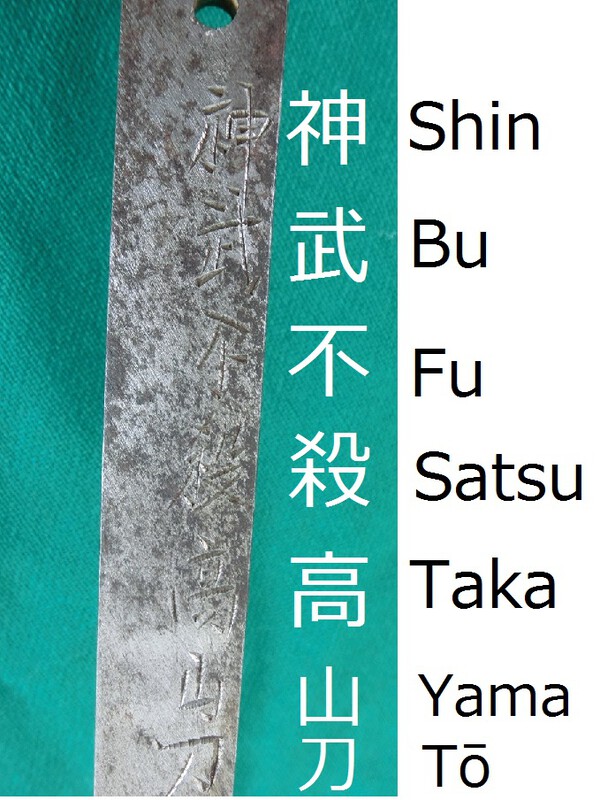
-
Type 98 Shin Gunto Mei Translation
SteveM replied to cdertgSeRtQvZopl's topic in Translation Assistance
清宮=Kiyomiya (the name on your sword). Perhaps it is the guy mentioned in this thread http://www.militaria.co.za/nmb/topic/5859-showato-translation/ Kiyomaro would be 清麿 which is close, but not the kanji on your sword. -
Help With Translation And Date. Bishu Osafune Sukesada
SteveM replied to tesscoothome123's topic in Translation Assistance
I think 天文 also. The item taped to the shirasaya looks like it has the words 備州長船祐定 written on it (hence, it would appear to be an old registration paper) but the rest is obscured by tape and by the slightly blurry focus. If we could see more of it, it might help determine if the year is 天文 or something else. Be aware that the bureaucrats who fill in these registration certificates sometimes make mistakes. They are not always sword aficionados, and are not always accurate when it comes to deciphering centuries-old engravings. The registration certificate by itself is not worth anything, and its only value is, as above, giving you another opinion as to what the engraving says. Some collectors may find the very early registration certificates to be of some historical value, but generally its not really worth anything. If you can remove it from the shirasaya to get a better look at it, it does no harm to the ensemble, and takes nothing away from the value of the sword. Usually these certificates must be forfeited when you export a sword out of Japan. If it gets re-imported to Japan, it will get a new certificate. There actually looks like a sticker with some Korean writing on it as well, so that's slightly curious. As to the taping of the shirasaya; it may not be the biggest issue for you. I mean, your shirasaya looks very old and I wonder about the oil and dust buildup inside of it. Is the sword in good shape? Is it a nice sword? If so, you might consider getting a new shirasaya made (and hang on to the old bits if you want to keep them as historical artifacts). The important thing is to keep the sword in good condition. As for the rest of the shirasaya, it has an address and a name on one side: 佐賀懸浜庫村大字若宮 中野吉? Saga-ken, Hyōgo-mura, Ōaza Wakamiya Nakano Kichi? The other side says 宮地嶽三柱大神 Miyajidakemihashira Ōkami This is the name of a trinity of local (Kyūshū) shintō gods, I think. Here is a little bit on them http://www.miyajidake.or.jp/images/en/booklet.pdf Underneath this is 備州長船祐定 Bishū Osafune Sukesada The fune bit is obscured by tape. -
According to this site https://www.japaneseswordindex.com/oshigata/index.htmthere are three different Hiromitsu smiths producing guntō, all using the same 廣光 kanji combination. Yours looks very much like the second in this list, which looks different from Kajiwara Hiromitsu. The year is correct: 1943 (昭和十八年)
-
冨嶽不重君恩重 鴻毛不軽臣命軽 It seems to be a suspicious rendering of a phrase one of the 47 samurai had on his sword Ōishi Yoshiō had engraved on his short sword the phrase "万山不重君恩重 一髪不軽臣命軽" (Duty is heavier than 10000 mountains. Life is lighter than a hair) In the phrase on the sayagaki, the "10000 mountains" has been replaced by "Mt. Fuji" (Fu-dake), and the word "hair" has been replaced by "goose feather". The phrase on the sayagaki uses variants of some kanji that aren't in use in Japan. The last picture would be a name: Fuji Honzō (冨士本藏) or another possible reading of the given name is Motokura.
-
Here you go http://woodblockprints.org/index.php/Detail/Object/Show/object_id/836
-
I don't think yours was a dumb guess at all. I too am thinking this is a New Year's toy theme: denden daiko, daruma-otoshi, and kome kui-nezumi. The Tesso idea is interesting, but I find it hard to reconcile the denden daiko with Tesso, and I really think the ogre-face is a daruma-otoshi. So I'm thinking it is a New Year's toys motif (on this, the start of Chinese/Lunar New Year!).
-
...which means the Fuku on the opposite side would probably be something scratched in by the owner. 福 (fuku) by itself means good luck. It is a common kanji, often used in last names or other pronouns.
-
福 Fuku Couldn't tell you what it means in this context.
-
Looks like someone took a bit out of that sword.
-
↑ Close - but that gave me a good clue. These particular figures appear in the "Night Parade of 100 Demons". They represent unused or thrown away items/tools that have been turned into monsters. The standing one is a discarded biwa (lute or guitar-like instrument), and the crawling one is a discarded koto. http://www.nichibun.ac.jp/YoukaiGazouCard/U426_nichibunken_0054_0003_0000.html https://en.wikipedia.org/wiki/Hyakki_Yagy%C5%8D https://en.wikipedia.org/wiki/Koto_(instrument) https://en.wikipedia.org/wiki/Biwa
-
I find dog tags to be difficult. Japanese dog tags dating from WW2 do not carry soldiers' names, just a shorthand for what regiment the soldier is from. This particular one says (I think) 16th Infantry Reinforcement, 2nd Company, #403
-
Ehime-ken, Imabari-shi, Ōaza Tsujidō Sokabe Motoichi https://en.wikipedia.org/wiki/Imabari,_Ehime
-
I even wonder if it is Japanese. It is rare when you can't pick out a single kanji from a sayagaki that long. I would expect to recognize something - a part of a word...a name, a location, a title, a year, a description, anything. On this one, I cannot pick out anything.
-
I think the original Ludolf tsuba is 友貞 (Tomosada) as initially thought. The tsuba added by Christian is, I think, 城州, rather than 武州 or 勢州. Wakayama mentions nothing about a kin'in for either smith/craftsman.
-
迟ホ次郎 - is something trying hard to look like a Japanese name. 次郎 -jirō is a viable personal name, but 迟ホ is a funny hybrid of a kanji that is not used in Japan, and a katakana "ho" that has no place in a family name. The reverse side has a similar jumble of seemingly random kanji. I'm afraid it makes no sense. 坎?征千代. Could still be an authentic blade that somebody tried to tart up by adding kanji (and hoping to sell to a naive newbie). Unfortunately the odds of this being a blade of any value are pretty low.
-
Sanrakushi would be a personal pronoun: a name, but I don't know if it is an art name, or location-related name, or something completely different. Oite is a very common kanji, meaning "in". Tsukuru is also another very common kanji meaning "made (by)".
-
Hmm - try this (関) 於濃州勝?山楽師山麓吉道造之 (Seki stamp) Oite Nōshū-jū Katsu(?) sanrakushi Sanroku Yoshimichi tsukuru kore An unusual mei. I couldn't find another like it on the internet.
-
I think the seal is just one character. I looks like 保. It is the same character that is on the Masaie tsuba. Maybe it points to a specific school or workshop. It isn't a kao or a go. It's called 金印 kin'in (gold seal), but this is about all I know.
-
I've never seen a name on the tang's mune before. I believe it might have been the owner's name. Mamoru is a common first name for a male. This is assuming the kanji is indeed 護. I still have doubts, but in lieu of a more viable alternative I'll stick with it for now.

