kyushukairu
-
Posts
649 -
Joined
-
Last visited
-
Days Won
3
Content Type
Profiles
Forums
Events
Store
Downloads
Gallery
Everything posted by kyushukairu
-
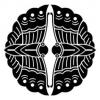
Christie’s London - November 1997 - Auction Catalogue
kyushukairu replied to kyushukairu's topic in Tosogu
Thanks Geraint, do you have that catalogue too? If so, is there an image of the lot? -
Christie’s London - November 1997 - Auction Catalogue
kyushukairu replied to kyushukairu's topic in Tosogu
That’s the one. Thank you for the link, Dale! Thank you for checking, Geraint. It seems it was part of the Lundgren Collection and most likely published in a separate book by Christies - https://www.japaneseswordbooksandtsuba.com/store/books/b222-lundgren-collection-Japanese-metalwork -
The character below 長春 is “作”
- 1 reply
-
- 1
-

-
I don’t suppose anyone has a copy of Christie’s London “Japanese Works of Art” from Tuesday 18 and Thursday 20 November 1997? I picked up a set of fuchigashira with a Christie’s label for ‘part of 181/4’ from ‘18.11.97’, and was wondering if someone would be kind enough to check for me and send a picture of the entry?

-
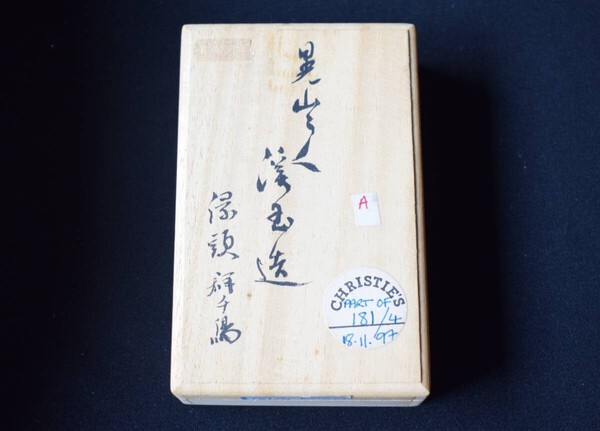
The given kanji look accurate and are possibly read as ‘Yoshimitsu Saitōchi’ [良光斉東知]. The last character is not actually kanji, but a kao [花押], which is a stylised signature. I had a look in Sesko’s meikan, and unfortunately there is no such artist listed there. Perhaps one of the other members can check Wakayama for you.
-
Is the attribution “Hikone bori” [彦根彫]? If so, this just refers to the style of production, much like “Heianjō zōgan” [平安城象嵌], rather than any particular school. The reason may be that the judges did not deem your tsuba to be from the Sōten school. Although Sesko includes Sōten in his Tōsō-Kinkō Schools, on account of them having produced some soft metal work, I’ve read elsewhere that any shakudo tsuba signed “Sōten” should be considered gimei. There were several other schools who produced “Hikone bori” tsuba, such as Aizu Shoami, and numerous Kyoto based artists, so perhaps the judges considered the tsuba to be produced by one of the latter, but without enough characteristics to attribute it to any specific artist or particular group.
-
Whilst several Hamano artists used the gō ‘Miboku’ (味墨), such as Shōzui, Masanobu, and Masayoshi, the mei does not resemble any of those listed in the meikan, and unfortunately without a kao to compare to other Hamano artists it’s unlikely that you will be able to connect it to a particular artist.

-
Fittings info help please
kyushukairu replied to DRICKS's topic in General Nihonto Related Discussion
The kashira depicts daruma, and the fuchi bears a gold seal with the kanji “Tō´u” (東雨), which was the gō of Tsuchiya Yasuchika. -
The mei is Nōshū jū Akinobu (濃州住亮信)
-
That was very kind of Mike. Your son’s tsuba is signed ‘Jakushi’ (若芝).

-
The tsuba is signed ‘made by Hiroshige’ (廣繁造). Unfortunately he is not listed in Sesko’s meikan. Perhaps someone with Wakayama’s book can check and see if he is included there.
-
On the left is Myochin Munekane (明珍宗周), on the right is Echizen ju Kinai saku (越前住記内作)
-
Yes, Mark. I saw them listed online. I’ve attached a good example of an Edo-Umetada tsuba [by Narimasa 就方], which nicely exhibits their surihagashi technique. I had another look at your papers and noticed that the description states that they are made from shakudo. In Sesko’s Toso-Kinko, it notes that the 2nd gen. Narishige [就受], created this style of shibuichi and gilt in surihagashi. I don’t know if Edo-Umetada also worked in shakudo [though I do have a papered suaka Edo-Umetada tsuba], but I recall reading somewhere that early Umetada artists [in Kyoto] also practiced surihagashi, so new papers might actually receive the same attribution.

-
I think the attribution on the papers is accurate, though ‘Edo-Umetada’ may be more precise. The signature style of the Edo branch of the Umetada was thick gilding in surihagashi [摺り剝がし] (polished to reveal the base metal on the protruding points) which was commonly done on shibuichi to replicate yamagane and create an antique appearance, which can be considered to be reminiscent of ‘Ezo’ tosogu.
-
Help Reading the Signature of Fuchi
kyushukairu replied to Krystian's topic in Translation Assistance
Hello Krystian, I would read the mei as ‘Ryūfūken’ (柳風軒) ‘Tomohiro’ (友廣) Ps. that’s a lovely set of fuchigashira. -
Lovely piece, Bob. I seen it in hand a couple of months ago, and would agree that it is Yokoya work. I think the seller obtained it from a collector in Hiroshima - at least it was among a huge collection which had just been purchased from Hiroshima when I saw it. From what I recall, the kojiri is made from silver, so the first character in the second line is most likely 銀. I agree with Steve, that the succeeding characters are 銅地, so perhaps the reading is 銀・銅地, to suggest that the appraiser is uncertain if it’s made from silver or silver and copper (i.e. shibuichi).
-
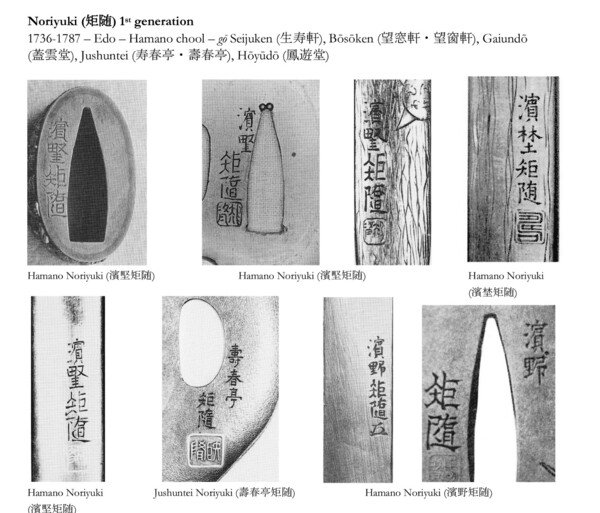
The first tsuba, as Vajo notes, depicts Shoki (the demon queller) and oni (a demon). It is signed ‘Hamano Noriyuki’ (濱野矩随), and looks to be made from shakudo (a mix of 97% copper and 3% gold). The oni seems to be made from copper, whilst Shoki has gold, silver and shakudo overlay. As for the second tsuba, Piers have given you a much better explanation than I could have.
-
Your are very welcome, Calimero. Whilst some sword-smiths made tsuba, your tsuba were made by artisans whose primary occupation was to make sword fittings (tsuba, menuki, fuchigashira etc). In my opinion, both tsuba are of decent, mid-range quality. Personally, I prefer the dragon tsuba, but that is just because I find Hikone work to be a bit too fussy.
-
Although Robert Held uses the term ‘kabuto-shi’ (兜師), I have not previously encountered this term in any Japanese source, and as such, I assume it is of Held’s own device. The term kacchu-shi* (甲冑師) refers to someone whose primary occupation was the construction of a set of armour. The term ‘kacchu’ [甲冑] literally means ‘armour’ and ‘helmet’, and ‘shi’ (師) refers to someone who is an expert/master. Tsuba made by such people, and in the style of those made by such people [usually a thin flat plate with a raised rim], are referred to as kacchu-shi tsuba. Myochin was one such group of kacchu-shi who produced tsuba in the style of a kabuto (with overlapping plates), and so, unsigned examples, which lack characteristics seen in such Myochin tsuba, could be referred to as kacchu-shi tsuba. However, the term ‘kabuto-shi’ (兜師) seems incorrect because, as far as I’m aware, there were no specialists whom only produced kabuto - perhaps one of our kacchu people could confirm or deny this. *I don’t know where the romanisation of ‘katchu’ comes from. The hiragana (reading of the kanji) is かっちゅ (the small つ [っ] indicates the repetition of the succeeding letter).
-
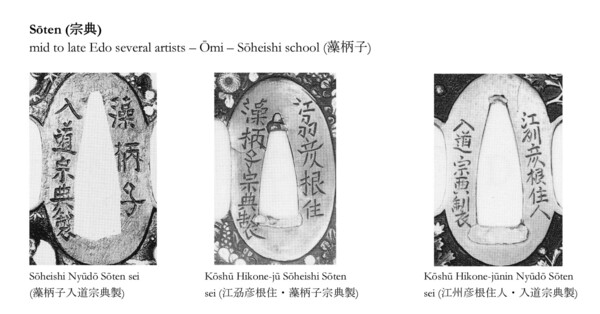
The first piece, with the dragon, is signed ‘Sunagawa Masayoshi’ (砂川正吉), who was active during the late Edo period. The second tsuba is signed ‘Kōshū Hikone-jū Sōheishi Nyūdō Sōten sei ’ (江刕彦根住藻柄子入道宗典製), which was used by a group of artist from mid to late Edo.

-
You’re too kind, Jesse Yes, of course Brian. Please do! Also, it might be a good idea to pin it to the translation forum so it’s easily accessible here?
-
Thanks for the second set of eyes, Piers! I’ve now fixed those two typos. In academia, we say that the best form of proof-reading is submission - it’s always after you have submitted an essay that you then notice the errors.
-
I have taken the time to complie a list of commonly encountered terms on NBTHK tōsōgu kanteisho. More specifically, the physical attributes which are listed after the description/ theme and attribution. My reason for putting these terms together is twofold: Firstly, a lot of diligent members put in the effort to try and figure out what is written on kanteisho before asking members for clarification. For such people, this will provide a quick reference to check common terms in the description to aid their own progress. Secondly, when members ask for a translation their reason is usually to obtain further information about the item which has been appraised. In such a case, translators (including myself) often only provide the description/ theme and attribution, since there isn’t much need to describe what can be seen. Should such members become curious about the other characters on a kanteisho they will be able to find them here. I would like to note that this is by no means an exhaustive list, but common terms which I found on kanteisho of tōsōgu in my own collection [I realise there are dozens of other tsuba shapes which I have not included]. And as such, I encourage members to add any further terms which they may encounter. Also, the English translations in brackets are mostly direct translations to explain the work/technique, rather than a definitive account. For convenience, I have listed the terms in order of appearance on the kanteisho. That is, after the description/ theme of the tsuba, is the mei or attribution [on some menuki the way the signature is applied is given], this is followed by the shape [for tsuba], the material the item is made from, the style of carving, the method of inlay, and the style of the rim [on tsuba]. Way of signing [on menuki] 短冊銘 - tanzaku-mei (signed on an inserted plaque) 割根先銘 - warinesaki-mei (signed on the support post) Shape [of tsuba] 丸形 - maru-gata (round) 竪丸形 - tate maru-gata (oblong round) 撫丸形 - nade maru-gata (smooth round) 木瓜形 - mokko-gata (four lobes) 角形 - kaku-gata (square) 撫角形 - nade kaku-gata (smooth square) 菊花形 - kikka-gata (chrysanthemum) 車形 - kuruma-gata (wheel) 葵形 - aoi-gata (hollyhock) 泥障形 - aori-gata (saddle) 変り形 - kawari-gata (unusual) 椀形 - wan-gata (domed/bowl) Material 鉄地 - tetsu-ji (iron) 赤銅地 - shakudō-ji (copper mixed with gold) 素銅地 - suaka-ji (copper) 四分一地 - shibuichi-ji (copper mixed with silver) 山銅地 - yamagane-ji (unrefined copper) 真鍮地 - shinchu-ji (brass) 金無垢地 - kinmuku-ji (solid gold) Surface 磨地 - migaki-ji (polished) 魚子地 - nanako-ji (fish eggs) 石目地 - ishime-ji (stone) 槌目地 - tsuchime-ji (hammered) 斜鑢地 - shayasuri-ji (diagonal filing) Openwork 地透 - ji-sukashi (openwork) 影透 - kage-sukashi (silhouette openwork) Carving 肉彫 - niku-bori (dimensional carving) 高彫 - taka-bori (high relief carving) 容彫 - katachi-bori (shaped) [common for menuki] 片切り彫 - katakiri-bori (half-cut carving) 毛彫 - ke-bori (hair line carving) 鋤出彫 - sukidashi-bori (dug away carving) 深彫 - fuka-bori (deep carving) 甲鋤彫り - kōsuki-bori (shell-shaped carving) 倶利彫 - guru-bori (level carving) Decoration 象嵌 - zōgan (inlay) 金象嵌 - kin-zōgan (gold inlay) 平安城象嵌 - Heianjō-zōgan (brass inlay) 素銅象嵌 - suaka-zōgan (copper inlay) 布目象嵌 - nunome-zōgan (crosshatch overlay) 色絵 - iro-e (colour overlay) 金銀色絵 - kingin iro-e (gold and silver colour overlay) Rim [on tsuba] 丸耳 - maru-mimi (round) 角耳 - kaku-mimi (square) 土手耳 - dote-mimi (piped) 打返耳 - uchigaeshi-mimi (bevelled) 鋤残耳 - sukinokoshi-mimi (carved down) 覆輪耳 - fukurin-mimi (metal band) 鋤出耳 - sukidashi-mimi (dug away)
- 10 replies
-
- 13
-

-

-
I give up, again! Help with a mei please!
kyushukairu replied to Bruce Pennington's topic in Translation Assistance
You’re very welcome, Bruce. The second one is 岡田兼定 -
I give up, again! Help with a mei please!
kyushukairu replied to Bruce Pennington's topic in Translation Assistance
Hello Bruce, It looks like 関兼宗作