kyushukairu
-
Posts
649 -
Joined
-
Last visited
-
Days Won
3
Content Type
Profiles
Forums
Events
Store
Downloads
Gallery
Everything posted by kyushukairu
-
Help with holster translation - thanks
kyushukairu replied to Nolacat's topic in Translation Assistance
Unfortunately, these are just inspection marks. If you orientate the image to the right you can see them better: ア二三?昭⚪︎ This translates to A23? followed by the Sho(wa) stamp, and the arsenal stamp, which I think may be Nagoya Army Arsenal (Nagoya Rikugun Zoheisho)

- 1 reply
-
- 2
-

-
Some info on the schools 1 - Mino (later gen) 2 - Shingen 3 - Shingen 4 - Shingen 5 - Heianjo 6 - Heianjo 7 - Tempo/ Heianjo 8 - Signed ‘Masanori’ (正矩作) likely Bushu 9 - Mito 10 - Aizu-Shoami 11 - Bushu 12 - Signed 'Choshu Hagi ju Nakai Zensuke/ Tomotsune' (長州萩住中井善助/友恒) 13 - Ko-kinko
-
Information on the Kikuchi School or Kikuchi Jyosui
kyushukairu replied to Jake6500's topic in Tosogu
Here's the Kikuchi School's genealogy for future reference. Also from Sesko’s Signatures of Japanese Sword Fitting Artists pg.25.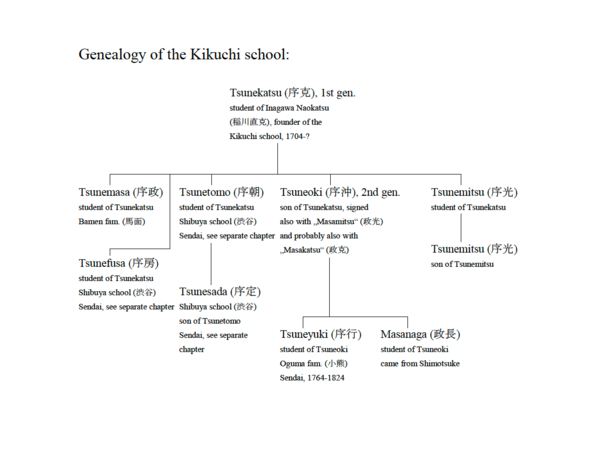
-
Information on the Kikuchi School or Kikuchi Jyosui
kyushukairu replied to Jake6500's topic in Tosogu
Jake, I don’t think the first tsuba which you posted (from Aoi Art) is linked to the Kikuchi school, there is no artist listed with that name, and the style isn’t in keeping with the Kikuchi school, who specialised in katakiribori. In my opinion, it’s a Mito school tsuba with a fictitious mei. The second tsuba which you posted is by Kikuchi Tsunekatsu, the founder of the Kikuchi school. I had a quick look at the meikan and the kao looks good to me. Here’s some information about him from Sesko’s Signatures of Japanese Sword Fitting Artists: 24.1 Kikuchi Tsunekatsu (菊池序克), 1st gen. The founder of the Kikuchi school was Tsunekatsu, a student of Inagawa Naokatsu (稲川直克). He also received the character for „Katsu“ from the latter. He was born in the first year of Hōei (1704) and was called „Seijirō“ (清次郎). Because of his artistic background in the Inagawa school he worked mostly in shakudō with nanako ground and takabori-iroe ornamentations but his strong point was katakiribori. In his later years he entered priesthood and took the nyūdō-gō „Sōju“ (宗寿). Other pseudonyms of Tsunekatsu were „Sōryūken“ (草流軒) and „Gidōken“ (蟻洞軒). There are also works extant which are signed with the characters (常克) for „Tsunekatsu“ and it is assumed that they go back to his earlier years. In addition, we know a joint work (gassaku, 合作) with Naoharu (柳川直春, 1750-?), the 3rd gen. Yanagawa, which is signed with the supplement „made at the age of 60“. That means Tsunekatsu was also in direct contact with the Yanagawa school. His year of death is unknown but the latest extant information about his age mentions „made at the age of 64“. That means he was at least active until the Meiwa (1764-1772) era. -
Skulls, bones, and grave markers—An interesting tsuba
kyushukairu replied to brentlewiis's topic in Tosogu
As Steve notes, on the left of the nakago-ana is 'Kikuchi Masahira' (菊地正平), but on the right is 'Bungo jū' (豊後住). There was only one professional tsubako in Bungo - Yasaka Eikan (八坂永閑). However, as with a lot of Satsuma tosogu, some Bungo swordsmiths also made fittings. I believe this to be the case with your tsuba. The most likely candidate is "MASAHIRA (正平), Kyōhō (享保, 1716-1736), Bungo → MASAHIRA (政平), Kyōhō (享保, 1716-1736), Buzen" -
Could be 'Harushige' (春重)
-
I agree with Ron. The kanji on the left look like 'Bushū jū' (武刕住) The second character on the right may be '~shige' (?重)
-
old news paper cutting of a sword shop
kyushukairu replied to lonely panet's topic in Translation Assistance
Although the logo at the bottom (and the entire advert) seems to be for Nihombashi Takashimaya (日本橋高島屋), which still exists today (https://www.takashimaya.co.jp/nihombashi/). Nihombashi Takashimaya is a department store. The sword advert refers to an Exhibition and Sale of Art Swords (美術刀剣展示即売会) which took place in that department store on Sunday (日) 3rd of June (6月3日). Unfortunately, it doesn't list the year in the advert. However, I had a quick search and it seems that the 3rd of June was a Sunday in 1989, so this may be the year of the newspaper, when the event took place, and when your tsuba was offered for sale. -
The reading is 'Jōka' [kao] (常嘉[花押]) - though it is also possible to read it as 'Tsuneyoshi'

-
bump
-
bump
-
bump
-
On the top right hand corner it says 'Pray for continued luck in the fortunes of war' (ino būnchōkyū 祈武運長久), and below that is the recipient's name 'Hayashi Chiyoji' (林千代治). The characters emanating from the rising sun are the names of those who signed it, to pray for Hayashi-san's continued luck in the fortunes of war. These are most likely people from his hometown - there are many people with the surnames Seiyama (清山), Hayagawa (早川), Nishio (西尾), and Hayashi (林) [presumably Hayashi-san's his own family members].
- 1 reply
-
- 1
-
-
One potential explanation is that someone who owned the tsuba wanted to convert it into a paperweight (bunchin 文鎮), and added lead to the kogai-ana, and brass to the nakago-ana to make it more functional (for their intended purpose)
-
I think that the tsuba would most likely be attributed to a swordsmith (tōshō 刀匠) and that the design is intended to replicate the windows of a Japanese teahouse (chashitsu 茶室)
-
Mokko suaka tsuba with silver fukurin. Sanmai plate. Dragons in clouds 85x82mm £360


-
Otafuku suaka tsuba with gold and silver iro-e Pine trees (symbol of longevity) Higo? Shonai? 72x65mm £240


-
Bushu-Ito - shakudo with gold inlay Wheel and ivy 70x65mm £275


-
Kamon tsuba - shakudo and nanako with silver fukurin. Gold and shakudo maru ni mokko (丸に木瓜) kamon 72x70mm £450


-
Ko-Shoami tsuba sold
-
Bars, cranes, and kiri-mon tsuba sold
-
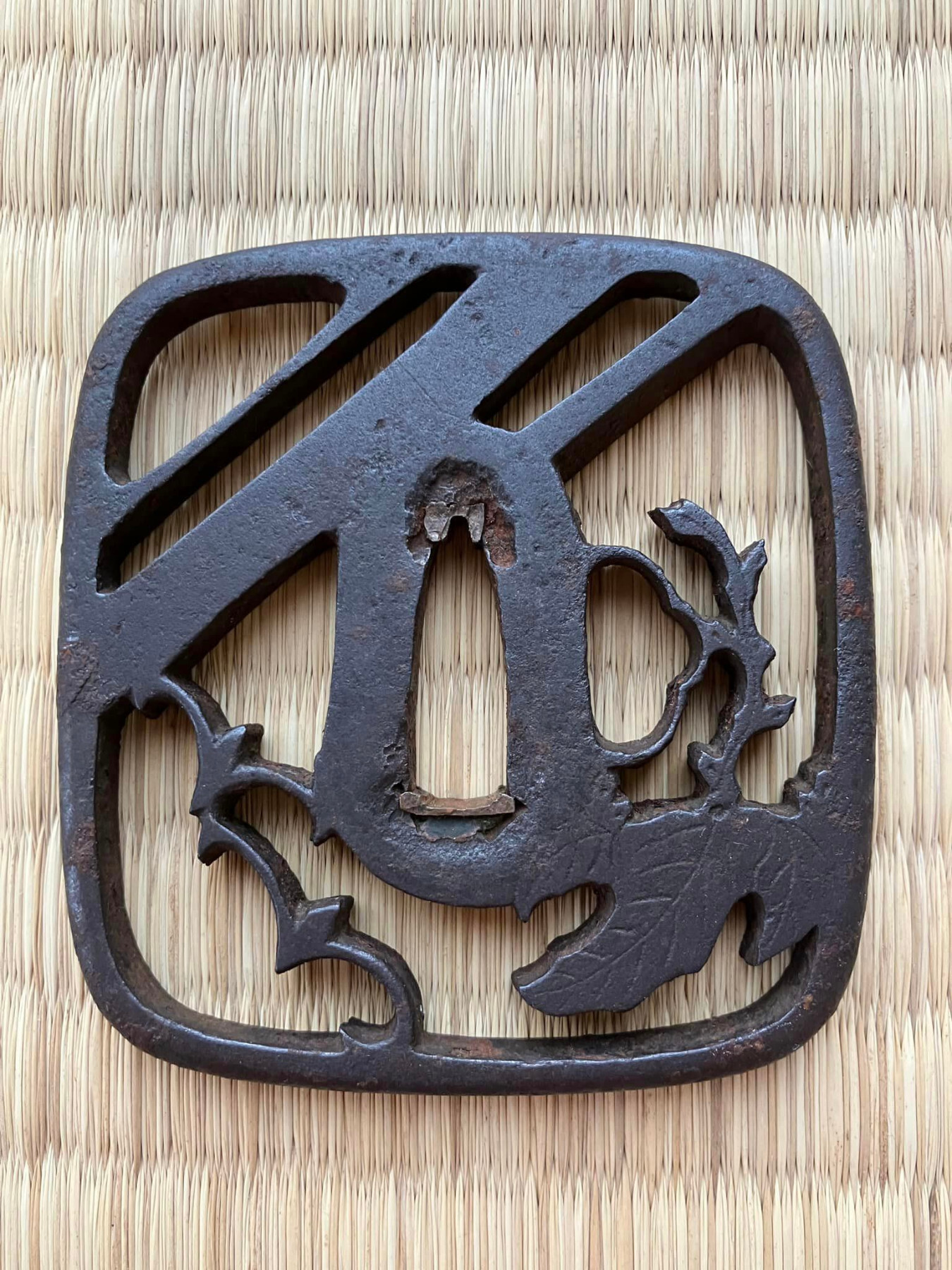
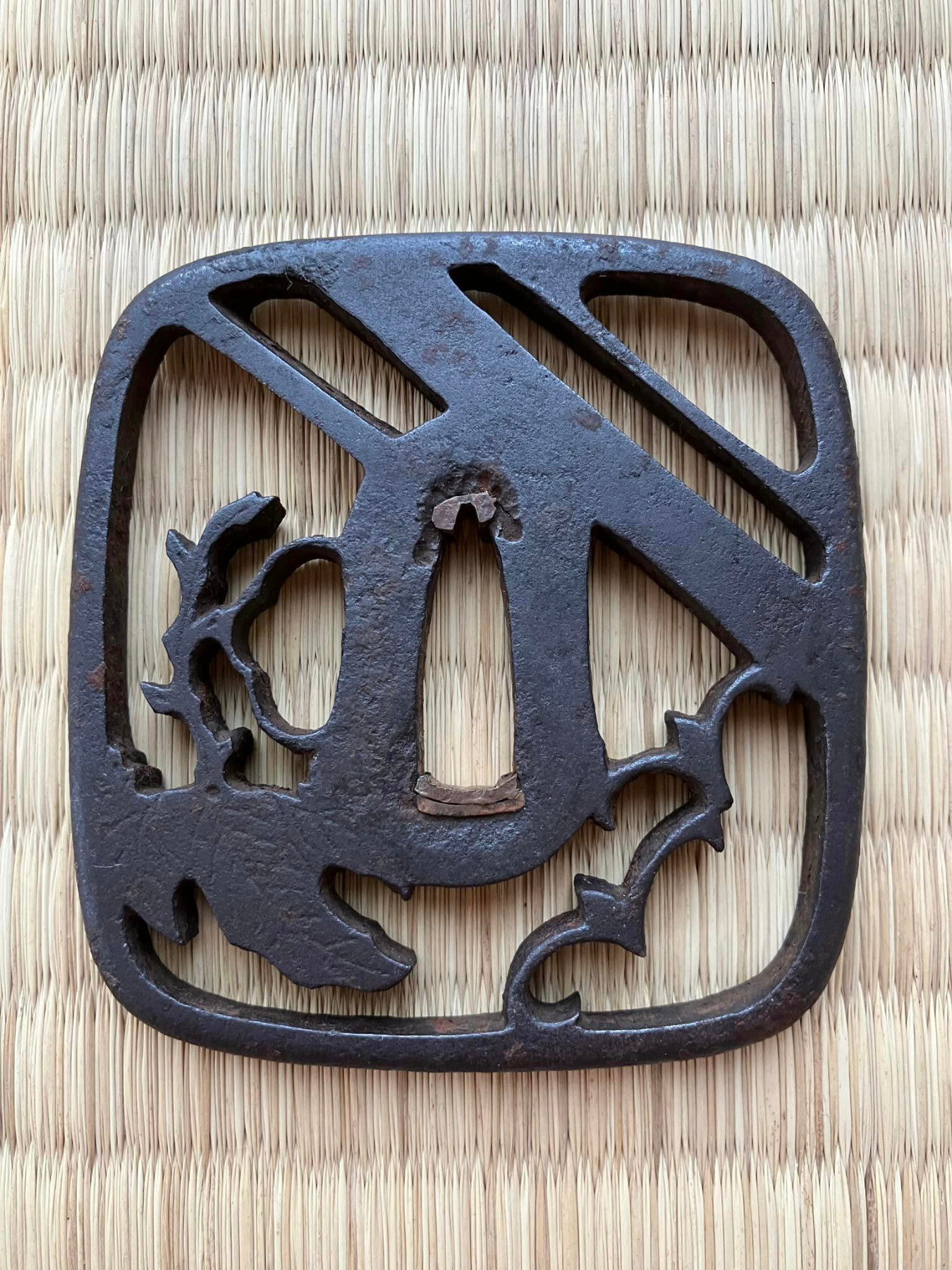
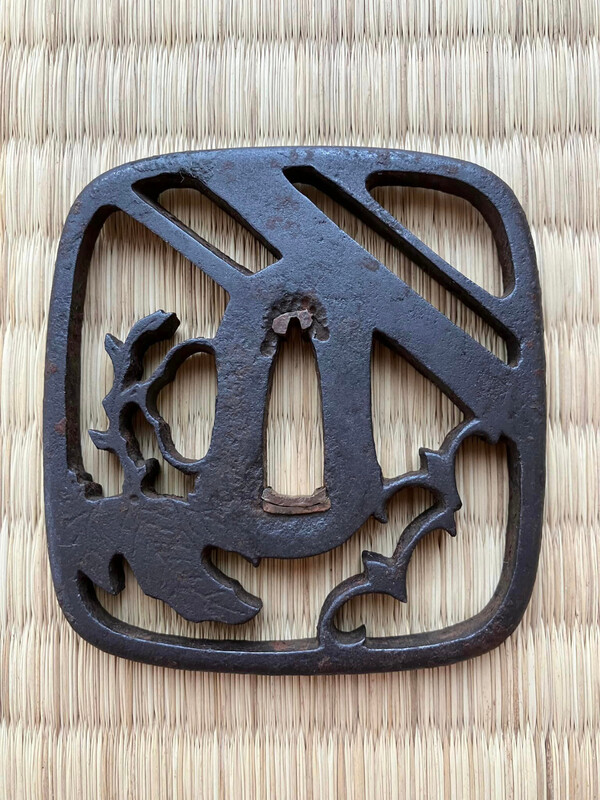
A strong, heavy, square-shaped iron tsuba with the theme of bars, cranes, and kiri-mon. Possibly Akasaka school, which produced such abstract designs in combination. 73-70mm £180
-
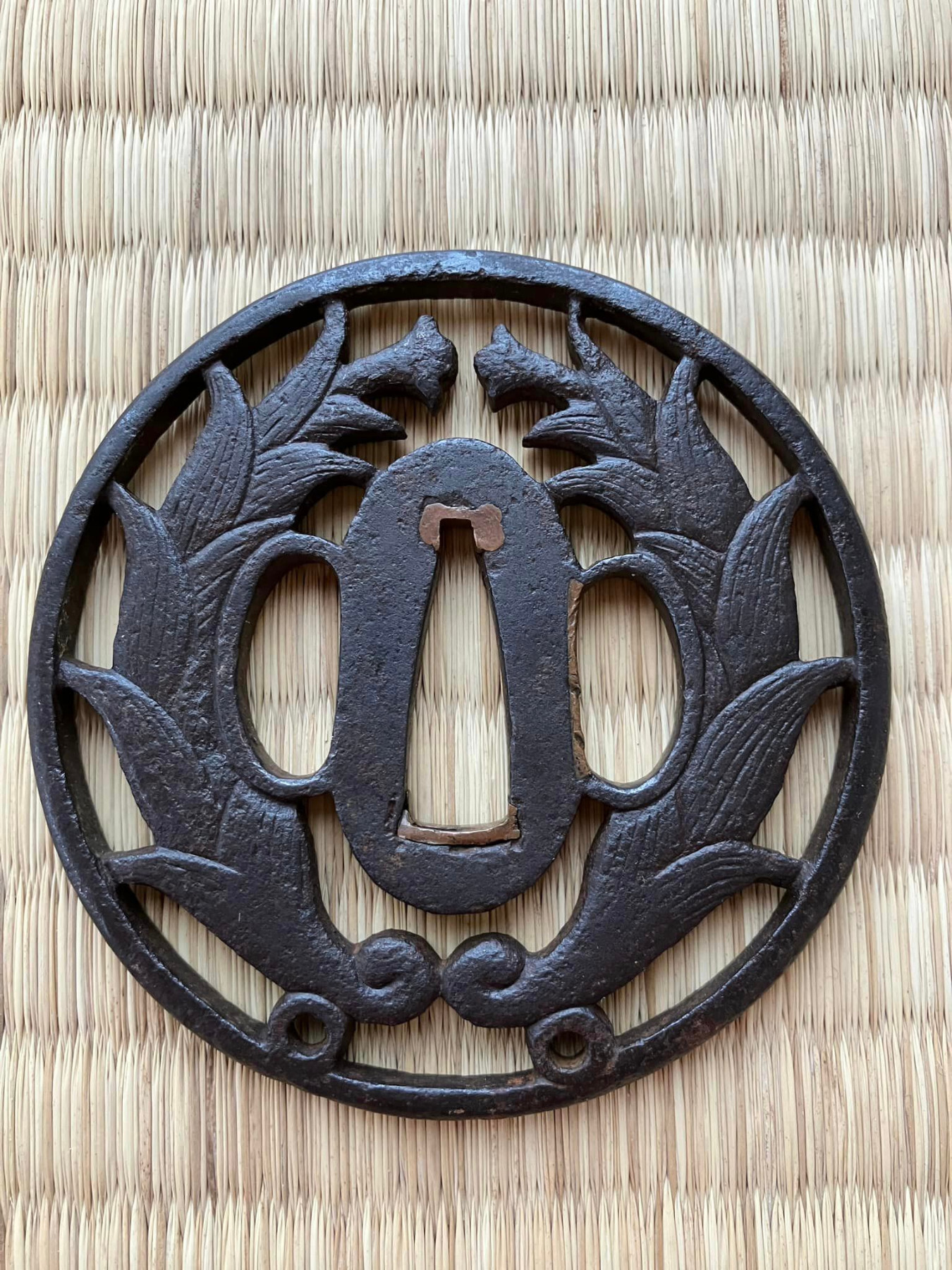
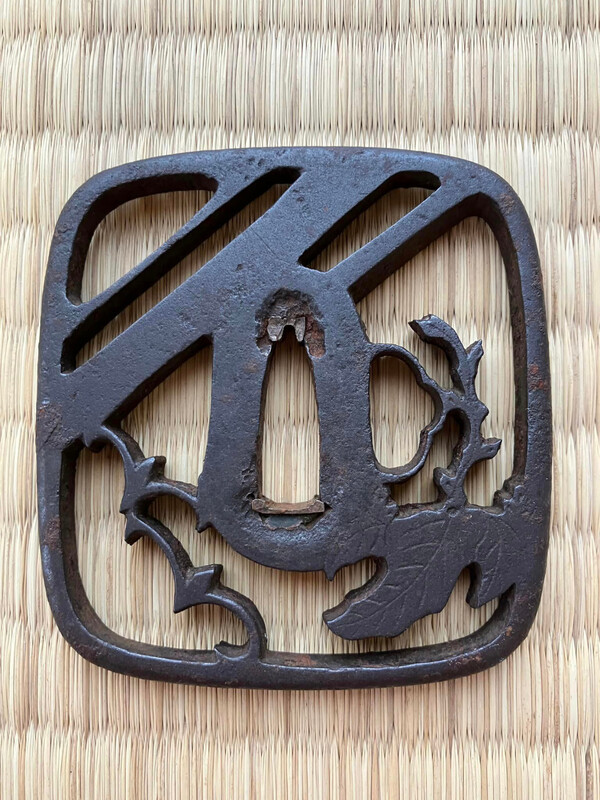
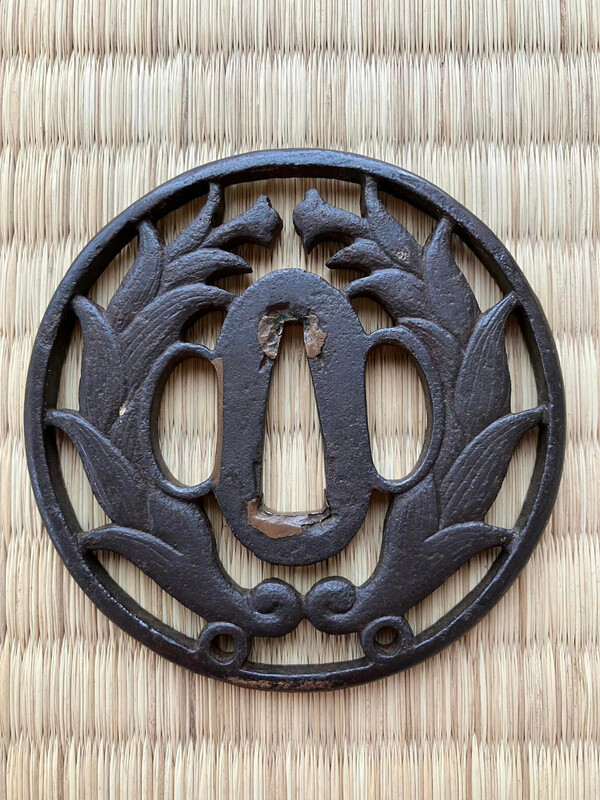
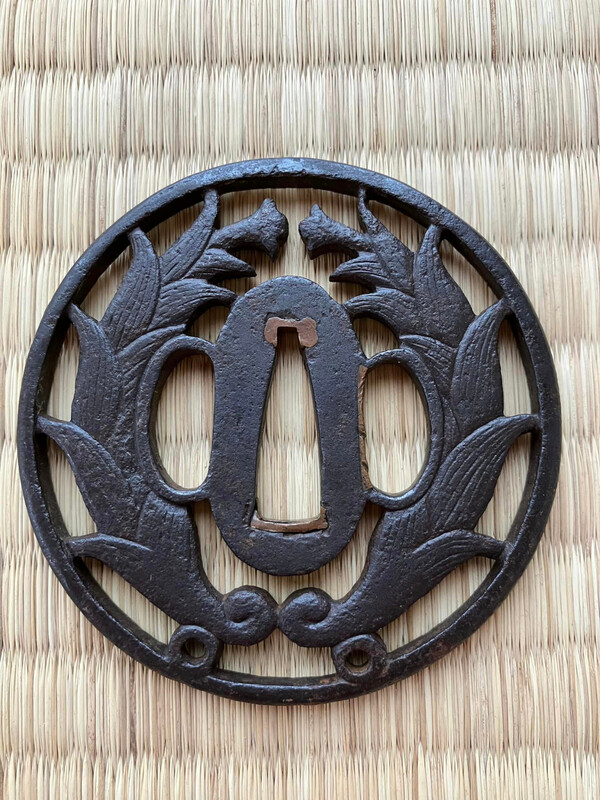
Ko-Shoami (pre-Edo) myoga-mon, iron tsuba. Myoga (茗荷), or Japanese ginger, was favoured as a family crest because the same pronunciation also means 'divine protection (冥加). There are strong tekkotsu (iron-bones) around the rim, which is a kantei-point for Ko-shoami. 75x75mm £190

-
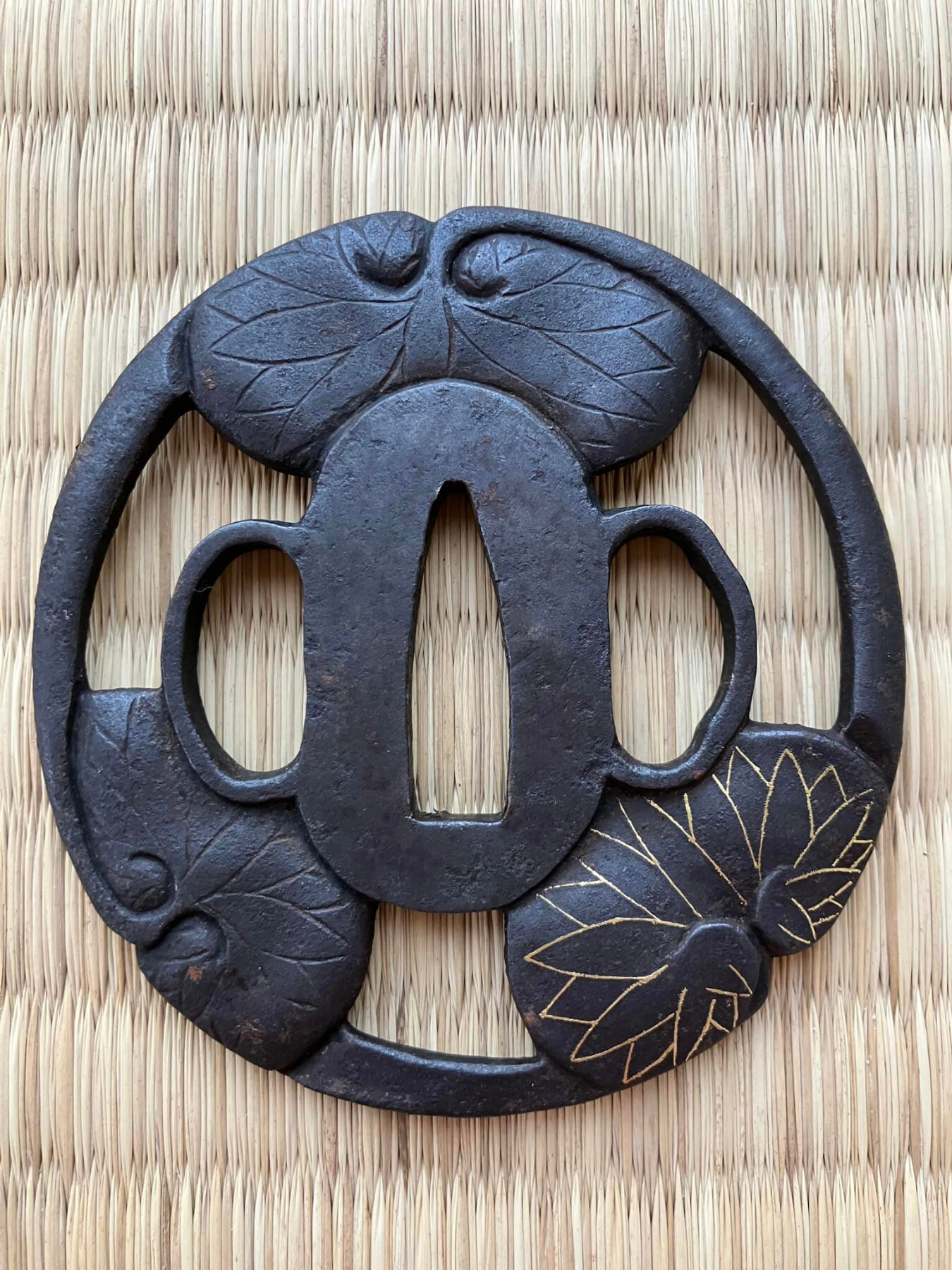
An interesting aoi-mon tsuba, with gold inlay on the front of the leaf, whilst the back of the leaf is intentionally unadorned. This may represent a particular branch of the Tokugawa clan. Possibly Echizen school, who specialized in aoi-mon tsuba. 72x67mm £160


-
Land and sea tsuba sold