Kanenaga
-
Posts
302 -
Joined
-
Last visited
Content Type
Profiles
Forums
Events
Store
Downloads
Gallery
Everything posted by Kanenaga
-
The most notable aspect of Yoshiaki's work that I've seen has been the utsuri. Smiths have been trying to recreate utsuri for centuries, and a few have had some modest success, notably Naotane and Sokan, but Yoshiaki was able to make dramatic utsuri which rivals the natural utsuri of early Bizen and Bitchu blades. Another swordsmithing secret lost.
-
Wonderful article! Required reading for collectors' wives??
-
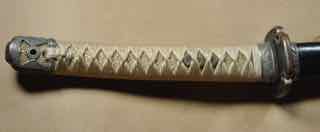
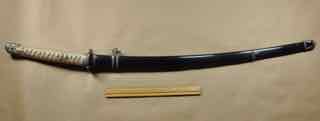
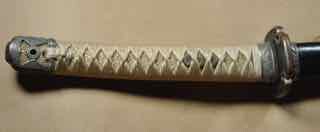
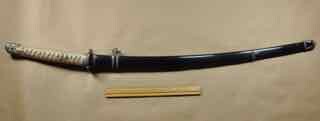
Not sure if this belongs here since I'm not a gunto collector, but here's something that snuck in many years ago among the koto stuff. It's been "tarted up" a bit, either during the war or after, I suppose. The ito has been re-wrapped, the fittings all silver-plated, the saya repainted or re-laquered, and the tsuba replaced with a civilian one. I was told it once held a Yasukuni-to, long gone.
-
BTW, the catalog of the Mitsumura exhibition at the Nezu Museum is entitled "Pinnacle of Elegance" and is one of the biggest bargains in sword porn (well, fitting porn mostly). 200 pages, many hi-res glossy photos of machibori kinko metalwork to drool over, lots of English -- and all for less than $20 US.
-
Nick, My Hawley & Chappelear book of mons shows 51 examples with wisteria, but none in which the racemes point in opposite directions.
-
Give Back To Caesar What Belongs To Caesar
Kanenaga replied to Jean's topic in Auctions and Online Sales or Sellers
I won't be surprised if Brian disallows any more discussion on this topic, but I find this a tremendously educational thread. I probably should have my head examined for jumping in here, but I for one would prefer that Darcy's comments don't squelch further contributions. I think that some of the negative comments about this blade are subject to alternative interpretations, so I'll challenge some of what has been said: 1. I don't see this hamon as "wild." It's suguha ko-notare, and not that different from other hamons in Yamato tradition. It's the hadori that's wild. 2. The dragon toes do extend into the true hamon, as shown in the angled photos. This means that the horimono were applied prior to tempering, since it is generally understood that the true hamon is too hard for carving. This would seem to give credence to the "retempering" theory, but is equally consistent with the horimono (quality criticisms aside) as ubu-bori. 3. Then this blade with the florid notare hamon that was invisible with a fake suguba hamon on it went to the NBTHK who gave it Tokubetsu Hozon in spite of this... Hard to accept. The NBTHK shinsa members know how to look at a hamon. 4. Looking at the face-on photo in the kanteisho, all we see is hadori. We cannot see the true hamon. 5. Retempering is a big deal, with risks like hagiri. I doubt it is done except to correct fatal flaws. This blade did not have fatal flaws or it would not have passed shinsa. 6. A simple explanation for the change in the blade's appearance is that since the shinsa is that it has been "pimped up" with a new, wilder kessho finish, to enhance marketability. I suspect this is a frequent occurrence, and does not alter the fundamental charactersitics of the blade. In this case -- to the credit of this list -- the change has only served to raise concerns among the "wary." A marketing strategy gone bad? Anyway, those are just my thoughts. Flame away -- or just ignore my rantings. -
Trying again...
-
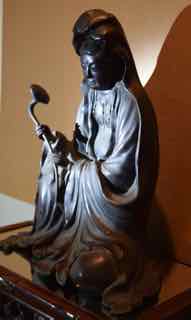
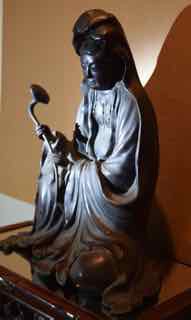
Your Cannon (Guan Yin) may be holding a Chinese-style ruyi scepter. I'll try to upload a photo of a bronze one that lives with me.
-
Boris Markhasin has an interesting and scholarly article entitled Investigation of a Chokuto Tachi in the KTK 7th annual exhibition catalog, pages 83-88, for those who may have a copy. The tachi in qustion is thought to have been retrieved from lake Biwa. Boris had Ted Tenold polish another of his archaic blades, and you could clearly see hada and hamon in places.
-
I believe this tsuba is on display -- or was at least in November during the DTI -- at the Nezu Museum in Tokyo, as part of the Mitsumura collection show.
-
Jussi is a master of diplomacy. I’m not, so I have to bite my tongue, because if I said what I really think about that ShibuiSwords article, Brian would surely disallow it for “flaming.” My take: Today’s NBTHK is the force that keeps the world of Japanese swords and fittings reasonably stable. Without it, this collecting community would be in complete chaos. The NBTHK also publishes reference books and a monthly educational journal, maintains the sword museum which we are all welcome to visit, and holds periodic conventions at which one can study in hand some of the finest items in existence. These activities promote and encourage the study and appreciation of nihonto and related crafts. Who else is doing anything comparable? Have there been problems in the past? Apparently so, although the magnitude varies considerably with the teller. How many service organizations have been lily-pure since day one? (Think governments, churches, NGOs, …) We should focus on what the NBTHK is doing now, not how it once was. I for one am grateful for the NBTHK, and think it deserves our respect and support. Les
-
The annual NorCal TaiKai Aug. 4-6 in SF was once again a wonderful nihonto-immersion experience. Fred Weissberg and colleagues are to be thanked and congratulated on arranging a highly successful event. The room was full (all tables sold, I believe), and it was neat to greet old friends and make some new ones, including several Japanese dealers. Lots of swords and fittings on display, and I saw many items both small and large changing hands. A dozen or more Juyo blades were offered for sale (or just tire-kicking). A special tent was set up with different kinds of lighting for careful examination of prospective purchases. The NBTHK display was a kantei exercise organized by Mike Yamasaki, with Mr. Myoga, the well-known Japanese dealer, serving as judge: Kagemitsu tachi, Kiyomaro tanto, Satsuma Masayoshi daito, an Oei-Bizen wakizashi, and a Shinto Nobukuni daito; also just for appreciation were a Rai Kunimitsu tachi (TokuJu) and a Soshu Akihiro wakizashi (JuBi). [Plug -- the NBTHK-AB does this kind of thing at each North American show, plus other educational materials, so join and be supportive!] The NTHK shinsa seemed to be doing a brisk business, assisted by members of the NorCal club. The hotel was comfortable, right across the water from SF airport. Dinners and drinks (just a few) were provided for the table-holders. A semi-spontaneous Hawaiian musical event on Friday evening was an unanticipated treat. Sorry that I have no photos (imagine a large room full of people, swords, and stuff), but perhaps others will offer some. Except for DTI, I know of no better venue for seeing, learning, greeting, and maybe a little buying/selling. Mark your calendars for next year -- first weekend in August, I believe. Les
-
Don't expect the NTHK to necessarily be more forgiving, they have a reputation for being quick to fail blades if there is even the slightest uncertainty. I have 2 swords that were "pinked" by the NTHK (at US shinsa) and subsequently got TH from the NBTHK. The only papers to be seen at DTI are from NBTHK. Les
-
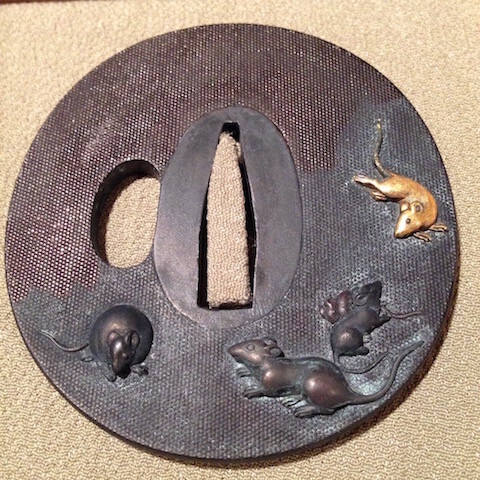
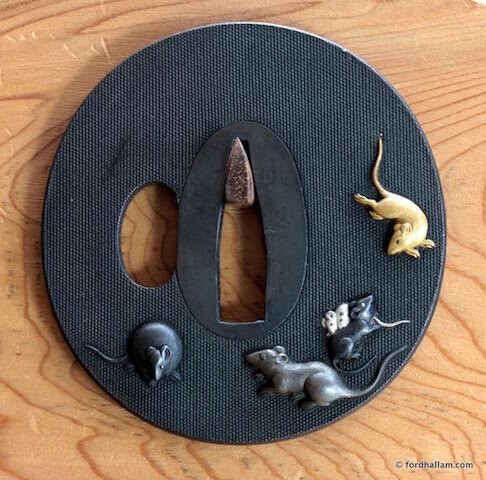
As you can imagine, I was very pleased with this outcome. Pre-restoration, I could not even recognize that the pup was silver, and the big fellow at the bottom shibuichi. I've read that rats were considered auspicious, because their presence indicates that you must have food in your storehouse. Les
-
Hello All, Hoping not to re-open the preservation-vs-restoration debate, but I thought the group might be interested to see another example of what can be accomplished when an expert metalsmith (FH) "touches-up" a soft-metal tsuba. The tsuba is signed on the backside [ichinomiya] Tsunenao with kao. Les
-
I would certainly do an A4 hardcover, perhaps a B4. I hope there will be plenty of text to complement the photos. Les
-
Identification Of Mon On Gunto
Kanenaga replied to dirk marshall's topic in Military Swords of Japan
Can anyone read No 90? Les -
Will be in Bangkok for a few days next month. Anyone have recommendations for where to find (real) antiques, swords, other treasures? Les
-
http://www.nihonto.com/7.8.14.html Juyo Token Les
-
AFAIK, 95% of Munetsugu's blades have his typical nioi-deki choji-midare hamon with midarekomi boshi, which this is not. He made a few in suguha, which this is not. He also made a very few nie-intense osoraku-style wakizashi (to annoy his Yotsuya neighbor, Kiyomaro), which this is also not. But then, a really good smith could probably make whatever he wished. Les
-
Nick, I'll take number 6 (cross-shaped with small inlays). Bring it to the DTI, I'll collect it from you there. Cheers, Les
-
What Is Happening To Nihonto Message Board?
Kanenaga replied to Peter Bleed's topic in General Nihonto Related Discussion
Hello All, Lurker here. I’ve been visiting NMB intermittently for several years, never posted because had nothing to contribute. But this is an interesting thread, thanks to the OP for raising it, it gets to the core of what is this Board for? Of course, the answer rests ultimately with the Admin, to whom we are all immensely grateful for the time and effort he donates to this enterprise. I have a friend who is a 20+ year experienced collector and student of Japanese swords, who never looks at NMB. He says “There’s nothing there for me.” To my way of thinking that’s a problem – partly with him, but also for this Board. I notice also that some high-end dealers used to periodically post special items, either as kantei or just for interest, but rarely do so now. Yes, those items were usually for sale, but hey – everything is for sale at DTI, and it’s the best learning experience in the world IMHO. This thread has devolved into a debate on the merits of providing free advice to newbies, but my interpretation of Peter’s OP (correct me if I'm mistaken) was a plea for more advanced discussion – not exclusive elitism, just more – and I for one would support that. I’m not exactly sure how to orchestrate that, but one suggestion might be to ask the greybeards to present a periodic question or topic – perhaps in some kind of rotation – that might stimulate meaningful discussion, or even a little (gentlepersonly) controversy. The goal as I see it is to retain the interest of the advanced collectors while servicing the needs of the newcomers. Anyway, my two yen. Before I lapse back into lurker status, let me quote one of my dear departed nihontophile friends with a piece of advice that has helped me time and again over the years: This is a hobby, it’s supposed to be fun! Les